
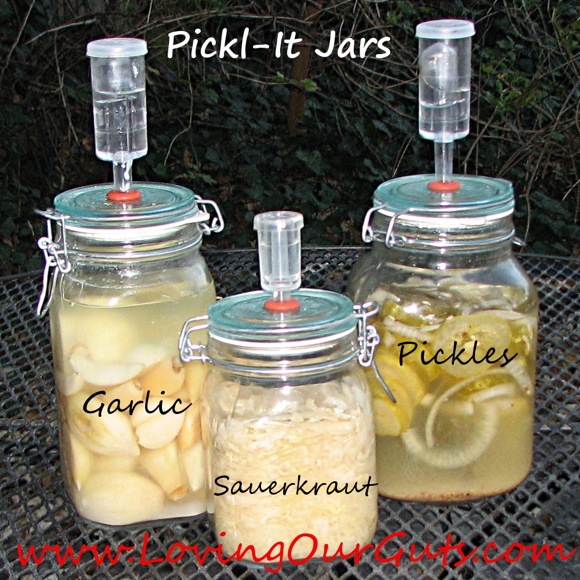
Patty is here sharing her experience with fermenting in the Pickl-It jars. This is definitely a GAPS topic, because she found that controlling her fermenting environment produced more healing foods. But also, this is a great exploration for anyone who is looking to take their fermenting to another level. Though I’m not convinced one must have a Pickl-It or similar vessel to get great results, I do agree that you’re more likely to get consistently great results. Be sure to share your experiences in the comments! –Wardee
Recently I decided to try fermenting in dedicated fermenting vessels with a controlled oxygen-free environment. Why? My family had been on the GAPS diet for 2-1/2 years and still had healing to do. My 4-year old was reacting to the fermented foods I made in mason jars and the fermented foods purchased from the store. So I was hopeful that new fermenting containers would make a difference for her — and for all of us.
Why Oxygen Free?
I want to talk first about why I thought fermenting in an oxygen-free environment might be a good next step in my fermenting.
As I researched this issue, I reached the conclusion that foods fermented in a controlled oxygen-free environment are not only the most healthy, but the most likely to provide healing benefits.
Here are some of the benefits I came across when researching what happens when you keep oxygen out of your ferment:
- you’ll get higher levels of beneficial bacteria and even a different balance of bacteria — some bacteria won’t thrive at all in the presence of oxygen (bifidus, for example)
- you’ll prevent the formation of alcohol, since alcohol production prefers an environment with oxygen
- you’ll prevent high histamine levels in your finished fermented foods
- you’ll get more enzymes and vitamins produced
- you’ll prevent mold from growing (mold requires oxygen to grow and thrive)
- you’ll prevent your food from oxidizing (turning brown)
(references Bifidus and Oxygen, Does Oxidation Effect Fermentation, Unseen Mold in fermented food, Histamines in Young Sauerkraut)
In order to provide this kind of environment for my ferments, my top contenders for fermenting vessels were the Pickl-It jars and Harsch Crock.
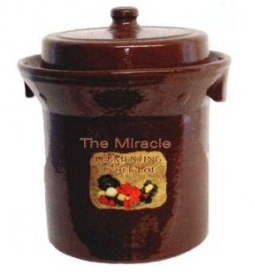
The German Harsch Crock
First, I considered the Harsch Crock. This is a German-style stoneware fermenting crock that comes in a range of sizes. It allows you to make a large volume of sauerkraut or other fermented vegetables at once. It has been used for generations and is an authentic traditional method of making anaerobically fermented foods.
It has a trough all around the top that you fill with water to seal the lid. The trough-lid combination functions as an air lock that allows fermenting gasses to escape easily while preventing oxygen from entering. The lid does not need to be attached since the connection between the lid and crock is sealed with water.
However, it has some drawbacks. One is the size. The smallest one is 5 liters — that’s more than a gallon!
Second, keeping these crocks cool on hot summer days would be difficult since my basement gets very warm, and my fridge is generally packed with produce.
Third, my basement has some mold in it and I have heard that those crocks are prone to mold contamination.
And finally, there was the price. A Harsch crock is a significant investment! (Starting at over $100 right here.)
Pickl-It Jars
Then I heard about the Pickl-It jars. I didn’t want to jump into anything, though, so I took my time learning all I could about the Pickl-It jars and how they might be a modern replacement for a Harsch Crock.
Pickl-it jars create an oxygen-free environment in a slightly different manner than the Harsch. The jar is certified hermetic, and has been tested and proven to be perfectly airtight. (The thick gasket and the strong wire bale holding the lid down creates this airtight seal.)
A hole is drilled in the top. A gasket is placed into the hole, and then an airlock is inserted into the gasket. The airlock contains water. The water allows gasses to freely escape from the jar but prevents oxygen from entering.
I saw several advantages with the Pickl-Its:
They are much smaller and cheaper. The largest size Pickl-It jar is the same size as the smallest Harsch Crock and is about 1/3 the price.
They fit into a refrigerator easily, making it possible to try out a new recipe in a smaller quantity than 1 gallon. Should a mistake be made, there is far less food to throw out. (Ask me what happens if you forget to add salt to your pickles. Yuck!)
I liked that I could provide an oxygen-free environment for my kefir, much like how traditional kefir was made: in a bladder hung by the door that people would hit on the way by to shake it up. A bladder is an anaerobic container. It allows gasses to escape but prevents oxygen from entering.
I bet you can tell already that I chose to switch to fermenting in Pickl-It jars. 🙂
Our Results
Once I switched to making our fermented foods in Pickl-It jars, I discovered something I did not expect. We like the flavor of our fermented foods much more now!
The sauerkraut is crunchy and very sour after months of fermenting, rather than mushy and brownish as it was before. Eating it is a real pleasure; I used to choke down my “aged” sauerkraut.
Even though we liked that (old-method) sauerkaut when it was young, it caused terrible rashes on my daughter’s face. I now know it was the histamines in the kraut to which she was reacting. Our Pickl-It sauerkraut doesn’t have the histamine problem.
You can see more of our health improvement results on my blog: Anaerobic Fermentation Our GAPS Missing Piece.
Do you use Pickl-Its or another controlled fermenting vessel? What do you think? What were your results?
New to our GAPS series? Get up to speed by browsing past posts in this series or reading what the GAPS diet is.
...without giving up the foods you love or spending all day in the kitchen!

2 free books:
Eat God's Way
Ditch the Standard American Diet, get healthier & happier, and save money on groceries...
We only recommend products and services we wholeheartedly endorse. This post may contain special links through which we earn a small commission if you make a purchase (though your price is the same).


Thank you for sharing this information and saving me from doing the research. I have been considering these Pickle-It jars and now know they will be my next investment. 😀
Glad to be of help.
I have 3 Pikl-it jars an I love them! I’ve been making sauerkraut for decades, and the Pikle-it makes it so easy and successful. I’m very glad to know that our kraut is also healthier! Thanks for a great post!
I do love how fool proof it makes my ferments!
Does the ferment have to stay in the pickle-it jar until fully consumed? Or can I transfer it to another kind of storage device while I am making some new ferments?
Hi Miriam,
You need to keep the fermented food protected from oxygen to maintain the benefits of anaerobic fermenting. Once the active fermentation is done you can insert a plug in the hole or swap the lid for one without a hole but you really need to keep it in an airtight jar to protect what you have made. Fido jars are what Pickl-It jars are made from and so they are a good choice for an airtight storage jar.
Such a wonderful article! I’ve had the Pickl-it for a few years now and I LOVE it! However, in my learning about Pickl-it I asked this same question, about being able to transfer it to another jar, or keep it in a jar without one of those plug’rs. What I learned from Kathleen is that even after the “initial fermentation” as she calls it is over, the ferment is still releasing gasses and creating pressure, so if you put a plain jar lid on top of the ferment, it being airtight and all, you are going to have that pressure building up with nowhere to go, creating the risk of explosions in the fido jar.
Plus, every time you open and close the jar, you’re letting oxygen in. So how’s it going to get it? It could if the pickl-it lid was on with the airlock, but not with the plain lid. That’s why I love the mini airlock, it makes for easy storing, and safe food.
Are there any other places to purchase Pickl-It Jars besides their website? I have emailed them previously about shipping to my APO address, but can not get a reply. I would love to give them a try.
What do you think about the DIY airlocks that are similar to the Pickl-It?
There are a few independent retailers who have jars to sell but otherwise you will need to go through the Pickl-It Website. I know that the company has recently gone through some transition and customer service should improve. It can be hard when a small company suddenly goes through big growth as this one has.
I just saw the last question you asked.
I’m generally a fan of DIY but in this case I’m not. Drilling in glass is very risky and can result in microfractures in the glass that can result in glass splinters in your food. Not to mention the risk of glass dust in the air while you are making it. The Pickl-It inventor worked long and hard to develop a process that would avoid that risk. It really isn’t something that a person can do at home with regular home equipment.
You could try http://www.homesteadersupply.com as they do just the lids (Pickle Pro). Have just ordered some to try out but their customer service is MUCH better than Pickl-it’s was (i.e. they actually responded and were very helpful – I live in Europe and they arranged delivery even though the website says they don’t deliver internationally).
Thanks for the review on the Pickl-it jars.
I have been dreaming of getting some,but have not made the financial leap yet.
I was hoping my husband may ask what I want for Christmas. 😉
Hi Patty!
Thanks for the great information! I received my pickl-it jars today! Yay! Can’t wait to try them out. I think I read to hand wash them…should i sterilize them with boiled water? I know the tops probably not – just wash really well. I know it says not to put in the dishwasher. I want to make some pickles! Mine never worked in mason jars. Also, i had been eating some of my sour cream and yogurt made from my mason jars and depression, fatigue, gut pain and being more constipated started sneaking back in so i’m pretty sure it’s from the sour cream and yogurt. I still have about 3 liters of sour cream….is there any way to use it? Would freezing it kill the bad stuff in it? Do you think I can cook with it? Hate to throw it out but if nothing will make it safe to consume i will throw it out. Thanks again Patty! 🙂
Michelle
Has anyone used or know about The Perfect Pickler?
Okay, I’m still reading the back-and-forth on this issue all over the internet. My general guess is that if a true expert like Sandor Katz has fermented in open crocks for decades with no problem, but someone who has a profit motive to sell me a special jar thinks I need the special jar …I think an open crock will be fine.
But there’s one factual mistake I can tell you for sure. An airtight jar is exactly the environment yeast likes for producing alcohol. I have made hard cider, and an airlocked jar is recommended (otherwise it will eventually turn into vinegar; acetobacter, which produces vinegar, is aerobic). I had some shredded carrots I was fermenting recently in a very nearly airtight jar, and they produced a lot of alcohol because they were so sweet. That alcohol isn’t going away unless I leave at least the brine open to the air … which is what I think I’m going to do.
Another interesting fact is that burial in the ground is not completely anaerobic. A group of Inuit has been burying fish in the ground for generations, to no ill effect. But recently they started wrapping their fish in plastic instead of leaves like they had done before … and there have been huge outbreaks of botulism due to the anaerobic environment. Now they are trying to spread the information among the Inuit, “Don’t improvise. Do it exactly the way your ancestors did, or don’t do it at all.” Animal intestine or stomach is also not airtight. It allows for diffusion of oxygen, carbon dioxide, and water, which is how sausages shrink and dehydrate inside their casings.
I’m thinking not completely anaerobic is the more traditional way … though if you have better results with a Pickl-It jar, by all means use it.
P.S. About the alcohol — the pickl-it website reads, “The resulting flavor of sauerkraut is a combination of: lactate, acetate, ethanol, carbon dioxide and diacetyl.” I don’t know about you, but I actually don’t want ethanol (a form of alcohol) or acetate in my food.
First I will address the alcohol issue. All fermented foods contain alcohol. It does not matter how you ferment. Everything I have been able to find says that alcohol prefers an open ferment so using an anaerobic method will minimize alcohol production but will not eliminate it. If you want to completely avoid alcohol you will need to completely avoid any fermented foods. Vinegar is simply the next stage after alcohol. I have made hard cider many, many times and I always have used an open ferment. If I let it go too long it turns into vinegar.
A plastic sheet is not air tight. Plastic allows oxygen in. I recently opened a new package of freeze dried apples. I had kept it for many months before opening it and my freeze dried apples were not crisp at all but soft, more like regular dehydrated apples. Clearly air had been getting into that sealed package. It does not come through quickly enough to keep an animal alive but it does come through.
There is no such thing as mostly air tight. Your carrots were exposed to oxygen. Things are either air tight or they aren’t. A slow leak is still a leak.
Sandor Katz may have written a couple of books on fermenting but he hasn’t ever studied the science of it and he is very open about that fact. Those who have studied the science say that anaerobic is the gold standard. They use very expensive stainless steel containers to ferment in. I’m happy to be able to choose a much more economical glass container for fermenting at home that gives me the same quality of results if not the same volume.
My family has seen huge benefit from switching from an open ferment to an anaerobic ferment. I did it open for many years. I’m far from new to this. I switched to anaerobic containers this past spring and wish that I would have made the change long ago. The health benefits for many family can’t be denied. I am motivated to tell others about it simply because for us it was a big piece and I really wish that I would have know about it much sooner. I feel like I wasted time trying to heal us using open ferments. My family has been on GAPS for over 3 years. We aren’t new to healing our guts or impatient.
You did not address the histamine issue at all in your reply. My younger daughter obviously reacts to fermented foods done in an open container but she does not to ones done in an anaerobic container. Science backs up that this is a histamine issue and that fermenting long enough in an anaerobic container will eliminate that problem.
Patty, You said that your family is not new to GAPS nor are they impatient. Well, our family IS new to SCD/GAPS and we ARE impatient. My son has a rash right NOW. He always gets the kind of rash in the same place whenever he is reacting to a food or substance in a food. I really really appreciate you posting this and anything that shortens the learning curve for us and others. I make sauerkraut just fine. Everybody eats it. It does get mushy. I am more than happy to hear there is a better way that will get us faster results, especially if it will be tastier. Thank you so much. These jars are goin on my shopping list.
Please note, a grolsch lock type seal or wrapped in plastic are very different that the airlock mentioned here, which prevents pressure building up and air to escape, but no new air coming in, similarly to the crocks. A starter kit of Pickl-It’s and a bunch of Fido jars for storage (my system) is similar to the price of one crock, and allows a lot more versatility. I have had good success. Thanks for your input. I’ve never had good luck with milk kefir in an open ferment, but I never even considered trying it in my pickl-it! I’d love to hear more about how that works before obtaining more grains and trying again. Ours always gets a bit sour, to the point no one enjoys it, though we love several types of yogurt, water kefir, Kombucha, etc.
Wardee,
I’m curious if the recipes in your Lacto-Fermentation cookbook use Pickl-It jars? If not, would they be easily convertable? Thanks!
Jean — All the recipes allow for using whatever container you’d like, Pickl-It or homemade airlock or crock. 🙂
Hi Wardeh, I have read Nourishing Tradition’s report on fermenting kraut. She says to ferment for 4 weeks and then leave it on the counter for another 4 weeks as you eat it, for most probiotic effect. The kraut she talks about does not include whey.
I have your Idiot’s Guide and really like the whey recipes; the Tsukemono is terrifically popular at our house.
However, I’m confused. I really want to understand if using whey is the best method, how long a ferment period is optimum when using whey, and if refrigeration is truly needed or if the kraut should be left on the counter after the initial ferment period is over. Thanks!
ps: I use Pickle-Pros I got from Jerri at homesteadersupply.com and/or Fido jars.
So how does Pickle Pro hold up to Pickl-it? I definitely like the price better.
I posted some scientific questions on Sandor’s site but I see he’s erased them.
Curious whether all anaerobic is definitely better… waiting for science to report that we need a li’l mold ;P
I have lids and air locks from Primal Kitchen. They do a great job and are much less expensive.
We make our own airlock jars and my food tastes great and stays fresh for many, many months. They are very simple to make. A glass drill bit is needed if you are using glass lids. Otherwise a regular bit will work. We used wide mouth mason jars, tattler lids, grommet, and airlock from wine shop. Most of this can also be bought on Amazon.com and there are many tutorials online. My glass pickling jars look exactly like the Pickl-it. I bought my glass Fido jars at TJ Maxx last year for $3-4/each.
I am in the process of making my 1st batch of sauerkraut in a Pickle-It Jar (I have made sauerkraut using other methods in the past). I am pushing down with all my might on the sauerkraut in the jar and there is no brine. Do you know if I can add a brine solution? Thank You. Julee.
Yes. If there is no brine after 24 hours or not enough, just add a 2% brine solution to bring the level of the brine to 1 inch over the pushed down cabbage.
Do the pickle-it jars smell while fermenting? I’m a college student living in a tiny apartment with three others the only place I have to keep these would be my walk in closet and I don’t want my clothes smelling like.. whatever fermenting smells like. 🙂
Most of the smell is contained but some will escape with the bubbles of gas. I do not know if keeping it in a closet will cause your clothes to smell like pickles or not. certainly the smell is much stronger when you open the jar than standing next to the jar.
Well, just tried my first batch of pickles (cukes) in a Pickl-It jar. After the 7 days on the counter I opened the jar to add garlic (as per Pickl-It web site directions)…..and the cukes are mush! What happened?!
Hi Lynne! I made pickles for the first time this past summer. I read somewhere that it’s necessary to cut off the blossom end to prevents mushiness and also to add grape leaves or something else with tannins to keep them crisp. Hope that helps!
why do you need to add the garlic after the week? why not at the beginning?
Hi Patty,
How sturdy is this brand’s lid? Pickl-It brand. I bought an anaerobic canning system about 8 months ago, just the lid and water system and the plastic lid cracked within a couple weeks of use! However, the pictures you’ve shown display a plastic water system inserted into a glass lid! I must have purchased from a different company… I’ll check into the brand you recommend and try again. 🙂
By the way, this is a wonderful article and I really appreciate the insights into histamines. I work with clients who have histamine issues and we have found two unique probiotic supplements that work well for them. But I have missed all the press you were discussing and that your friend mentioned to you, about the longer, anaerobic fermentation consuming those histamines. This is really helpful information that I look forward to implementing. I have been to your site now and read a few of your related posts. All great. Thanks again!
I like to make sauerkraut with red cabbage, the color is so pretty. One head of cabbage and a tablespoon of salt, and a few days sitting out in my jar. It’s so good.
I do not understand the difference how to make “cabbage” and “sauerkraut”. Or is it the same? When I want to ferment histamine free vegetables (except cabbage), I ferment this for 7-10 days. When I want to ferment cabbage without histamine, is the cabbage ready to eat without histamine issues after 7-10 days, or must it be fermented for 10 weeks to be histamine free?
I switched to Pickl-it last fall. I purchased fido jars from Sur la table (gallon) and then got lids from pickl-it. I bought the smallest cheapest jars they made then switch out the lids to different size fido jars. I use glycerine in the air-lock and stored about 12 gallons of ferments in my garage when the weather turns cold. I did: pickled beets. mix of cabbage and beets, garlic garlic roots(amazing medicinal ! ), but our favorite was cucumbers and zucchini. and dilled beans … . the only spoilage I got was from letting the airlock run dry. Everything tasted totally amazing.
I have an airlock i purchased from a wine making store but do not know how to put it together. I like making sauerkraut but using airlock is something completely new to me. Last year i put all of my kraut in the refrig which took up a lot of space for 5 gallon crock. I need to find another way to better store my kraut so i can use more of my refrig space.
Fortunate for me, while surfing the internet for the best way to ferment foods I came across the Pickl-it web site and knew immediately I had struck the Mother Lode. I called the contact phone number and a marriage of foodies was solidified over months with Kathleen, the brilliant brain child i.e. INVENTOR of the Pickl-it line. Over the next few months we spoke for over 16 hours via land line. She is super smart and regularly consulted with organic microbiologists. Seriously into the science of fermentation. Developed a lifelong wonderful microbiology type passion for fermenting foods and photography. I’m a semi pro photographer for well over 50 years and I post PICTORIALS of many of my ferments…then send them to Kathleen. She gets so excited as the photographs are BEAUTIFUL. Taught many, many people around planet earth the PICKL-IT FERMENTATION METHODS…..SIMPLY THE BEST WAY TO FERMENT. How I differ from others is I charge NO MONEY to anyone!! Efficiency is KEY. I have ferments going on years. My home grown salsa became addictive to folks in the bay area & elsewhere as folks would set aside one day to drive North to Santa Rosa. The First Farm to fermentation was held over 5 years ago. I was there! NO ONE was into the Pickl-it. I was the first or at least one of the first. I taught young chef’s the fine art and they now have a thriving $$$ business called Cirque de Ferments. Friends and I would visit Tierra Vegetables in Santa Rosa and buy all the necessary ingredients just picked at the 36 years running organic farm. Bring home and start playing with the food, then into the Pickl-it for a trip back South. My ten Plus liters of salsa I made the first time lasted for 18 incredibly delicious months in the frig…..open it up and the room is filled with amazing healing aromas! Love, love, love fermenting huge cloves of GARLIC. Turns it super crunchy and takes the major sting out of it. All fermented foods via the pick-it are far superior to other methods including their small size and ease to work with and clean. I invested in multiples of the entire line from the 1/2 Liter to the 5 liter biggie I use for BEET KVASS with a 1 % brine. Sits on my counter for a month then I decant into the 3 liter Pickl-it for storage in the refrigerator. I have 4 ounces each AM and onto the German Bellicon Rebounder as the best exercise ever. Kvass is the first ferment I teach my many students new to fermentation. Super for the liver and kidneys. I teach the whole enchilada so to speak from sprouting organic seeds from sproutpeople.org to juicing to culturing kefir,jun,Kombucha, dehydration and my favorite fermenting with the Pickl-it. I coach folks worldwide on reclaiming their health via the Traditional Lifestyle. Kathleen grew up with her mother fermenting foods and determined there was a much better way to do it….started crude drawings, wrote a blog to solicit interest then finally decided on having the jars manufactured in Italy. Nothing but top quality. Smartest foodie I’ve ever met. Once you start fermenting with the Pickl-it there is no going back….you and your loved ones will be healthier for the remainder of your lives. JUST DO IT! Thomas
Thomas! I sooooo wish you were near us and could coach us!! I have read so many different timings for sauerkraut!!! Some say 2 weeks and put it in the “cellar”. WHO HAS A CELLAR!!! The basement might be 5 degrees cooler than our upstairs. Do I leave it on the counter for 2 weeks, and then in the refrigerator for another 6?? If I want to make a combination of veggies like carrots, red pepper, and cabbage does that ferment for 2 weeks and then then 6 in the refrigerator? Or is that different? Is it a 2 week ferment, put in the fridge and edible immediately? I thought Kathleen had told me cabbage has to go long or there’s some negative factor. I LOVE the Pickl-it’s. I’ve only made dilly carrots, kvass and pickles. Someone please help! I make these ferments for all my grandchildren so I need it to be perfect…hence the Pickl-it’s. I know one family that uses just a starter and no salt saying it’s not good for their situation…soooooo confusing!! Thank you ANYONE who can help.
Can’t tell you how much reading I’ve done recently regarding fermenting. Have done a couple of batches of Sauerkraut which turned out reasonably well. After considering several methods, I decided to follow the same method Patty suggested and was surprised and embarrassed (in front of myself only) to discover that water is supposed to be in the airlock. Not once have I seen any mention of it. The problem is remedied and hopefully I didn’t introduce too much oxygen.
Thanks Patty for the details.
Daniel — Ah, that’s a bummer! When I do videos with an airlock I talk about putting water to the fill line. It’s an important detail, but one we all learn just in time. 🙂
Hi,
Thanks for this great article! I’m wondering if it is necessary to use a weight to submerge the cabbage when making saurkraut in the pickl-it. If you don’t use a weight, do you need to add brine to make sure all the cabbage is submerged? Or does it not matter because of the airlock?
Thanks.
I FERMENTED CUCUMBERS WITH PICKLING SPICE. SOME OF THE SPICE CAME ON TO THE TOP PART OF THE JAR AND IS CLOGGING WHERE THE CARBON DIOXIDE ESCAPES. ANY SUGGESTIONS? OR SHOULD I JUST LEAVE IT? WILL IT SPOIL THE FERMENTING PROCESS? THX SOOO MUCH!
Hi I am new to fermenting, where can I find exact recipes and step by step instructions using the pickl-it lids? I would like to make beet kvass, sauerkraut, and fermented pickles but I would like the ratios based on how many liters the jar is, is there any helpful place to find this info? thank you