
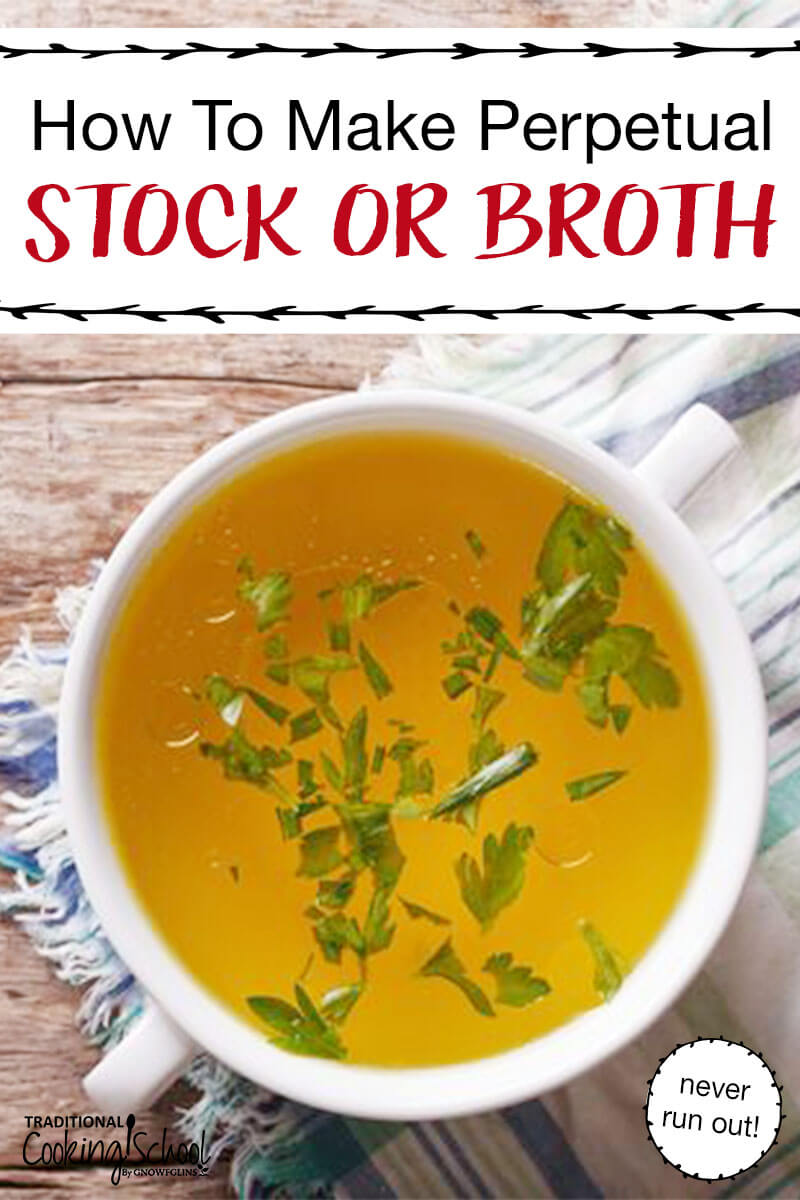
Last week we talked about how nourishing stock or broth is the foundation of a traditional diet and should be consumed regularly.
Why? In addition to being rich with minerals, broth contains gelatin which aids digestion and helps the body more fully use protein. People on the GAPS diet are urged to learn What’s The Difference Between Stock And Broth, learn how to make beef bone broth, what to do with bitter broth, and to eat a cup of broth a day.
That’s a little bit hard to do. For one thing, it is hard to find interesting and appetizing ways to get it in without drinking it straight. Don’t worry about that, though — Mindy and I and lots of commenters help you overcome that hurdle in last week’s post: 8 Ways To Get That Stock In (Without Drinking It Straight).
But what about keeping up the routine of making stock constantly, so it is always available? You know how that goes. Fill the pot with bones and water and vinegar. Simmer, strain, store, use. Wash the pot and start all over again. Practically daily. Yeah, that can be inconvenient. Worth it, definitely. But it could be simpler. It could be easier.
Let me introduce you to perpetual stock.
With perpetual stock, you hardly feel like you’re working at all. With perpetual stock, the stockpot is always on, always ready. You don’t have to store the stock, you don’t have to wash the pot daily, you’re not always messing with it. We love using our perpetual stock in any of these hearty blended soups for a quick lunch. Paired with a “grown-up grilled cheese sandwich” and homemade pesto, we couldn’t be happier!
How to Make Perpetual Stock or Broth
Perpetual Stock or Broth
Ingredients
- bones and other animal parts
- 1 splash raw apple cider vinegar
- veggies onions, garlic, odds and ends or anything else you'd like to add
- pure water
- sea salt optional
- crockpot preferably 4 quart or larger
Instructions
-
Put your bones and other food goodies in the crockpot and cover with water.
-
Turn on to high for 1 hour, then turn down to low.
-
Every crockpot is different, so adjust heat as necessary while the stock cooks. A gentle simmer is okay, but try to avoid a rolling boil. No simmer but consistent heat is good, too.
-
After half a day or so, you can begin ladling out stock as needed. I love having a crock of stock ready to add to every meal!
-
Season it up in the dish you’re making or by the mug.
-
Replace water as necessary and keep the stock going…
-
After a few days (or more often depending on how much broth you’ve used), scoop out the spent foodstuffs — they go to the compost. Usually I do this when the broth is no longer flavorful and no longer fatty.
-
Start the process over again by adding more bones and the other ingredients.
-
Keep adding water and keep that broth going… and going…
Recipe Notes
Every week or so, you should probably allow the stock to get very low in the crockpot without replacing water. Turn off the crock, then clean it. Then start all over again. Switch crockpots every so often so one isn't working for weeks at a time. The most nourishing stock/broth comes from the most nourishing bones. Grass-fed, pastured, etc. If your stock does not gel, consider adding good-quality gelatin. GAPS people with very sensitive digestive systems may find long-simmered stock too rich. If this is you, don't let the stock keep going for hours and hours or days.
Do you keep perpetual stock going? Any tips to share? Do you think this would help you get more broth in your diet?
New to our GAPS series? Get up to speed by browsing past posts in this series or reading what the GAPS diet is.
...without giving up the foods you love or spending all day in the kitchen!

2 free books:
Eat God's Way
Ditch the Standard American Diet, get healthier & happier, and save money on groceries...
We only recommend products and services we wholeheartedly endorse. This post may contain special links through which we earn a small commission if you make a purchase (though your price is the same).


when I move, I think one of my first household purchases will be a crockpot.
I can my stock. Beef, turkey and chicken stock is always ready. Use it to make rice dishes, gravies, soups, etc.
I tried this, but there must be something wrong with my crockpot, because after the first day my stock just tasted like burned bones. It was totally disgusting, and I had to throw it all out and start over with fresh bones on the stove. 🙁
My crockpot would get too hot on the low setting too. I used a light dimmer chord. Don’t know the proper name for it, but it is the chord you would plug into a floor lamp so you can adjust the brightness (& on/off) with your foot. That has solved my over-heating problem!
You might want to check with your local fire department. It is my understanding that extension cords are not meant for heat producing appliances. This could be a fire hazard! Please check!
mine too!!!! UGH! I have tried to make it several times. It is quite expensive and has to be thrown out every time! Burnt bone smell, even urine smelling. YUCK. And it takes days to get the smell out of the house! My dad tried it when he was recovering from gall bladder surgery- poor thing… the broth liked to have killed him. I didn’t try it before giving it to him, so felt badly that the coughing hurt him. That was my 4th time trying to make broth and I haven’t made it since. I would love to know how to make it correctly because I have read the health benefits. I have GERD so badly and leaky gut. I’ve had a hysterectomy and a thyroidectomy (My immune system is wrecked- I catch pretty much every cold and germ I come in contact with, and it takes a long time for me to get well again.) I’m tired of having colds 6-7 times a year and the flu 2-3 times a year.
I used to have the same problem with my crockpot overheating and a really nasty smell from the broth. I cured it with two things: 1. Use a timer switch with the plug-in. My smaller crock only has low or high settings. Low is not low enough; it will still boil water. So after about six hours on low, I fix the timer switch to go off and on at half hour intervals (24/7). You to have to experiment with your own crock since they’re all different, but as Wardee says above, the goal is to keep it warm enough, but not boiling.
2. Scrape the sides of the crock periodically from any thick fatty deposits, and discard. I try to skim out all the fat if it’s not an organic chicken, because that’s where most toxins are concentrated. It also seems to be the source of most of the nasty smell, at least if it is cooked too long. I think that’s why regularly pouring off broth to drink and adding fresh water back helps prevent this from happening, because most of the fat gets removed early on. Hope this helps somebody!
I would be careful on recommending this stuff to people with no gull bladder. The bile that is excreted by the gull bladder serves many purposes. One is to neutralize the stomach acid as the food leaves the stomach. The intestines don’t want the acidic stuff from the stomach. i don’t know what to actually recommend. But, be careful you don’t cause harm.
Interesting. That makes sense but my husband has no gallbladder or appendix and he drinks perpetual broth consistently and no problems. ?
I had the same problem. Buy some thieves oil spray and spray it into your mouth once every couple hours. Also i hope your on AIP with regular bone broth. I hope this helps you.
If I use my crock pot for anything the food taste like the “crock pot”, not a pleasant taste. I wonder if it is the material that the crock is made out of?
Jen Goulet Kessler – this is what I was talking about.
@Alice — I would guess your stock pot runs too hot. Do you have an older one that cooks lower?
Nope, that’s the only one I have. It’s ok, though, because I usually have one day a week that I’m home and can make stock.
I make chicken and I make beef stock and freeze it into ice cubes. I can put a few into whatever I want.Works good for me. i am 81-years old. No meds, no supplements and no aches or pains. I run 5Ks and 10Ks. My basil metabolic age is 66 years.
I have on occasion bought a $4.99 Costco Rotisserie Chicken. It is almost embarrassing to admit it, because I usually go for organic pastured chickens. But this $4.99 chicken makes the most gelatinous amazing broth I have ever seen! I have a hard time getting my $20 organic chickens to make a gelatinous broth. Any ideas of why this might be? Thanks! 🙂
The reason you get more “gelatinous” stock from a rotisserie, is because of the carageenan that they add to the chicken. I have yet to find a rotisserie without carageenan added. If you can’t get your organic chicken to make a good broth, its one of two things: 1. you didn’t add enough vinegar and let it sit for an hour before heating, or 2. the organic chicken is raised in a chicken coop, not outdoors, and just given organic feed… this makes the fat poor quality, and makes the cartilage poor quality too… so you don’t get a good gel (chickens raised like that are not getting enough protein, therefore they are deficient in good protein, fat and amino acids). Try finding pastured chicken, or adding more vinegar, or take up Wardee’s tip and add in plain, good quality gelatin.
Instead of gelatin you could add a couple of chicken feet to the pot. ( an asian grocery store will have them)
Yes, chicken feet are the most nutritious part of the chicken. The feet and the skin should not be thrown away. I buy good roasting chickens. I put the whole thing into the stock–of course I dress it first.
correct about the chicken feet. i get a chicken that only has the head removed. Plop half plus the feet into a pressure cooker, 2T apple cider vinegar, vegies and voila! perfect broth. I only use the slow cooker to make perpetual chicken broth and toss it all after 5 or six days.
I generally make my stock while cooking my chicken.
I put either a whole chicken or just legs (whatever I find on sale) in the crock, cover half way with water and add the vinegar. I let it simmer until the chicken is done then remove the chicken from the pot. I remove the meat and return the skin and bones to the pot to continue simmering.
This results in a stock that gels BEAUTIFULLY!
I like the idea of perpetual stock, but I was using some of my last batch while it was simmering and found it to be toooo fatty. You mention it being fatty in this post. Is it supposed to be? I usually put my finished batch in the fridge and once the fat solidifies at the top I scrape it off.
Is this a good thing or bad thing?
Animal fat, from high quality, naturally raised animals, is good for you. At the beginning of the batch of stock there’s a lot of fat present. What I do is add both stock and fat to dishes.
Fat isn’t desirable if you’re canning stock or if there’s so much you don’t like to eat it. But barring that, it is very good for you and very good to get in your dishes!
Another consideration is that fat goes rancid more quickly than other foods. So it is good to use up the fat in the stock sooner in the perpetual stock cycle rather than later.
Agreed on all points re: perpetual stock. But the fat also adds so much flavour so i dont worry about it. If just making stock to freeze, in the pressure cooker, I let the fat gel on top overnight, scrape it off and boil the water off – used nearly every day, while it lasts. this is rendering made simple. Even simpler if done with the fat that drains off your roasted and spiced up chicken. Once rendered and solidified in the ‘fridge fry up your eggs (or anything else) with this instead of butter or coconut oil. Yum.
This is what I do. I remove the chicken when it’s done, debone it, put everything that is not chicken back into the broth and simmer on very low for another 8-10 hours. Very rich. Where I live, I can get more organic chickens than beef bones from pastured animals. That’s the biggest rub for me.
Thank you for these details!
had the same thing happen for me Alice, I never thought it might be a temperature issue. Hmmm, will have to try again.
This is helpful Mari. My idea was to move in with you and have you perpetually make stock for me. 🙂
😀 Reserve a room for me, too!
Hello I am just wondering about the cost of keeping the crock pot running all the time. I also think that it seems that it would be very important to have the chickens be organic since we are getting concentrated nutrients from them. Am I correct in thinking that?
I would like to do a cost calculation about how much money it costs per quart of broth to make it this way – can anyone help?
Adrienne,
Yes, you’re right — high quality, pastured chickens are best. I meant to add that to the post.
On the cost calculation, you’d need to know a few things:
–cost of running the crockpot for a certain length of time
–amount of stock you can produce during that same length of time
–cost of bones and other ingredients
Then you could find out what the cost is per quart, per gallon, etc.
Thanks. How much vinegar? This is the first I’ve read about adding that.
Marian — The vinegar helps pull minerals out of the bones. I really do splash. Literally. But if you want to be more specific, a few tablespoons up to 1/4 cup.
Learning about perpetual stock was a really big deal for me! I had previously been under the impression that you could only make one batch of stock with a batch of bones, and at an expense of about $10.00+ for each batch of bones, I wasn’t making it very often. So, I believe that one fact about perpetual broth deserves emphasis and repetition: YOU CAN USE, AND REUSE, THE BONES UNTIL THEY CRUMBLE! (Or, until you don’t like the taste – IF you can’t remedy that by adding herbs, spices, onions, garlic, or something.) I’ve found that I don’t need to put so many bones in my pot to have good broth as I had previously believed.
I use a 6 qt. oval roaster oven for my perpetual broth, and can do my browning or roasting right in the same vessel on the Roast setting (350 degrees), then turn it off, add water and vinegar and leave it for one hour. (It has a removable porcelain cookwell.) When I turn it back on, I set it on Cook (300 degrees) until it gets a good simmer going, then turn it down to Slow Cook (200-250 degrees). This method is so much easier for me, because I have a gas stove and had the most difficult time trying to get the flame set low enough without it going out on me. This roaster really helps me to always have broth!
A FEW WORDS ABOUT FLAVOR: 1) IMO, the flavor and color can be favorably improved if you take the extra time to brown or roast the bones first (about an hour), then make the broth as usual, adding the pan drippings to the broth pot. 2) I’ve learned that if you put carrots in it, especially if you put in too many, they make the broth sweet. That may or may not be a good thing, depending upon personal taste. IMO, sweet broth is awful, but it might help your children drink it. 3) If you don’t want bland broth, remember to add some vinegar each time you add water, which also helps pull the minerals out of the bones. 4) My favorite herb for broth is bay leaves, adding them every day or two.
ONE QUESTION: How do you know if you still have gelatin in your broth when it’s always hot?
Thanks for the tips, Brenda! Good point about frugality. 🙂
The only way I know to test for gelling is to let a small amount cool.
Thanks for your kind words, Wardee, and for all the helpful information that you provide for us!!
As if the above wasn’t long enough, perhaps I will add that my broth experience consists of using grass fed beef bones exclusively. I’d love to make chicken broth, but at $15.00+ for a 3 pound chicken, that just isn’t going to happen here. 🙁
If you calculate it out though, its not so bad. If I use that chicken in a recipe, I can get two meals from it. Then, I can get FIVE quarts of healthy organic chicken broth as well! I’d say that’s a pretty good deal if you look at how much you’re getting from that 15.00 chicken. You just have to get your mind off that initial price tag bc its way more than one chicken for one dinner. 😉
I use 8-10lbs of chicken to make 8qts of broth. You must rly have watered down broth. I take the meat off sometimes, but I buy wings to get a good gel. Deboning 10# of wings on a weekly basis gives new meaning to the word tedious! We go thru all 2 gallons of broth weekly or biweekly at most. Its easy to do if you make soup even once a week (4qts right there). We dont have a big family, but even drinking 1c broth a day per person, bam, uses up the other gallon.
Great advice! Once things become a habit, they don’t seem like *work* at all – just part of everyday. Thanks for the encouragement!
Thanks, everyone! Sure appreciate it!
We grew up having soup every meal so I really miss that. I’ve been wanting to start the GAP diet but
have been unsuccessful because I haven’t been able to make broth regularly.
I’ve made chicken broth with meat & bone. A chicken makes about 5 quarts of broth.
It’s a long process cooking on stove top. I have used my 10 yrs old Rival crockpot to make broth over night
& it boils hard at a low setting. Also I stop using my crockpot after reading risk of lead leaching into food.
Perhaps I need to investigate to find a crockpot that is safe and try again?
Question: Is it a good idea to break the big bones to get more minerals/nutrient out of the bones?
I would like to make beef & fish stock also. Again that means spending time researching to find a good source for organic beef & fish head.
Just looked up the lead in crockpots. Was worried there for a minute. Like this lady, I will test mine. I wonder if you could bring a lead tester around with you in the store.
http://www.stacymakescents.com/the-great-crock-pot-lead-debate
Hi Wardee! I make stock frequently, since I started GAPS last year in May. I now know that even when I’m completely off GAPS I’ll still be making it almost daily since it’s so nourishing and goes with so many meals we eat. I’ve always got some going or in the refrigerator or freezer.
For many months, I made stock like you are describing and it worked fine, except that I found that after no more than 2 days, my chicken stock would start to taste off. I would often use up most of the broth and then add water again after several days, and sometimes I’d add a bit of apple cider vinegar again, more spices, and also some butter or ghee which I always add to my stock when I first put all the ingredients in.
With beef, it would take longer for the off taste to develop, maybe 3-4 days. I got tired of it tasting off, so I’ve started taking it off the stove and just storing what I’ve got. I now think that may be because of two reasons: 1) I have really never skimmed off the fat from the initial heating. I always wanted to save it because I love the fat, and I just kept in in the stock because I use my stock for so many other things we eat – beans, rice, cooking meats and veggies, casseroles, etc., and 2) because for awhile I had the heat setting up too high (above medium) for the initial heating. Then many times it would get left there for 20-30 minutes because I’d be in the other room and would forget about it before I realized it was at a rolling boil, and for too long. But maybe it was something else that was happening that I’m not even aware of?
In the house we’re currently renting, the stove is terrible and even on low it scalds broth or anything else if left for too long. We also don’t have a working timer. My husband decided that it was time to invest in something besides a crock pot since all of the ones we ever bought didn’t last very long and I was worried about lead or other toxins getting into our food. Enter the hot plate. Best kitchen investment I’ve ever made. It has two plates, and I can have stock going on it nearly continually without worry. I can also actually cook on it, just like the stove. And unlike a crock pot, it has many different heat settings – it goes from 1 all the way up to 12. I was always annoyed how my crock pots never had anything besides high and low, and wished I had more control over the temperature.
The other thing I have always had trouble with is getting my stock to gel. I have done everything I’ve always read to get it to gel – with chicken I always add gelatin, use chicken feet with the carcass when I have it, etc. When I store my stock in the refrigerator, I always get the layer of fat on top, but it never gels. Do you have any idea what I could be doing wrong? Sheesh, I just realized this comment, which I intended to be fairly short, has now turned into a small novella. 🙂
Raine — I don’t care how long, I love your comments!
I think the off-taste you experienced before has everything to do with the fat staying in there too long and the crockpot running too hot.
In any case, how cool about your hot plate.
It is my experience (often) that when cooking the chicken, the drippings gel quite well and the stock less so. So if you’re cooking the chicken at a totally separate stage, try not using all the drippings in a dish (I know, it is hard!) and putting them in the stock pot too to share the gelatin love. 🙂
I’ve read that you wan’t to keep the stock around 180 degrees. If you do it too hot it breaks the gel. You will still have a tasty bone broth, but it wont be as jelly. Also, too much water will also dilute the gel. I understand you want to just cover the bones and veggies with water, just barely.
Raine I’d love to know which brand/model hotplate you bought. My crockpot is way too hot.
I’m wondering if the hotplate is as energy-efficient as the slow-cooker…also as economically efficient. Has anyone done the math? Love this post!
Thanks Wardee! 🙂 Yes, I guess I have not been using enough of the drippings since we usually end up eating most of them when we cook the whole chicken. I always forget about that. Thanks for the reminder! 🙂
Hi SJ – Here’s the post I wrote about it on my site. Let me know if you have any questions. I love my hot plate! 🙂
http://agriculturesociety.com/general-information/the-solution-to-lead-laden-crock-pots-hot-plates/
Great post! I’ve been doing this as well but only every couple weeks. I freeze as much stock (& soup) as I can to use during the weeks I don’t make stock. I like to use my crockpot for dinner too, so I don’t want it constantly occupied. 🙂
I have had a problem with stickiness in my crockpot though. When I go to wash the bowl after I’ve been simmer stock (on warm, even low makes it boil) for several days, it’s super sticky & gross & will NOT come clean unless I soak it for hours & scrub for hours. Makes me sad & consider going back to my old stock pot on the stove. Any tips??
What about skimming the scum that rises to the top?
Hi.Wardeh and all,
If I am not making a perpetual broth and just making a batch once every week or two then about how long do I leave it simmering? How long is too long in affecting the nutritional value and flavor?
I do not want to leave cheaper appliances like crock pots (even the best) plugged in while I am not home as it makes me nervous about the potential of their staring a fire in my home as I leave my elderly mother who does not more very fast and pet in the home alone. Also, any suggestions for brands and models of crock pots that you have found tried and true would be most welcome.
I figure I can save the bones in the freezer and use them again with any new bones I accumulate between batches so not to waste them with just making only one batch of bone broth. Do you see any problems with doing this? I cook for only three of us so I plan to freeze some with each batch I make so as I constantly use it I will be replenishing my stock in the freezer with each batch. I figure for only the three of us that should keep us with a constant supply of stock to have at least one cup a day as suggested.
Thanks in advance for any info and suggestions!
Carol G
I’m just wondering about the onions and garlic I put in my beef stock, should I strain those out after 24 hours or are they fine in there for a few days/for as long as I keep using the same bones? Also, the meat on the bones, do I take the meat off after a day or leave it in for as long as I keep that batch going? I have a batch going right now and LOVE the idea of being able to pull what I need when I need it. I’m thinking I’ll freeze a quart every day or so to have on hand for when I need to use my slow cooker for something else. Its so much easier to take a quart here and a quart there rather then storing all of it at once. Thanks for all the information. 😉
Laura — I wouldn’t use onions and garlic in perpetual stock. They get very sweet, and at least I don’t like it. Yes, with the meat — cook till done, take the meat off, and return the bones to the pot. I hope this helps you out!
I remember, from my childhood, my great-aunt would always have a stock pot on the stove. Soup was served with every dinner and supper(they were from the old country where dinner was at lunchtime, but the biggest meal of the day, and supper was at dinnertime, but more like a lunch). I dont know how she started the stock, but most left-overs went into that pot. And the soup was always great. I think she threw it all out and started over every couple of weeks, but I really cant be sure.
It’s a shame that that type of info gets lost as technology removes us from having to know it.
I enjoyed the article, and I will try to keep a perpetual beef stock on hand …. just because I love a hot cup of broth in the winter months.
Thanks
True about the old ways getting lost. One addition to your thought…These methods and resulting health benefits have been largely replaced in the business of food distribution in our post-industrial western world. Lots of reasons underlie the change in how we eat/cook/live. That includes wartime economy, changes in household roles and the impact that has on how we learn to cook, and the availability of both food outside of the home and our over-scheduled lifestyles. Love your comment.
I don’t use vinegar at the beginning and get a great gel!
Hello,
I have a question for you. We butchered our own beef this January. I have two large nesco roasters going with bone broth. I am getting ready to change out the food scraps and continue on. There is still meat on the bones that is loose. Should I remove that from the continuing new batch of broth? Will it begin to spoil in any way? I would like to move forward indefinitely with the bone broth and leech as much out of my grass fed animal as possible. Bone broth is bone broth and not meat scrap broth right? Help me about the meat please? Thanks.
Every time I’ve made stock, either on the stove or the crock pot, it always bland and tastless regardless of whether its chicken, beef or pork. I follow all your instructions… what could I be doing wrong?
I’ve been doing perpetual broth in a crock pot continuously for two or three years. Every morning, we dip out broth for everyone in the family. Then we change out the bones if needed, add more water, let it simmer again….. The first batch with new bones definitely has the best flavor and the best gelatin. But the subsequent batches just need some fat added in, and they end up tasting fine. The secrets to delicious broth are salt and fat. I use the same bones for three to five days, usually beef bones, chicken bones, or chicken feet. I never roast the bones or add vegetables, because I need the entire process to be simple and easy. Usually one of my sons (ages 6 to 12) does the whole chore by himself each morning. If we’re going to make soup, we skip the morning doses and save it all for the soup.
What is the health benefit of drinking broth everyday? This is my first time to this website and I am finding it extremely interesting and would like to try this broth daily. Also, should I use Bragg’s apple cider vinegar or regular apple cider vinegar that just adds apple cider to distilled vinegar?
Chiming in…you should use a cider vinegar that has all that sediment in the bottom that, when stirred up, makes the cider a little cloudy. That is where the magic happens.
In theory, this sounds great. But when I tried, my entire house smelled like chicken broth day and night. Did anyone else experience this?
I heard if you keep it going, you get MSG in it. Thoughts?
We use bones, necks, wings, skin, and all else from *smoked* birds, chicken or turkey. Sometimes our own pastured animals. The smoke makes all the difference, and the broth that actually makes it past all the sampling to the freezer makes the best soups, esp with cumin, taco seasoning, diced potatos, kale, lime, cilantro and such.
With the perpetual bone broth can I leave the same bones in all week until they disintegrate? It’s been about 4 days… Small brown bits are now in the broth as well. assuming they are coming from the inside of the bones. Still tastes great but Is this safe to eat?
Since my teenage son isn’t much into soups, I’ve been using stock to cook noodles (spirals, macaroni, etc.) and rice instead of water. Rice isn’t so unusual, but I haven’t heard of anyone else using my noodle technique. We use only brown rice noodles, which absorb somewhat less water than regular wheat noodles, but when cooked are almost indistinguishable. I don’t use excess valuable stock; I add just enough to barely cover the noodles, and stir the pot often as it cooks. The noodles absorb the liquid as they cook. The result is a very tasty noodle dish with a creamy sauce.
hi love your post. I’m new to making broth. I saved my turkey so I can make it. How much water do I put in it to how mug acv? How long do I cook it for? South to learn. Thank you!
Great tip! Having stock so readily available makes it easier to incorporate into your every day diet. I do something similar using a woodstove. I often have stock simmering on the woodstove during the winter. It is easy to ladle out, filter through a mesh colander, and use for various things. Plus no extra electricity needed.
Some have mentioned making the broth more flavorful… A few years ago I stumbled upon using Rosemary when cooking my chicken- and I’ve never looked back. I use a lot of Rosemary and garlic (plus celery and onion) while cooking the chicken, and then even add fresh rosemary and garlic when I put the bones and water back in for the broth. Super delicious. When I had a severe bout of candida last year I was having this broth and quinoa plus a few bits of chicken for breakfast daily. It was so comforting and delicious. Try the Rosemary! 🙂
What crockpot are safe? What brand do you use? I’ve heard some leach into food. I have 2 crockpot I’ve had for years..and recently heard about stuff leaching.
I know this is an older post, but since many of you, and, to be honest, myself included, are wanting information on lead in crockpots, I decided to do a search and found this website with serious research information:
http://terminalverbosity.com/soapbox/environment/the-skinny-on-lead-in-crock-pots-it-may-surprise-you/
I hope this helps all of you wondering and trying to find a solution to stove top simmering for days!
Hi,
I just started making stock and tryed out keeping it perpetually going. I kept taking some out and adding new water and put some new chicken necks in on day 3, I did put some squash and vegtables in just to make it an onging meal, and kept eating them and adding more but after about 4 days it started making me feel sick, bad food reaction to it. It was definetly the broth but I dont know what went wrong. It was constantly boiling, mostly a full boil, I just read not to keep it so high Ill try that. Can the fat go bad boiling in there? Or maybe it got to rich?
Hi Shanti,
The fat can definitely go rancid. You could also be sensitive to histamines. Here is an excellent article from Megan at Eat Beautiful on these issues and tips for making broth: http://eatbeautiful.net/2014/07/23/megs-bone-broth/
Millie
Traditional Cooking School
Hi, thanks for an interesting article! I like to turn off my electrical appliances before I go to bed … Is it ok to make a perpetual broth which gets turned off at 9pm and then turned on again at 7am? Or am I risking getting food poisoning?
Hi Anna,
I’m sorry to say this wouldn’t be safe. You’d want to put it in the fridge when not on heat.
Millie
Traditional Cooking School
I’ve been making stock (that’s when you use bones) and broth (that’s when you use only the meat) for a long time in the crockpot with perfect success. I haven’t used cider vinegar, tho, and wonder what the main purpose is for using it.
Also, I do not put bones or ANY meat product into my compost pile!
Have you ever made stock from rabbit? We live in the city, but want to raise some of our own meat. Our first rabbits are ready to process, and I would really like to fully utilize them.
Hi Katie,
We haven’t made rabbit stock but you can use the bones of any animal to make stock. You should go for it. 🙂
Millie
Traditional Cooking School
Is there a recommended minimum temperature to keep the bone broth perpetually on to make sure it is safe to drink??
Hi Beth,
The low setting is the proper cook setting and can be used for however long one needs to cook the broth. High can be used to start it. The warm setting is hot enough for more than 2 hours.
Millie
Traditional Cooking School
Love this idea however I don’t like the continued smell of broth. My Husband, sister & I are doing the 30 day broth challenge. I’ve been freezing it but I’m tired of the hassle so I’d like to make this and refrigerate the broth but not sure how long it would last. I would then save the bones and start over after a few days and continue the process. Thanks for your help!
If the broth is refrigerated it will keep a few days – especially if the surface is covered with tallow and seals it. More than that, I would freeze it for the best quality. Same with the used bones.
Hi Pam,
The strained broth will last several days in the fridge (even a week or longer). You could save the bones and start over. You can get a few uses from the bones this way.
Millie
Traditional Cooking School
thanks so much Millie! My next batch will be done this way!
What do you do overnight? Do you let it cook overnight or put in fridge during the night and take out and cook again in the morning?
I leave it on overnight, and continuously for about a week. I have done this twice. The first day that you add bones you have to be sure you skim as much fat as possible off the first day. If it isn’t done, it becomes strong tasting and then rancid. After that I skim when fat is visible on the top of the broth. I liked this way of making broth for the cold weather because if it was available and hot, I tended to turn to it and use it in some way.
Has anyone looked into what cooking temperatures are best? I’m kind of late in the game, but after reading through all the comments, I’m thinking of comparing temperatures of the appliances that I already have. I have a Crockpot with warm/low/high settings. I also have an Instant Pot with slow cooker settings. With my digital thermometer with probe, I think I should be able to figure out which appliance and setting will work best. As with other commenters, my Crockpot cooks way too hot on the low setting.
Hi, Debbie.
We have not compared temperatures. You want to avoid boiling for sure so lower is better. :). My cockpot’s low setting is still too high.
~Danielle, TCS Customer Success Team