
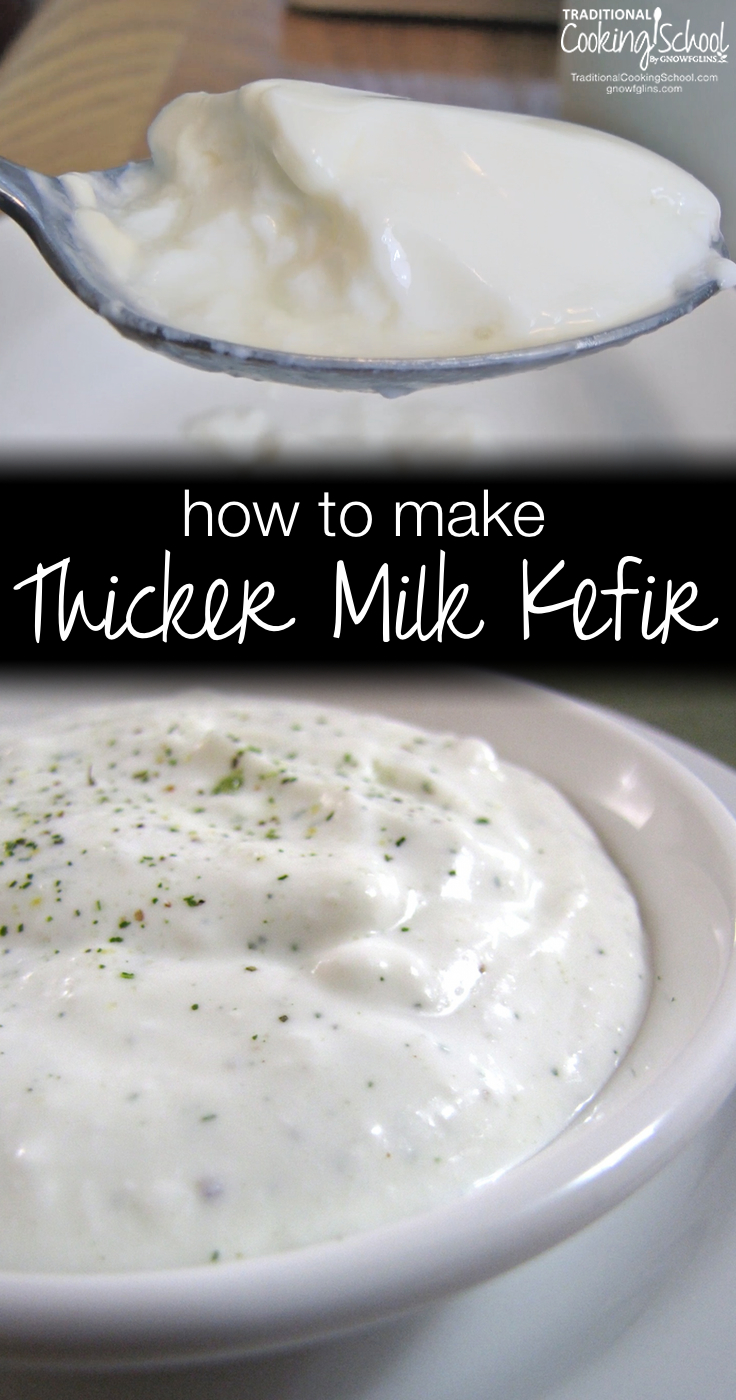
Chrissy asks today’s question…
“Can you tell me how to make thick kefir?”
Of course! I have 2 methods to share with you in the video and transcript below.
For even more information, check out our Cultured Dairy & Cheese eCourse, as well as How To Make Milk Kefir (and why it’s so good for you!).
Method #1 — Let Kefir Ferment Longer
Like all cultured dairy, kefir gets more and more thick the longer it ferments. The beneficial organisms produce acids as they digest the milk sugar, and these acids thicken (aka “curdle”) the milk.
So, let it go longer! It will eventually turn into curds and whey — don’t let it go that far. 😉
I let my milk kefir ferment 2 to 3 days in the winter, and 18 to 24 hours in the summer. Warmer temperatures speed up the process.
Although this method does yield thicker milk kefir, some people don’t care for the extra sourness. That’s why method #2 is a great option, too!
Method #2 — Drip Kefir Through Cheesecloth
Drip your 24-hours-old (or so), mild, thinner kefir through 2 layers of 90-count cheesecloth. You can also use a pillowcase-weight cotton cloth.
After a couple of hours, you’ll have thicker milk kefir! If you let it drip for a day, you’ll have kefir cheese. Choose a time frame that results in the consistency you want.
More Kefir Related Articles:
- What To Do With Over-Fermented Kefir? #AskWardee 111
- Help! How Do I Find My Kefir Grains? #AskWardee 051
- How Long Does Kefir Last? #AskWardee 060
- My Kefir Looks _______! Are My Kefir Grains Okay? #AskWardee 015
- Kefir Grains Or Kefir Powder — Which Is Better? #AskWardee 040
- The ULTIMATE Water Kefir Guide (how to make it, store it, flavor it, brewing tips & MORE!)
Do you know how to make thick kefir?
...without giving up the foods you love or spending all day in the kitchen!

2 free books:
Eat God's Way
Ditch the Standard American Diet, get healthier & happier, and save money on groceries...
We only recommend products and services we wholeheartedly endorse. This post may contain special links through which we earn a small commission if you make a purchase (though your price is the same).


I typically culture on my counter for a day or so then put the jar…grains and all…into the fridge for another day. I then will strain out my grains to start a new batch; the completed batch is usually the consistency of a slurpable milk shake.
I do the same and was going to suggest this.
Me three! Makes beautiful and tasty kefir!
Could you please tell me what your grains/milk ratio is? I get thick kefir by just covering the grains with the milk.
Yolanda — About 1 tablespoon grains per quart of milk. You can do a little less or a little more. I have gone a few months experimenting with more grains and the kefir developed an overgrowth of yeast plus it chronically separated early into curds and whey. But another thing I have learned is that grains act differently among themselves and also in different milk. So ultimately, we have to play with it to get it right for us. I hope this helps!
Hi Wardee, How do you know if you have a yeast overgrowth?
After fermenting for 24 hours I put kefir in refrigerator for another day with grains still in. It ends up being very thick.
I use step one to get thicker kefir, and I strain it through a thin strainer I got with my grains from Cultures for Health. But since I work standard work hours, I can only really strain in the evening. If it’s too thin one night, I will just leave it until the next night.
Wow – what timing. I was just looking for advice regarding this yesterday. It seems like mine is separating before it thickens. I tried with less milk yesterday and after stirring the curds and whey together it was practically as runny as milk. Trying with more milk today. When I checked this morning there were grains suspended in thickness on top but it wasn’t thick all through so I stirred it up. I use an “electric blanket” that keeps it at? about 72F. Maybe I should try w/o heat source. I was just hoping to have a batch every 24 hrs. 🙂 So, you don’t stir or agitate yours during fermentation, do you. (I? didn’t used to with grains I had before. I have new grains and am struggling to get the taste and texture I was accustomed to.)
Anyway, thank you for this post!
Coreen — I don’t typically agitate mine during fermentation, BUT it is sometimes helpful if you’re experiencing what you’re experiencing (thick at top and runny at bottom). I think you should keep the heat source — unless you want to slow it down more.
I have some kefir going right now with a grain I split off another. I think it is not happy being split because it is doing what you’re saying — thick kefir at the top and runny at the bottom. Yesterday I gave my kefir a stir and another day. I am not used to this behavior! 😉
Wardee, I’m curious how your split-off is doing. I have not had a single batch where it just gets a nice flat firm top to signal that it’s done. It always separates before getting firm and gets chunky and does other weird things. I tried soaking it in yogurt (read it somewhere) for 12 hrs before adding milk and fermenting for 24 hrs for 3 batches. It just made the subsequent 2 batches super carbonated – had “cheese” exploding out the top with tons of whey on the bottom. I tried adjusting the ratio. I tried rinsing the grains. And the grains are getting smaller and smaller. (>_<) The taste is fine – no "offness". I would love to hear your thoughts… if you have any – especially if you managed to get yours to behave properly.
This was happening to us. Then we gave some grains away and made a batch with a lot fewer grains, and it was much better. Now we make smaller batches (two half-quart bottles instead of one big quart bottle) with an unbelievably small amount of kefir grains in each bottle (about 1/8 – 1/4 tsp). Perfect kefir every day!
I like to ferment mine for half of the time, remove the grains, and ferment it for the other half. In the summer, it’s about 24 hours with the grains and 24 hours without. It makes a thicker kefir, but I don’t have to struggle to separate the grains from the kefir.
I do the same. One day on the counter then the whole thing , grains and all in the fridge. This way it thickens but doesn’t get too sour.
Thank you! This worked!
I keep my kefir in the fridge since I am the only one drinking it and I just can’t drink that much milk/kefir every day! Will the kefir grains remain viable over time in the fridge? Obviously it slows the fermentation down a LOT. I’ve keep it in the fridge for weeks upon weeks and it never gets thick but I believe it IS fermenting because I can smell it, but it is also as consistent as plain milk, no thickening at all.
BUT if I remove the jar and put it on the counter, within 12-24 hours it goes to curds n whey! I suppose if I set some of it out I’d have to drink it within about 4-8 hours to be able to consume it before it goes to curds n whey, right?
Anyway, LOVE YOUR VIDS! Isn’t it about time for another webinar? =)
Marci — As long as the grains have milk sugar to consume, they’ll stay alive in the fridge.
If it is separating that fast at room temperature, yes, you’d want to stop it early — but you don’t have to drink it on the spot. Just remove the grains and put the kefir in the fridge.
The solution to thicker kefir for me has been to use LESS grains. It sounds backwards but it really works. Try using less grains and see if it works for you. If I use too many grains the kefir doesn’t thicken up well.
To get thick kefir that isn’t overly sour, I put a teaspoon of grains in 1/2 cup milk. I let this culture for 24 hours. Then I take the grains out and add 1 cup fresh milk. I let this sit until it thickens (usually 12 – 24 hours).
Thanks for sharing with us these easy to learn video clips, Its all clear. Thanks a lot.
I find the more grains I use with a smaller amount of milk, the thicker it gets.
I’ve been getting *very* thick kefir lately by using half cream and half whole milk. And by the way, it tastes divine.
If you have the resources to try out different types of milk, some make thicker kefir than others. The thickest I have found is nigerian goats milk. I would guess this is due to higher fat content.
what does kefir taste like? plain yogurt?
The taste is somewhat hard to describe. II would liken it to a very tart blueberry – one that wasn’t sweet at all. Maybe that is why blueberry pairs so well with it in a smoothie. Plain kefir has a much different palate profile than plain yogurt, too. I can’t stomach plain yogurt but plain kefir I can. I guess it is like a fruity pungent sour cream or cheese flavor.
I also like plain kefir but can’t stand plain yogurt, which I find interesting. I think the bubbles from the fermentation (even in small amounts) distracts me from the sourness.
Tastes like buttermilk to me, raised on it as a kid so I’m loving the new kefer experience!
Wardee,
I know this is an old post, so I’m not sure if you’ll get this question, but I figure it’s worth a try. We had been making our kefir with raw Jersey milk from a local farmer, and it was lovely!—Nice and thick, creamy, not at all yeasty. It just had a nice sweet-sour smell and taste. However, we recently acquired some dairy goats, so I switched my grains over to raw goat’s milk. I expected it to take some time to adjust, but it has been over a week and my kefir is still yeasty and quite thin. When I pour it in the strainer, it just runs straight through (I always had to stir my cow kefir through). I have searched all over online for info and have come up with nothing. I knew that you had goats and wondered what your goat kefir experiences were.
Thank You, :o)
Audra
Hi, Audra.
I would just give it more time. Sometimes I’ll get grains and they’ll take to the milk right away. Sometimes, it takes a few weeks. There’s no rhyme or reason. And it is also seasonal, depending on the quality and consistency of the milk. So just keep on…. 🙂
Thank you, Wardee.
I am guessing you have to train Kefir grains to accept the difference between goats and cows milk. The first set of cow raised grains I got never would accept the goats milk so I gave them to a cow milking friend. The second set which had been frozen to send to me did after about a week of daily changing them in only a cup of milk (1 TBL grains) to reactivate them.
You might try freezing your grains and then re-awakening them only with goats milk. If that doesn’t work I would find someone you can order goat kefir grains from.
hey,
my raw cow milk kefir produces delicious soft cheese but impossible to get any “kefir cheese” from my raw goat milk !!?? any luck since your last post ? anyone else ?
jp — You mean you can’t make kefir and then drip through cheesecloth to make soft cheese? What happens?
I’ve been making kefir for several weeks now and am getting better at it. After the day or 2 on the countertop, I strain the grains out and then I end up with a somewhat watery-with-small-white-clumps slurry. What can I put my kefir grains in to be able to pull them out without “disturbing” the texture of the kefir?
Mine never gets thick. Ive been culturing mail order grains about 6 weeks and have never achieved a consistency greater than regular milk. Ive tried different temps, ratios, etc. Nothing seems to change the incredible “yeasty, watery beerlike” taste of the finished product. I thought this would taste similar to starter kefir or commercial kefir but it is nothing like it.
Put fresh cold, whole milk (pasteurized) on the grains and let it sit at room temperature for about an hour (or even less). Than put it in the fridge for the next 10 hours (or when you think is good to consume…trial). Make sure you stir it a few times in the process… You do this a few days untill the bacterial and fungus flora will ballance in the grains, and after that you will get the best kefir ever…Smooth taste, creamy and with carbon dioxide … Let me know your results !
Are you saying that you change the milk every 10 hrs or so but keep it in the fridge for a few days? My culture is a few weeks old now but still not thickening and smells very yeasty. I’ve tryed lots of different things but still runny and yeasty. So frustrating!
I am having the same problem. I am using raw cows milk purchased at the farm where I got eh kefir grains at. After 24 hours of letting it sit in temperatures of 72ish degrees it is watery and yeasty…. Can I consume the. How can I make better, think and tangy not warty and yeasty.
Mine curdles before it gets thick too. It also has a bad taste..not sure that the grains like regular store milk. When I had raw milk it was wonderful…and was so simple. I really wonder if anyone with regular milk has made tasty kefir.
There’s a lot of factors that contribute to your kefir’s final look and taste.
I experimented with lots of different types of milk, and even though the results varied a fair bit, I never got a “bad” kefir.
In my opinion, it is something wrong with your grains, or you do something wrong.
One alarming thing I found out communicating with my subscribers is that some of them were told to rinse their grains prior to feeding them milk for a new batch.
If you do that, PLEASE STOP IT!
Washing the kefiran and the yeast off the surrounding of the grain interferes with their capacity of processing lactose in the milk.
I would be very happy if you’d let me know, for everyone’s benefit.
To your health,
Marius
This is the 2nd time I have tried kefir grains without raw milk…it never works like raw milk. With raw milk you can let it sit out and it will clabber without it going bad but you cannot do that with pasteurized milk. So how can the kefir grains work in milk that is not raw.
I only know that it tastes nothing like raw milk kefir. I did not rinse my grains until it started curdling. I do not think it was bad grains. I can only get milk from Walmart. I did try organic milk last time, same outcome.
I have the same issue as the last few. My kefir never seems to thicken. Instead there is a separation into little bits of milk and is still a consistency of the milk I added to it. I never rinse it. Ferment for 24 hours on the counter – tried more milk, less milk, less kefir grains. Everyone seems to have a different ratio of kefir to milk – I have tried several over the last few weeks.
I have tried different temperatures as well.
I tried the second ferment and that separated into curds and whey and just about expanded up out of the jar.
I am still drinking it but I would definitely like it to be more creamy that thin and curdly.
Any suggestions?
Teri
Teri, have you tried different milk? Or, are the grains new to your milk? Perhaps they need more time to adjust.
Hi Wardee,
How long do you leave your second ferment for?
Lauren — About 1 day. 🙂
My kefir is usually ready really fast, often 4-10 hours, as it starts separating. I like the more solid kefir cheese. So I took advice to put the jar in shallow water so it would not ferment so fast. For the second ferment, do I put the kefir (without grains) in the jar on the countertop with lld, or should I second ferment in frig? I guess I don’t totally know what second ferment means. Then, I plan to strain it with a sheet through a strainer for the cheese. At this point, is it best in frig in open air? I’m confused about when it should be in frig and when it should or should not have a tight lid. I want it to taste good. Thanks for any help. I’ve tried different things and the cheese part is starting to taste good.
Julie, I usually do a second ferment on the counter. That is for full activity. Moving to the fridge will slow the activity way down, but it will still ferment over time (say a week or two). You would consider doing the fridge if you find the flavor too strong from fermenting again at room temperature. I hope you enjoyed the cheese!
Great job Wardee! You always do such a good job explaining your processes – and that is helpful to the rest of us! God bless!
We were given a starter for Christmas so now I have to figure out what to do next. 🙂
Just found this and watched your video. What ratio grains to milk do you use. In the video it appears you are using a half gallon mason jar? Basically how many cups to how much kefir grains?
Hi Lori,
Wardee uses/recommends using 1 Tablespoon of kefir grains per quart of milk. So for a half gallon container about 2 Tablespoons of kefir grains should work just fine.
Millie
GNOWFGLINS Support Team
IT’S WORKING!!! I like using the raw goats milk best and I will also sometimes have to use SuperNaturals whole milk. It’s lightly pasteurized, grass fed, and not homogenized. It’s actually thickening up now and I love it fizzy. I do the second ferment usually with orange rind and a few orange rings. I also make chai kefir now. I’m stunned that it is all working.
I want to be able to keep up on the raw milk, be it cow in winter or goat the rest of the time. I do feel it makes a better kefir for me.
If I over ferment and it separates by half I just make kefir cream cheese and have the whey for my other ferments. I can shake it and still drink it, but it is quite sour and I am not as partial to it then.
I’ve been making milk kefir with regular lowfat milk for about 4 weeks now. I was making yogurt everyday and having a difficult time keeping up with the unbelievable amount my grains were producing but it tasted great and I was so excited about my “new” yogurt. Then I became ill about a week ago and now I am nauseated by the thought of kefir (I’m not pregnant). Also, I started experiencing constipation which I have never experienced in my life (Was I consuming too much (1 cup yogurt per day)? Fermenting it too long (24 hrs)?). Since I’ve stopped the kefir yogurt, my digestive system is back to normal. At the moment, my kefir grains are resting in a jar of milk in the fridge and I’m not sure if I should go back to it or not (still nauseated thinking about it). If I do go back, I would definitely start small but what on earth do you do with all that extra kefir!!!!!!
I use it to make pancakes.
Also, if you want a thicker kefir, you can do a secondary fermentation (grains removed, at room temperature) with slice of organic orange peel. This adds flavor, more beneficial bacteria, and thickness. It also works with lemon peel.
Larisa Sandford
It seems if you add raw cream it makes it thicker too…
I’ve been making kefir for awhile now. My kefir has always been thick and sometimes it has some curds on top. These last two batches have curds on the top but the kefir is thin. I’m not sure but it smells (bad) sour too (that might just be me worrying). Could my grains be dead? Would they turn the top of the batch into curds if they were dead? Why is this happening all of a sudden if I haven’t changed anything?
Hi,
Thanks for sharing this info. I’ve tried making kefir several times, but it was a pure mess :(..
I live in Dubai where it’s extremely hot most of the year. After just 4 hours on the counter the kefir was already smelling quite alcoholic, but was as thin as milk!
I heated the milk up very slightly then added my kefir culture( which I purchased from Dr. Mercola) and stirred it in. Was I not supposed to have stirred it up? Just drop the culture into the centre and leave it?
The culture I had was dry and kinda looked like a whitish powder.
Since I’m living in such a hot climate what is your suggestion for making the kefir? Should I keep it in the fridge instead of on the counter?
How long does it take before the kefir turns alcoholic (in a moderate temp)?
Thank you
Hi. I am not sure how hot your temps are but from what you described I think you might have a kefir powder and not the actual grains. The grains will look like small cauliflowers it won’t be a powder. You do not need to heat the milk just put the grains in the milk, stir only if you want to. The milk should get thick and not be thin. I use 1 Tablespoon grains to 1 quart of whole milk.
I really would like this to work, but it is not getting thick. It is above 80 degrees in our home right now. I filled a 1/2 gallon glass jar about half way with raw milk and dropped my kefir grains in. I covered the ball jar with a towel and put a rubber band around it. 19.5 hours later I took out the grains and am left with just liquid, not at all thick. I really want the THICK kefir you showed in your video. Do you have any suggestions? I know you said it was in the fridge and SET UP, but it seems it would be a miracle at this point for it to get thick in the fridge. Thank you so much.
@stephanie…I’m not sure how long you have had your grains but raw milk makes the best kefir. But it takes a few days for them to get started.
Also you need a certain amount of grains for a certain amount of milk. Mine is the size of a quarter for 1 1/2 cups of milk. If the milk separates, the grains are too big for the amount of milk you are using. If the milk’s too thin, there’s not enough grains for it to ferment the milk in the 24 hr time period. I can be making good yogurt and the temps turn cooler and it will take my grains longer to ferment the milk.
Joan O’Keefe
I went from using pasteurized milk in a half gallon jar years ago and I would let it separate until there was about an inch of whey on the bottom – that way it was still creamy when I stirred it all together. I would do the whole shaking & straining. These days I use a pickl-it jar and milk from my Jersey. My kefir never separates, never gets a yeast overgrowth, is always thick & creamy. It doesn’t seem to matter if I use 1/2 tsp of grains or 3 cups of grains, only how long I leave it according to what the temperature is. I never shake or strain, simply pick up my lump of grains off of the top. I’m not sure what the difference is, but I love the newer way… it suits my lazy self. 😉
I finally found a kefir that did not contain sugar! I am loving the thick tangy flavour, so much better than yogurt.
I’m trying to make kefir with Body Ecology kefir starter powder and raw milk..fermented for 24 hours, tried to keep temperature at about 72 F..at one point it went up to about 80 for a few hours. Didn’t get thick and tastes slightly funky….wondering if variations in temperature affect fermentation? have put it in the fridge and will see what happens…Anyone have experience with powdered starter?
After playing around for what seemed like forever I found the method that works for me I add 1 tbsp grains to 2 quarts of milk ( the milk is at room temp when I add the grains, sometimes it means I leave the milk out overnight). I gently stir with a chopstick or rock the jar every 4 hours for 12 hours in the summer and up to 24 hours in the winter. I put a plastic lid on finger tight. metal lids make it taste funny. I cover the jar with a tea towel. As I see a few tiny bubbles in the milk I know it’s time to strain. I pour the kefir through the strainer and stir out my grains. Please don’t use silicone when making kefir! Silicone will kill the grains. I don’t wash the jar but reuse it for another four batches. I pour the first fermented kefir into a jar and add 1/2 cup cream and gently stir. I second ferment that on the counter with a plastic lid just sitting on the jar covered with a cloth for 2 or 3 hours and then refrigerate. I keep grains separate for cow, goat and sheep milk but I add cow cream to all. Sometimes I will add a drop of vanilla to second ferment or raw cacao nibs and mint leaves or a few strawberries or raspberries or some rose or orange water. My current concoction- coconut milk instead of cream with a piece of pineapple and a drop of vanilla!
To culture cream I use plain prepared kefir- 2 tbsp per quart. I don’t lose my grains and I don’t have to strain. I have churned this into butter and was mostest pleased with the results! Im looking forward to making ghee from this cultured butter.
Hi Wardee I wonder if you can help me a bit here. I’m in Alaska and just started making MK. My house temp on average is about 68 degrees. I have been using about 1 TBN of grains to 1 quart milk. I’ve made two batches, one I tried to give it some heat throughout the day off and on. It took to about 38 hours before I noticed some slight bubbles on top and what appeared to be like curdled milk on the top. I strained it at this point, blended it with some fresh strawberries and put it in the fridge. It is creamy, and smooth, and almost like a whole milk milkshake. The taste is milk, and not carbonated, and overall I liked it.
Second batch is now going on 40 hours of counter time. I gave it no heat and have just let it sit, turning it upside down periodically to move the grains around then leaving it. I have some slight bubbles at the top, and its curdled looking on top again, grains are floating at top not bottom, but it is still somewhat thin through, and I’m not getting a nice gelled product like yours. Several folks I’ve been talking too seem to think that this is a very long time to be fermenting, but I think the cooler temps obviously slow things down and being in Alaska, with my house being cooler is going to be much different then someone who is fermented at temps above 70. May I ask what the temp your place is that you are letting it sit for 2 -2.5 days on the counter? Is that normal in a cooler temp for it take this long or longer? I’m just worried about it turning into curds and whey, but also feel like I’ve never reached the true “gelled” stage yet either and would like that. When I turn the jar sideways it looks almost like an ice cream shake…its not like separated curds, but looks sorta thick and slurry like, but is still rather liquidy around the slur, and near the bottom. Does this mean it needs more time? I prefer the taste a bit milder, but my son likes it thicker, very bubbly, and sour and I’m trying to make some for him now. Plus just sortof perfect the fermentation times. Any suggestions or advice you could give me would be so helpful! Thank you!
I just let mine ferment until I get curds and whey, then put through a plastic sieve, retrieve the mother pieces and whiz up the curds with fruit or something – yummy! I’m in Canada – and our house is at 68-72F or so…
Kia Ora from New Zealand! I always strain my kefir for 2 hours or so thru a piece of butter muslin then stir in some maple syrup, golden syrup , or pureed fruit to change the flavour. Even folks who have tried and not liked kefir change their minds after tasting it! On the odd occasion that I have over strained it I just stir in some of the dripped whey until it is the thickness that I prefer……now if there were only some way to tweak kombucha to make it more palatable….
This looks so good! What a great way to enjoy a natural probiotic!
Thanks for sharing! Does it keep long?
Hi, Vanessa,
Great question! Wardee answered it here: https://traditionalcookingschool.com/food-preparation/how-long-does-kefir-last-aw060/?swcfpc=1
~Peggy, TCS Customer Success Team
I don’t know what it’s like to have runny kefir–mine is almost as thick as molasses every time.
I put about about half a cup of grains in about 16-20 oz of whole or 2% store-bought milk at close to room temperature. I let it ferment for two days and stir by swirling it around if I notice separation.
I then put it through a colander with holes just small enough to hold back the grains. I flip the grains over several times to get them to release most of their kefiran.
The grains then start a new fermentation in fresh milk while the kefir goes into the fridge so I can drink it a fraction at a time.
The only other possible difference is that I bought the grains from a company on Amazon that said its grains came from Lebanon. Hope this helps.
Two more tips: when I take a rest from kefir, I place the grains in bottled water to which a tablespoon or two of lactose has been added. Finally, if the sourness is a bit too much, I simply add some Stevia packets and that makes it much more palatable.
I make kefir with 18% cream rather than milk and it’s thick naturally; no straining required. I use it in place of yogurt and sour cream, and easily make cream cheese and a feta type cheese. Working on making a harder cheese with it. It makes so much sense to make cheese with kefir; no cultures or starters needed. It’s already there.