
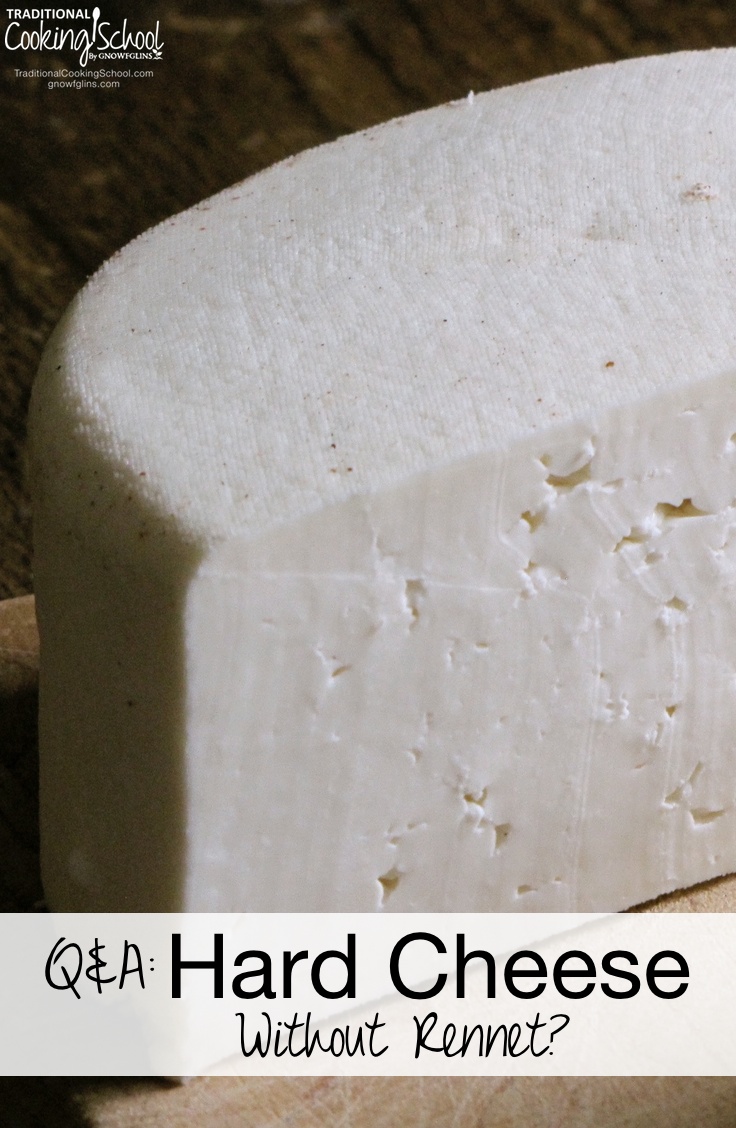
Today’s question comes from Michael Bunker, author of the book Surviving Off Off-Grid. His family’s Jersey cow is newly in milk and they’re making good use of it!
“I like to do things the old fashioned way. I learned from watching your class videos that I don’t have to buy a starter, but can use held-back clabber to make great sour cream and soft cheese.
I’ve made some awesome sour cream and soft cheeses this way. I also made the kefir balls in olive oil (free video here) — but I used straight clabbered cheese instead of kefir, and it turned out great.
So, can I make hard cheeses without rennet, too? If I hang the clabber, then salt it, press it, and age it, will it make a good hard cheese?
If I can get good curds directly from clabber, why go through the whole rennet and cooking step? Am I missing something?”
Breaking This Down
Making your own starters is fantastic. As you know, this is what you’re doing when you save clabber and use it to inoculate future batches of cultured dairy.
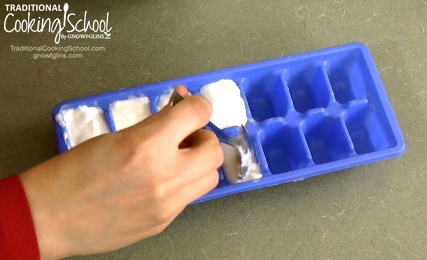
Skipping the rennet is not so easy to do. Here’s why.
Both starter cultures and rennet can achieve coagulation. But they achieve it differently and over different lengths of time.
- Starters coagulate milk proteins through acid production, over time.
- Rennet coagulates milk proteins through enzyme action, quickly.
Which method is used determines what cheese you get.
How Starter Cultures Work
As the beneficial organisms in a starter culture consume the milk sugar (lactose), they produce acid. These acids curdle or coagulate the milk.
But it takes time. For instance, clabber develops into soft curds over 2 or 3 days.
Could You Get Hard Cheese From These Curds?
In my opinion, curds formed by acid production are probably too soft for pressing into hard cheese.
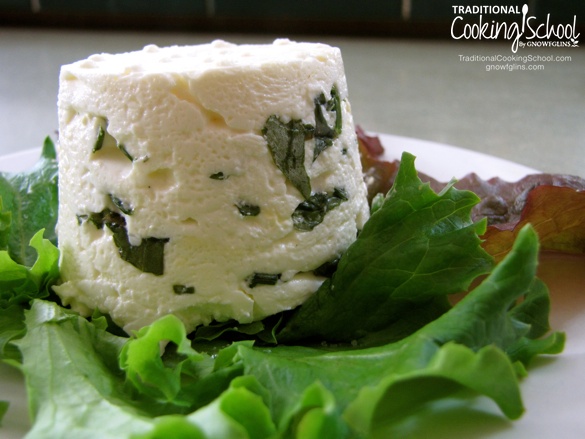
If you let the process go longer, and let the curds firm up from additional acid production, you might end up with cheese that’s too sour for your tastes — plus the cheese might be crumbly from the high level of acid.
I haven’t tested this; it is just my speculation. But you can try it, because it could end up being something you like very much!
Acid & Stretchy-Melty Cheeses
A high level of acid will be a problem when it comes to stretchy or meltable cheeses like mozzarella, queso fresco or cheddar. The acid would form the curds, yes — though they will be too soft, I think — but it would interfere fatally with stretch.
Too much acid makes the cheese break instead of stretch.
Rennet Solves The Acid Problem
Enter rennet, an enzyme traditionally gathered from the stomach lining of a calf. Today there are vegetable sources, too.
Rennet coagulates milk into curds quickly, without producing acid.
While the rennet is working (it takes about an hour in most recipes), the culturing organisms can produce the right amount of acid — instead of too much — for the stretch you want.
Some acid is needed to get good stretch, as in traditional mozzarella, but too much acid will cause the cheese to break instead.
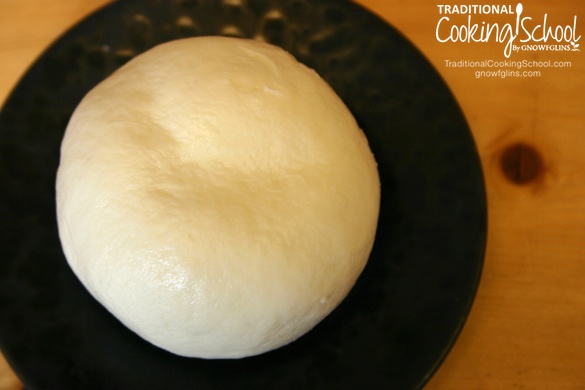
Well-tested recipes (such as in my class) tell you the right amount of time and ingredients (starters + rennet) to achieve this.
The (My) Bottom Line
So… to summarize. You need to coagulate the curds somehow. In my opinion, acid-coagulation (starter culture only) creates:
- too soft of a curd for hard cheese
- too much acid to create stretchy-melty perfection
Personally, I wouldn’t skip the rennet. Please let me know what you decide and where your adventures take you…
Be sure to check out How To Choose Rennet For Cheesemaking!
Have you ever made hard cheese without rennet?
...without giving up the foods you love or spending all day in the kitchen!

2 free books:
Eat God's Way
Ditch the Standard American Diet, get healthier & happier, and save money on groceries...
We only recommend products and services we wholeheartedly endorse. This post may contain special links through which we earn a small commission if you make a purchase (though your price is the same).


Someone recently asked me about a substitute for citric acid in cheese. any thoughts on that one? I’m new to cheese making and have just been using non-GMO citric acid.
Laurie
Laurie — I believe you’re referring to recipes (such as quick/easy mozzarella) where citric acid is added to achieve a certain level of acidity quickly at the beginning for particular results. For instance, in mozzarella, the citric acid makes the cheese stretch — thus 30-minute mozzarella.
The use of citric acid is, in my opinion, modern. Traditional recipes rely on bacterial cultures to produce acid for the desired results. For instance, in the traditional mozzarella cheese recipe of my class, we don’t use citric acid. Instead, the culture produces the acid. It takes longer, but we believe the results are better. Better flavor, better stretch. It is a little more difficult — but not terribly so, in my opinion. Our cheese is still easy — and you don’t need citric acid.
I hope this helps!
Oh, you can use nettles as some other herbs as a rennet substitute:
“To make rennet substitute from Nettles, boil a pound of Stinging Nettle with just enough water added to cover for twenty to thirty minutes. Strain off the liquid and add a fair amount of salt, what will easily dissolve as you stir it into the hot liquid, do this carefully it will be different each time. To begin with, try using 1/2 cup of this specially made Nettle infusion to each full gallon of milk.”
(http://www.homesteadingtoday.com/archive/index.php/t-370437.html)
The book Stillroom Cookery suggests nettle tops, cleavers or Jerusalem artichokes.
“Make a strong tea by boiling a handful of the vegetable coagulants in 2 cups water. After cooling I have used 1 1/2 cups of curdling tea to 1/2 gallon of milk and it worked fine”
I haven’t tried either of these methods, as I like the predictability of rennet, but I think it might work for Michael if he’d like to give it a try.
Thank you, Laurie! Great info! 🙂
I am new to kefir. I’ve only had my kefir grains for 5 days,but I am excited about the variety of things that can be made with kefir.
Dom’s kefir site discusses how to make cheese without rennet including a cheddar cheese.
http://users.sa.chariot.net.au/~dna/kefir_cheese.html#photos
Billie — Thanks! Very good info. I’ll pass it along!
I am new to cheese making and would like to know if there is a way to use an “old” cheese to inoculate a new batch. For example purchase a good quality parm and use a part of it to make my own parm?
Pat — I’m sorry but I don’t know the answer to this. 🙁
Pat… this is how you inoculate cheeses like blue and Camembert I am told. It doesn’t take a piece as such but just a scraping .
I understand Michael has, and butchers, cows. Rennet is made naturally from calf stomach (animal rennet). I’ve never done it, but that is the way it was done for thousands of years before vegetable rennet was made. I’m sure there must be something out there on the internet that tells you how.
hey guys,i also started experimenting with cheesemakeing,an came across this yogurt based cream cheese invloving putting the yogurt in a muslin or cheesecloth bag,putting that in a strainer and letting the whey seperate,great substitute, but it wasnt that close to philly,so i decided ill make actual proper cream cheese at home,only to find out i cant get vegetable rennet nearby,nor do i know about the plant extraction method or about the plants,i do have the mesophilic starter culture though,anybody know any substitutes for rennet?
cheers
I and my son moved to Bolivia and I am wanting to make our own cheese. I’m not that familiar with stinging nettle, and from my research, it sounds like I’ve been lucky! Does anyone know of other plants that I might find here in South America that I can use for rennet substitutes? I see the trackback from “Cheese’ about papaya, and there are a lot of them growing here, two trees in our own yard, but I’ve never seen any white juice from them.
Thanks for the really cool post! It answered a lot of questions I had.
Hi,
I think the fella named DOM does make kefir hard cheese without the rennet.
I have a question along those lines. He mentions straining the curds from kefir and then using the whey later for making ricotta.
1] Is the whey in your method useless for making ricotta?
2] Could the ricotta and the kefir curds in DOM’s method yield a possible hard cheese?
I love your site to BTW 🙂
I make a fabulous parmesan substitute using kefir – I just drain it, press it and then salt and dry. Its a little bit crumblier than the real thing, and doesn’t have the true parmesan smell, but it is still cultured and we love it.
I’m focusing on making low input cheeses (trying to avoid buying rennet or starter cultures etc) and find that variations of pressing and drying kefir are giving me the types of cheeses I want. I can highly recommend Doms kefir cheese site for tips.