
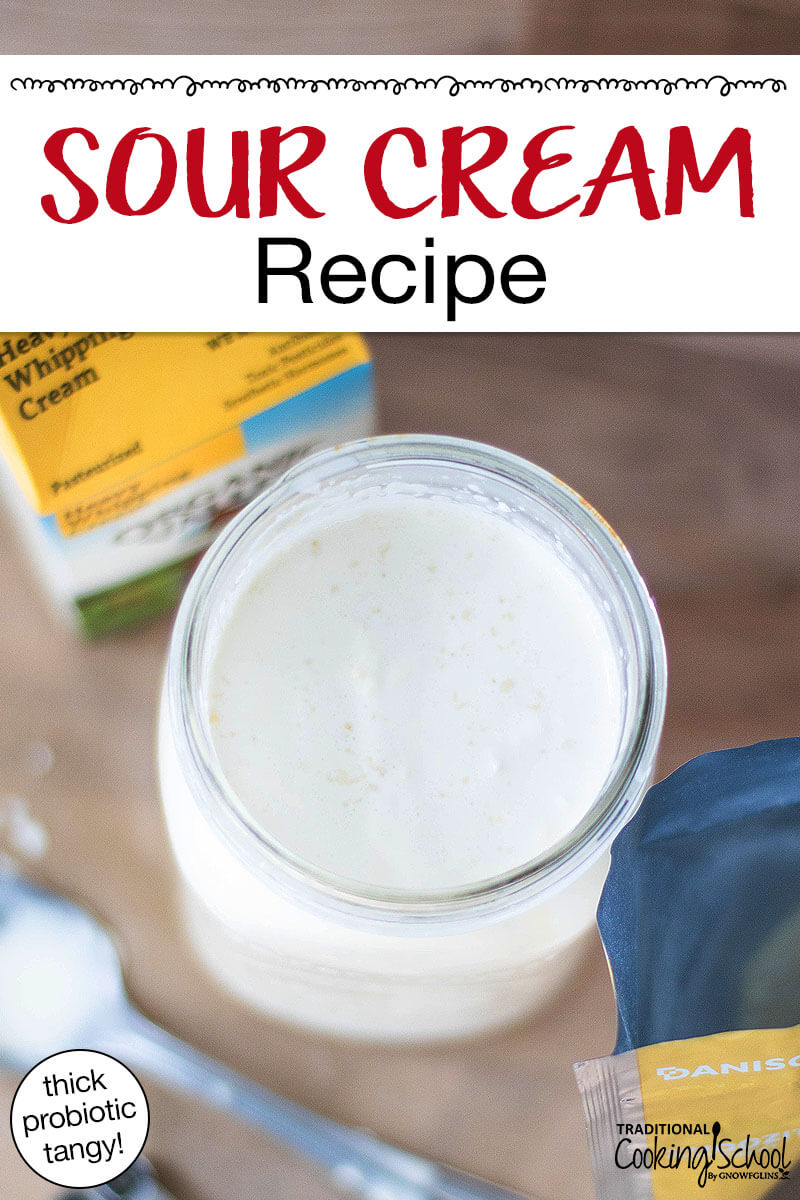
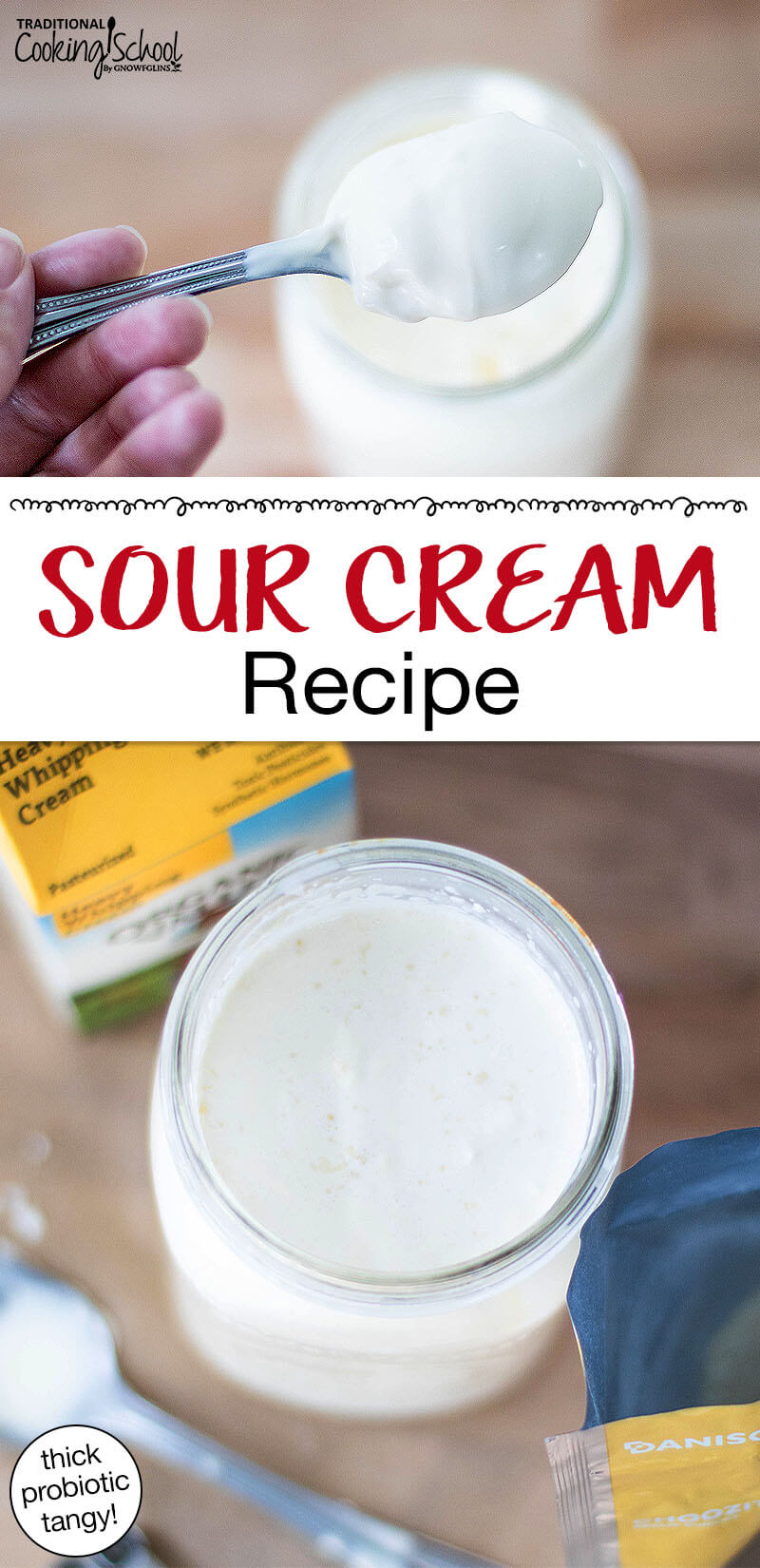
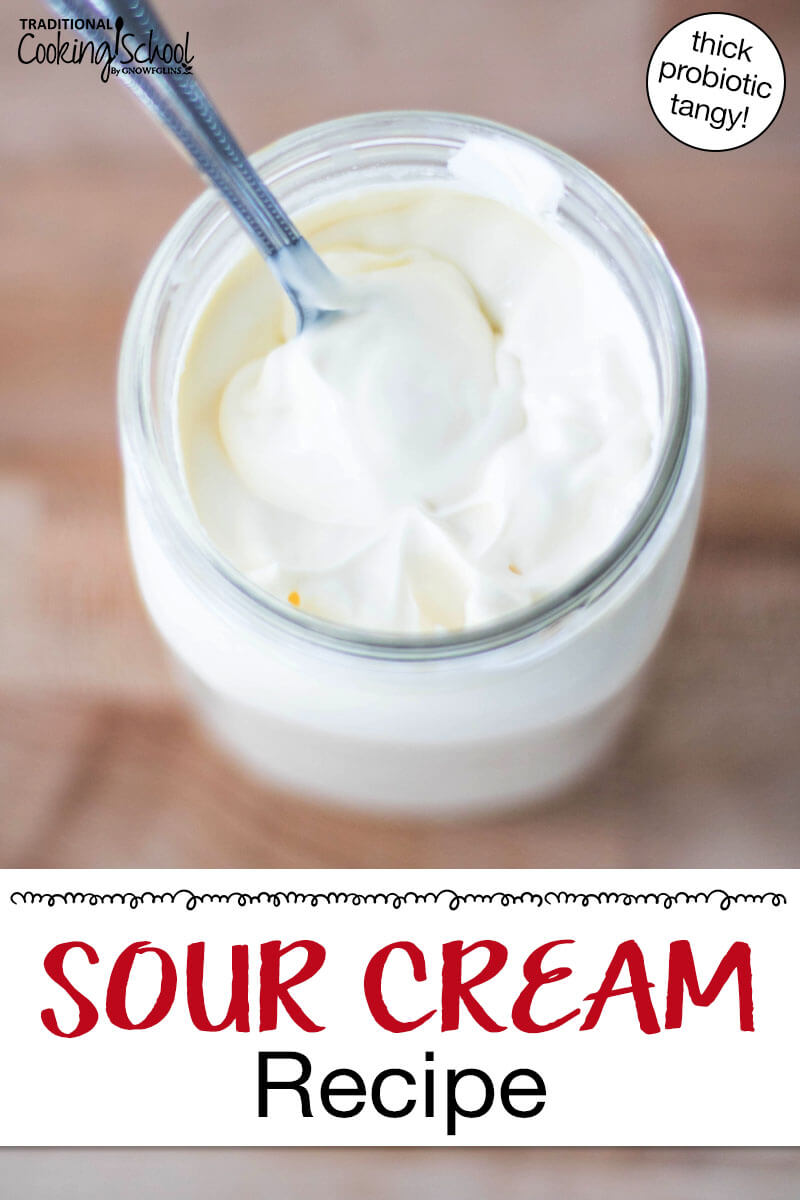
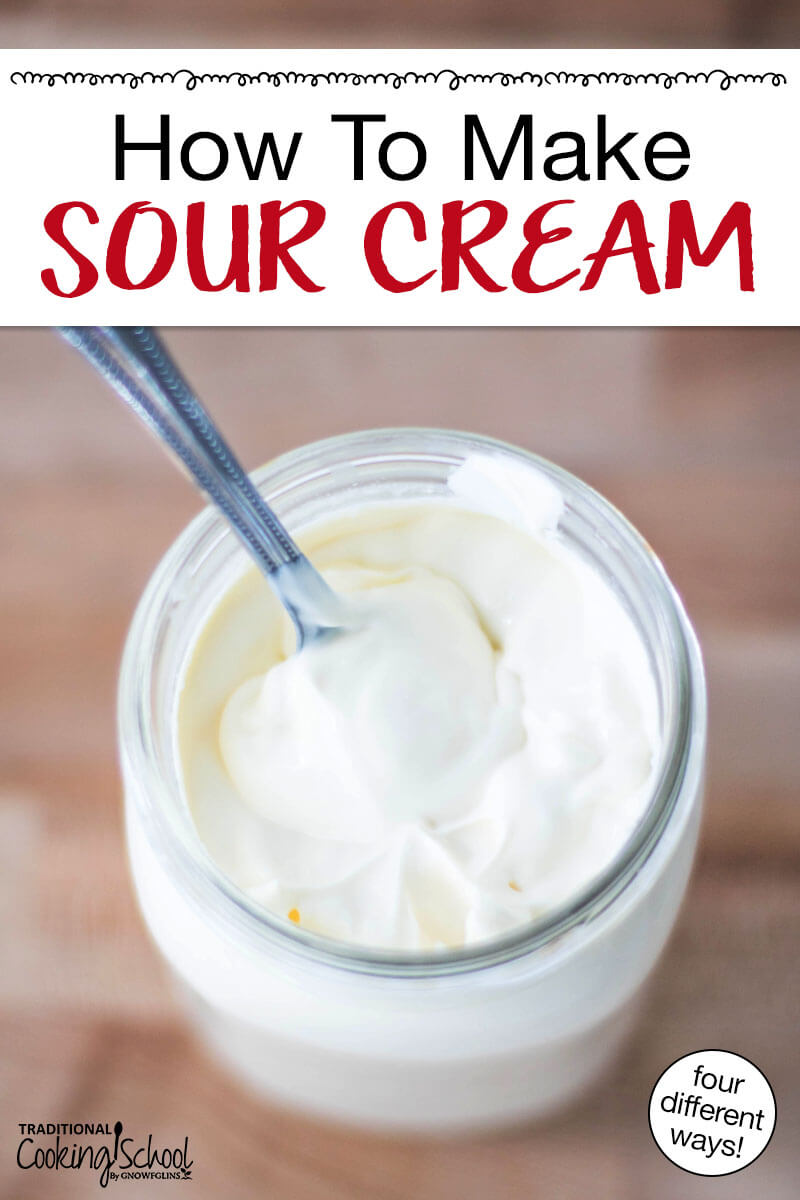
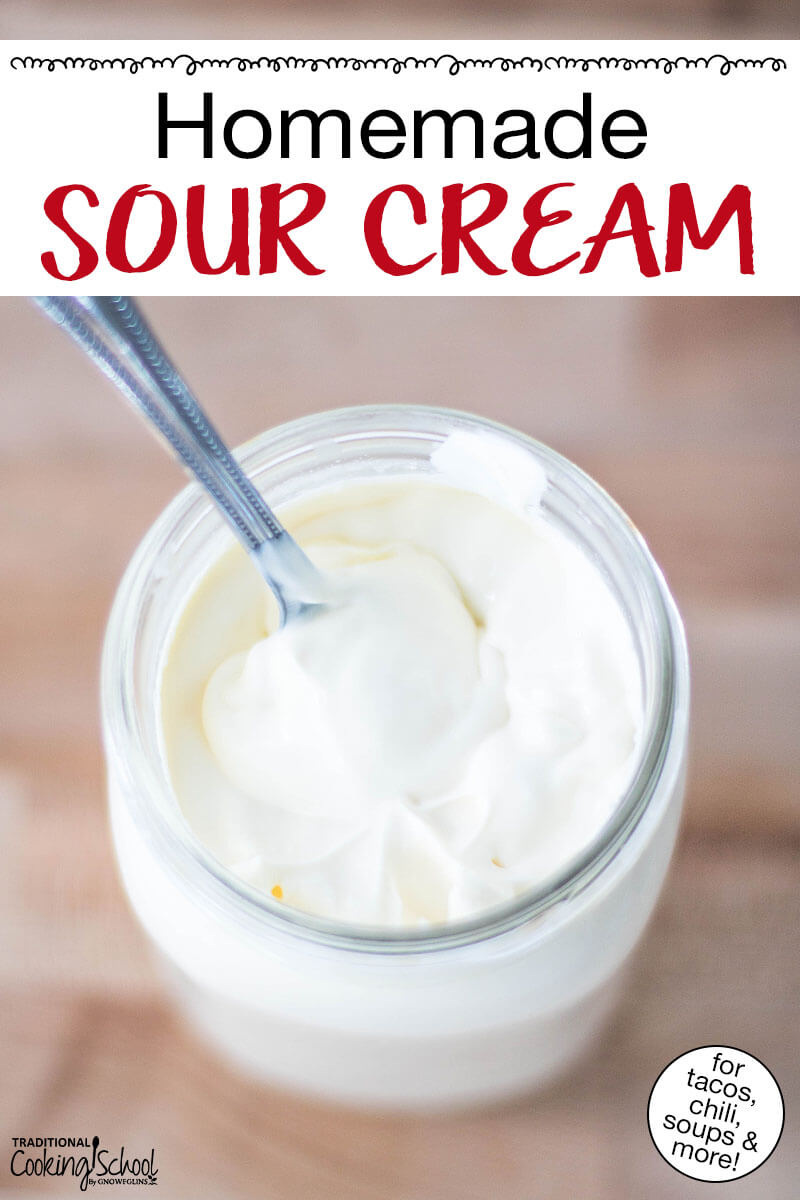
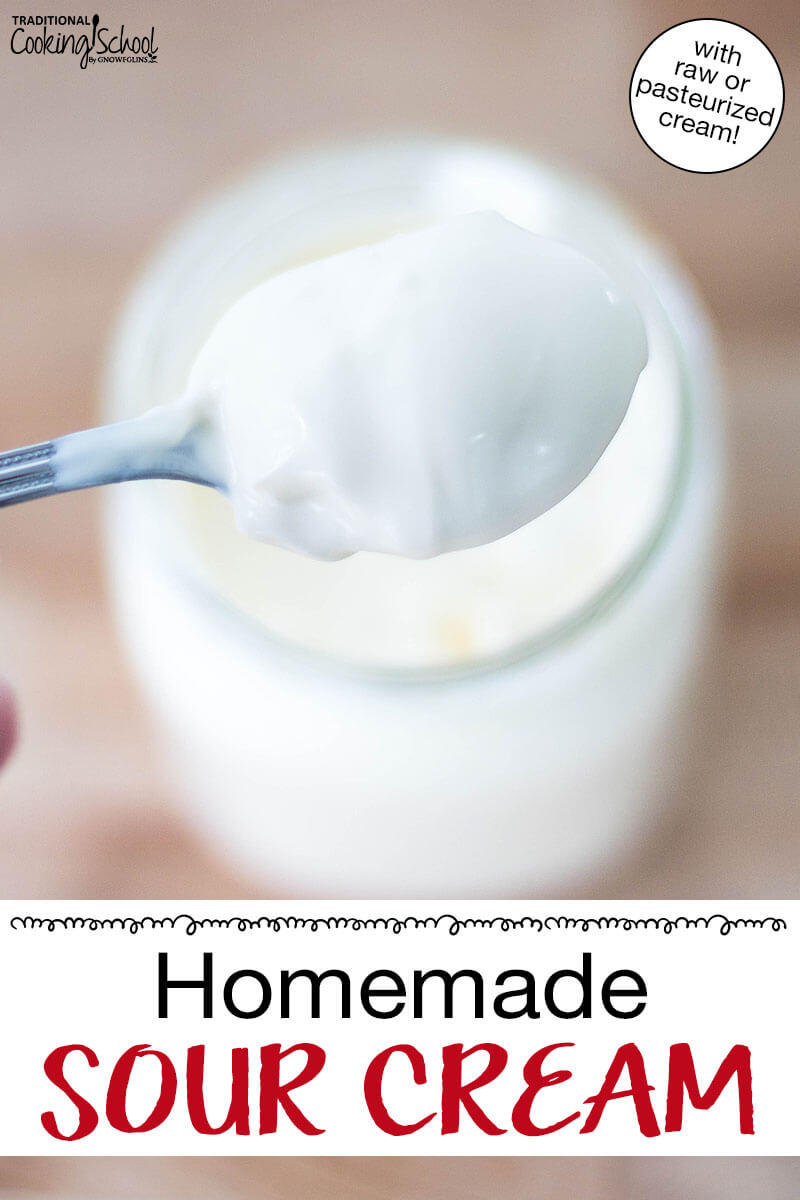
Homemade sour cream is rich, tangy, and alive with probiotics. Here’s how to make it with 5 minutes of prep time and only 2 ingredients. It’s delicious drizzled on chili or tacos, or turned into cultured butter!
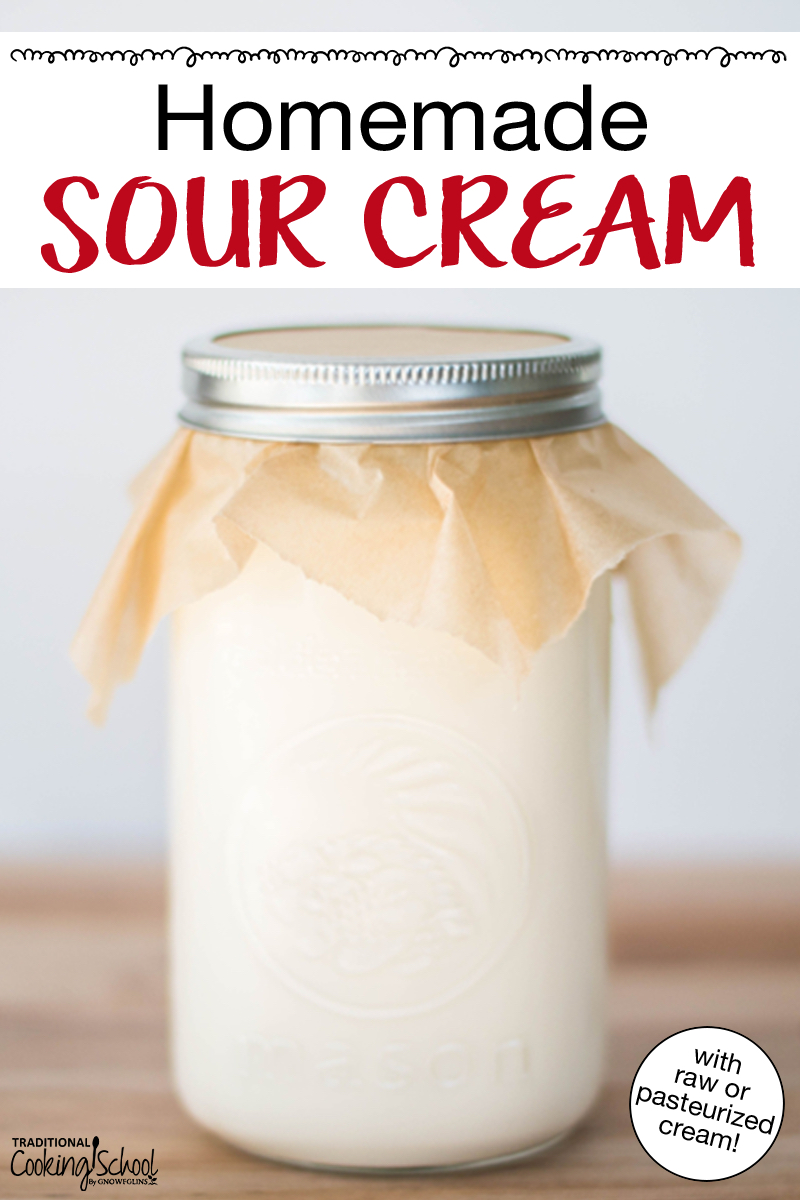
The best part of making your own cultured dairy products (soft and hard cheeses, yogurt, cultured cream cheese, milk kefir, cultured butter, and more…) is that you begin with ordinary milk or cream, and end with an indulgent, tasty food teeming with probiotics and other microflora!
Whether you start with raw milk from your local dairy farmer or pasteurized milk from the store, you’re making whatever milk you get better!
With sour cream, the name says it all — sour cream is “soured cream.” The cream has been thickened and flavored from the acids produced by the proliferating natural organisms.
Or, have you heard of crème fraîche? That’s a European style sour cream, a bit thinner than the American style of sour cream, but otherwise very similar.
Homemade sour cream is rich, tangy, and delicious drizzled on fresh fruits or soups, stews, and more!
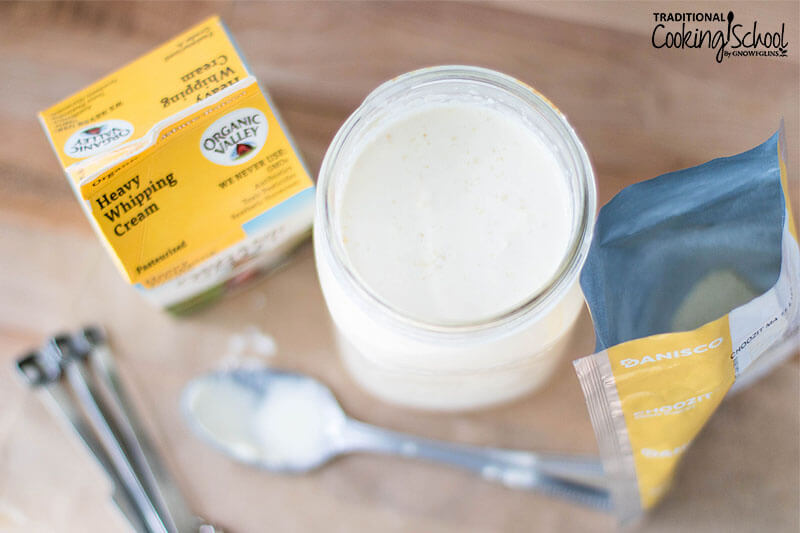
Table Of Contents
Ingredients
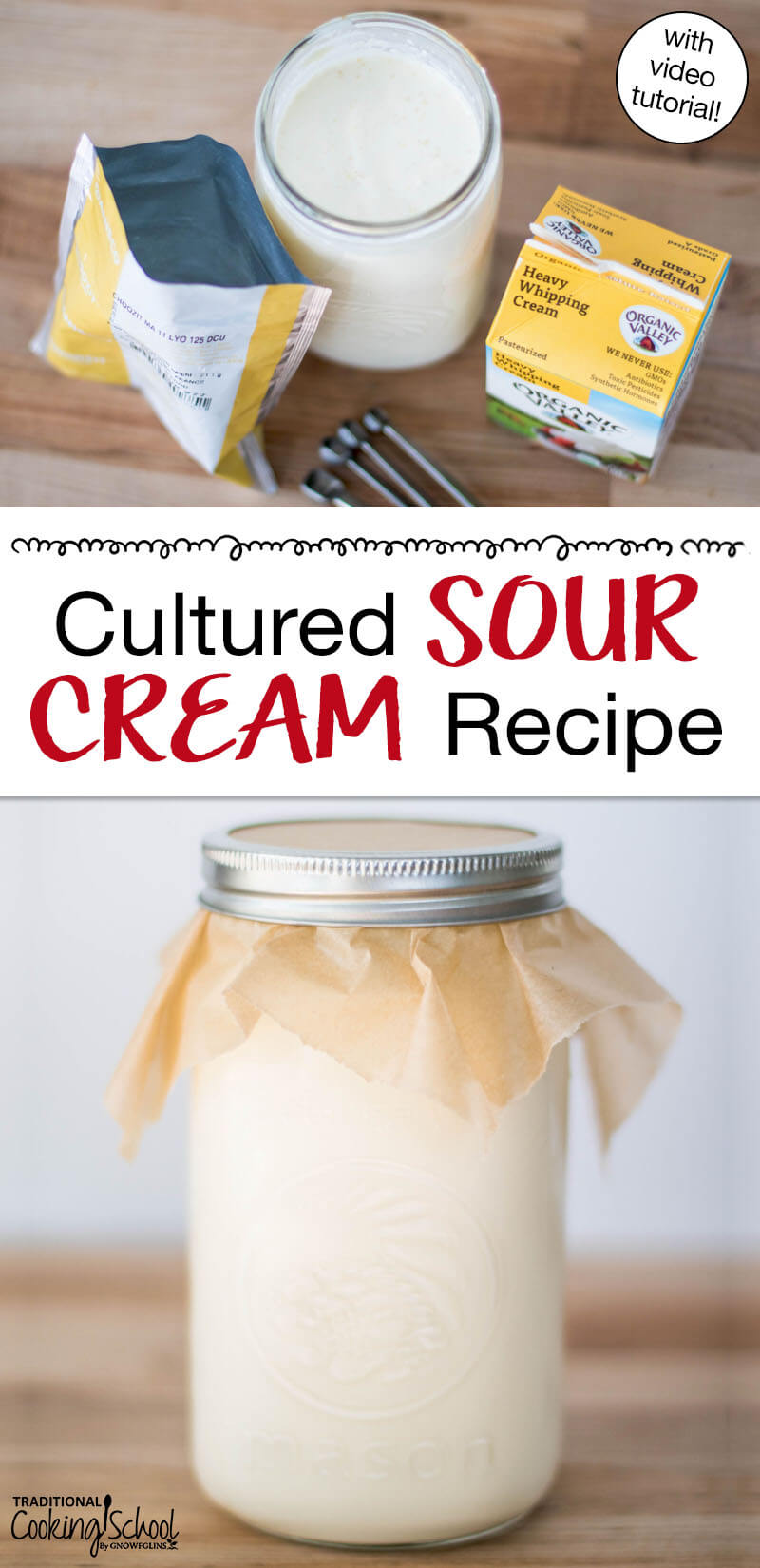
- Heavy cream – This can be raw or pasteurized, but not ultra-pasteurized. Choose the best quality you can, preferably raw cream from a grass-fed animal. Yet if this is not possible for you, remember that if you’re culturing dairy at home, you’re making whatever milk you are able to get better!
- Culture of choice – If using raw cream, you don’t have to add a mother culture (though you may choose to do so!) because the beneficial organisms in the cream will proliferate over time themselves, producing a cultured cream or sour cream. You definitely need to add a starter culture if using pasteurized cream because it contains no beneficial organisms to proliferate and/or protect against spoiling. Choose a mesophilic cheese culture such as this one, or plain yogurt, dairy kefir, buttermilk, store-bought sour cream with active cultures, or dairy kefir grains.
Supplies Needed
- Glass jars – You will need a pint-sized glass jar for culturing the cream.
- Paper towel or cloth napkin, plus rubber band – For covering the cream while it cultures.
How To Make Sour Cream
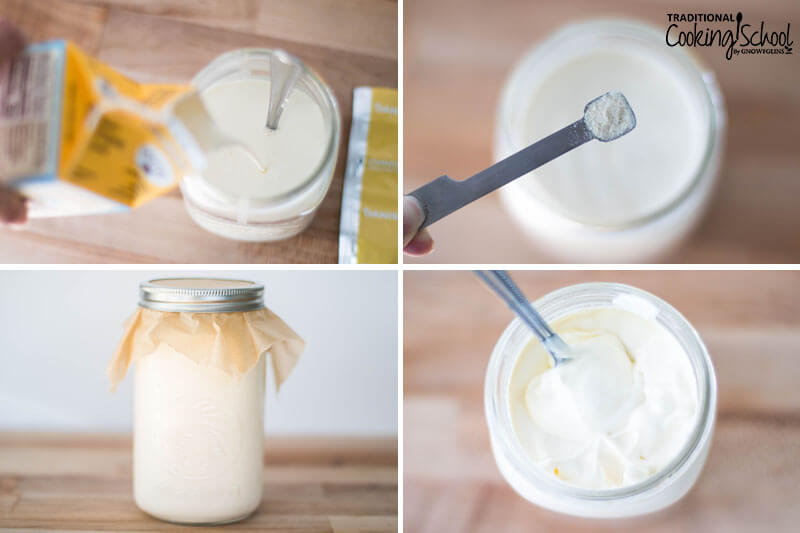
- If using raw milk and you haven’t already, skim the cream from the top. Here’s how!
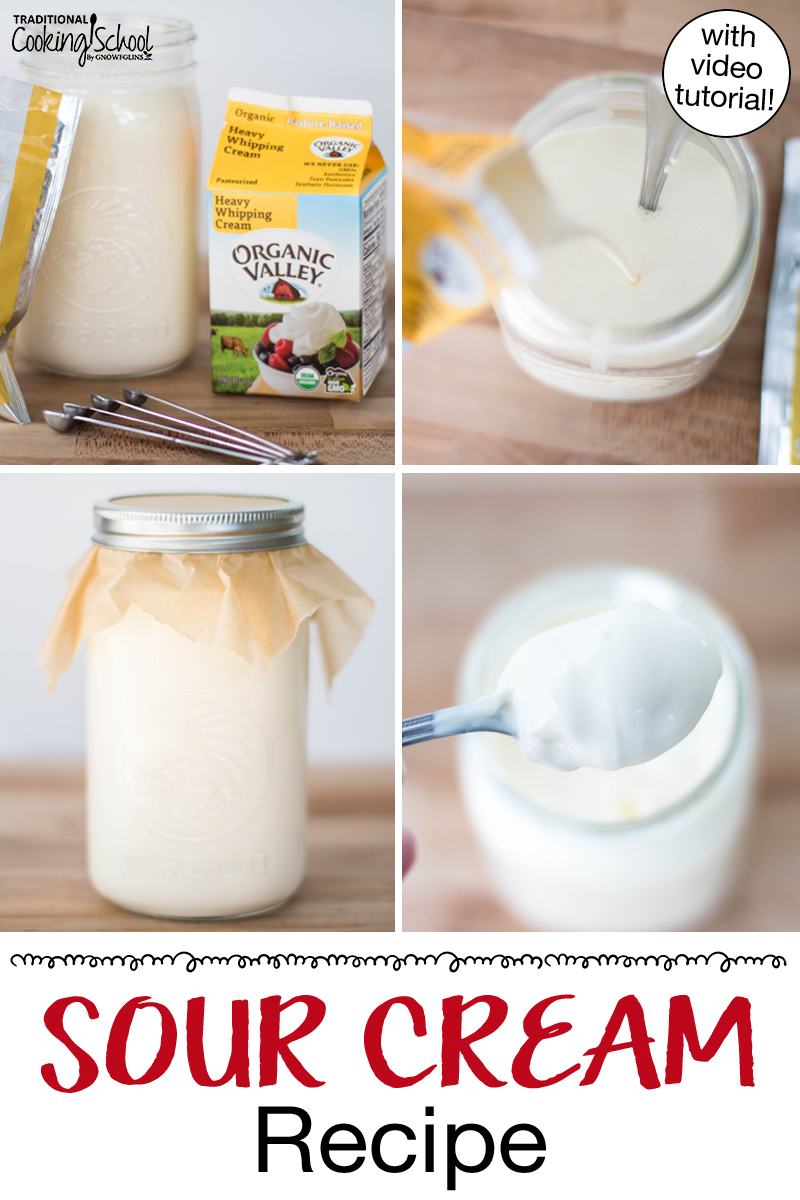
- Culture the cream, either by letting raw cream culture spontaneously at room temperature, or by adding a starter culture of your choice to a quart of raw or pasteurized cream.
- Stir the culture in well.
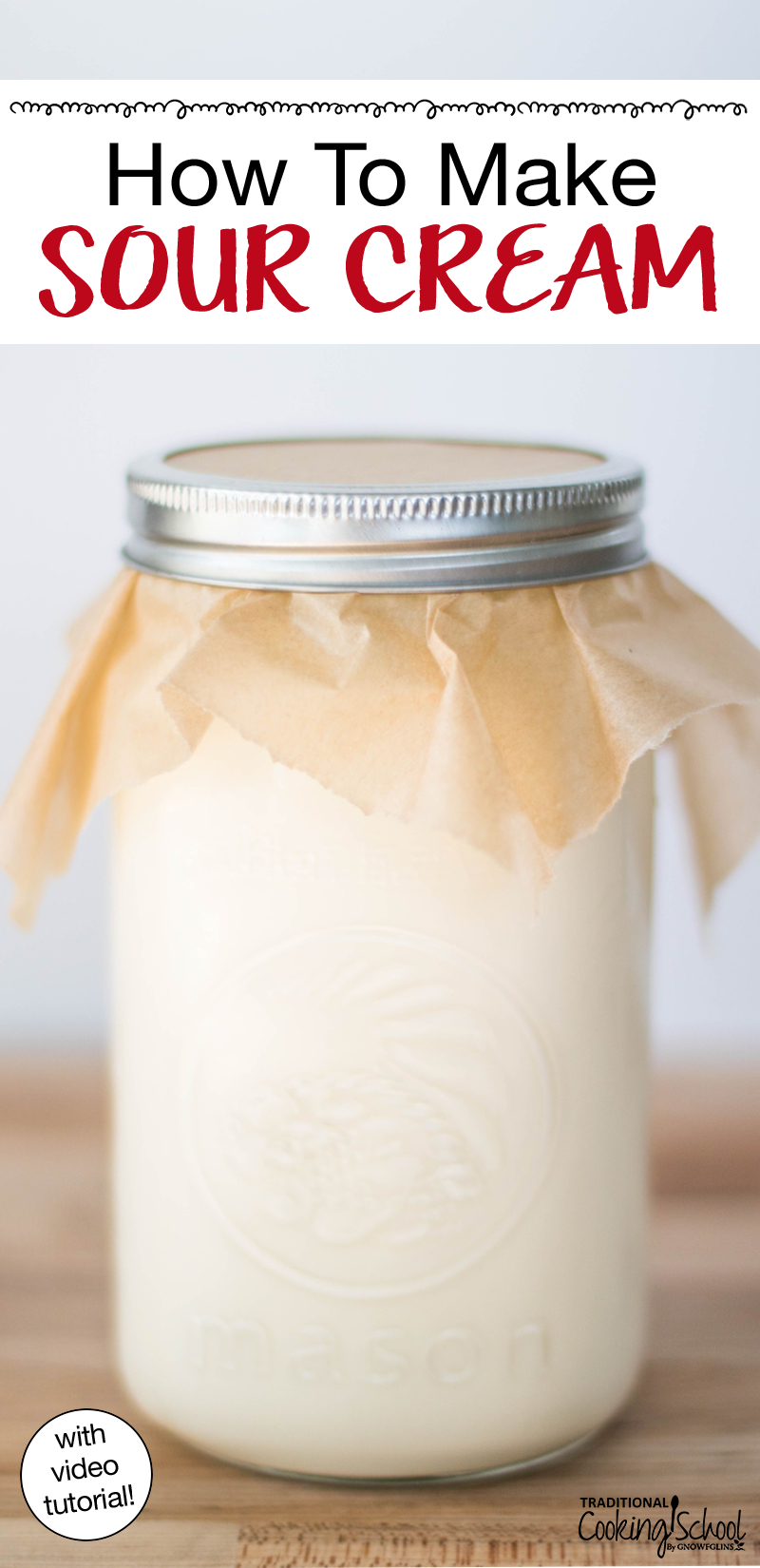
- Cover the jar with a cloth napkin or paper towel, and secure with a rubber band.
- Let the cream culture, or ripen, at room temperature for about 24 to 48 hours.
- Check every 12 hours to see if it’s set up or not. Peel back the top layer of cream to see if it is thick all the way through the jar. There also may be bubbles throughout the cream, showing that a fermentation has taken place.
- When it’s set up to a thick cream throughout the entire jar, it’s done. Cover with a regular lid and put in the refrigerator to chill it thoroughly.
Alternate Method: Clabbered Milk
By far the easiest method of making sour cream is to clabber milk first. Clabbered milk is raw milk that is allowed to sour spontaneously and thicken over time. When you clabber milk, the cream naturally rises to the top and sours as well, yielding “sour cream” once skimmed.
I recommend this method for those who enjoy the stronger, more sour flavor that clabbered sour cream has, particularly if you have a milk cow and you just need to do something with all that milk! This method is so easy and you can clabber a large amount of milk and cream at once.
Once you skim the sour cream off the top, you can feed the rest of the clabbered milk to your chickens or other animals.
In this video excerpt from the Cultured Dairy & Basic Cheese eCourse, I show you this alternate method of making sour cream.
- Start clabbered milk with raw milk that is warm from milking or at room temperature, or with pasteurized milk.
- Either let raw milk sour spontaneously at room temperature, or add a starter culture to pasteurized milk (it lacks the naturally present microorganisms to clabber by itself).
- If using, stir culture in well.
- Cover milk with a cloth napkin or paper towel, and secure with a rubber band.
- Leave to culture at room temperature for 1 to 2 days, or longer in the winter.
- Once the culturing time is over, both the cream and milk are thickened from the acids produced by the proliferating natural organisms.
- The cream has also conveniently risen to the top. Skim off the cream — it’s now sour cream — and chill.
- Compost or feed to animals the remaining clabbered milk.
Sour Cream FAQs
Do I need a starter culture?
If you’re using raw milk or cream, then no. If you’re using pasteurized milk or cream, then yes… however it doesn’t have to be dry powdered culture such as this one. You can also use yogurt, dairy kefir, buttermilk, store-bought sour cream with active cultures, dairy kefir grains, or even a previous batch of your homemade sour cream*.
The advantage to using a dry powdered starter culture is, if they are new and not degraded from being stored too hot, you can ensure a better result. Having said that, either can be used in this instance and if one option is much more economical for you, you can go with that!
*You can use your homemade sour cream to make more sour cream, however (if you use raw cream) it won’t work indefinitely. After a few (or more) times it will probably stop working and/or not taste so good. This is because of the competing cultures in the raw cream. So at that point, you can either buy fresh sour cream from the store to start the culturing process over, buy a mesophilic culture… or, if you’re a member, we do have instructions for how to make a culture that DOES culture sour cream indefinitely in our Cultured Dairy and Cheese eCourse.
Why is my sour cream thin/runny?
Depending on how long you culture your sour cream at home and what starter culture you use, you may end up with a crème fraîche consistency or a thicker sour cream. It’s all normal — and with experimentation, you will find the thickness you like!
Ideally, it would be set up for you in 3 days or less. Toss it if it’s not set up by 3 days, and if you didn’t use a starter culture this time, use one next time.
My sour cream tastes or smells funny. Why?
I’m sorry to hear that! It would have do with the original cream and its quality and/or age. Try to find a high-quality source of fresh raw milk, if possible, and use a starter culture to ensure better results next time.
How long will my sour cream be good for?
The sour cream will continue to “age” in the fridge after culturing. For the best flavor, it is best to eat within a week or two.
After that, it is not necessarily bad, because it has the protection of the culture, but some people don’t care for the stronger taste that develops. I don’t have a rule of thumb for the expiration date because it does depend on many factors, one of which is personal preference.
How to store sour cream: can I freeze it?
Yes, you can freeze it. Store in the refrigerator for up to two weeks, or freeze in a zip-top bag for long-term storage.
The consistency might not be as smooth and creamy once it is thawed, but especially if you’re using it in baked goods, this won’t matter.
How to use sour cream.
There are so many ways to use sour cream!
- Drizzle on fresh fruit.
- Make lemon sour cream for dolloping on salmon patties.
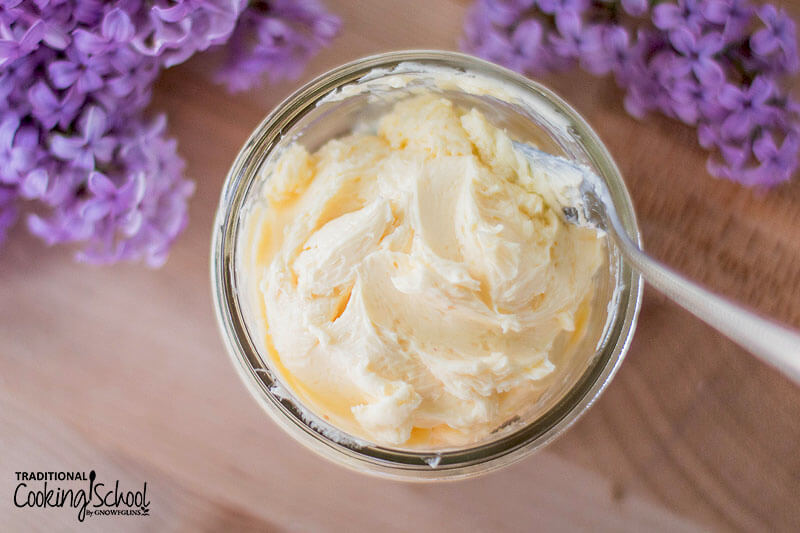
- Turn it into cultured butter! (pictured above)
- Whip up a batch of salad dressing, like this one or my favorite ranch dressing.
- Make potato salad or cauliflower potato salad.
- Dollop onto chili, tacos, enchiladas, quiche, etc.!
- Add to beef stroganoff.
- Use as the acidic medium for soaking overnight blueberry scones.
Other Cultured Dairy Recipes
Sour cream is just the tip of the iceberg when it comes to cultured dairy, and we’re adding more recipes to the TCS blog all the time, so click here to browse our Cultured Dairy archives! Here are a few of our favorites…
- The ULTIMATE Milk Kefir Guide (how to make it, troubleshooting tips & MORE!)
- How To Make Thicker Milk Kefir
- Cultured Cream Cheese (+5 flavor options!)
- How to Make Raw Milk Mascarpone: Soft, Probiotic Cheese
- How To Make Cultured Butter
- Compound Butter {Butter Gets Dressed Up!}
- How To Make Homemade Buttermilk + 5 Buttermilk Substitutes
- What To Do With Soured Cream?
- Homemade Cottage Cheese From Raw Goat Milk
- Trim Healthy Mama Fuel Pull Cottage Cheese {homemade}
- Middle Eastern Kefir Cheese Balls {with free video!}
- What To Do With Soured Cream?
- Homemade Raw Cheddar Cheese
- Fermenting Trouble Shooting FAQ’s
For the very best of our cultured dairy recipes, including video tutorials, be sure to check out our Cultured Dairy and Cheese eCourse. I show you how to make the Middle Eastern cheeses of my childhood: salty, savory, and usually served with a plateful of other Mediterranean goodies (like pickles, olives, pocket bread, hummus, or eggs). Mmmm!
Did you make this homemade sour cream recipe? If so, please give us a rating on the recipe card below. Then snap a photo and tag us on social media so we can see how you enjoyed it!
Sour Cream
Homemade sour cream is rich, tangy, and alive with probiotics. Here's how to make it with 5 minutes of prep time and only 2 ingredients.
Ingredients
- 1 pint heavy cream raw or pasteurized
- 1/8 teaspoon mesophilic cheese culture or 1/8 to 1/4 cup store-bought plain yogurt, buttermilk, or sour cream with active cultures; or dairy kefir grains
Instructions
-
If using raw milk and you haven't already, skim the cream from the top. Here's how!
-
Culture the cream, either by letting raw cream culture spontaneously at room temperature, or by adding a starter culture of your choice to a quart of raw or pasteurized cream.
-
Stir the culture in well.
-
Cover the jar with a cloth napkin or paper towel, and secure with a rubber band.
-
Let the cream culture, or ripen, at room temperature for about 24 to 48 hours.
-
Check every 12 hours to see if it’s set up or not. Peel back the top layer of cream to see if it is thick all the way through the jar. There also may be bubbles throughout the cream, showing that a fermentation has taken place.
-
When it’s set up to a thick cream throughout the entire jar, it’s done. Cover with a regular lid and put in the refrigerator to chill it thoroughly.
Recipe Notes
Use sour cream as a topping for tacos, soup, salmon patties, and chili. It even makes the best cultured butter!
...without giving up the foods you love or spending all day in the kitchen!

2 free books:
Eat God's Way
Ditch the Standard American Diet, get healthier & happier, and save money on groceries...
We only recommend products and services we wholeheartedly endorse. This post may contain special links through which we earn a small commission if you make a purchase (though your price is the same).




I tried this one time (saw it someplace else), and it all ended up tasting like stinky feet… I don’t have a cow, so I started with refrigerated raw milk from a local Grade A for raw dairy. Any ideas what went wrong?
Alice — Clabber isn’t predictable. The best results come from totally fresh raw milk. Yours may not have been fresh and competing organisms affected the flavor.
I get raw milk from a local farm and would love to make our own sour cream, but I don’t want to ‘waste’ the soured milk on my chickens or cats (if the cats would even have it.)
What else could I use the skimmed sour milk for? Being skimmed, I don’t think I’d want to use it for yogurt. What about as a substitute for buttermilk in recipes like pancakes?
Julie — Baking is a great use for skimmed sour milk. Or anywhere you see yogurt or kefir called for. You can add it to smoothies or salad dressings, which would be good actually because you can add coconut oil or some fat to make up for it being skimmed.
Sour milk is wonderful in pancakes and any baking that requires milk. I use my homemade kefir and also my sour milk in my baking. And to answer another question, yes, your pets will love it!
Clabbered skim milk can be used to make low-fat cottage cheese, too. Cut the curd (optional), warm curd double boiler style, very slowly. In about an hour, the curds will firm up and there will be more whey. Strain through cheesecloth for about 2-3 hours. Break up curd, salt. Optionally, mix in a couple tablespoons of cream. Play around with options til you get it like you like it. Inspired by the Little House on the prairie cookbook.
I discovered this the first time I tried clabbering whole milk. I had a half-gallon jar almost full, with a mason lid just resting on top (not screwed down). The cream made a thick plug (with lots of bubbles in it) and lifted the lid right off by about 2 inches!
Elizabeth — That is SO funny! 🙂 What a surprise that must have been!
How long is spontaneously soured cream generally good in your opinion? I have some cream that got a little lost in my fridge for a while:) It seems fine to me but then I am second guessing myself because I know it has been a loooong time!
Angelia — It is probably still good. You can trust yourself on that. Anyway, if it had some mold at the top, you can usually skim that off and still use what’s beneath. 🙂
You mentioned filtering the milk when you bring it in. How do you do that?
Kara — I put a gold coffee filter in a wide mouth funnel and set that on top of my jars. I pour the just-milked milk through that setup into the jars.
Hi Wardee
What is the purpose of filtering the raw milk before you make the sour cream. What would happen if you skipped this process. Just wondering…
Hi Deb,
Wardee filters the milk after milking to remove any debris that may have fallen in during the process. If you are getting your milk from a farmer or dairy this process will already have been done.
Millie
GNOWFGLINS Support Team
I wish I could do that with goat’s milk but after that amount of time the milk is very goaty. I am really thinking about getting a cow next year. I will still keep my goats for my daughters 4H but I sure would like cow’s milk again. Thanks for sharing :).
Mona — Goat’s milk won’t really separate like this, at least not in 1 to 2 days. But you might get a little layer of cream at the top. 🙂
So we raise our own milking goats and I have tried doing the clabber thing and its not working is that because goats milk wont “clabber”? Can I still eat the sour cream on top??
Wardee, I have been working through your cultured dairy e-course for a while now and I had so much fun. But only just recently was I able to get raw milk. So my question, after the milk and/or cream is soured or clabbered, when does it really get bad, or is bad for you?
Barbara — It doesn’t really get bad. It gets strong, and too strong for most people. At the top surface there may be mold growing. You can skim that away and usually underneath is fine.
Souring is a continual process. Over time, the dairy sours more. Occasionally, you’ll have spoiling, but usually people don’t like it rather than it has gone bad. 😉
I’m just working through your eCourses at the moment, hope i’m not repeating something you already mentioned somewhere.
Clabbered milk is used in Germany to make a traditional milk product called Quark. Thats how its traditionally done, without any added cultures: After skimming off the cream, just leave the fresh milk in a clean covered jar to ferment on the counter(1-3 days)( your clabbered milk), once it’s thick, pour it into a cheese cloth and hang it to drip dry over night in the fridge. Stir it well to make it smooth and silky, then fill it in clean jars.
The aimed for consistency is thick, but not dry like cream cheese. It’s much milder than Kefir cheese and offers itself for many uses.
We make Herb quark, mix in chopped fresh herbs with pepper and salt, serve it with cooked potatoes or rice- very tasty( or use dry herb salt)! Or we just spread it on our bread with honey, or served with mashed bananas and honey is very nice too as a desert for the kids. Or use it in a recipe for baked cheese cake.
Thanks for sharing all your knowledge Wardee!
Nina — Thank you for sharing about Quark! I love hearing stuff like this, especially when it is a personal experience. 🙂
Nina, I have a couple questions. You’ve skimmed the cream from a half gallon or so of fresh milk and let your skim milk sour on the counter? Do you have whey on the bottom and the “cheesy” material on top becomes quark?
yeah i do the same as nina does and i make it into cheese.and i use it as cheese that i spread on toast or chappatis(whear flour breads) or i use it with herbs.
Okay, I have some milk in my fridge that is just over a week old. It’s too sour to drink at this point (I tried) but I don’t want to waste it. Would this still work out okay if I skimmed the cream off…? I’m wanting probiotic sour cream to make ranch dip. Or, since it’s already souring some, would it not taste so good? I have not made my own sour cream before and I am not a huge fan of cultured dairy products as it is. But since my son and I have decided to start eating ranch dip with veggies I wanted to make my own so we could have good probiotics in it. Any thoughts on this? Worth a shot?
Kate — Yes, you can. Just skim it off and that’s your sour cream. The only thing is whether you like the flavor or not. If you don’t, it still might work in dressing w/ the other ingredients to mask it. Or you might love it!
As I mentioned in a previous comment, clabber is unpredictable and it is best when you start with fresh milk. BUT, I have often used sour cream from older milk and we like it.
I am new to this working with raw milk. I let 3/4 a gallon sit on a open shelf for 1 week as my house is usually around 65 degrees. Only in the evenings do we reach 70 degrees. When I took my milk off the shelf, it had separated into milk on bottom, whey in the middle, cream on top. It did have alittle mold in one spot so I removed it before I worked with the milk. I removed the cream on top and put it in a dish. Then I ladled out as much as possible. (I had this in a gallon jar.) Then I ladled out the milk that was also thick, into a linen dish towel in a bowl. I let the cream and milk in separate bowl drain. That gave me additional whey. My question is what is the remainder milk/cream product called, and what can I do with it???
Hello. I am new to using raw milk. If I want to drink the skimmed milk should I let it sit in the fridge to seperate and then skim the top for sour cream or butter and then just keep the milk for drinking?
Yes, you can do that. 🙂 In the video above, I let the milk and cream sour together, then skim off the cream. However, this means the milk is soured, too. If you want to keep the milk for drinking, you’d skim cream beforehand.
I buy a gallon raw milk from a nutrition store. Once I get it home it only stays sweet for a few days before it starts to sour. There are times that I haven’t had chance to finish it and (because I heard raw milk never goes bad) it has sat in the fridge for many, many weeks in a glass ball jar. It smells and tastes so sour that I’m sort of afraid to use it. Is it really ok? Does it matter if the milk has soured naturally on the counter or soured in the fridge? When is it TOO bad to consume?
How long will the clabbered milk last in the fridge and do you need to warm the milk if it has been in the fridge before culturing?
I’ve kept clabbered milk for a quite a while in the fridge– maybe a week or a little more. It’s a great way to extend the life of the milk. I don’t warm my milk, I remove it from the fridge and set it to clabber. Super easy!
I’ve tried culturing our raw milk but it always separates and smells terrible! Ive tried kefir and yogurt, but I think our house gets too warm (up to 85 when the stove is on). I’ll try sour cream though, I just hate wasting milk.
I love making sour cream by using 3 parts cream mixed with 1 part cultured buttermilk to get it going: leave overnight to culture and you have sour cream on top and buttermilk you can use again for a start, on the bottom.
I love this easy method Wardeh shared, too, but the flavor is amazing and consistent with a buttermilk start.
We LOVE making glaze using this sour cream and brown sugar: aMAZing on cinnamon rolls or as a fruit dip.
I’ve seen several people mention their raw milk only lasts a few days. This I don’t understand. I have a herdshare in a local Jersey dairy. I pick up my gallon once a week, but if I go away on vacation for 10 days, the milk is still fresh for another 2 or 3 days, and it is sweet. I do keep my milk on the bottom shelf of a refrigerator in our garage that is only opened once a day or so, so the temp remains constant, but I’ve drunk 14-day-old milk and found it still sweet. The dairy has a good refrigeration tank, which may be the secret.
é
My raw soured cream tastes nasty. If I would use sour cream as a starter, would that make the soured cream taste better?
I love using cultured buttermilk as a starter for sour cream: the flavor and texture is amazing. I use 3 parts cream and 1 part buttermilk and let it sit at room temp for 12 hours+/-
The buttermilk sitting under the sour cream will be thick like yogurt, but is delicious and can be re-used for your next batch of sour cream.
So is this cultured buttermilk what we could buy in the store? And we could keep using it over and over to make more sour cream? Or is it like yogurt that needs to be renewed every 5 batches or so to keep making the yogurt (or sour cream!)?
Thx!
Hi Helene, if you are using cultured buttermilk from the store you want to make sure that the container says live culture in order to inoculate your sour cream. You probably need to renew the culture every few batches to keep it thriving. ~ Vicki, TCS Customer Success Team
We buy raw milk from the Amish and its already chilled. Can you still do this?
Yes! Just let it come to room temperature. I use a starter culture for more consistent results and just mix them together and let ferment.
THANK YOU for posting written instructions, too. Not everyone can watch videos. <3
Now if I only had a cow…or at least access to raw milk.
What little sour cream that I use, I will just by at the food stores.
Where I live in the USA, there are two brands of sour cream that have live active cultures – Daisy and Great Value. I live in a rural area with few options, so someone in another place may have more and healthier options. Always read the label to make sure you’re getting the real stuff not the artificially soured cream that has a bunch of unhealthy additives (that make it taste bad, in my opinion).
Gig
THANK YOU for this!!
Minnesota bans regular people– who don’t own cows– from buying raw milk from dairy farmers 🙁 … so stupid…we grew up on “raw milk” when my uncle was a dairy farmer.
I will have to try this with my goats milk and see if it works. If it doesn’t chickens just get more yummy food!!!
@Deanna, you should look into milk share programs
Terra Collinsworth Beresford
Will gently pasteurized but not homogenized milk work?
Do you milk by hand or use a milking machine?
Is it at all possible to make sour cream from pasteurised milk? We have no access to raw milk at the moment, only shop bought pasteurised.
Thanks
Hi. I was hoping you might be able to send me links to your dairy video’s/blogs/articles? I am getting two dairy-goats in a couple of weeks, and while i make my own yogurt and soft cheeses, I realyl want to learn all the different things I can do with milk so as not to waste it. I have made butter before, and it was good, but I know I can do better with practice.
I know that often-times ‘cultured’ milk is used for making butter, how do I do this? do I let it sour first?
I know that to get any decent amount of cream out of goat-milk I have to get a seperator.
I am just bubbling over with questions.
Thanks
-Kasey
Sour cream sweetened to taste with BROWN sugar makes the easiest, tastiest frosting/glaze/fruit dip ever. Amazing on cinnamon rolls and super fast to make. 🙂
Thanks for sharing your ideas!
I wish this was for non-dairy sour cream since I am highly allergic to milk, cow, goat, you name it. That is one of the few things I haven’t found a suitable recipe for or any worth eating in the store. Oh well!
Wonderful recipe