
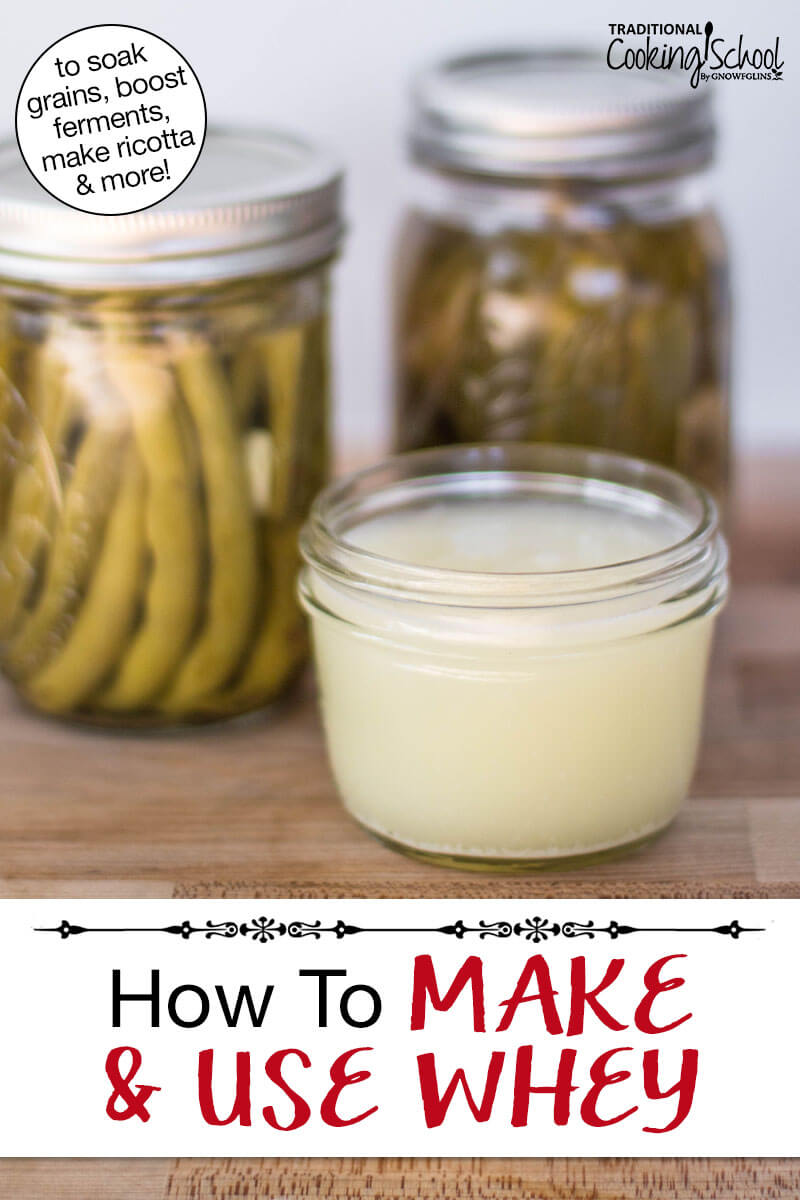
Probiotic, liquid sunshine, whey is fermenting gold! We call for it in many of our favorite recipes, from zingy fermented mustard to homemade muesli. You can even use it to soak grains! I’ll walk you through the process of how to make whey, which forms will work for fermenting, and uses for whey!

Table Of Contents
What Is Whey?
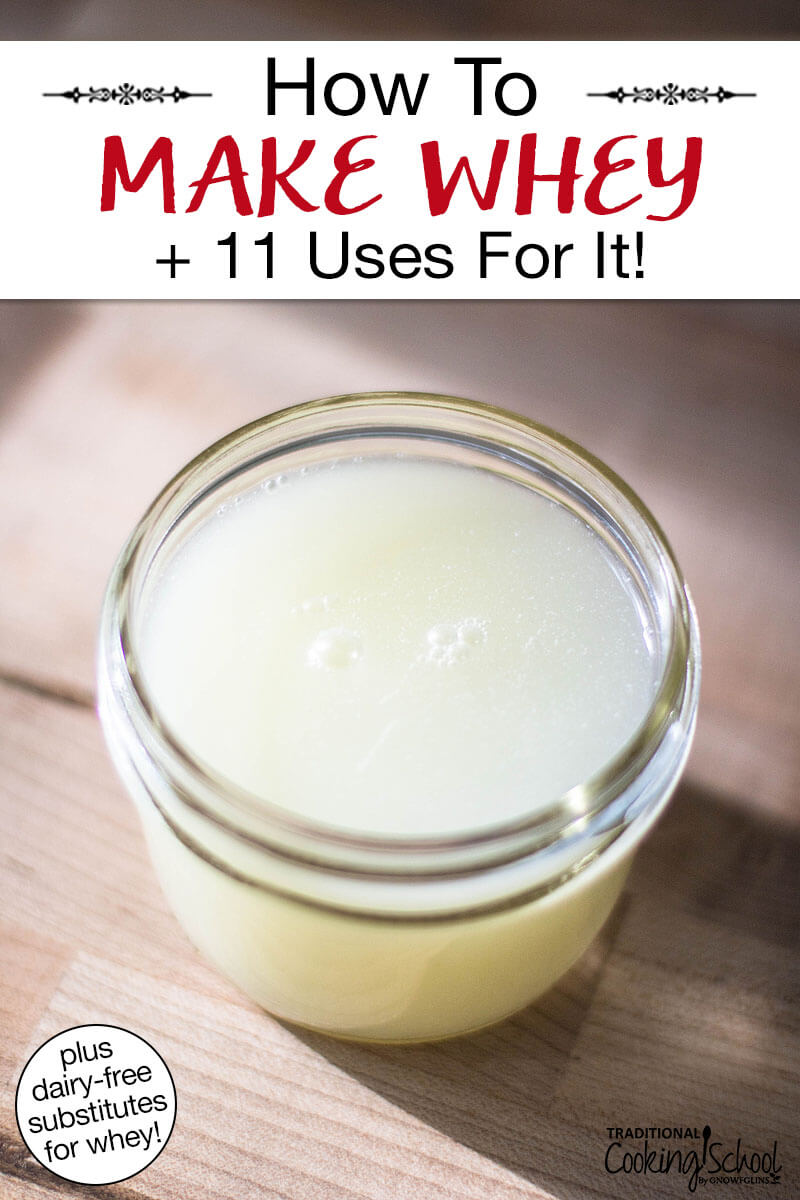
Whey is the yellowish liquid that drips out of fermented (cultured or soured) dairy — whether that be homemade yogurt, kefir, sour cream, buttermilk, clabber, chevre, or other cheeses (like raw cheddar cheese).
Beneficial organisms proliferate throughout dairy, consuming the milk sugar (lactose) and producing acids that curdle the milk. This souring can progress so that the milk separates into distinct curds and whey, or you can press or hang the curds so that the whey spills out.
Whey is mostly water, with dissolved protein, probiotics, beneficial acids, enzymes, vitamins and minerals, too.
Why Use Whey In Fermentation?
Quite often, we inoculate a fermentation at the beginning with a starter culture (a colony of beneficial organisms). This kick-starts the fermentation and prevents spoiling organisms from getting a foothold.
Whey is quite often chosen as a starter culture (but there are others; see below), so it is important that it contains beneficial organisms. Some whey does, and some does not.
Types Of Whey: Acid Whey Vs. Sweet Whey
Whey can be sweet (from rennet-coagulated dairy, which includes most hard cheeses) or acidic (from dairy that’s been thickened by the acid produced by fermenting organisms, like yogurt, kefir, clabber, or sour cream), and salted or unsalted. It is usually unsalted, but we do get salted whey off cheeses later in the cheesemaking process when it spills out after the curds are salted.
These types of whey can be used in fermenting — as long as they are raw.
Sometimes people make cheese at high temperatures or heat dairy after it is fermented. Whey from this dairy is no good because the beneficial organisms have perished.
Anytime you’re wondering if a certain whey will work, ask yourself this question: from the time the milk was cultured, was it heated much beyond 100 degrees (or so) Fahrenheit?
If yes, you can’t use it as a fermentation starter culture. If no, you can use it as a starter culture because it retains beneficial organisms.
Most of my cultured dairy and cheese recipes don’t go over 102 degrees Fahrenheit — and most of these stay around room temperature — making their whey suitable for fermentation.
Finally, the highly processed whey protein powder that is sold as a nutritional supplement is not the kind of whey we would use in fermentation (nor is it a real, whole food).
How To Make Whey
Below is a video and recipe excerpt from our Lacto-Fermentation eCourse.
Ingredients & Equipment
- Cultured dairy product – To make whey, you will need to drip it out of a cultured dairy product, preferably raw. Yogurt, kefir, and soft cheese will all work. You may use store-bought kefir or yogurt too, as long as they have active cultures.
- Cheesecloth – You will need two pieces of 90-count cheesecloth or a pillow-case weight piece of cotton cloth.
- Colander inside a pot or bowl that holds it – To strain out and catch the whey.
Instructions
-
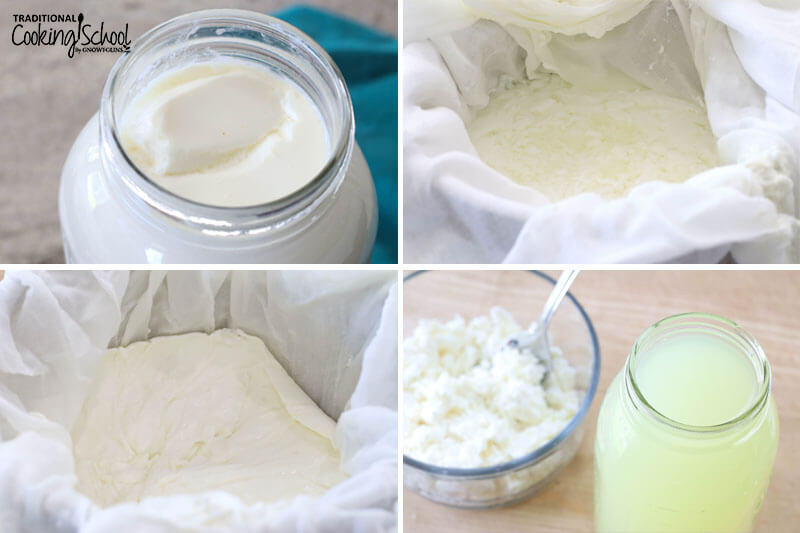
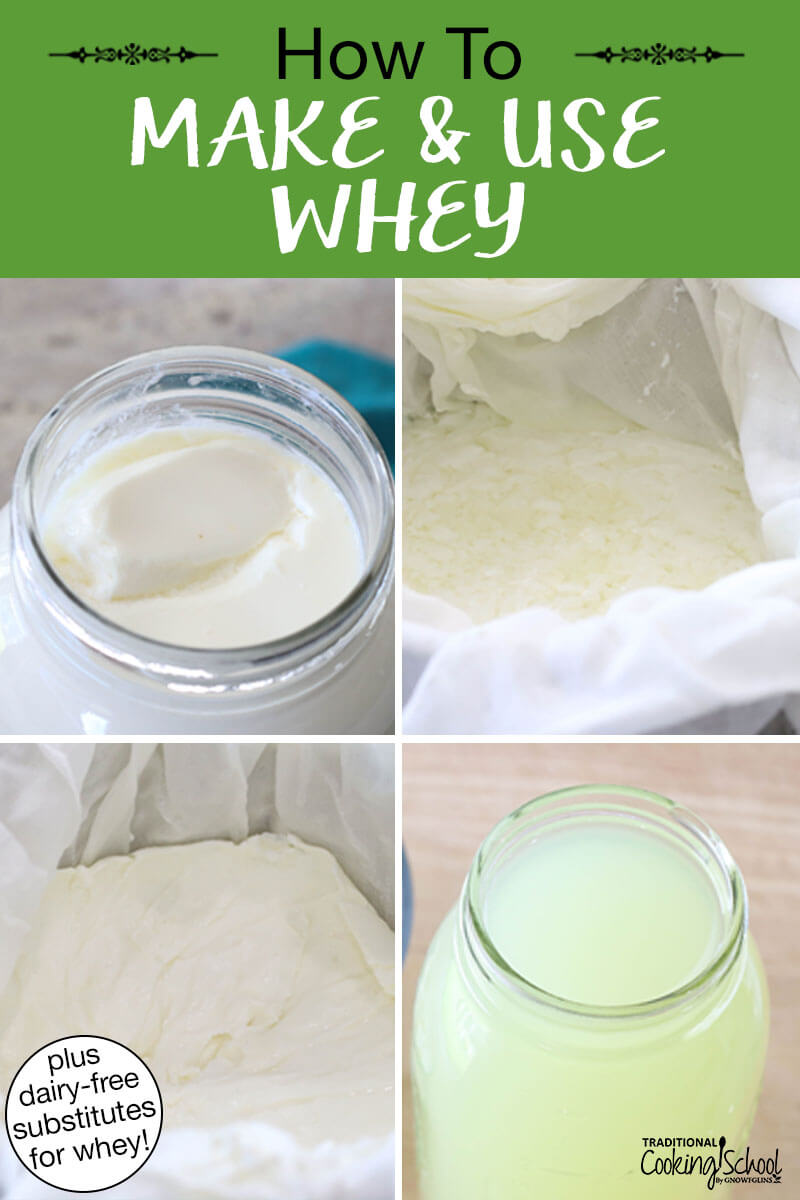
Line a colander with two pieces of 90-count cheesecloth or a pillow-case weight piece of cotton cloth.
-
Put the colander inside a pot or bowl that holds it.
-
Pour the cultured dairy into the cheesecloth-lined colander.
-
Tie up the ends and tuck them inside the colander.
-
Let the whey drip out for about a day, or hang up the bag so gravity can speed up the process.
-
Scrape the cheese out of the cheesecloth and use as you would cream cheese.
-
Pour the whey into a clean jar and store it in the refrigerator for many weeks, or freeze for many months.
Whey FAQs
My whey is the wrong color/cloudy. What color should it be?
Whey should be yellowish. Whitish, cloudy whey means that some of the milk solids got in there, too. This could be due to cheesecloth not being a very fine weave. You could restrain it using a tighter weave cloth to purify it, but you don’t have to.
Whey with more milk solids won’t last as long as whey that is purer, but you can still use it for ferments and other foods as long as it still smells and looks good (instead of rotten or moldy).
How long does whey keep?
At room temperature, I stay on the safe side and say that whey is good for up to 24 hours (meaning, it can be used to make ricotta or in other ferments; longer than 24 hours and it should be used for animals or watering plants instead; see below for more uses).
In the refrigerator, it keeps for a matter of weeks. It freezes well for many months.
Over time, if any milk solids slipped into the whey during straining (which is normal), they may become moldy floating at the top of the whey. Strain them off as necessary, and usually the whey is still fine.
It should smell fresh; let your nose be your guide on whether it has spoiled or not.
Can I freeze whey?
Yes! In fact, freezing whey in ice cube trays is my favorite way to keep it fresh and use it up slowly over time. You can thaw the whey as needed ahead of time, or use it up as-is (frozen).
Simply add the frozen whey cubes to smoothies or to the soaking batter of your baked goods (where they will thaw and release the acid for soaking… make sure to account for the thawing time and let your soaked baked goods soak a little longer than normal).
What should I do with the kefir or yogurt cheese leftover from making whey?
Enjoy kefir or yogurt cheese in any of these delicious ways!
- Season with this herbed seasoning salt.
- Use in probiotic potato salad.
- Spread on toast, biscuits, scones or crackers.
- Replace kefir, yogurt or sour cream in salad dressings.
- Mix with herbs, salt and pepper along with milk or sour cream for veggie dips.
- Add to smoothies in place of yogurt or kefir (with additional liquid).
- Turn into yogurt or kefir cheese balls — drip the whey out until the cheese is very dry, then shape into balls and submerge in olive oil or brine drizzled with olive oil and used as a dip for sourdough flatbread and other cold or finger foods like hard-boiled eggs, pickled vegetables and hummus… Mediterranean-style!
- Turn into cheese balls.
- Enjoy as a citrus frosting on this soaked chocolate torte.
Did you make whey? If so, please give us a rating on the recipe card below. Then snap a photo and tag us on social media so we can see how it went! Then keep reading below the recipe for more ways to use whey!
Homemade Whey
When making low temperature cheeses, whey will spill out from pressing or hanging curds. However, it is probably easiest for most people use the whey from making kefir or yogurt cheese, or the soft cheese of the Fundamentals eCourse.
Ingredients
- milk kefir or yogurt, chevre, etc.
Instructions
-
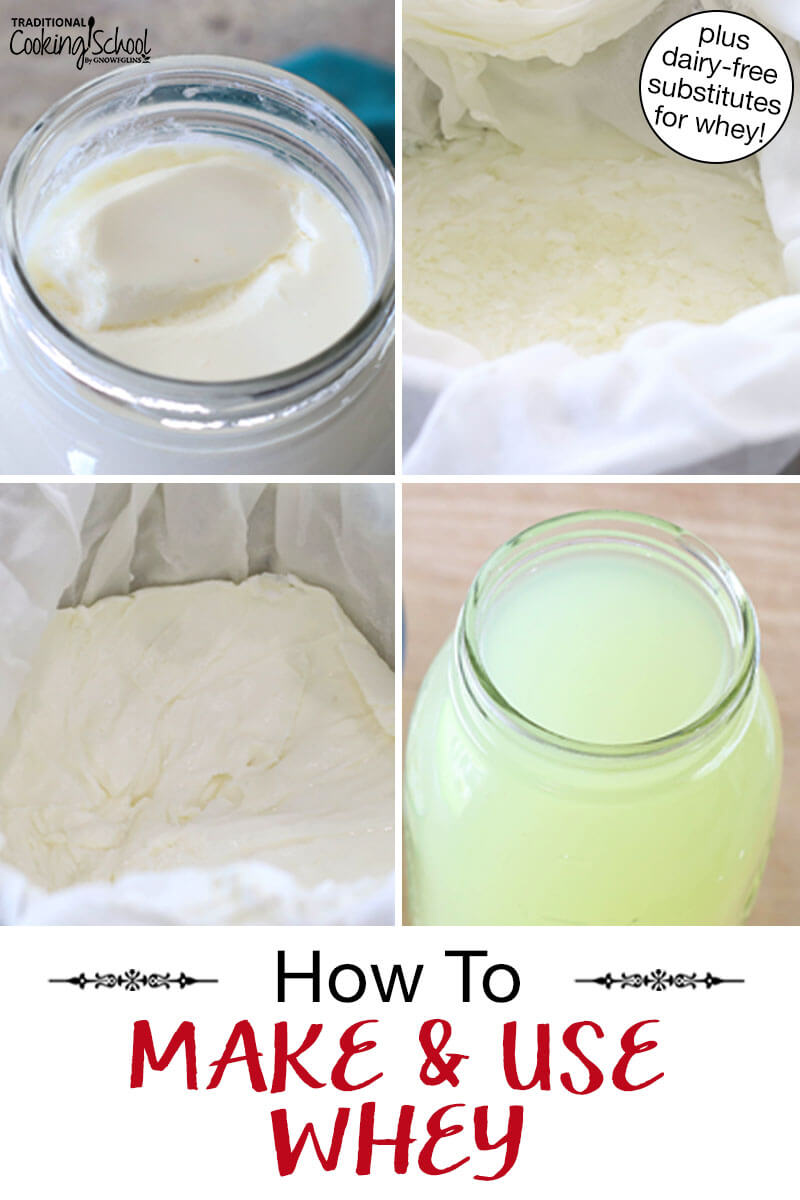
Line a colander with two pieces of 90-count cheesecloth or a pillow-case weight piece of cotton cloth.
-
Put the colander inside a pot or bowl that holds it.
-
Pour the cultured dairy into the cheesecloth-lined colander.
-
Tie up the ends and tuck them inside the colander.
-
Let the whey drip out for about a day, or hang up the bag so gravity can speed up the process.
-
Scrape the cheese out of the cheesecloth and use as you would cream cheese.
-
Pour the whey into a clean jar and store in the refrigerator for many weeks. Or freeze for many months. The whey will last a long time.
Recipe Notes
It is normal for a few milk solids to slip through the cheesecloth with the whey. Over time, they can get moldy floating at the top of the whey. Strain them off as necessary, and usually the whey is fine. It should smell fresh; let your nose be your guide.

Non-Dairy Substitutes For Whey
If you are dairy-free, you can substitute whey with non-dairy starter cultures. Here are your options and how much to use.
- Leftover Fermenting Juice – The juice of previously fermented pickles, sauerkraut or other ferments is rich with beneficial organisms. Use at the same rate as whey. However, keep in mind flavor matching; a pickle juice is probably not going to taste very good inside a fruit ferment.
- Water Kefir – Use a finished batch of water kefir at the same rate as whey: about 1/4 cup per quart of ferment.
- Water Kefir Grains (hydrated) – This is an idea shared by Christine C., eCourse member. She uses ?1 tablespoon extra water kefir grains per quart of ferment, and scales up from there. Similarly (although not dairy-free), you can use 1-1/2 teaspoons of extra dairy kefir grains per quart of ferment.
- Homesteader Supply Fermenting Starter Culture – We also recommend a purchased veggie starter culture such as this one. Add this to your ferments in place of whey at the rate of 1/16 teaspoon per quart of ferment. Mix the powdered culture with the same amount of filtered water as whey is called for. For instance, if the recipe calls for 1/4 cup of whey for a quart of ferment, then mix 1/16 teaspoon with 1/4 cup filtered water and add that to the recipe in place of the whey.
What if a recipe doesn’t specify a starter culture and you want to use one? Generally, 1/4 cup of liquid starter works for one quart of ferment. Scale-up accordingly.
If a recipe calls for another amount, by all means, follow the wisdom of the recipe author. Like many aspects of traditional cooking, starter culture usage is not an exact science and a range of amounts will probably work.
Uses For Whey: How To Use Up An Abundance!
Julia A. asks:
“I thought the last #AskWardee about using up yogurt cheese was humorous, as I go through yogurt cheese very quickly. Alas, I could use help with the opposite of that. How to use up the whey when it is coming to you in abundance. Yes, I get lots with yogurt cheese, but I am right now listening to whey drip out of the Middle Eastern cheese as well. I have about a half gallon of whey. Most recipes only call for small amounts. I’m sure there are places that you’ve shared uses for whey, but thought an #AskWardee would be helpful. Are there recipes/uses for whey that call for more than 1/4 cup (or greater) quantities?!
11 Uses For Whey
I broadcast #AskWardee live each Wednesday at 10am Pacific (1pm Eastern) on Periscope and Facebook Live. Both the podcast and video replay of this week’s show are below. Enjoy!
Subscribe to #AskWardee on iTunes, Stitcher, YouTube, or the Podcasts app.
#1 — Old-Fashioned Ricotta Cheese
This is the obvious usage when you have lots and lots of whey leftover from cheesemaking or culturing dairy. When you do this, you’re getting even more cheese from your milk. It’s using your milk twice for cheese — the ultimate in frugal!
It’s also a great use for salted whey.
I have a recipe in our Cultured Dairy eCourse or eBook.
Basically, you boil the whey until the dissolved proteins precipitate out (come out). Then strain — voila, ricotta cheese!
(The remaining liquid no longer contains active cultures because it’s been boiled, and it doesn’t contain protein anymore because that’s in the ricotta!)

#2 — As A Fermenting Culture
As discussed above, jumpstart your ferment by adding 1/4 cup whey (from cultured dairy with active cultures) to a quart of any fruit or veggie ferment. This is considered a starter culture.
Here are a few of our favorite lacto-fermented foods:
- Homemade Kimchi: An Easy Korean Sauerkraut Recipe
- Simple, No-Pound Sauerkraut
- Homemade Sauerkraut In A Stoneware Crock
- Naturally Fermented Jalapeño Peppers
- Fermented Tex-Mex Salsa
- Lacto-Fermented Hummus
- Lacto-Fermented Homemade Ketchup
- Lacto-Fermented Mayonnaise
- 3 Lacto-Fermented Mustard Recipes (zippy, zingy flavor!)
- Lacto-Fermented Cranberry Sauce
- Lacto-Fermented Turnips & Beets
- Old-Fashioned, Crunchy, Fermented Garlic-Dill Pickles
- Lacto-Fermented Carrot Sticks (gut-healing probiotic snack for kids!)
Now, do you have to use whey for fermenting? Here’s the answer!
#3 — Homemade Sodas
Use whey as the base culture for homemade soda, like fermented lemonade or limeade.

Homemade Soda with Whey
Need to use up excess whey? Here's an easy recipe for homemade soda… (It calls for 1 cup of whey!)
Ingredients
- 2 1/4 cups lemon juice about a dozen lemons, can substitute lime juice
- 3/4 cup evaporated cane juice or sugar, sucanat, or rapadura
- 1 cup whey
- pure water
Instructions
-
Put the sugar in a gallon jar.
-
Add warm or hot water, just enough to dissolve the sugar when stirring.
-
Combine the lemon juice and cool water to fill the jar to the shoulder (3/4 full).
-
Add the whey. Stir.
-
Cover tightly and let culture at room temperature for 2 to 3 days.
-
Transfer to fridge or decant to Grolsch-style bottles and chill. If it's too tart, add honey or stevia, to taste.
Recipe Notes
- A wonderfully refreshing way to use up leftover whey!
#4 — For Soaking Grains Or Flour
Use whey in place of acid when soaking grains or flour in soaked recipes. We use acid when soaking grains in traditional cooking to neutralize phytic acid that would otherwise prevent mineral absorption when eating the grains.
Using Kombucha to soak grains or flour is a similar concept that I discussed in this #AskWardee!
#5 — Add To Smoothies
Use whey as some of your liquid in smoothies. It’s a great protein, enzyme, vitamin, and mineral boost!
You can even freeze your whey in ice cubes and use those cubes instead of water ice cubes as ice in your smoothies!
#6 — Bread Dough
Use whey as the liquid in your bread or pizza dough. It works great and adds protein!
#7 — Water Your Plants & Garden
Whey can fertilize your plants!
Your acid-loving plants, like blueberries or tomatoes, will love acidic whey. Keep in mind, however, that you should dilute whey when using it to water plants (1 part whey to 1 part water) and only add 1 inch of whey-water per week. More info here.

#8 — Make Bone Broth
This is a particularly good use for salted or partially salted whey.
Cover your bones with whey and/or water. Because whey is acidic, you can skip adding vinegar to pull nutrition out of the bones, then make broth as usual.

#9 — Use In Salad Dressing
Use in place of acid (like lemon juice) or in place of water or milk. Check out our archive of salad dressings here.
#10 — Feed Your Animals
Add some whey to your animals’ water or offer your chickens a pan of whey occasionally. The probiotics (if it’s not been boiled), protein, vitamins, and minerals are good for them!
#11 — Add To Compost
We water our compost pile so it’s moist for the composting activity. Use whey instead of water on the days you have an abundance and no other pressing use.
Additional Links
- Traditional Cooking School’s Cultured Dairy eCourse
- Traditional Cooking School’s Cultured Dairy eBook
- swing top, Grolsch-style bottles
- evaporated cane juice or sucanat
- How To Use Whey To Water Plants
- 5 Tips: How To Prevent Mold During Fermentation #AskWardee 074
This post is a combination of two posts originally published and written by Wardee Harmon on 7/21/11 and 6/8/16 respectively. The posts were combined, updated, and republished on 5/5/21.
...without giving up the foods you love or spending all day in the kitchen!

2 free books:
Eat God's Way
Ditch the Standard American Diet, get healthier & happier, and save money on groceries...
We only recommend products and services we wholeheartedly endorse. This post may contain special links through which we earn a small commission if you make a purchase (though your price is the same).












Please forgive my ignorance in advance! I’ve recently begun making ricotta cheese from milk by heating it to just under boiling point and then adding vinegar or lemon juice. It tastes great! I was under the impression that the liquid that remained was whey so I came to this page for ideas on how to use it other than as the liquid in bread, which I do all the time. But now, I’m totally confused! What is this liquid I have???!! Is it not whey? Is it okay for me to be using it? And if the protein from your whey all goes into the ricotta cheese you make, does that mean my liquid that I’ve been thinking was high-protein whey actually has no protein? What is it then? I’d appreciate any clarity you can give me on this. I’m so confused!
Hi Tina,
I’m sorry to say if you make ricotta in the manner you described, there is no protein in the leftover liquid and there are no probiotics, either. 🙁
Millie
Traditional Cooking School
Thank you, Millie. Is there any nutritional value to the liquid if I make it this way? Does it contain the carbs from the milk? Should I just be dumping it? Thank you for your help.
Just fyi, I live in Malaysia so our dairy options are pretty limited. I can’t buy cottage cheese, ricotta, or rennet anywhere here.
Hi Tina,
There is not much left in this whey. The protein is gone, the probiotics and enzymes have perished from the boiling. All that’s left is acid, for the most part. You could use it for compost water or diluted to water plants, but other than that, we can’t see much benefit. Sorry!
Millie
Traditional Cooking School
If nothing else, you can still use it in place of water for breads and baking and smoothies, then it doesn’t go to waste. This is the same way I make cheese and that’s how I use up my whey.
Wow, absolute commonsense uses that I know of all of them but never thought of the majority of them. Bravo! Now to conquer ricotta from whey, too cool!
I appreciate all your ideas to use my excess whey up. How long is whey still good for? You said you can give whey mix in the animals water what ratios how much water to whey? I have a house cat can she have they whey? Also is it ok to give her some of my 1st fermented kefir or 2nd fermented with fruit? I understand your not suppose to give cats milk after they been weaned from their mothers milk becuase they will get diarrhea from cow’s milk becuase they cannot digest it. Also can my cat have kefir cheese too? Thank you for the great ways to use whey? I am going try freezing it cubes and add it to my smoothies.
Hi Jody,
Great questions. You would want to google for some of these questions as we don’t know the particulars for each kind of animal. For chickens, Wardee gave them straight whey. For other animals, she adds a small amount to their water. Her goats, cow, and sheep would not drink the water if there was too much. 😉
Millie
Traditional Cooking School
Jody, I had ‘heard’ that yogurt (so obviously, kefir!) would help hold back the gingivitis nasties for my kitty who can’t get dental work (due to major heart valve issues). I started buying organic, whole milk plain kefir to pour a bit in her dish before adding her yummy wet food on top.
Since it’s such an unusual scent/flavor, especially for carnivorous kitties, I started with only tiny drops, well camouflaged, but in short time she was lapping up 2 – 4 tablespoonfuls without the sneakiness. Most important? Going on 3 years now, her deathly foul smelling breath has sweetened to normal and her other viral? related issues have cleared up completely!
I finally got some grains, and am making too much for the two of us to finish, so you know, cheese, sourdough, dressings, etc. etc. . . . I’m also trying to find how long whey lasts, I thought it was at least 6 months? maybe a year? I read it somewhere.
Hi, Villainesse,
Thank you for your testimony! Whey typically lasts up to 6 months in the refrigerator.
~Peggy, TCS Customer Success Team
i have a question: I tried to make ricotta from whey left over from kefir cheese and nothing happened. i get whey i use very good quality cotton to strain it (not cheesecloth) so could it be that my whey was so “clean” that there was so more left behind or what could have gone wrong? Thanks
Hello Wardee,
I just found your channel and am just learning all of the uses for raw milk. Can raw milk that clabbered in the refrigerator be used the same as milk clabbered at room temp?
Thanks,
Pam
Hi, Pam.
Yes, it can be done in the refrigerator. It will be a slower process.
~Danielle, TCS Customer Success Team
I needed whey to make a fermented chutney, so I made cottage cheese using full-cream, permeate free milk and lemon juice. The “whey” remaining after straining the cheese looked really white like milk, rather than semi opaque like the photo of whey on this post. Can I use this liquid as whey in my recipe or do I need to try again?
Hi, Eva,
If your cottage cheese recipe uses a live culture and doesn’t heat it too high that it would kill the beneficial bacteria in your whey you should be good to use it in your fermentation process. You are seeing more of the milk solids left over that is why yours looks more cloudy.
~Peggy, TCS Customer Success Team
My whey strained from my clabbered milk is almost a pinkish color. It smells good. Is this ok?
Hi, Rachel.
The pink discoloration is not good. I’m sorry. It is likely mold.
We have information on preventing mold here: https://traditionalcookingschool.com/q-a/how-to-prevent-mold-during-fermentation-aw074/
~Danielle, TCS Customer Success Team
I followed the steps and the cheese I got was just like Philadelphia! I was really happy to have a healthy alternative. But I just did it again and it came out much more acidic this time! I’m not very happy, but I did all the same things! Why did that happen? I even got the raw yogurt from the same source…My sister thinks it’s because we hung it up more this time, even if it was for the same amount of time…
Hi, Adrienne.
The acid is produced by fermenting organisms so depending on the length of ferment the end result can be more acidic.
~Danielle, TCS Customer Success Team