
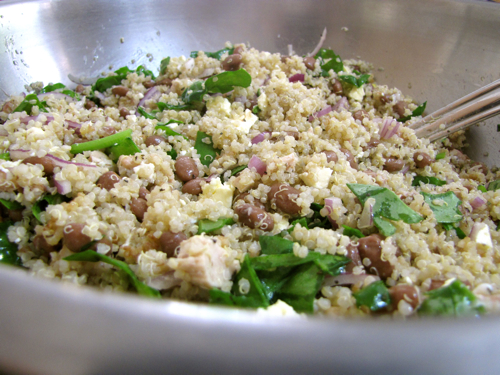
When the warmer weather settles in — which it hasn’t quite here, still raining — I start making lots of cold grain salads. My favorite grain to use is quinoa. The salads are a satisfying, yet light and cool, main dish and can boast of including virtually anything you’ve got on hand.
We attended a Memorial Day picnic on Monday and I hemmed and hawed all weekend about what to take. See, I usually always take a quinoa salad and I thought maybe I should take something different for a change. But by Sunday night, true to form, I was rinsing and soaking the quinoa anyway.
We arrived at the picnic on Monday, the quinoa salad in hand, and one friend commented that she thought about bringing a quinoa salad but didn’t because she figured I was going to. Another friend said she had been looking forward to the quinoa salad I was sure to bring. They got me there. I guess I’ll stop fighting it and always bring one. 😉 People depend on it, see?
Spring Quinoa Salad
Ingredients
- 4 cups quinoa soaked, cooked, and cooled *
- 1 to 2 cups pinto beans soaked, cooked, and cooled **
- 1 to 2 cups chicken cooked, cold, diced ***
- 1/4 red onion quartered and sliced thinly
- 1 to 2 cups spinach coarsely chopped ****
- 6 to 8 radishes sliced thinly (not pictured)
- handful fresh basil coarsely chopped
- 1/2 cup raw cheese crumbled or diced *****
- 1/2 cup+ extra virgin olive oil
- 2 to 4 tablespoons balsamic vinegar or lemon juice, optional
- sea salt to taste
- pepper to taste
Instructions
-
Toss all ingredients together in a big bowl.
-
Use more or less of any of them.
-
Adjust seasonings.
-
Give the flavors some time to mingle, in the refrigerator or at cool room temperature.
-
Enjoy!
Recipe Notes
*See grain soaking and cooking instructions here.
**See bean soaking and cooking instructions here.
***See how to cook whole chickens in a crockpot here.
****If eating on a regular basis, spinach should be lightly steamed to reduce oxalic acid. But occasionally, we eat it raw.
*****I used the no-tech Middle Eastern cheese in the Cultured Dairy & Basic Cheese eCourse.
Do you make cold grain salads? What do you put in them?
This post was featured in 33 Nourishing Main Dish Salads.
...without giving up the foods you love or spending all day in the kitchen!
2 free books:
Eat God's Way
Ditch the Standard American Diet, get healthier & happier, and save money on groceries...
We only recommend products and services we wholeheartedly endorse. This post may contain special links through which we earn a small commission if you make a purchase (though your price is the same).


This is a delicious recipe, Wardee, thanks for sharing it!
I have a nifty spiral slicer and I use it on zucchini to make thin, angel hair pasta style zucchini to add to the salads. So pretty. I get compliments on how it looks and it tastes so good! And carrots – oh how I love carrots!!!
http://www.amazon.com/Joyce-Chen-51-0662-Saladacco-Spiral/dp/B0000DDVYE/ref=sr_1_2?ie=UTF8&qid=1306937074&sr=8-2
Laurie — Carrots and zukes, yes! 🙂
Mmm!! The carrots and zucchini sound like great additions!
I have not made many cold grain salads, but this recipe looks like a great one for me to try with those spring pickings.
Can’t believe how hot it is already – this looks like a perfect meal for these days.
Quinoa tabouleh has always been a “go-to” cold grain salad for me. Cooked, cooled quinoa, tomatoes, cucumber, parsley, mint, olive oil, lemon juice. Simple, standard stuff I usually have in my pantry – we’ll feast on it for a week!
My other favorite salad isn’t a grain salad – its Sally Fallon’s “Variety Salad” from Nourishing Traditions. Carrots, cucumber, tomatoes, red cabbage, and her oil, vinegar & dijon mustard salad. YUM!
Amanda — Oh, me too — there’s nothing like quinoa tabouli! I haven’t tried the variety salad, but you can bet I will now. Thanks for mentioning it.
I’ll made a couple of different cold grain salad, they always go over well. I’ll have to pick up some quinoa and try this one out. Looks good and hardy!
I love quinoa—it’s so great for gluten free cooking, too.
My husband would love this for his work lunch. Now if my radishes
would just grow a little quicker~
Thanks for sharing!
yummy, yes not really warm yet, but still love the recipe and plan to put into my meal plan. I need to read up on the raw spinach. I eat it often. I like kale and beet greens too in my smoothies, Do you know if they are better for you raw?
Erin — According to Nourishing Traditions (page 366), cabbage, broccoli, Brussels sprouts, kale, beet greens, spinach and chard contain oxalic acid that “blocks calcium and iron absorption and irritates the mouth and intestinal tract.” A light steaming preserves vitamins and minerals but washes some of the oxalic acid away (along with pesticides and nitrates if they’re grown commercially). Eat with plenty of raw grass-fed butter to help get the most from the minerals!
Fermentation is also a way to handle the oxalic acid. 🙂
Have you ever tried sprouted quinoa? I rather love it, and it sprouts so quickly! I soak it overnight, drain and rinse, spread it out on a jelly roll pan, and cover with a damp towel. It’s done in a day. Delicious!
Sounds delicious! I haven’t used quinoa much, but you have inspired me to try this recipe with spinach.
Thanks Wardee for the information on oxalic acid. Think I’ll break my routine up by steaming my spinach sometimes as I did this morning. Had it with a couple eggs yum. Trying to balance the good you get from raw food and nutrients you get when you steam.
Looking forward to learning more about fermentation of veggies this summer from you:} Sounds like a great way to get the benefits from raw and “processed”
the sun is shinning on the Coast :}
I’ll have to try your salad. I like sprouted lentils. Or is that a bean? And even when someone else brings _their_ lentil salad, our dressing are different. I also love a quinoa salad with cumin. I’m just finishing a salad with wheatberries and navy beans, dijon dressing. Yum! I like your newsletters a lot. Thanks!
I love quinoa; it’s lighter than brown rice and so versatile. I’ll be sure to try the recipe though I’ll probably sub the spinach for another green and turkey for the chicken as I am doing Dr. D’Adamo’s Genotype diet. I’m also going to make (my first time) fermented cabbage. I’ve used it instead of brown rice in stir-frys and my son ate it with brown sugar and soy milk for breakfast. Love and Light
Why do you have to ruin the recipe w chicken??
Barbara — If you don’t care for the chicken, just leave it out. 🙂
Wardee,
I like how this is a ‘spring’ version of the quinoa, because I have been trying to put together my own recipe for each season. We take so advantage of the fact that we have access to all veggies in any season, but I’d love to change some things for our family and truly highlight what is in season, and try to get the bulk of that grown by me or others. Its a big change for us, so thank you for the resource. What brought you to eating the veggies in their season? And how do you ferment spinach? I also had no idea that steaming had its advantages for spinach I’d been hearing so much about raw raw raw I thought it was the best. How do you steam your spinach? I’ve been looking at a recipe book that they just sort of saute it barely till it wilts is that what you do?
Could you please also email me the answers I can be terrible at going back to the post on the blog. [email protected]
Eat with plenty of raw grass-fed butter to help get the most from the minerals! I like how this is a ‘spring’ version of the quinoa, because I have been trying to put together my own recipe for each season. Erin — According to Nourishing Traditions (page 366), cabbage, broccoli, Brussels sprouts, kale, beet greens, spinach and chard contain oxalic acid that “blocks calcium and iron absorption and irritates the mouth and intestinal tract.” A light steaming preserves vitamins and minerals but washes some of the oxalic acid away (along with pesticides and nitrates if they’re grown commercially). I have a nifty spiral slicer and I use it on zucchini to make thin, angel hair pasta style zucchini to add to the salads.
Curious…how many days do you think this would keep in the fridge (like for making a big batch to eat for lunch throughout the week)? Thanks!
Hi! I linked to this recipe in my June Real Food Monthly Meal Plan article. I like that you used soaked grains as well as soaked beans. Thanks for posting!