
Lacto-fermented radishes are tart and tangy, crunchy and fresh… perfect on green salads or dipped in our favorite homemade ranch dressing. If you’re new to fermentation, this easy gut-friendly recipe will get you started!
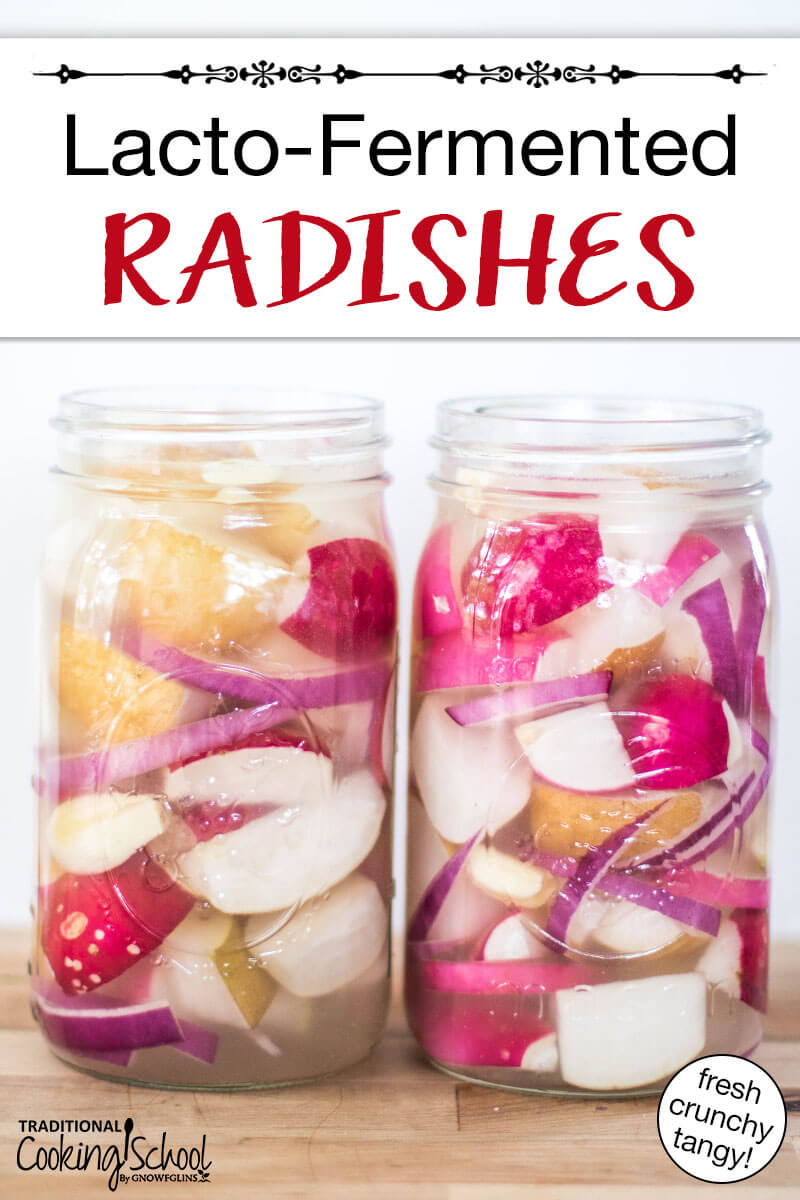
Have you ever eaten something so good that you’re scraping the bottom of the jar before you know it?
These naturally pickled, lacto-fermented radishes are just like that!
The brine, if beginning with red radishes, is just about the prettiest I’ve seen. And the nutrition? Can’t be beat.
Table Of Contents
Supplies Needed
You can invest in fermenting crocks, fermenting weights, airlock lids, etc. if you would like. But this is all you really need!
- Glass jars – You will need quart-sized glass Mason jars, preferably wide mouth although regular mouth jars will work in a pinch.
- Metal bands and lids – For covering the jar(s) of radishes as they ferment.
Ingredients
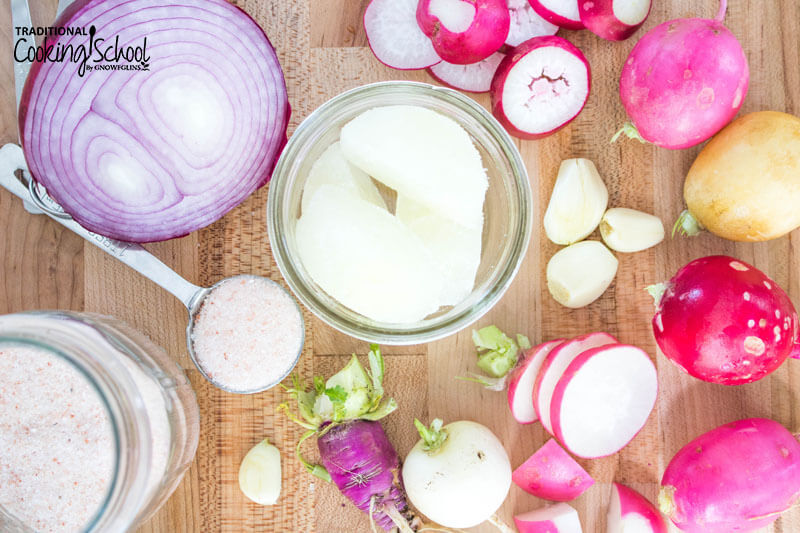
- Radishes – Organic and/or local, if possible.
- Sea salt – Choose a high-quality, fine-grain, mineral-rich salt. Don’t use store-bought, commercial iodized salt. Salt is not optional since it protects the fermenting foods from putrefying bacteria while allowing the beneficial bacteria necessary for proper fermentation to thrive. It’s essential, in the amount written below, for safe fermentation.
- Pure water – Use mineral-rich, chlorine-free water rather than contaminated well water or straight city water which may contain chlorine, chloramine, and/or flouride, etc. Mixing chlorinated water with cultures can affect your lacto-fermentation recipes. If your water is not clean or you don’t filter it, I recommend purchasing spring water or filtered water (here’s how to choose the best water filter for your family!). If your water is filtered and does not re-add minerals back, consider fortifying it with natural mineral drops. I discuss using reverse osmosis water for fermenting in this #AskWardee.
- Whey – Although optional, the use of whey in ferments kickstarts fermentation and helps ensure consistent results. Learn how to make whey here. If you’re dairy-free, you can use leftover fermenting juice from pickles or sauerkraut instead at the same rate as whey.
Flavor Options
Mix and match the below spices and herbs to come up with your dream flavor combination!
- Garlic – 2 to 3 whole crushed cloves per quart.
- Onion – 1/4 red onion, thinly sliced, per quart.
- Pepper – 1 teaspoon whole peppercorns per quart.
- Ginger – 1 inch chopped ginger root per quart.
- Coriander – 1/2 teaspoon coriander per quart.
- Mustard – 1/2 teaspoon mustard powder per quart.
- Bay leaf – 1 bay leaf per quart.
- Dill – 1 teaspoon dried dill seed per quart.
Directions
- Make your brine by dissolving salt in water. Simply combine salt and water in a half-gallon jar and stir until the salt dissolves.
- Prep veggies: Chop ends off radishes chop into quarters (small radishes) or sixths (large radishes). Thinly slice onions. Peel and crush garlic cloves.
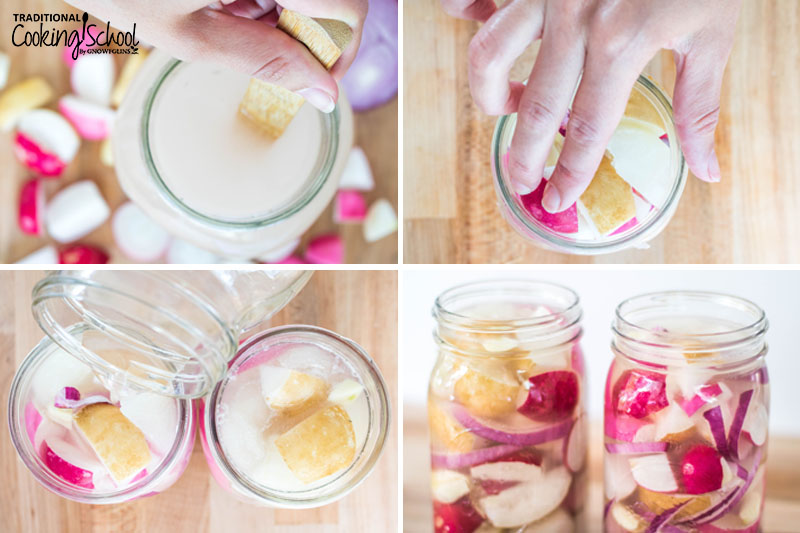
- Fill as many quart jars as necessary to use up all prepared vegetables. Pack radishes alternately with onion and garlic.
- Press down on the veggies to make sure they’re packed in well but leave an inch of headspace at the top of the jar.
- Pour brine and whey, if using, over top.
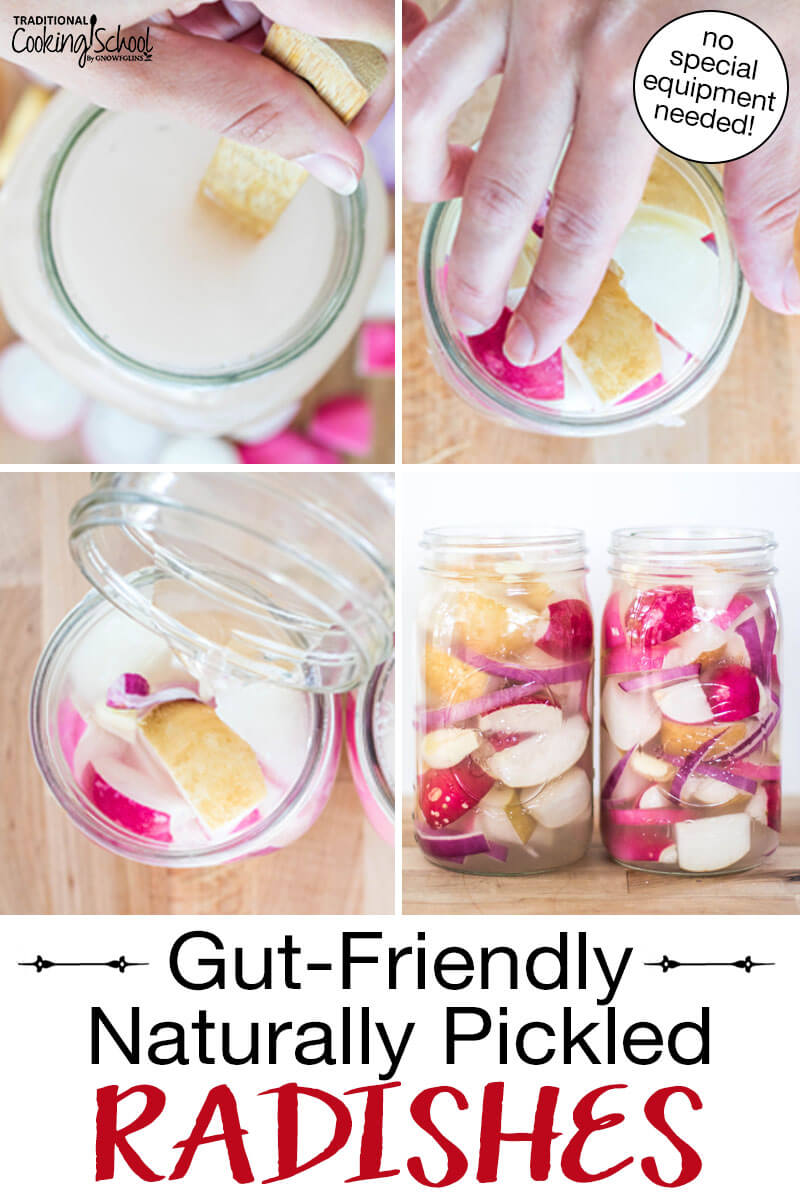
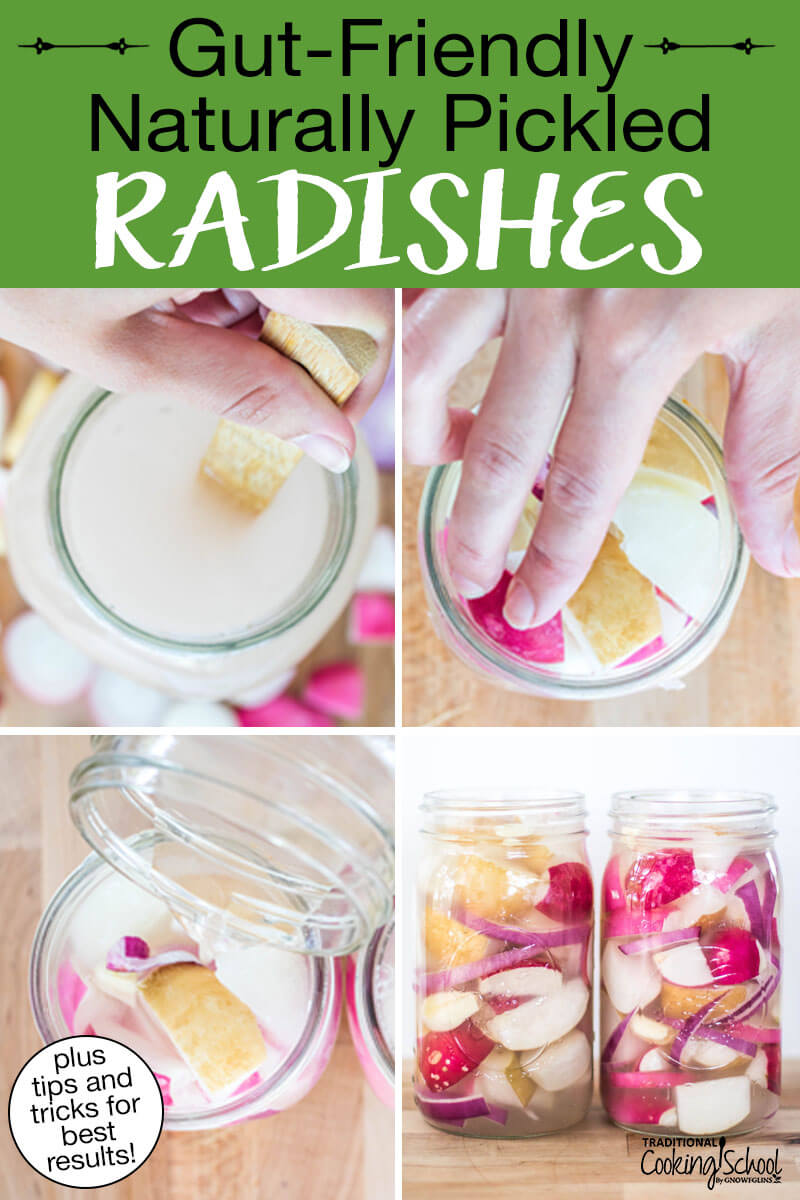
- Use a clean regular mouth jar lid to weigh down radishes below surface of liquid (otherwise they like to float up to the top).
- Put the lids and bands on the jars and tighten securely.
- Leave on the counter at room temperature for 3 to 5 days. Look for bubbles as a sign that fermentation is happening (if you don’t see bubbles, read my tips below). Taste periodically until you achieve your desired flavor. Skim off any mold that accumulates on the surface (see my tips for troubleshooting mold below).
- When done, transfer to the refrigerator or cool storage.
Frequently Asked Questions: Tips & Tricks
What type of radishes can I ferment?
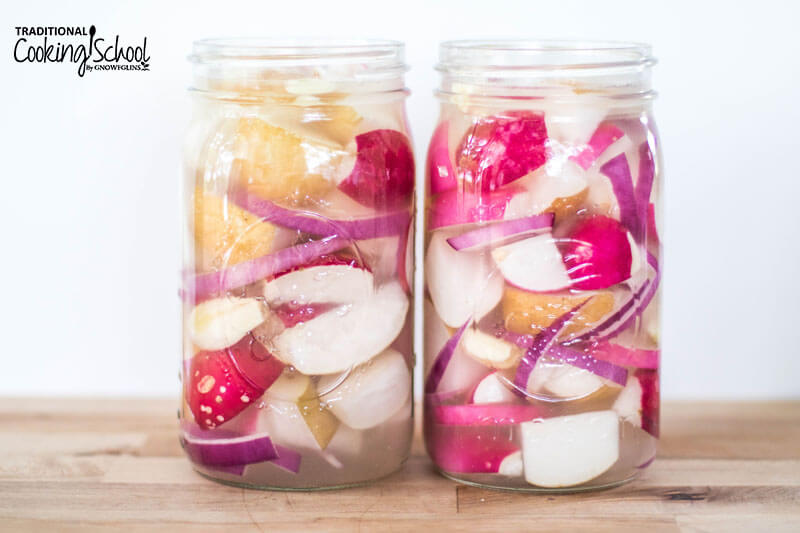
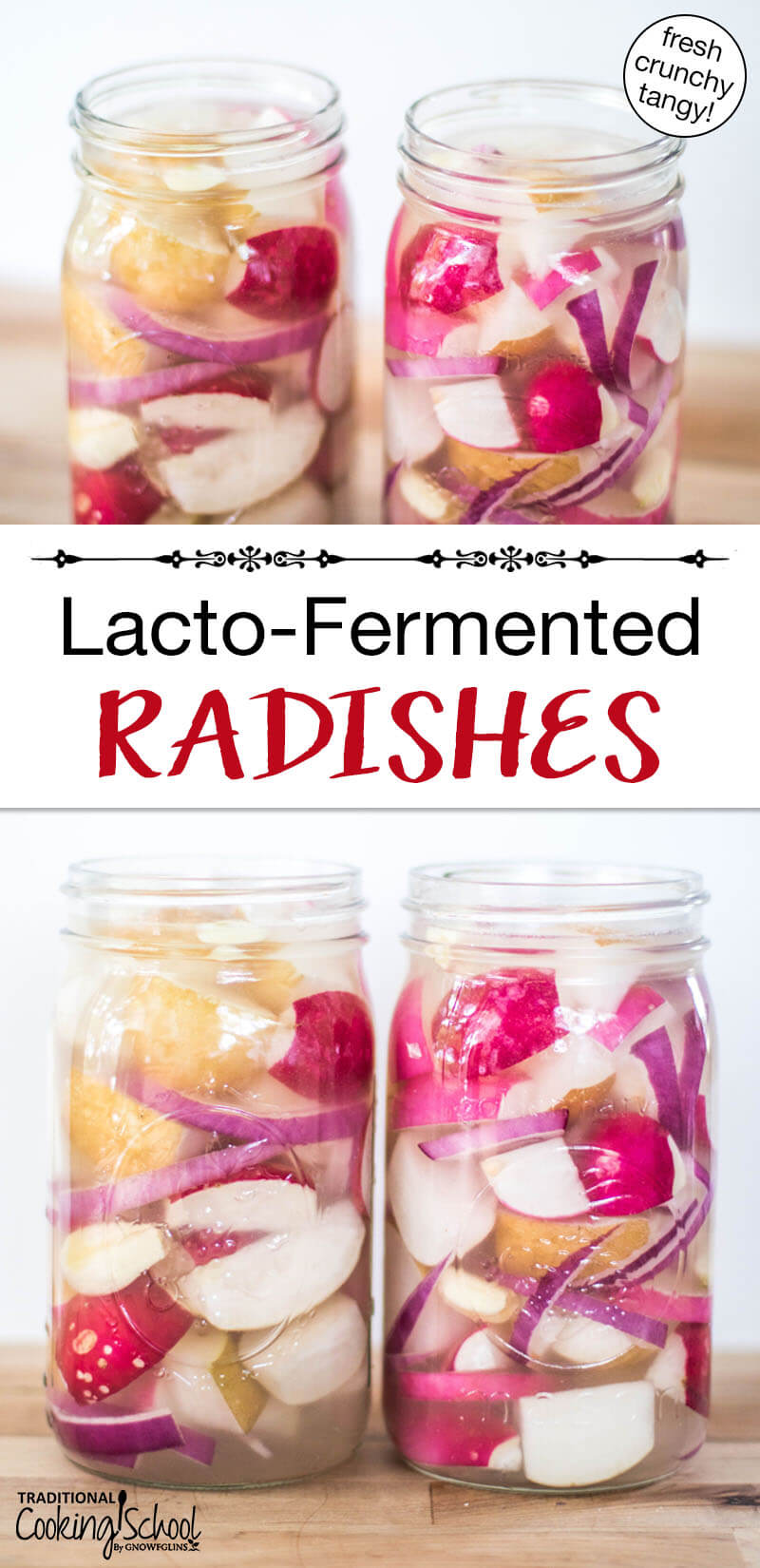
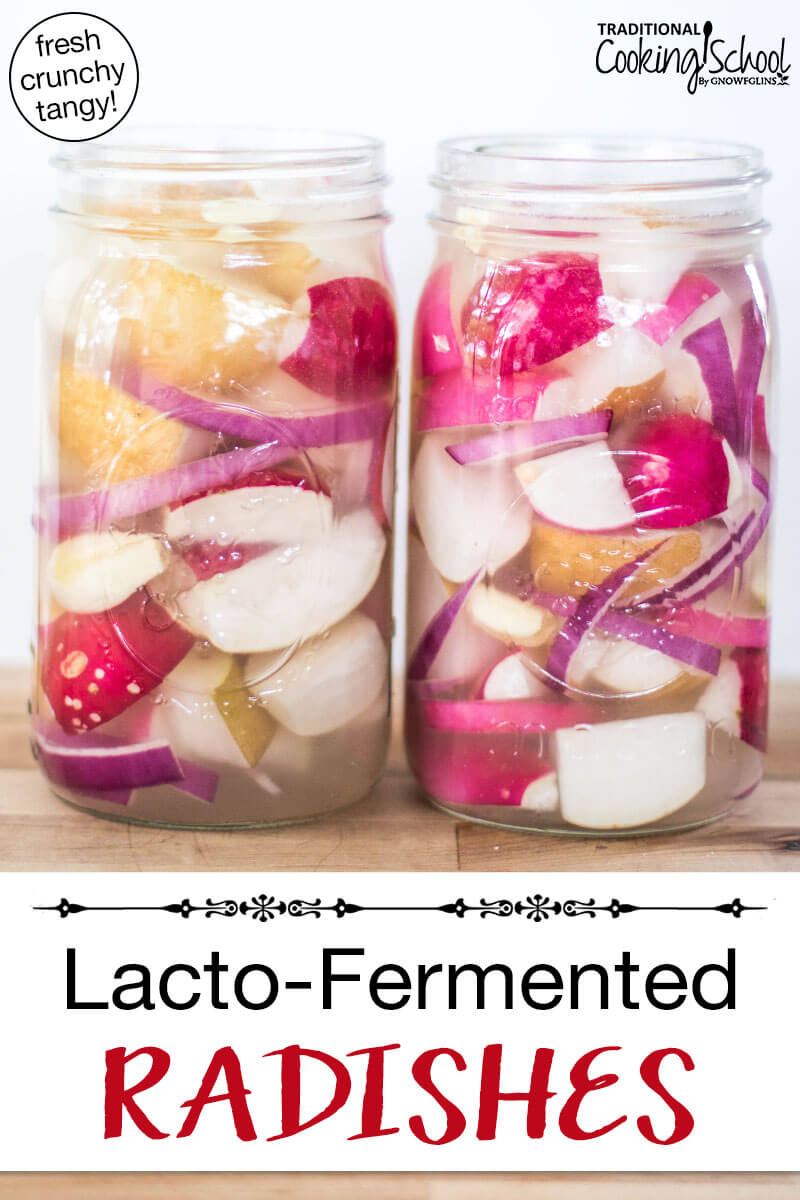
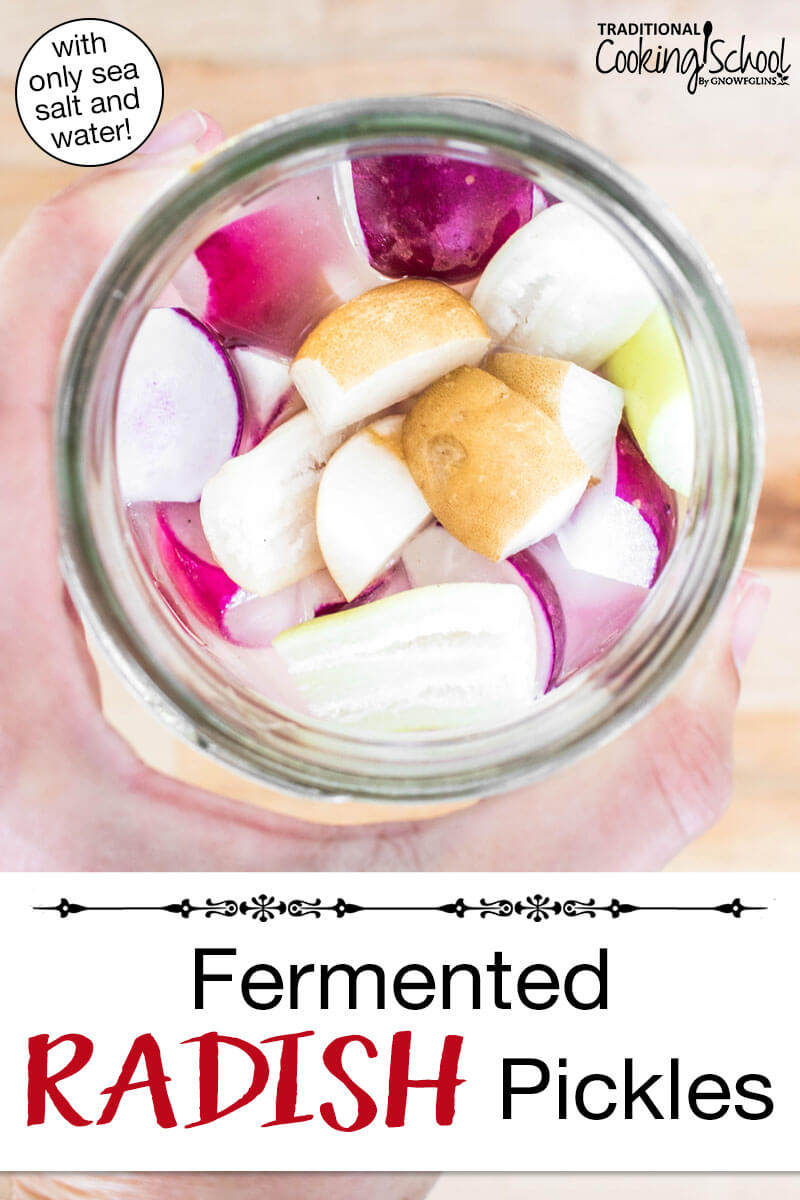
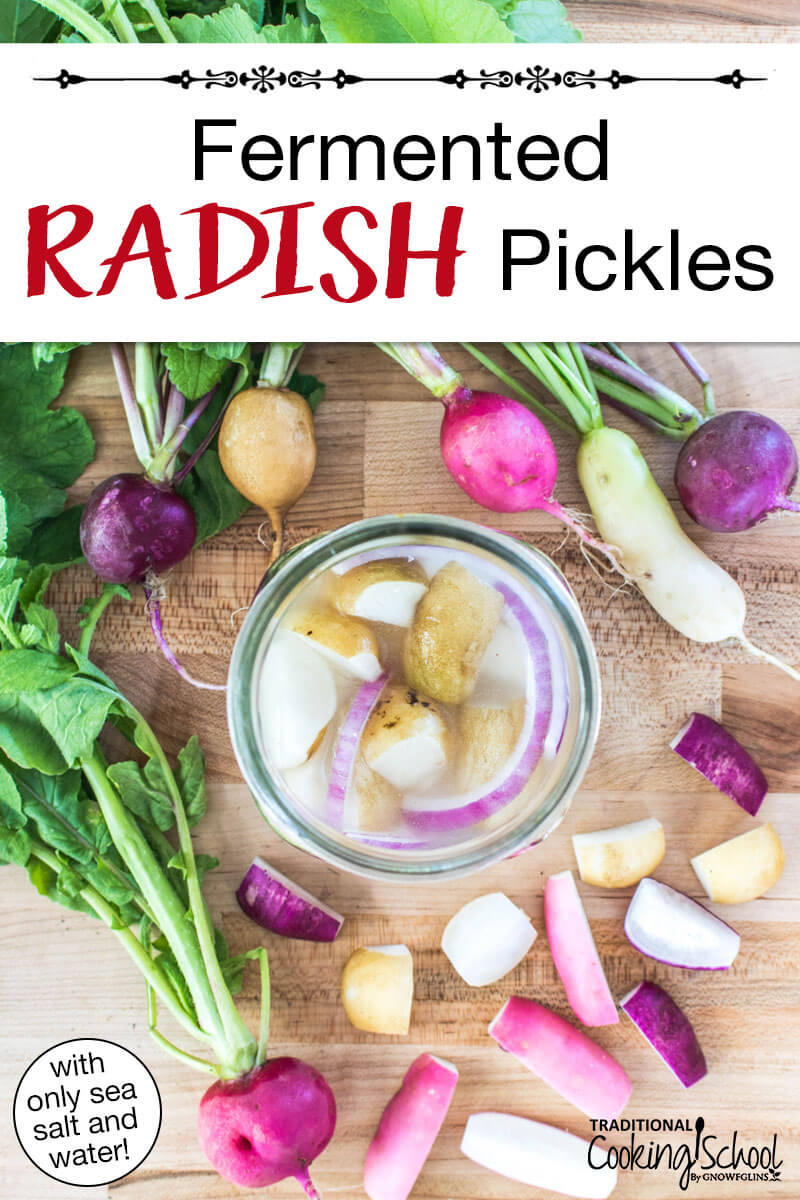
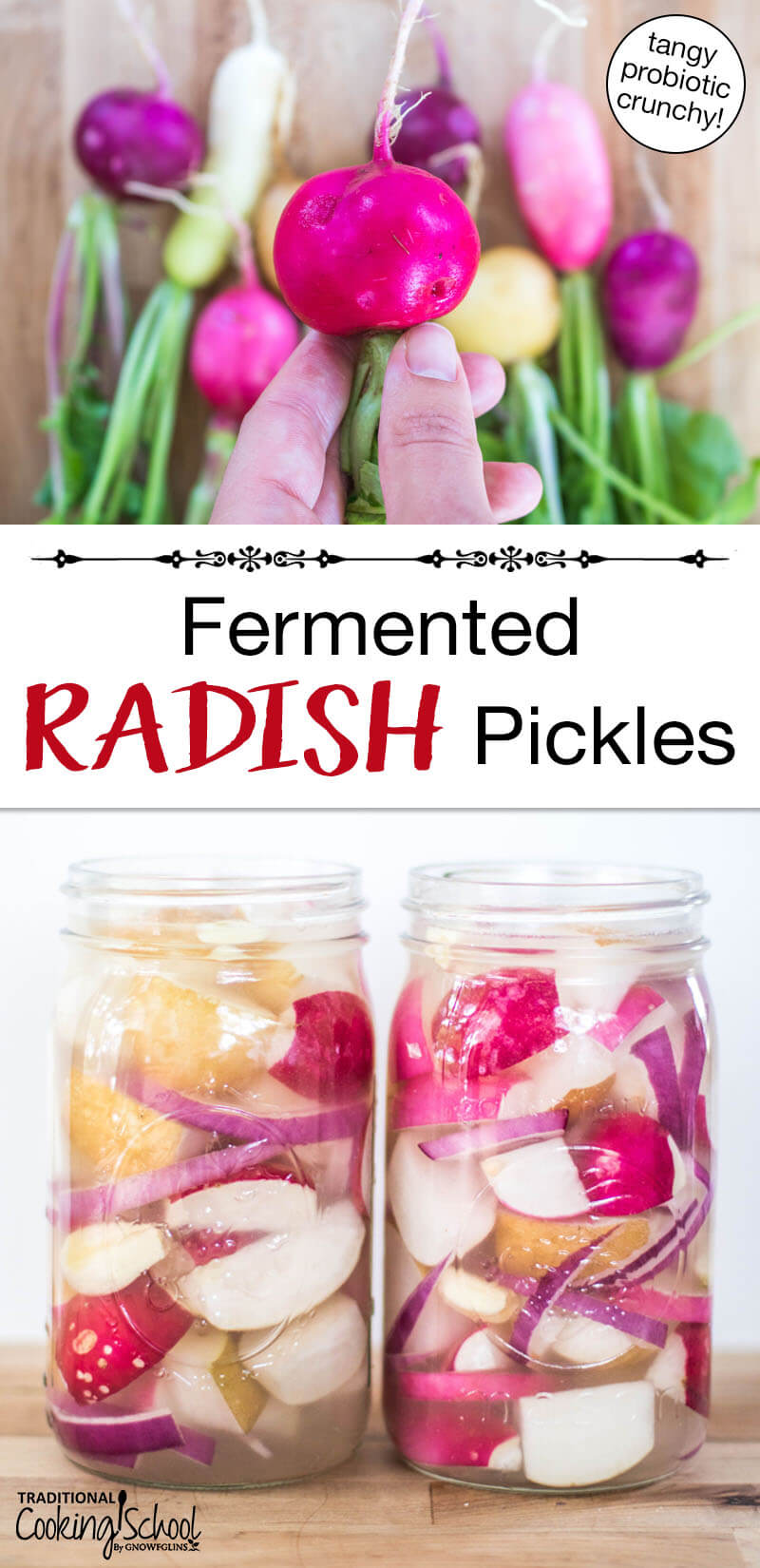
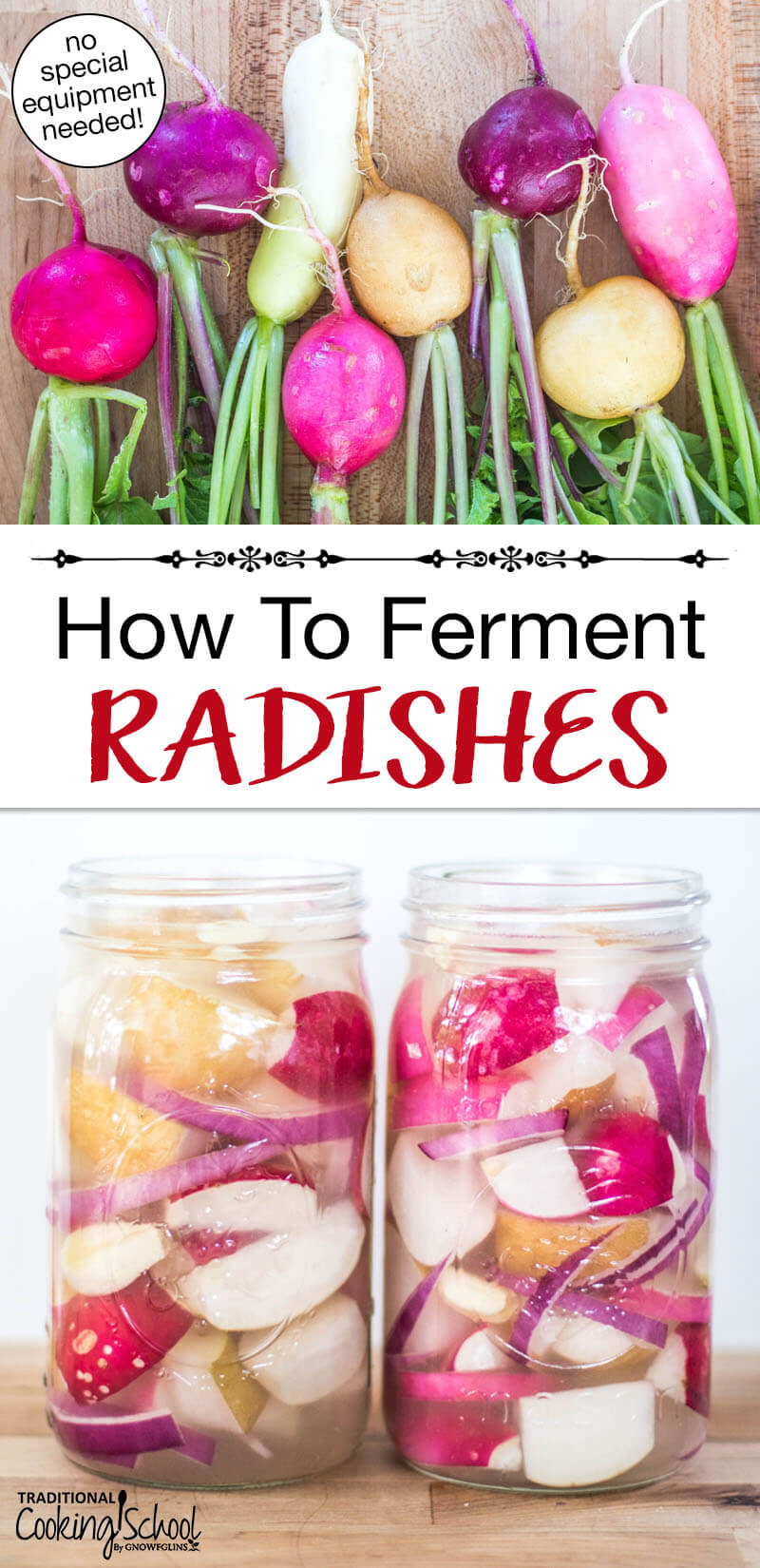
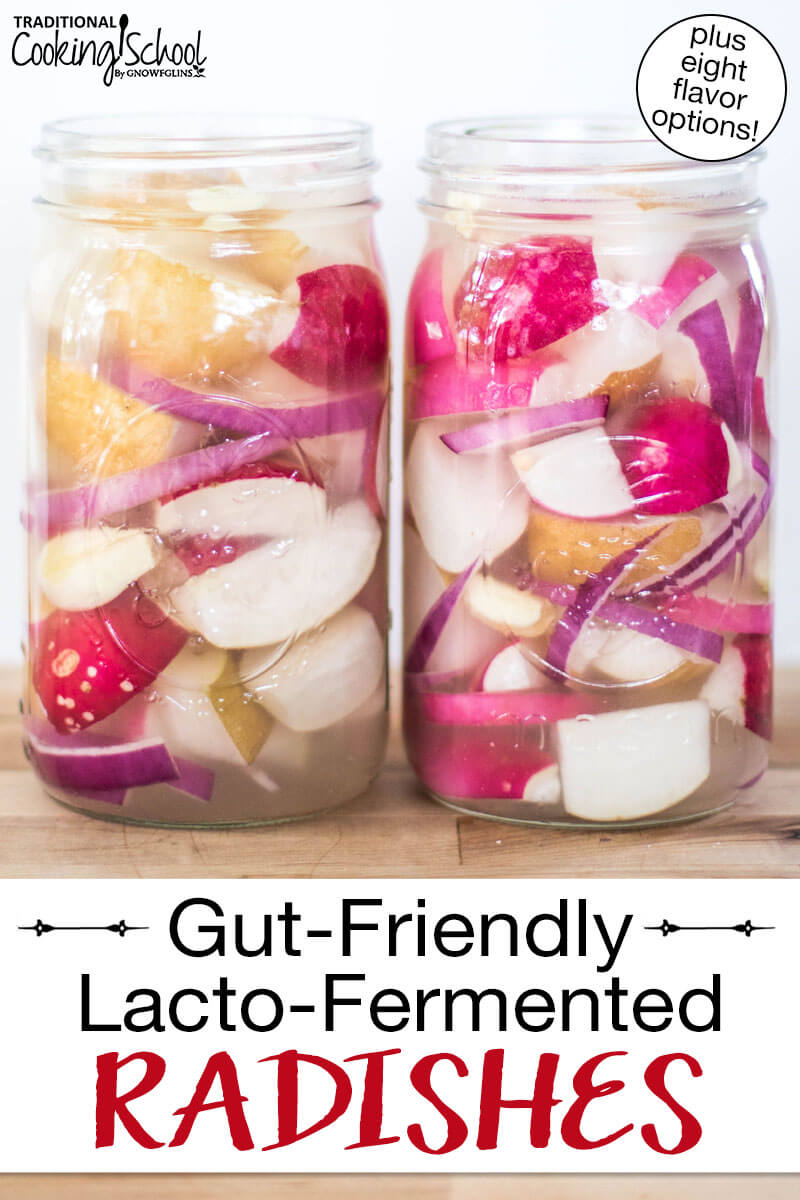
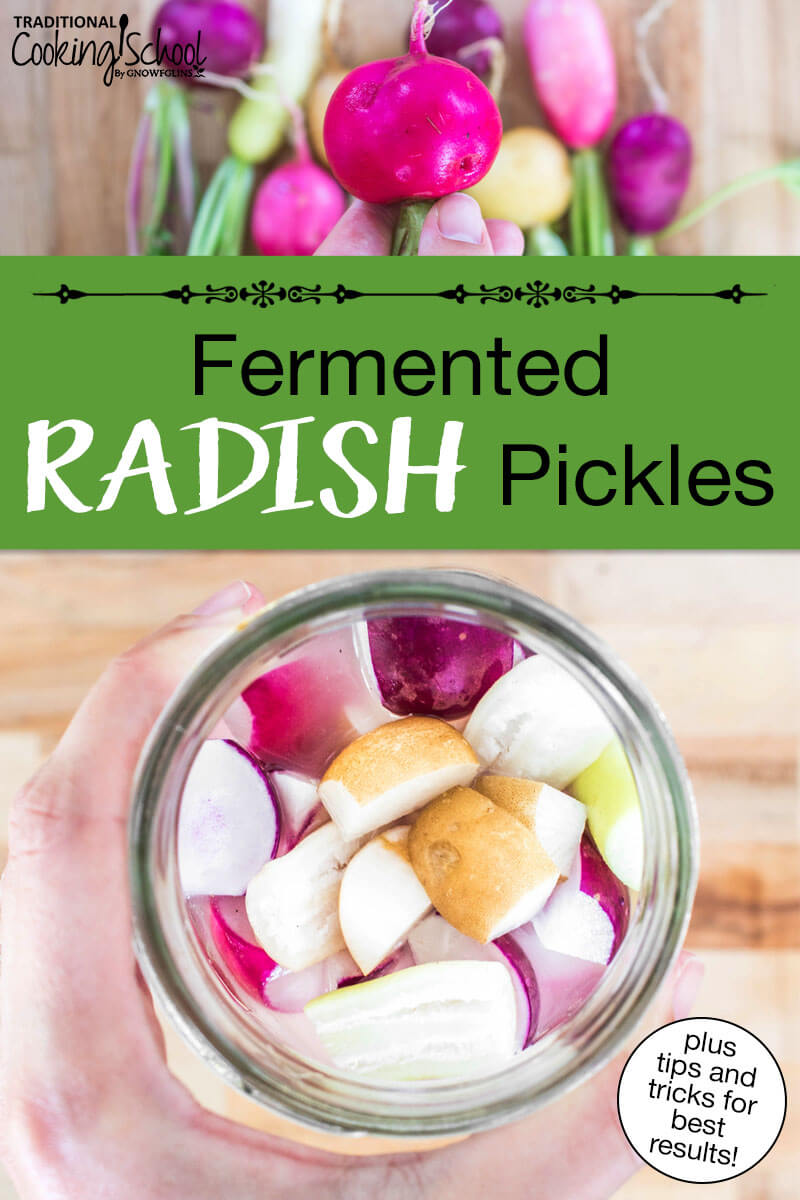
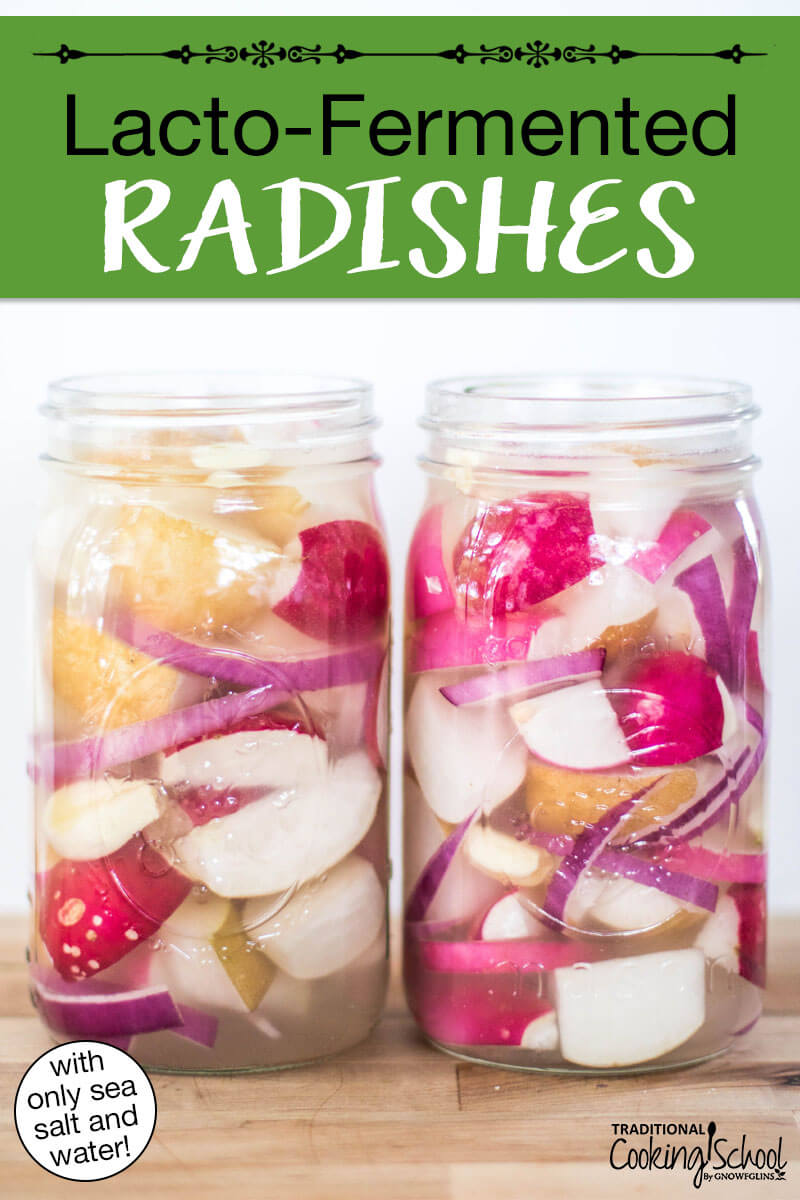
Any kind. I have used just plain red radishes, and an Easter egg mix of radishes (pictured). They all work!
I’m dairy-free. Is there another starter culture I can use instead of whey?
Yes! You can use leftover fermenting juice from pickles or sauerkraut instead at the same rate as whey.
Help! I don’t see any bubbles in my fermented radishes.
Look for other signs of the fermentation process, such as texture changes, color changes and the whole mixture starting to develop sourness from the lactic acid that’s produced. If you’re seeing these signs, all is well. If you’re not, is your ferment kept in a warm enough place to allow the beneficial bacteria to thrive?
I think I see mold in/on my fermented radishes. Is it safe to eat if I skim it away, or should I toss the whole thing?
It depends. Please reference this post for preventing mold during fermentation, and what to do if it happens.
How can I tell if my radish pickles are spoiled or not?
Trust your nose! Though be aware that if it repels you but is not spoiled, it might be because you’re unaccustomed to fermented foods and need time to adjust to a new normal. If you aren’t sure, you can take a little taste and see how it goes. It’s always okay to be on the safe side and compost the ferment or feed the chickens with it and start again.
Check out this #AskWardee for the signs that your ferment is on the right track. And here are hard and fast signs that a ferment has gone wrong:
- It’s moldy. Pink or fuzzy is not good.
- It’s mushy.
- Its smell repels you because it’s putrid or rotten, not just sour. Your nose KNOWS this!
- When you taste it, it gives you an upset stomach. (Don’t confuse this with a healing reaction, though.)
Any time you get into a jar, repack it carefully to keep all food submerged and under the protection of the brine.
How can I tell if my fermented radishes are done?
Go ahead and open a jar up to smell and taste it! No two ferments are going to be exactly alike — this is a flexible process and you really have to open the jar and dig in to see what’s going on in there. I discuss the typical signs of a finished ferment in this article.
How to eat fermented radishes.
I personally love eating pickled radishes straight from the jar! Also delicious, serve as part of a charcuterie board, a veggie platter with homemade ranch dressing dip, atop a green salad, or sliced thinly on a sandwich, they’re also fantastic on a hummus platter with this homemade sprouted hummus and cut up veggies. They are tart and tangy, crunchy and fresh!
Can I reuse the brine?
Definitely! Do keep in mind the flavor, however. A garlicky radish brine is probably not going to taste good inside a fruit ferment… but would be delicious in other savory fermented foods, like another batch of pickled radishes or homemade sauerkraut!
Other Fermented Recipes
Here are a few of our favorite fermented vegetables!
- Pickled Radish Pods
- Old-Fashioned, Crunchy, Fermented Garlic-Dill Pickles
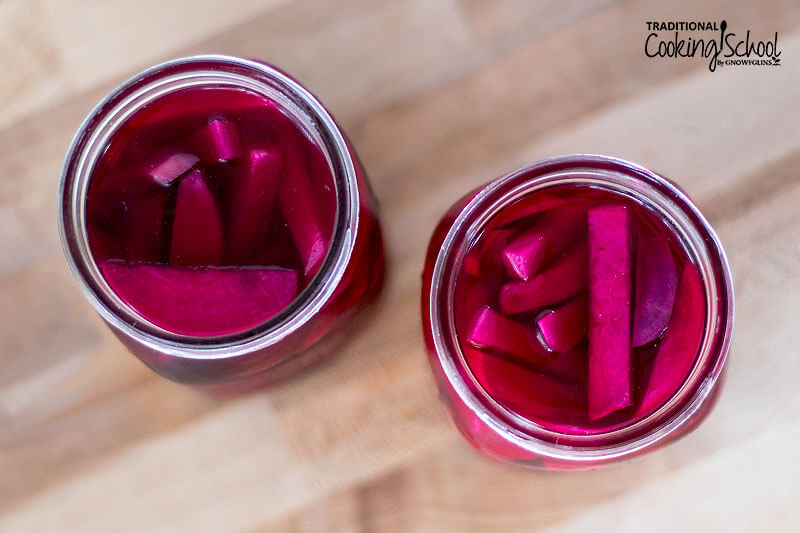
- Lacto-Fermented Turnips & Beets (pictured above)
- Lacto-Fermented Carrot Sticks
- Garlic-Dill Pickled Okra (crunchy, not slimy probiotic snack!)
- Homemade Sauerkraut In A Stoneware Crock
- What Is Lacto-Fermentation? {Video}
- Fermenting Trouble Shooting FAQ’s
Did you make this recipe? Please leave a star rating in the recipe card below, then show us your finished product or your favorite way to enjoy fermented radishes and tag us on social media @tradcookschool.
Lacto-Fermented Radishes
Lacto-fermented radishes are tart and tangy, crunchy and fresh... perfect on green salads or dipped in our favorite homemade ranch dressing. If you're new to fermentation, this easy gut-friendly recipe will get you started!
Ingredients
- 1/2 gallon pure water
- 6 tablespoons sea salt
- radishes ends chopped off and cut into quarters
- 3 cloves garlic crushed; per quart
- 1/4 red onion sliced thinly; per quart
- 1/4 cup whey optional; per quart
Instructions
-
Make your brine by dissolving salt in water. Simply combine salt and water in a half-gallon jar and stir until the salt dissolves.
-
Chop ends off radishes chop into quarters (small radishes) or sixths (large radishes).
-
Thinly slice onions.
-
Peel and crush garlic cloves.
-
Fill as many quart jars as necessary to use up all prepared vegetables, layering radishes with onion and garlic.
-
Press down on the veggies to make sure they’re packed in well and don’t fill up higher than within 1 inch of the top.
-
Pour whey, if using, and brine over top.
-
Use a clean regular mouth jar lid to weigh down radishes below surface of liquid (otherwise they like to float up to the top).
-
Put the lids and bands on the jars and tighten securely.
-
Leave on the counter at room temperature for 3 to 5 days. Look for bubbles as a sign that fermentation is happening (if you don't see bubbles, read my tips below). Taste to see where you like the texture and taste.
-
Skim off any mold that accumulates on the surface.
-
When done, transfer to the refrigerator or cool storage.
Recipe Notes
This recipe is easily scaled up or down. I have called for enough water and salt to make 1/2 gallon of brine, which is enough brine to cover at least 3 quarts of radishes.
Don't have enough brine to cover all of your radishes? Make more brine in the same ratio of water to salt.
Have too much brine? Store in a sealed jar at room temperature for a few days and use as needed in other fermenting recipes. If not used within a few days, transfer to a non-glass container, such as an empty milk jug, because otherwise the jar might crack.
This post was originally published and written by Wardee Harmon on 5/17/11. It was updated and republished on 7/7/21.
This post was featured in 37 Ferments for Spring.
...without giving up the foods you love or spending all day in the kitchen!

2 free books:
Eat God's Way
Ditch the Standard American Diet, get healthier & happier, and save money on groceries...
We only recommend products and services we wholeheartedly endorse. This post may contain special links through which we earn a small commission if you make a purchase (though your price is the same).





And save the tops for radish leaf pesto!
I’m planting radishes this year for the first time, since I can’t seem to get enough of them! This really looks fantastic, and I can’t wait to try them. Thank you for sharing the recipe, and for info on the book!
I was just looking at all our radishes thinking, “I would love to ferment these.” Thanks for the great recipe!
I was wondering about LF radishes. Glad to know they turned out so well. I think I’ll plant a few more squares of them knowing I can ferment them 🙂
Hello Wardee,
Thank you for this beautiful post! I just wanted to check – you mentioned using whey specifically from yogurt or cheesemaking. I have a lot of whey to use that is just from raw milk left out to separate. Should this be OK to use in this recipe (and others) or is it not the same. I just wanted to make sure before I make these 🙂 Take care!!!
Meredith — Yes, that whey is fine! As long as the dairy fermented somehow, the whey will have an active population of good bugs for the ferment. 🙂
Thanks, Wardee. I was wondering about using whey rather than so much salt. I thought I had read (from you) that you could use whey for most lacto-fermenting but hadn’t looked up that reference yet. Question: are you using the 1T salt for flavor only or to help the ferment/preservation? Thanks. Barbara
Barbara — You can reduce the salt if using the whey, yes. In this recipe, that salt is a great deal for flavor. A salty brine is delish — and I’ve added it to salmon salad, salad dressings and other things for a pickly flavor. But I *think* it is salty enough that you could even halve the salt and still have enough flavor.
This sounds just fantastic!! Not sure why I never thought of it. What are your thoughts on subbing mustard seed for the mustard powder?
Carolyn — That would be great! People often put in whole seeds, but I like to crush mine (mustard, peppercorn, dill) to release more flavor into the brine.
Wardee
I fermented some daikon radish recently and it is delicious!
Wardee – I will have to try your variation as soon as our radishes are ready to harvest. Thanks so much for your kind mention of the book!
Shannon — You’re so welcome. I LOVE your books, especially because of the essays from your heart.
I was just thinking of fermenting some radishes….but I don’t have any whey. I’m new to fermenting. Will it work okay using salt instead?
Colleen — Yes, that will be fine! You’ll need to up the salt though. Make a brine of about 2 tablespoons of fine salt to 4 cups water. Let it cool and use that to cover your radish mixture.
I am new to all of this. I have a question about fermenting. Do you have to use whey? Why I ask, don’t know how to make. Also, if have to make from raw milk, having hard time finding.
Thank you.
Tina — No, you don’t have to use whey in veggie ferments. But the salt must be sufficient to prevent bad organisms from flourishing. So double up on the salt up there and you can skip the whey.
Whey is pretty easy, though — drip plain yogurt or kefir with active cultures through a fine cheese cloth and what drips out is whey. 🙂 The milk doesn’t have to be raw — but it must have been cultured with beneficial organisms and then not heated again to get good enough whey. You can also substitute water kefir for whey in lacto-fermenting.
Thank you for replying. I’m still on just lesson 2 of your fundamentals course and I’m learning. Don’t really understand whey, kefir, etc, but I’ll get there. May GOD continue to bless you.
Can you use kombucha instead of whey?
Raminder — I would just leave out the whey. The Kombucha’s organisms produce different acids so while it would ferment, it wouldn’t necessarily be lacto-fermented. However, you could still do it!
“Skim off any mold…”. Is it normal for mold to grow on fermented vegetables? My first try at sauerkraut had some mold around the edge on the top of the liquid and I got scared and tossed the whole thing!
Sharmista — Yes, it is fairly normal, especially in warm temperatures. If the mold hasn’t gone throughout the ferment, it is usually fine.
Skimming mold is really not ok – it shoots deep tendrils deep into your food. Lactofermentation is by definition an anaerobic process – which means no air should be getting into your ferment. This does not mean a little air – but NO air. Mold is not an issue if you properly fermenting. I use the Pickl-it jar which is a closed air system – no mold or undesirable bacteria get in – plus you have an airlock so that the CO2 can be released. so no exploding or oozing jars either – really great affordable systems – I only teach using these now that I understand the biochemistry of lactofermentation.
This is a limited way to think of fermenting. Cultures world wide have been fermenting for hundreds and thousands of years without those jars, and they were al a lot healthier than modern man. Loosen up a little. It sounds like you are an educator, but you should broaden your horizon and read the book “Wild Fermentation”. Cheers.
Lots of cultures have used various methods of fermentation that suited their climates and seasons. For instance Koreans used crocks and buried them. The crocks had a lip and were buried underground which prevented oxygen from getting in. Also they tended to do Kimchi ferments in the colder fall and winter season. This is different from what so many are trying to do all year around or during hot seasons, which really can make it easy for mold to grow. Lisa is right that mold sends it spores spiraling far down into the product, which you can’t just scrape off.
So if you can tolerate eating mold this will be fine, but if you can’t, then a true anaerobic system would be better. There are numerous inexpensive airlock lids out there as well as cheap ways to create a truly anaerobic ferment without spending too much. I did the mason jar thing for years never knowing why it made me slightly sick and often turned out viscous or slimy or moldy.
With my airlock lids I get crunchy fermented vegetables, tasty pro-biotic brine that I often drink and I can let my ferments go long enough to develop all the vitamins, and pro-biotics they can. Some of my sauerkraut ferments go for 30 days without a speck of mold or any problems in the airlock jar.
What we don’t know about how other cultures did things thousands of years ago is part of what we need to keep our minds open to. I think we have to realize we really don’t always know how to mimic thousand year old healthy results, or even if our results are truly healthy.
Here’s and article that did some scientific experiments using different methods and then looking at how much pro-biotic activity was created in the food that was being fermented. I love this article and always refer people to it who need to understand what is desirable in a ferment. And believe me this gal tries every way of using jars and airlocks and crocks that we would use in modern times. She also tests the actual pro-biotic activity in these ferments which is the reason we’re all doing this-right? There are actually several articles about this but the one I’m linking to is her conclusions and recommendations.
http://www.nourishingtreasures.com/index.php/2012/07/03/sauerkraut-survivor-final-report/
I just made these, well 3 days ago, and they are delicious!! I love the ginger/garlic flavors. This is my very first lacto-ferment and i am so glad they are a success. Our vegetable CSA is throwing a potluck party next weekend and I am definitely making some more of these to take.
would this work with beets as well?
Yes! 🙂 Though they take longer to ferment as they’re harder.
Hi, This is my fist experiment with lacto-fermenting. I wasn’t quite sure on the whey so I just used plain yogurt that I made myself from goat milk. The thing that I am wondering is how do you know if they are good? When the 5 days were up I shook it up really good (because I thought I should mix the ingredients.) and when I opened it, it was like opening a soda can. A lot of air came bubbling up for a while. Does this mean it is bad? They have an….interesting flavor. They taste good, very sour-tartish, kind of like pickels? Is this how they should taste? Is it dangerous to eat if they are not “good.” (Like if bad bacteria grew in it?) Sorry for so many questions. Thanks so much for the recipes!
Jennifer — It sounds like it is doing awesome! The bubbliness is just perfect, and the way you described the flavor is just great, too. You could ferment it longer if you wanted the beets to be softer. Enjoy!
I read in another post of yours that whey is optional in purely vegetable recipes. Can I omit the whey in this recipe? And do you think it would be okay if I used pint sized jars instead?
Sarah — Yes, it is optional. This brine is salty enough to just leave it out. With lower salt recipes you’d want to increase the salt when omitting whey. The whey provides a starter culture and also increased acidity to assist a good fermentation. But it can be left out and the naturally present organisms will increase in numbers and do the fermenting.
I have had my eye on these for a while and just made them subbing some carrot coins for part of the radish since I only had one bunch. I also added a couple baby turnips I had. Can’t wait to try them! I like them sour though, so it will be a few days.
Ooopsie. I usually weigh stuff down by inserting a gallon zip bag into the mouth of the jar and filling it with water so it pushes the solids down. My bag leaked and now my ferment is full of water. Do I leave it, of do I strain it and start over?
Is this how they should taste? Barbara — You can reduce the salt if using the whey, yes. With lower salt recipes you’d want to increase the salt when omitting whey.
i’ve made these a couple of times–minus most of the spices, and inoculating the brine with some old, active sauerkraut juice instead of whey. delicious. i’ve started adding radishes to all my cruciferous mixes. thanks for the idea!
I have fermented radishes several times in the past, as they are my daughter’s favorite! This time my brine turned syrupy, though, which I have never seen – do you think it could be off? It doesn’t smell terrible, but the brine is absolutely thick.
I made these as my first-ever lacto-ferment and they are delicious! Thank you for the recipe!! ^_^
I want to keep making more ferments, but don’t have much room in my fridge. My unfinished basement is cool, but it’s not below 65F….do you think my radishes might still be safe down there?
Forgot to mention, I made them with extra salt instead of the whey, as I didn’t have any.
That’s really not cold enough for storage of ferments. Like you, I am limited on cool space. It’s a challenge!
Can you use Body Ecology culture starter instead of whey?
Hi Lori,
Yes. You can use the Body Ecology starter culture.
I know that lacto-baci…dudes are in my sourdough culture. Can I use that to start my ferment?
I wondered this yesterday as I mixed up the flour/sugar/spice porridge for my kimchi–why can’t I use sourdough discard instead of flour paste?
Hi Jessie,
You wouldn’t want to use a sourdough starter. The starter also has yeast and that may cause prevent a strong lacto-fermentation.
Millie
Traditional Cooking School
Can I use kohlarbi?
Hi Linda,
Absolutely! 🙂
Let us know if you try it.
~Peggy, TCS Customer Success Team
I tried the kohlarbi. I used kefir water and let them go 4 1/2 days. They are crunchier than the radishes but the fermented taste was just right for me.
I did the radishes and they are so good! Even my son, who doesn’t usually like fermented foods, liked them.
Hi, Linda,
Thank you for letting us know and I am so happy they turned out great! 🙂 I can’t wait to try fermented kohlrabi for myself. It’s always exciting when you find something new that the family will like.
~Peggy, TCS Customer Success Team
Fantastic recipe. Thanks for sharing
I started a lacto-ferment of zucchini yesterday since they are overflowing my fridge! Cannot wait to eat some.