
Now I’m not sure what rendered goat fat is called… Lard? The internet doesn’t yield the answer. Anyone know? 🙂
My husband and kiddoes butchered a goat last weekend. B. came in the house and asked me what I wanted before they hung it or gave the innards to Areli (our dog), and I said, “The fat, the heart and the liver.” The heart and liver I plan to add to other meat dishes to boost nutrition. The fat was destined for rendering and a multitude of cooking uses: definitely frying, perhaps pastries, and possibly soap. I hear that goat fat makes very hard soap.
How to Render Goat Fat (or any animal fat)
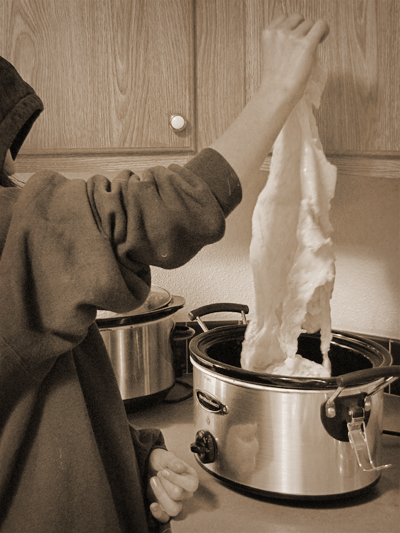
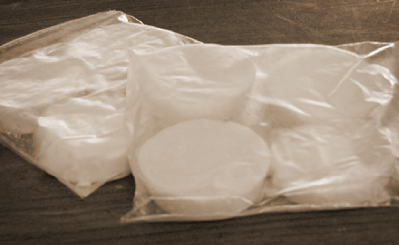
I have rendered beef tallow before, and this followed the same process — except this goat fat was so white and clean. The finished product needed no straining. I was able to ladle the melting fat right into muffin tins, which I froze in quart size bags when hardened. My mom tipped me off to freezing small chunks in the freezer, which she learned from my grandmother and namesake, Tata Wardee.
How to Render Goat Fat (or any animal fat)
Use these instructions to render fat from any animal.
Ingredients
- fat cut into small chunks
Instructions
-
Ideally, cut up the fat into small chunks (how small? anywhere from 1/4" cubes to 2" or 3" chunks).
-
Or you can skip that and put the sheets of fat right into the crockpot or pan.
-
If you skip this, it is possible the process will be longer, require more stirring, or less completely render.
-
But it's all good. I read that women used to render big pieces of fat in big iron pots outside over a low fire, using big wooden paddles.
-
On low, allow the fat to begin melting.
-
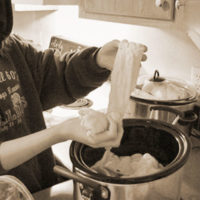
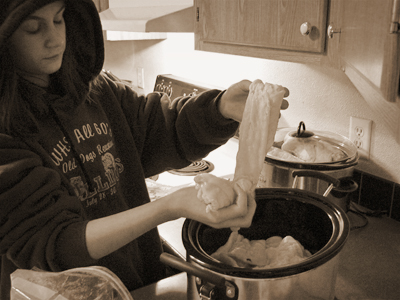
As it melts, ladle it into waiting containers, through a strainer if necessary.
-
Your containers can be mason jars, baking trays, muffin tins, or ice cube trays.
-
Tip the pan as needed to fill the ladle.
-
Gently stir the fat in the crock or pan to make sure all pieces are getting equal heat treatment.
-
Repeat the ladling, stirring and heating until all the melted fat is released.
-
If you have more fat, you can keep adding it as there is room.
-
You'll know you're done when all that remains are “cracklings” — yummy, crunchy leftovers.
-
Using a crockpot is more hands-off; just an occasional stir is all that is necessary in addition to the ladling off of melted fat.
-
Using the stovetop requires that you be present and stir more — but the process is much faster.
-
Either process can be smelly (like a deep frying smell), depending on the type of fat.
-
Some people use their crockpots or electric roaster pans outside or on a porch to keep the smell out of the house.
-
I found that this very clean goat fat was hardly smelly at all; much less than the tallow I've rendered.
Recipe Notes
For best results, keep rendered fat in cool storage or freezer. Use for: pastries, frying and deep-frying (like these tortillas chips), or soap.
Conventional wisdom has got fats all wrong. Don’t be afraid of saturated fats; we need them. Before processed vegetable oils, healthy, traditional cultures had only the fats from animals, coconut and olive. (I am trying to think if there were any other obscure fats this doesn’t cover. Any way, you get the picture. ) These people were healthy and free of modern diseases. In our classes and on this blog, we use healthy fats frequently — from biscuits and muffins, to frying tortilla chips, to eggnog and cheese, to making and enjoying cultured butter, to peppermint patties, and beyond.
...without giving up the foods you love or spending all day in the kitchen!

2 free books:
Eat God's Way
Ditch the Standard American Diet, get healthier & happier, and save money on groceries...
We only recommend products and services we wholeheartedly endorse. This post may contain special links through which we earn a small commission if you make a purchase (though your price is the same).


Thanks for this post! I have a feeling we will be doing this at some point in the future.
I chickened out this fall and gave away the wether that we should have butchered… But we will have a new batch of goat babies this spring and it really is a good way to fill the freezer!
Jill — I know just how that happens, and so does my husband. Getting over the hump of the unknown, never-done technique is so big sometimes. You can do it, though!
Yes, it’s definitely the unknown part that unnerves me a bit! I’ve killed, gutted, and cut up plenty of wild game and beef, but something about butchering one of my little goats kinda bugs me… It will happen though!!
We have butchered a wether from someone else (the champion at our 4-H fair, actually – if ya can’t beat ’em, eat ’em! lol) and a couple others that we bought, but not one of our own babies yet. This is the year, though, so I know what you mean…
I rendered beef tallow just yesterday. It was by the front door in a crockpot where I could get to it easily but wouldn’t have to smell it. The mailman, the UPS driver, the guy who poured the new driveway and a couple neighbors all got a very abbreviated healthy fats speech when they asked what it was. 😀
Peggy — You’re hilarious! And such an evangelist. 🙂
Great post. We plan on raising Kinder goats in a few years when we move back up to Oregon. I’m looking forward to trying to fully utilize every bit of our animals and i make soap so will definitely try to use the fat for that.
Miranda — I am excited for you! What kind of soap do you usually make?
I make cold process soap and usually use a combo of olive oil, coconut oil and shea butter with essential oils. So nice! http://www.flickr.com/photos/mirandypandy/5241415098/in/photostream/
Miranda, your soap is soooo lovely. 🙂
This is quite interesting, I will have to share this information with the woman I buy eggs from, she also sells goat meat they raise (as well as many other meats). I would think it would be called lard, even though it is not pig lard.
-Brenda
Great post! It didn’t look as hard as I thought it would be. You are so right, it is so important that we eat real nourishing fat. Thanks for a great post.
It’s tallow, like beef or lamb. It is a very hard fat, white, clean. I hot pack mine in canning jars. As long a you get all the moisture and little bits out it’s fine.
You’re all amazing. I’m a classic modern-day fear-of-slaughtering-type of girl. How do you get over that hump?? (PS: I love hamburgers.)
I’m in the process of crock pot rendering of bison tallow. I thought I had to use water, so I put in 1/2 cup of water into my crock pot and have been cooking on low with the lid on. Does anyone know how you deal with the water? I hope someone knows:) Thanks!
Krissy — What did you end up doing? I would think when you take the rendered fat out (containing water) the fat will harden and float on top? Then you can separate them. I am sorry I am late to answer your question. You probably already figured something out. I hope so!
It wasn’t finished when I was ready to go to bed so I dropped the crock pot down to warm and turned it back up to low in the morning. I was afraid it would burn over night. I never could find an answer on the internet, the most I could find was a post saying it made no difference. When completely rendered I just removed the “cracklings” and poured my tallow into glass jars. There never seemed to be any water once the fat began melting??? There was no seperation in the crock pot or once I let the tallow cool in the jars. So I guess some how the water doesn’t matter. I would have guessed it would seperate out as well…but it did not. So now I have some 100% grass fed bison tallow for the first time!
Krissy — Maybe it all evaporated! Well, I’m really glad to hear it all worked out. Enjoy it!
Trying this tonight- it is in the cockpot on low for the night :0)
~Christina
as for the lard question…. I have an answer!
I was showing my mother my handiwork, to which she politely asked if it was for soap.
Lets just say that my explanation of having lard to cook with … has a reputation similar to cigarettes- lard has been really demonized! I think “rendered fat” sounds more like a necessary evil that people might be willing to consider.
There is my answer worth 2 cents.
What do you think?
~Christina
What is the purpose of salt & water in rendering tallow? Does the salt stay in the water or mix into the fat? Is it necessary?
Will pouring the rendered tallow through a finer mesh pull out odor as well? I rendered some beef tallow, but the odor is strong enough that I don’t think it would work in a sweet pastry.
Hello
I’ve rendered a lot of goat fat into lard.
Please never add water into any fat that you are rendering. The point of rendering fat Is to release and evaporate the water in the tissue.
It is best to cut the pieces whether belly or kidney fat into pieces so that it cooks more quickly and more oil is released. Cook the fat until the milky colour is gone… that is the water.
When the oil is clear turn it off and let it cool. It is extremely hot! This will also allow all of the fried pieces to settle to the bottom.
Let it cool at least 30-45 minutes side that it is still warm.
Ladle into glass jars or metal forms.
You can use a strainer to remove the little residuals. Squeeze the fat in the strainer to remove all oil.
Set it on a counter for 30 minutes to let it set.
The crackling or chitlings are great with a little salt added while still warm. You can bag them and put them in the freezer for storage.
They are great to eat and are excellent treats or food for your dog.
Happy rendering!!!
Thank you for this good info…
This is the fat from under the skin and not that which surrounds the inner organs?
Goats lay down fat mainly in the form of skin fat( looks like thin layer of bubbly, weblike sheet) or fat that gets deposited internally around the kidney area(longer and about forearm thickness).
On my previous post i forgot to mention…
When the fat is golden brown it is floating at the top.
Remove it out with a strainer and squeeze the chitlings to squeeze out oil. Do it over the pot .Careful… they are hot. Put squeezed chitllings into seperate container to cool. Once you have taken all of the largepeices out, let the small crumbles sink and pour off the oil once cooled.
The small crumbles at the bottom can be strained out from the remainder in the bottom of the pot.
Happy rendering!
MEP
Thanks for the good info and the encouragement. Learning to do what it takes.
Just reading this Enoch Good.
Stephana Good
Douglas Kraft, read this. ????????
Can someone tell me what goat meat tastes like? My husband and I are probably going to get some goats for milk next year. We’d like to be able to eat the males, but can’t find much information on it. If it is a good quality, affordable meat, why do so few people eat it??? Even of those who keep goats? Does it taste awful or is it difficult to butcher?
I think it tastes very similar to beef, at least ours do. I have had the chance to compare someone else’s grain fed wether to our grass fed, and ours was the winner, for sure. It makes great burger, steaks and roasts. It can be tough if not hung properly, as any red meat, but the pressure cooker takes care of that beautifully.
I’m totally new to this, and can’t get any grass fed beef fat, but I can get some from our local King Soopers, (Kroger), I’ve made ghee, and I wasn’t to hard, but I’d love to make some tallow or at least try, and this is the only kind I can get. what do you think, I asked at our local natural grocers and they recommended the Krogers.
My way to render it (I think the most correct name of the resulting product is “goat tallow”); note this is an old way.
Cut the fat in small pieces (obviously you try to clean it as much as you can before cutting) and put in a pot: put at least the double in weight of water and, at least, 1 full spoon of salt every 1 kg. of fat, and 1 glass of winegar every kg. of fat.
Start to heat slowly and then let it boil quietly some hours, stirring and blending regularly.
After that, before the cooling process, strain it.
Then let it to cool down in low temperature (outside, in winter, or in your fridge), and you will have a smart disc of white, pure tallow. Keep it out of the pot, clean the side below, and store it.
End of the process.
Did I miss this? How long does it take in the crockpot?
Goat fat is called tallow, just like deer and sheep fat.
How many pounds of tallow would you say you get from 1 goat?
Hi, Joanna.
It has been a long time since Wardee had goats. She doesn’t recall how much she got and it willy vary with each goat. 🙂
~Danielle, TCS Customer Success Team
How long can I freeze goat fat?
Hi, Ula.
Up to 6 months.
~Danielle, TCS Customer Success Team