
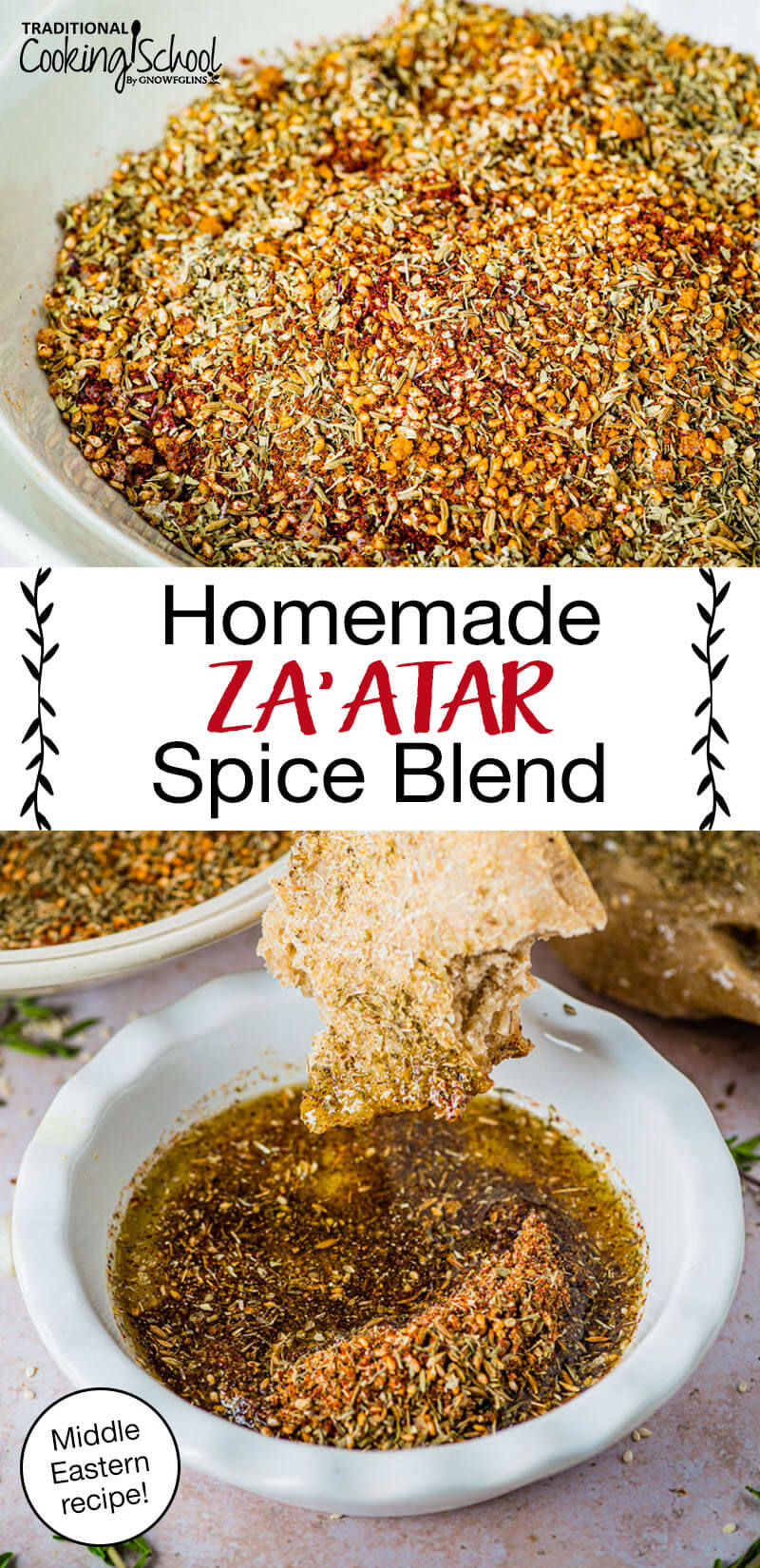
Earthy and savory with a toasty flavor, we love za’atar (also spelled zatar or za’tar)! This Middle Eastern spice blend includes dried marjoram, thyme, and oregano… and once mixed up, is best enjoyed with olive oil for dipping bread or spread onto my favorite Middle Eastern pizza called manakish. Read on for my family’s take on this recipe from our heritage!
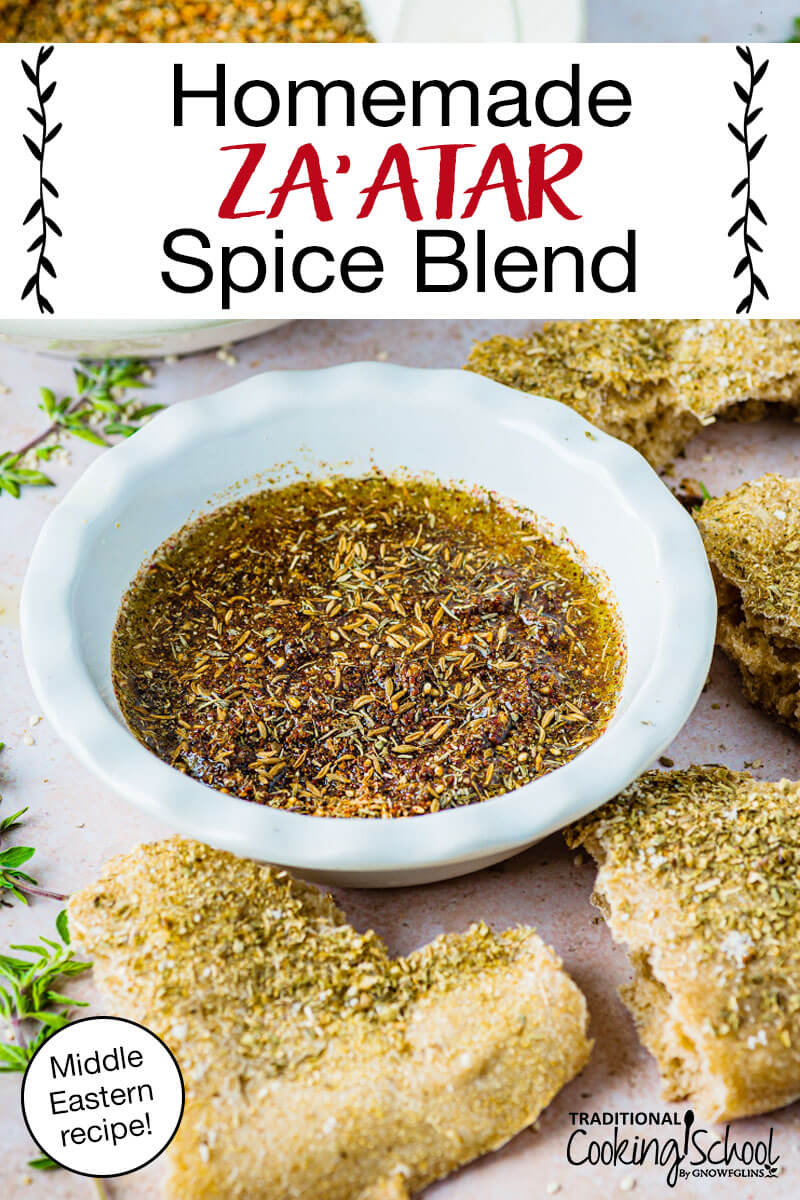
Growing up, on the days my mom would bake many loaves of pocket bread for the freezer, we’d pull out the za’atar and good olive oil for dipping.
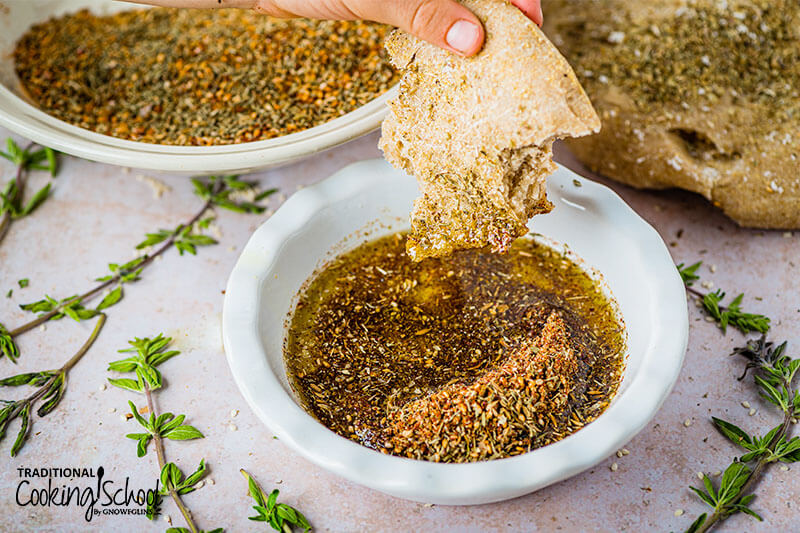
Called zeit oo za’atar (meaning “oil with Za’atar“), here’s how the dipping goes:
- Tear off a piece of bread
- Dip it in olive oil
- Dip it in the za’atar
- Eat
- Repeat!
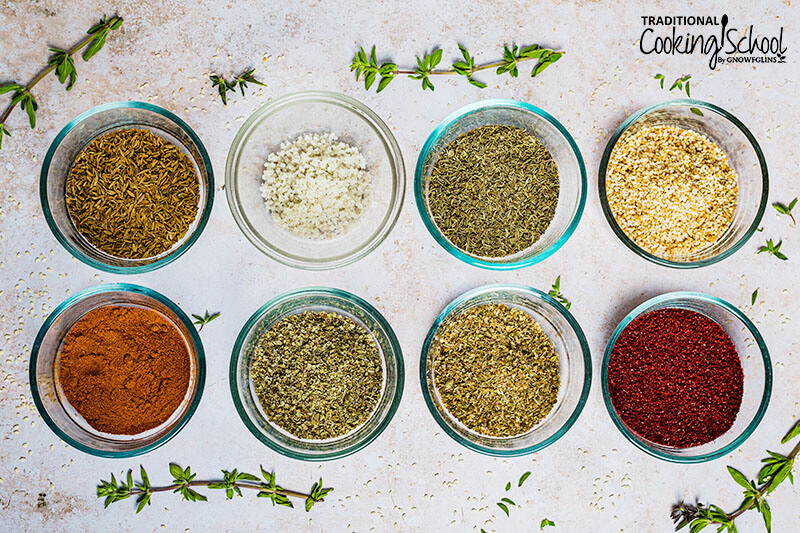
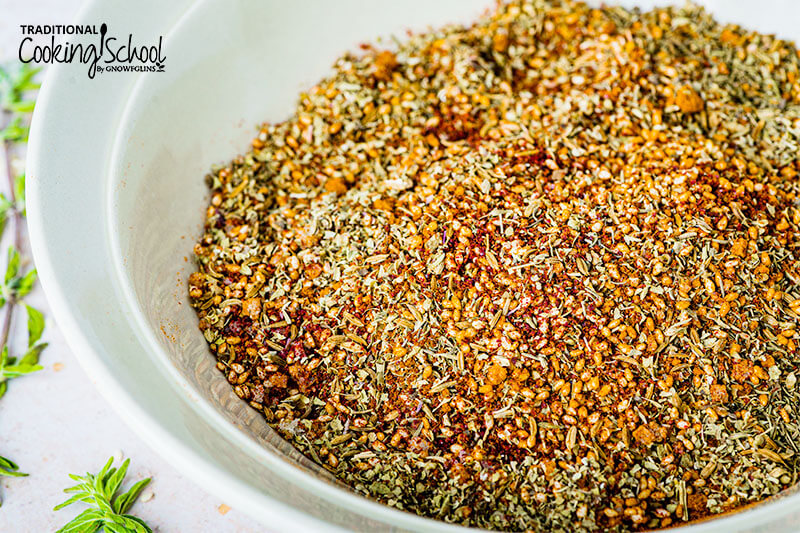
Za’atar is a classic Middle Eastern spice mixture that starts with ground oregano, thyme, and marjoram mixed with toasted sesame seeds and salt. Ground sumac is another popular addition, which we happen to love.
How Do You Pronounce Za’atar?
This word has different pronunciations depending on where you live. In America, it’s typically pronounced za-tar.
Others will say it with a pause between the two a’s: za-ah-tar.
Is it Zatar, Za’tar, or Za’atar?
Because most people pronounce it “za-tar” there’s confusion about the correct spelling. In truth, all three are correct which can cause some confusion that zatar, za’tar, and za’atar mean different things.
The traditional spelling is za’atar, but if you do a quick online search, all options will get you the spice recipe results you want.
Is It A Spice, Herb, Or Seasoning?
Za’atar is a somewhat confusing thing because it’s both an herb and a spice blend.
Za’atar the herb is most commonly known as hyssop, which is considered by biblical scholars to be known as the hyssop mentioned in the Hebrew Bible.
However, za’atar seasoning is the combination of herbs mentioned above, then mixed with sesame seeds and sea salt.
What Does Za’atar Taste Like?
Since za’atar spice blend is made from a blend of oregano, thyme, and marjoram, it has a very earthy, savory and toasty flavor.
Za’atar the herb, on the other hand, is Thymbra spicata, which is in the marjoram/oregano family and has a slightly minty flavor. Then, when you add in ground sumac, you’ll get a hint of a lemony flavor as well.
When all these flavors are combined together, the flavor is unlike anything I’ve ever had, so there’s really no comparison. You just must try it for yourself to see how wonderful it is!
Where Can I Buy Za’atar?
If you don’t have all the herbs on hand to make your own, you can usually find the Middle Eastern spice blend at your local grocery store.
Many stores are now carrying bulk organic dried herbs (which are much more affordable than buying by the bottle). If you have trouble finding the right herbs, (finding sumac can sometimes be difficult) we recommend this brand on Amazon.
Or, if you happen to know of a Middle Eastern market, I’d try finding the za’atar spice blend there. However, be careful, as I’ve read that some companies are using ground up pretzels or other fillers in the mixes. Sad.
Is It Good For Your Health?
Yes! Since homemade za’atar is made up of multiple herbs, and herbs are incredibly good for your health, za’atar seasoning is very healthy.
It’s likely what you eat it with that will make it either healthy or unhealthy.
Many of the herbs in za’atar have either blood-cleansing properties, can improve cardiovascular health, and a University of California San Fransisco study even found oregano to have breast cancer-fighting properties.
How to Eat Za’atar
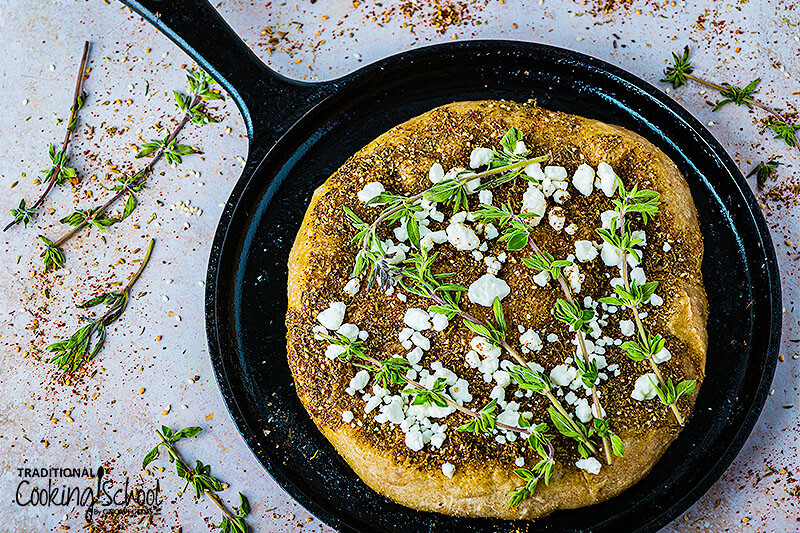
As a child, I often ate bread, olive oil, and za’atar alongside a breakfast of fresh vegetables, fried eggs, and goat cheese. My mom would spread zeit ou za’atar on dough before baking for manakish, a Middle Eastern pizza recipe.
Za’atar can also be used with traditional pizza crust, grain free pizza crust, meats, grains, yogurt, and Soaked Za’atar Spelt Rolls.
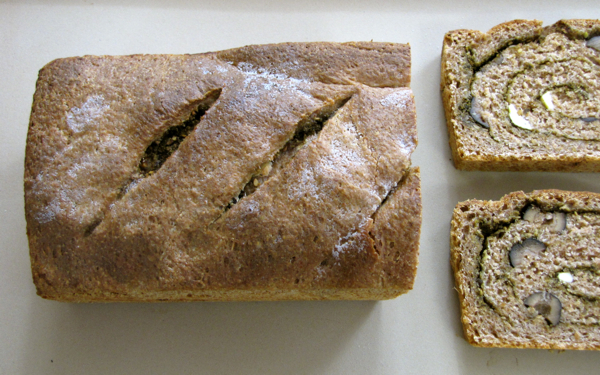
Pssst… Members, check out Lesson 6 of our Sourdough eCourse to find a sourdough swirl bread recipe (pictured below) that includes za’atar, olive oil, olives, feta cheese, and salt. It’s to-die-for!
How To Make This Za’atar Recipe
Typically speaking, whenever we make this recipe, we tend to double it. Our family LOVES za’atar, so we use it in many dishes.
We don’t like to store it very long, though. As with any herbs or spices, once they’ve been ground they begin to lose their potency.
So, feel free to scale the recipe below up or down based on your needs
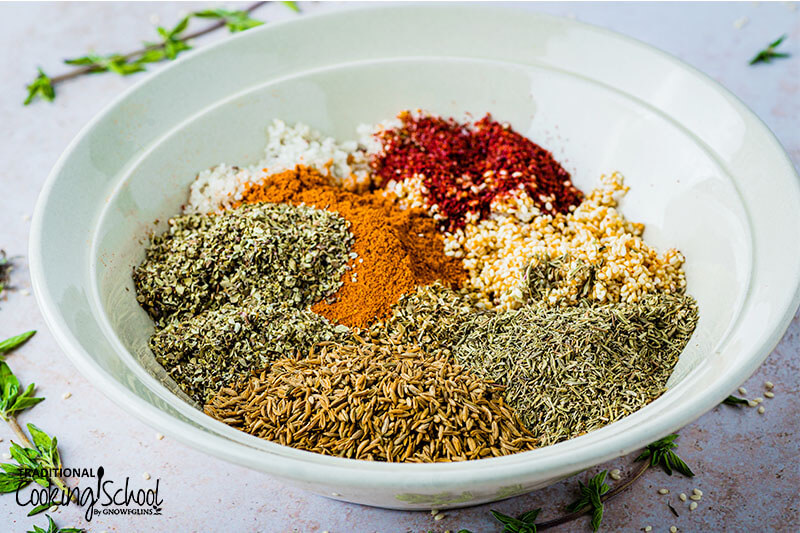
To make za’atar, simply combine all your herbs into a spice grinder and blend until desired, uniform consistency is reached. Then, mix in the sesame seeds and sea salt.
It’s best if you can immediately add some to olive oil and dip fresh flat bread into it!
Za'atar Seasoning
Spicy and fragrant, za'atar seasoning is a wonderful Middle Eastern dry herb blend that pairs wonderfully with olive oil as a dip, or spread on flat bread.
Ingredients
- 1/4 cup ground sumac
- 1 tablespoon sesame seeds toasted
- 1 tablespoon dried thyme
- 1 tablespoon dried marjoram
- 1 tablespoon dried oregano
- 1 tablespoon dried cumin seeds
- 1/2 tablespoon paprika powder
- 1/2 tablespoon sea salt coarse
Instructions
-
Measure out and add all herbs into a spice grinder or mortar and pestle.
-
Working in batches, if needed, grind herbs until desired, uniform consistency is reached.
-
Transfer herb mixture to a jar and add sesame seeds and sea salt.
-
Cap with a lid and shake until mixed well.
Recipe Notes
- Paprika is optional, but we like to add it for color.
- Grinding is also optional, however, we like our herbs to be uniform in size so the sesame seeds really pop!
What Spice Can I Use In Place Of Za’atar?
If you can’t find the complete blend for this Za’atar seasoning, then use whatever you have from the blend. It won’t be an exact match, but when so many delicious herbs are involved, it’s hard to go wrong!
Looking for more spice blend recipes? Try these!
...without giving up the foods you love or spending all day in the kitchen!

2 free books:
Eat God's Way
Ditch the Standard American Diet, get healthier & happier, and save money on groceries...
We only recommend products and services we wholeheartedly endorse. This post may contain special links through which we earn a small commission if you make a purchase (though your price is the same).


Wardee, what part of the sumac is used? I assume the berries?
Sylvia, I’m pretty sure it is the berries because ground sumac is dark red and so are the berries. 🙂
Dear, does it include with Oregano too? U mentioned Oregano on the paragraph, but it wasn’t on the recipe list?
Hi, Shine.
Yes, it should! We edited the post to include. ?
~Danielle, TCS Customer Success Team Lead
mmmmm. You are taking me back to warm Florida Saturday mornings on the patio with my taita spreading out all those goodies for us to eat! I’d love to see you tackle more traditional Middle Eastern fare. My taita embraced all things industrial at some point and used things like white rice and Crisco, etc., and looks at me like I’m crazy to want to take the time to do the old-fashioned way! I’ve been converting some of recipes (like her waraq arish) to use whole grains and fresher ingredients, but I’d love to see what you’ve done.
Growing up, our zaatar was spread on Pillsbury crescent rolls. Your version looks a lot better. LOL.
Nicole, my family uses alot of white rice and white flour. I can’t say I’ve seen Crisco, though. 🙂 I remake everything I do with whole wheat and brown rice. I should work on more dishes, thank you for the encouragement! I would love to see more of what you’ve done. 🙂
Can I use basmati rice or brown basmati rice? And I make my own naan bread, can I spread Za’atar on it goat cheese first?
Hi, Julie: Yes, you can use those varieties of rice. And yes, you can spread Za’atar and goat cheese on your naan. Sounds delicious! —Sonya, TCS Customer Success Team
Sounds good! Looking fwd to the class…and the video (reminder to self: make payment!) 🙂
Thank you Wardee. I use sumac in the kitchen so its good to know yet another use! I mostly use it for seasoning and for making a citrusy drink..
Mmmm… sumac. Brings back sweet memories of sprinkling it over a big pile of persian rice flavored with melted butter.
Every time you mention I keep meaning to ask – what is your middle eastern background exactly?
My dad is Iranian and my mom is a swedish/danish/german american mix. So I am more Iranian than anything else. We lived there when I was little for a couple of years. I learned the language and my mom learned to cook very authentic persian food. So our diet was a heavy mix of traditional persian food and typical american food. I learned my love of cooking from my mom. Unfortunately I didn’t learn to cook many persian meals, but they are some of my very very favorite foods in the world. Tons of lamb, beef, chicken, fish, vegetables, fruits and lots of white rice. The only thing that really bothers me about the huge pots of rice is that I’ve never seen it made without vegetable oils. So I wonder what they used before vegetables came on the scene.
Tara, thanks for filling me in on your background! I have been wondering as well. 🙂 As for me, my mom is German and my dad Palestinian. My mom learned how to cook everything from my dad’s mom (Wardee — I was named after her) who lived with us for many years. I don’t know the language, like you, except for a few things. I wish I had paid more attention when I was younger to the cooking, rather than just enjoying the food. 🙂 I didn’t see vegetable oils used, only butter and olive oil. Now, the flours were white and the rice was white — that bugs me. I wonder when that shift happened?
Oh how funny! Such similar stories! When we lived there (just before all the troubles in the seventies) we were living with my dad’s mother and extended family. My dad’s family was in the construction business so we often moved around and lived in tents in rural villages. So my mom learned to cook from all those sources. While I did learn farsi when I was there (as young children so easily learn languages) I forgot it all when we came back home. 🙁 Sad, I know.
And like you, I was too busy enjoying the food to be bothered with learning to cook it. Plus it was always such a comforting thing to have my mom busy in the kitchen and cooking all that delicious food. I didn’t want to change anything by stepping in and doing it myself. If that makes any sense?
Tara — That makes sense. Why mess with a good thing? 🙂
I loved zayt u zatar when I lived in Jordan for a few years. Yummy pastries with olive oil and zatar. I always thought that zatar was oregano. Didn’t know it was the mix. But your pic looks exactly like the pastries I loved. I think it was the same word for the oregano herb that grew in my friend’s garden and she would put fresh sprigs in our hot tea. I also love the middle eastern recipes. Keep them coming. Just made a fresh batch of your mujadareh last week. I think I’ll make it with chicken broth next time like you suggested. Love the nutrition. I eat it before I run! : )
Hi Wardee,
I thought you might like to know, I did a little post to promote what youa re doing here, on a little linky we are doing about Middle Eastern Recipes on my blog. 🙂
http://homeshalom.blogspot.com/2011/02/preparation-day-linky-15.html
You have been a real blessing to me..so I thought I would other folks know that!
Thank you, Pamela! Big {hug} for your kindness! 🙂
Hi Wardee! Ever since I read this post a year ago, I really wanted to try the za’atar, but never did. Well a dear neighbor of ours who is from Jordan, just brought me over some hot, fresh pocket bread, a very generous bowl of amazing olive oil, and, of course ;-), a nice serving of za’atar! It is amazing! She brought us more za’atar than what we will eat with the bread she brought, so I am going to make your Middle Eastern pizzas with the rest of it. Mmm…can’t wait! 🙂
Mindy — I’m so happy to hear this! You made my day. 🙂
Wardee,
Just wondering if you made any of the zatar from the links you posted yet? And if so, which you preferred? Also, what form is the sumac,
Thank you for this post. I’m interested in making my own Zatar but I’m having a hard time finding Sumac. I am disappointed that Mountain Rose doesn’t sell Sumac. Is there a place that you can recommend where I can purchase Organic Sumac from a reliable and trustworthy place?
Taste wise: I highly recommend, mix the herbs, salt, sumak and olive oil (enough that covers the herbs or more) and fry on a pan for a minute or two. The smell is gorgeous and the taste will send straight to the streets of Jerusalem 🙂 Enjoy.
Wardee,
Did you ever get your family recipe for Za’atar? I would be interested in a tried and true recipe for it if you can share the family recipe. 😉
I have a dear friend who is Lebanese. His mother sends him home from Lebanon with Za’atar when he visits and it is amazing! I had never tasted anything like it! I found a wood-fired pizza place near me that actually serves it as an appetizer. So delicious! I can’t wait to try making it!
I have been following you on face book for sometimes ,I live in Australia .i have all fresh vegetables and fruits from my land ,my husband is a keen gardener ,his hot house produces some good all year round .
I love the way you posted how to start sourdough starter ,
,I use Zaatar “all the time when my grandchildren are home with me. I use sumac with fresh salad called ” Fatouch”
Yesterday we collected some Kale and we did prepared them like the wine leave ( rice / parsley/lemon / olive oil /)
I preserve a lot we just finish the broad bean ,some I freeze and some In jar ,i have follow your instructions for sterilising very useful hints .The ministry for food was an interesting read .Thank you
I bought sumac and hadn’t a clue what to do with it…. lol.. this looks incredibly tasty and what a way to get in all the goodies from herbs too! Thank you Wardee 🙂