
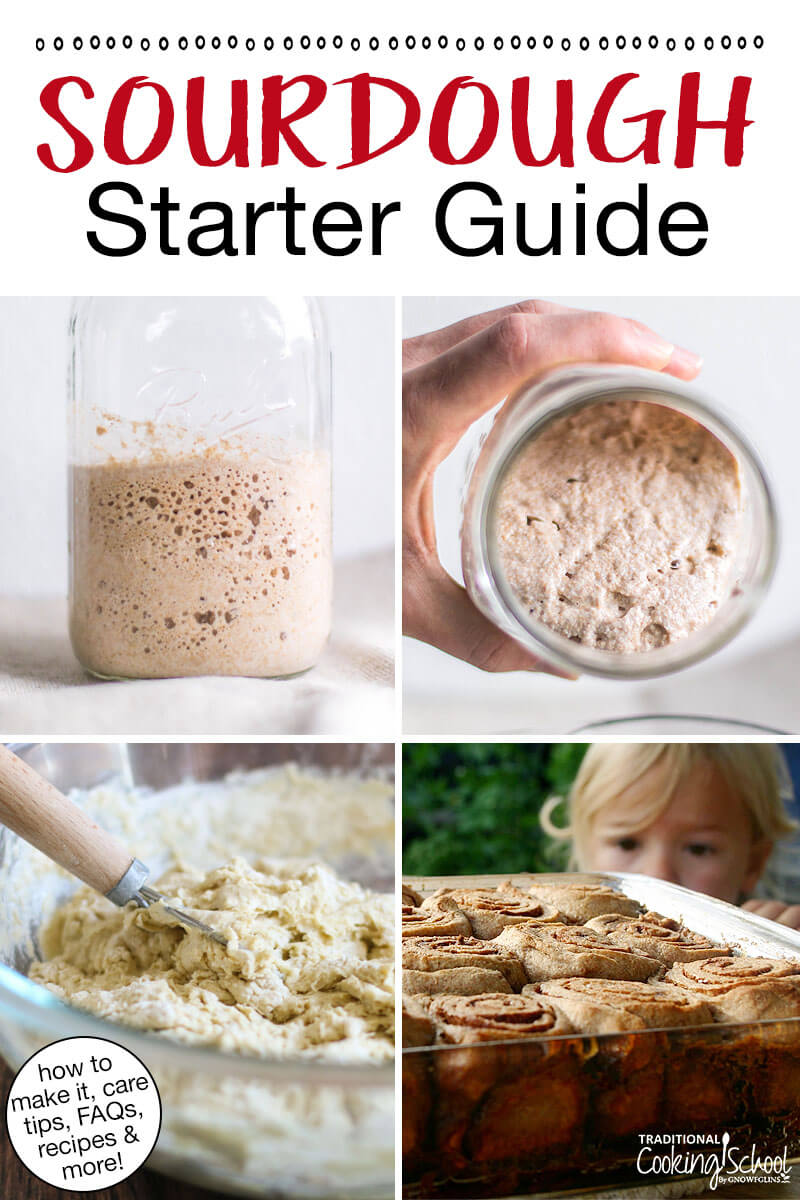
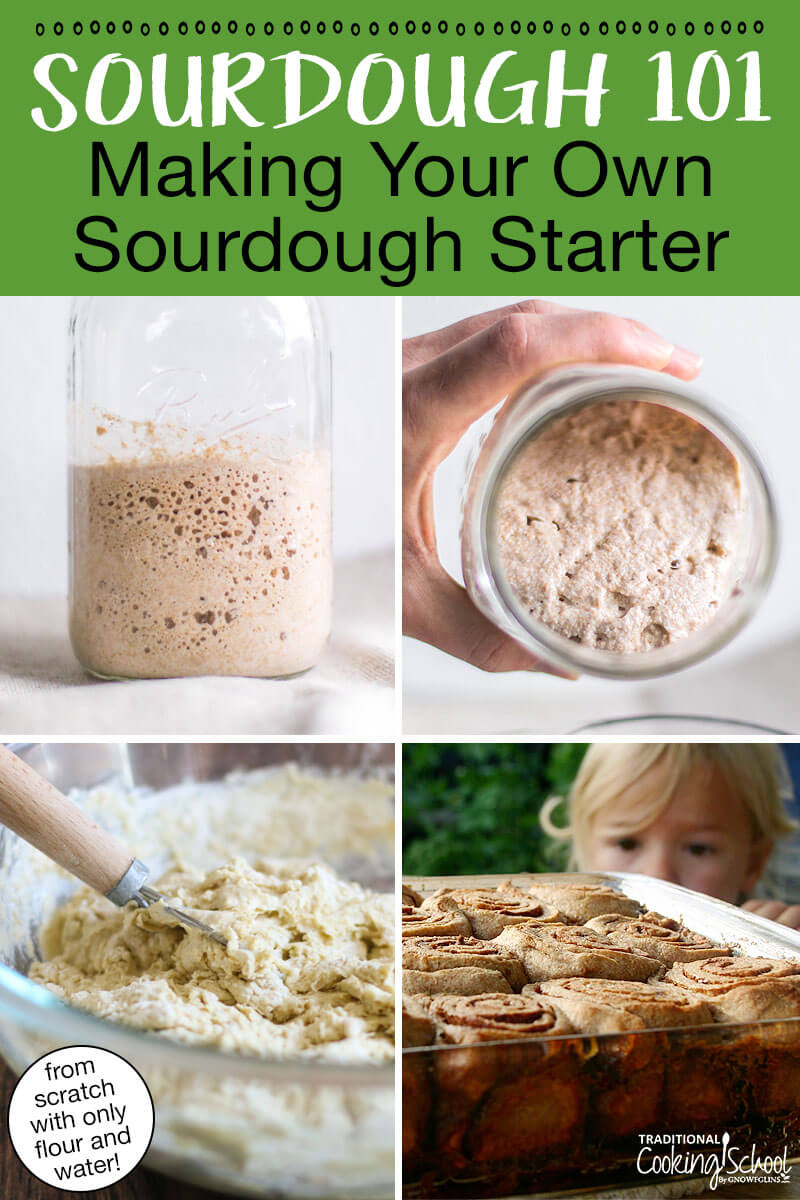
Bubbly and gut-friendly, a sourdough starter makes the best, most flavorful bread! So, how do you get one? Here’s how to make a sourdough starter from scratch with only flour and water… including which flour to use, maintenance and care tips, and answers to your FAQs! We’ll even share our favorite sourdough recipes like English muffins, pancakes, pizza crust, and chocolate cake.
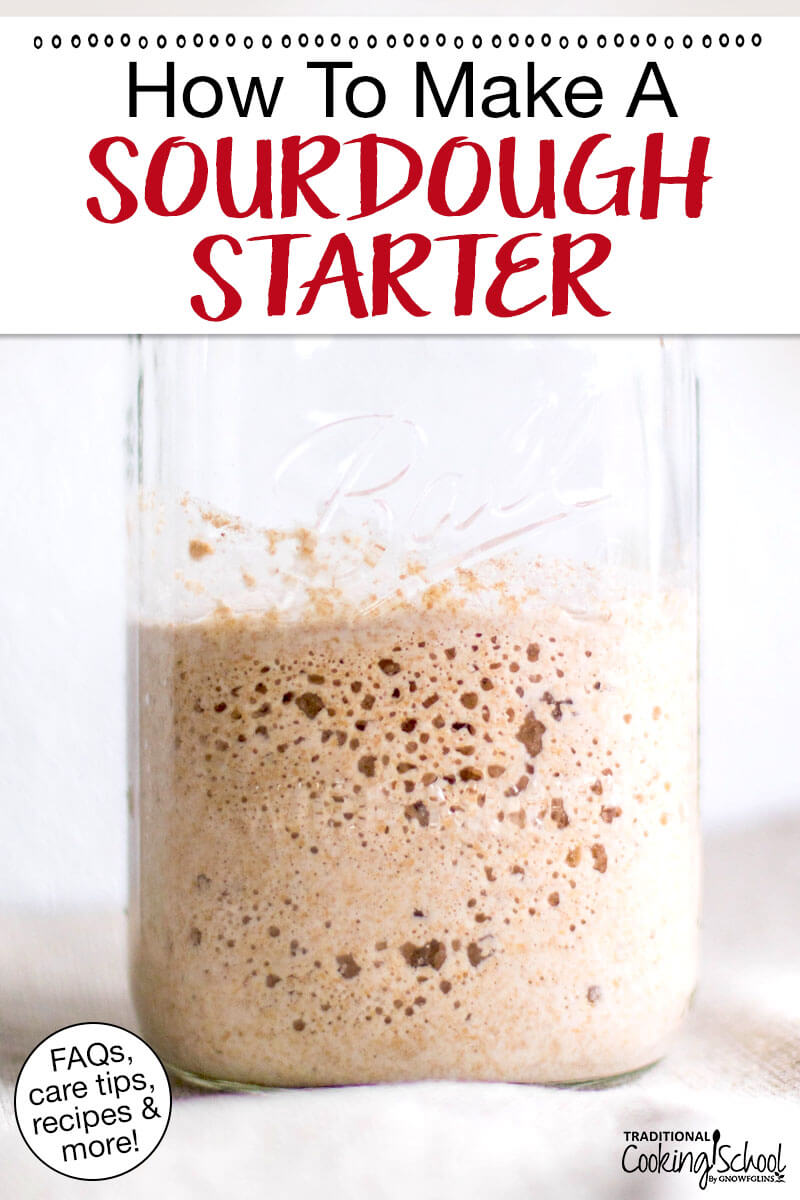
Making this sourdough starter recipe is easy, thanks to the already-present and abundant wild organisms on whole-grain flour (the fresher the better). My two daughters have done it — I know you can, too!
Table Of Contents
Why I Love Sourdough
What are the differences between today’s rapid-rise yeast breads and traditional wild yeast-leavened sourdough breads? Here is a summary!
(This information is consolidated from Wild Fermentation by Sandor Ellix Katz and Nourishing Traditions by Sally Fallon Morell.)
Pure Yeast – Baker’s Yeast – Commercial Yeast (Active Dry Yeast, Quick-Acting Yeast, etc.)
- selected strains of yeast that is chosen as superior, isolated and bred – a monocrop
- each confers desired characteristics for flavor, reproduction, ideal temperature
- engineered in a laboratory in a scientific quest for better breeds
- need to act quickly, before any wild microorganisms have a chance to get established
- depends upon more precise factors for success
- became commercially available in the 1870s
- diminishes much of the grain’s nutritional value
- stales easily
Wild Yeast (Sourdough Starter)
- motley crew of yeast growing with other microorganisms – an ecosystem, if you will
- unique flavors
- is everywhere – on the flour, in the air, always ready to stop and feast upon carbohydrate-rich food
- slower fermentation, allowing yeast to add B-vitamins and break down hard-to-digest gluten into more easily assimilated nutrients
- accompanied by Lactobacilli and other bacteria, which produce acids and contribute complex sour flavors
- easily propagated in the home kitchen, where it can be maintained for a lifetime, even generations
- breads until 130 years ago were made with this natural leavening
- versatile with regard to temperature or other growing conditions
- does not stale easily, retains original moisture much longer than baker’s yeast-leavened breads
As you can see, creating a sourdough starter (a colony of wild yeasts and Lactobacilli bacteria) is an investment in your health… and yields delicious, nutritious baked goods! Once you experience the beauty of sourdough bread, you can’t go back!
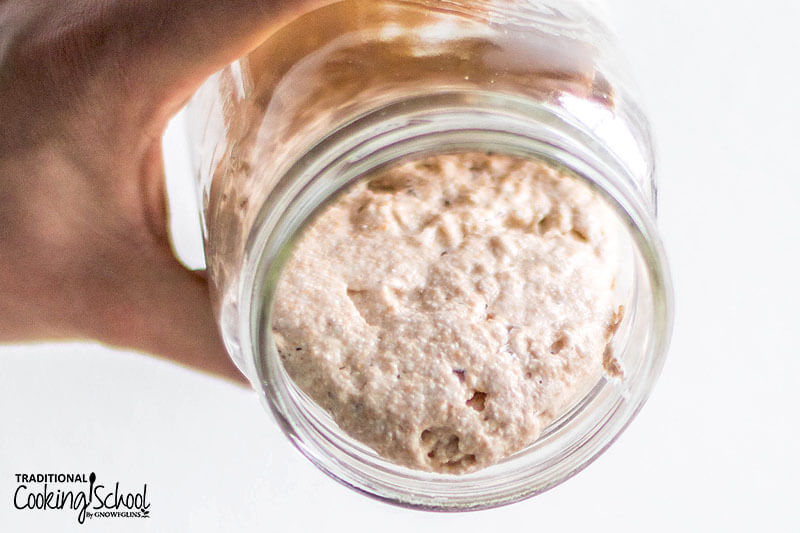
Ingredients Needed
Begin by gathering your materials. For your coming sourdough adventure, you will need:
- Pure water — To begin a starter, I encourage you to use mineral-rich, chlorine-free water. You might very well be able to start a starter with your tap water, but let’s begin by giving your starter the very best environment in which to grow; a chemical-free home. If your water is not clean or you don’t filter it, I recommend purchasing spring water or filtered water (here’s how to choose the best water filter for your family!). If your water is filtered and does not re-add minerals back, consider fortifying it with natural mineral drops.
- Whole grain flour of choice — Choose the freshest organic, whole grain flour you can find and keep it at room temperature. Warmth is helpful when working with sourdough. As for which flour is best, you can use whole wheat, spelt, einkorn (here’s how to make an einkorn starter, and how to transition your starter to einkorn flour!), rye, etc. You can even feed your sourdough starter foods other than flour (but hold off on that until your starter is mature).
Equipment
- Container — Choose a non-reactive container such as glass. Avoid plastic containers because over time, the acidity of the starter can cause the plastic to leach into it. When starting a sourdough starter, I prefer using a wide mouth, pint-sized Mason jar. Initially, we will be working with small amounts of flour and water. Using a smaller glass container allows for easier stirring and provides the perfect window for bubble watching! New life! I cover the jar with a cloth napkin and rubber band. Air is important in the sourdough starting process, so please do not screw on a lid.
- Utensils — The first time I started a starter, I used a wooden spoon for stirring. Feel free. The past couple times around, I’ve used silverware from my drawer. It’s less bulky and makes the task of stirring vigorously much easier. Whether you choose a wooden spoon or your everyday silverware, I do recommend that you stay away from reactive metals such as copper, brass, aluminum, iron, and lead.
How To Make A Sourdough Starter: Step-By-Step Instructions
The video below is a free release from our Sourdough A to Z eCourse and eBook. It explains what’s happening inside a sourdough starter… such a miraculous process!
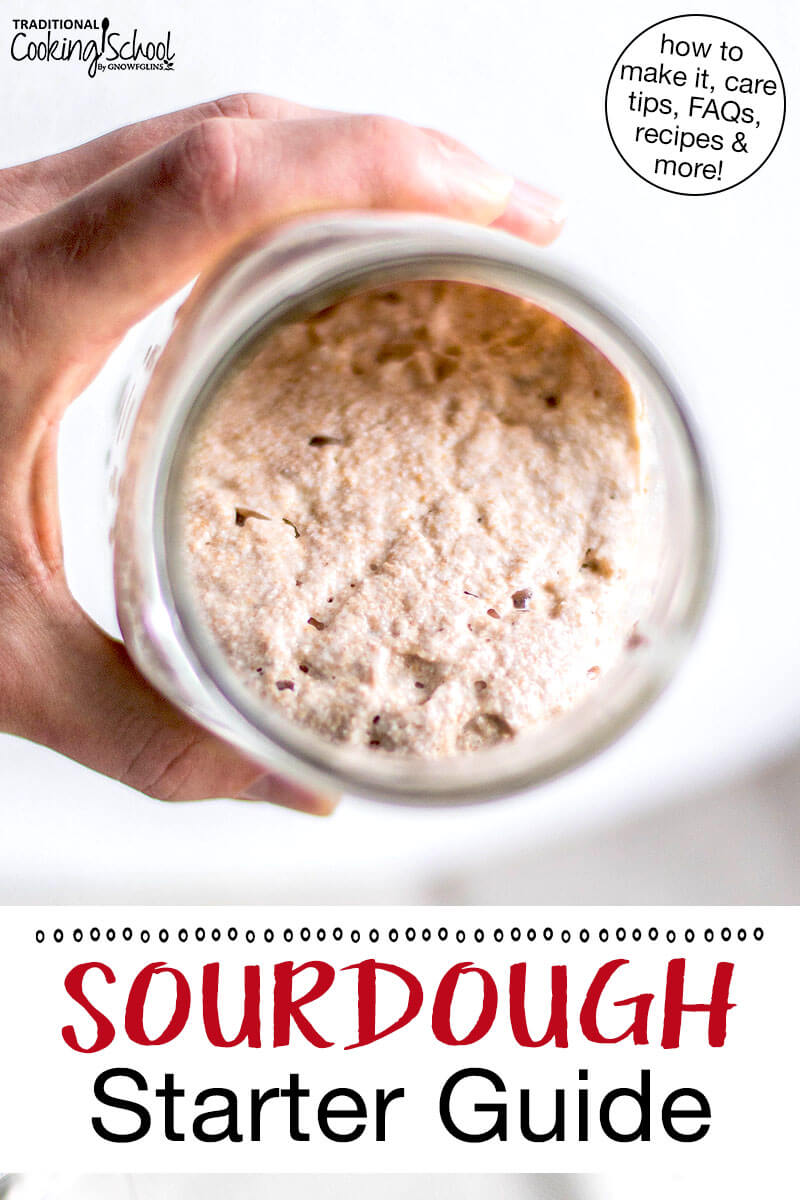
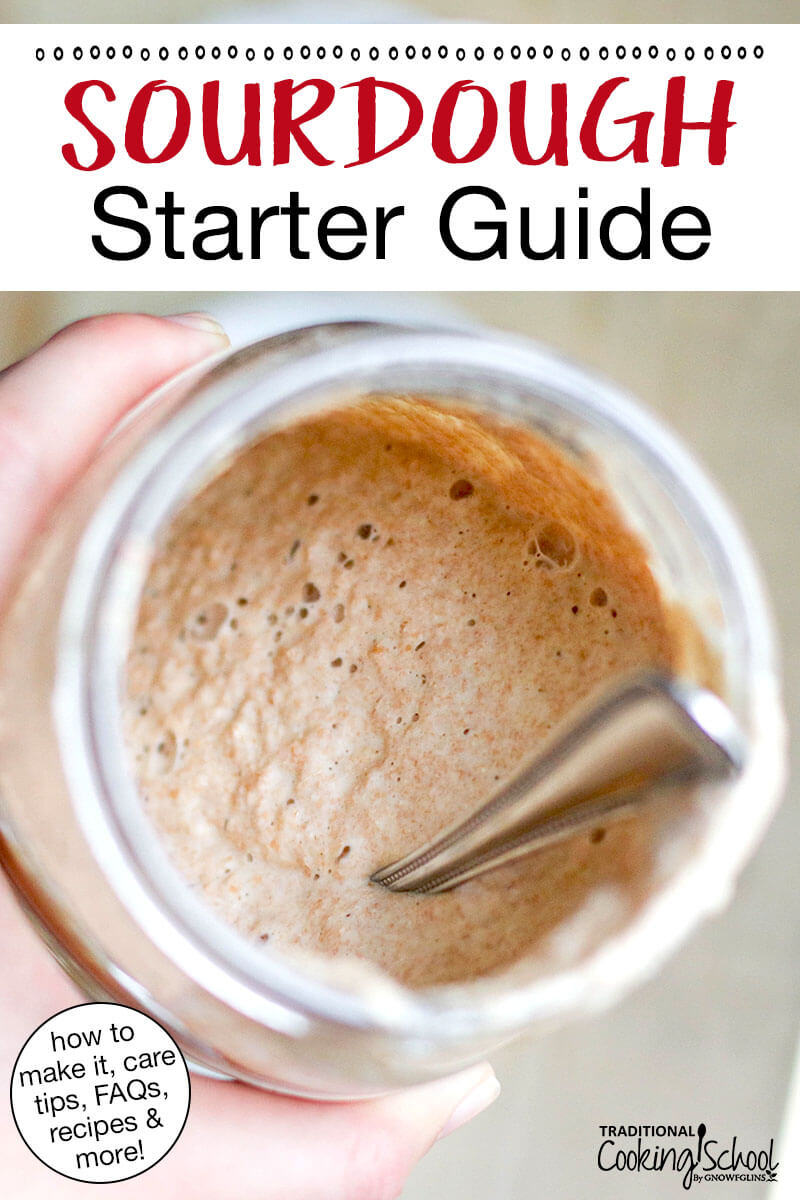
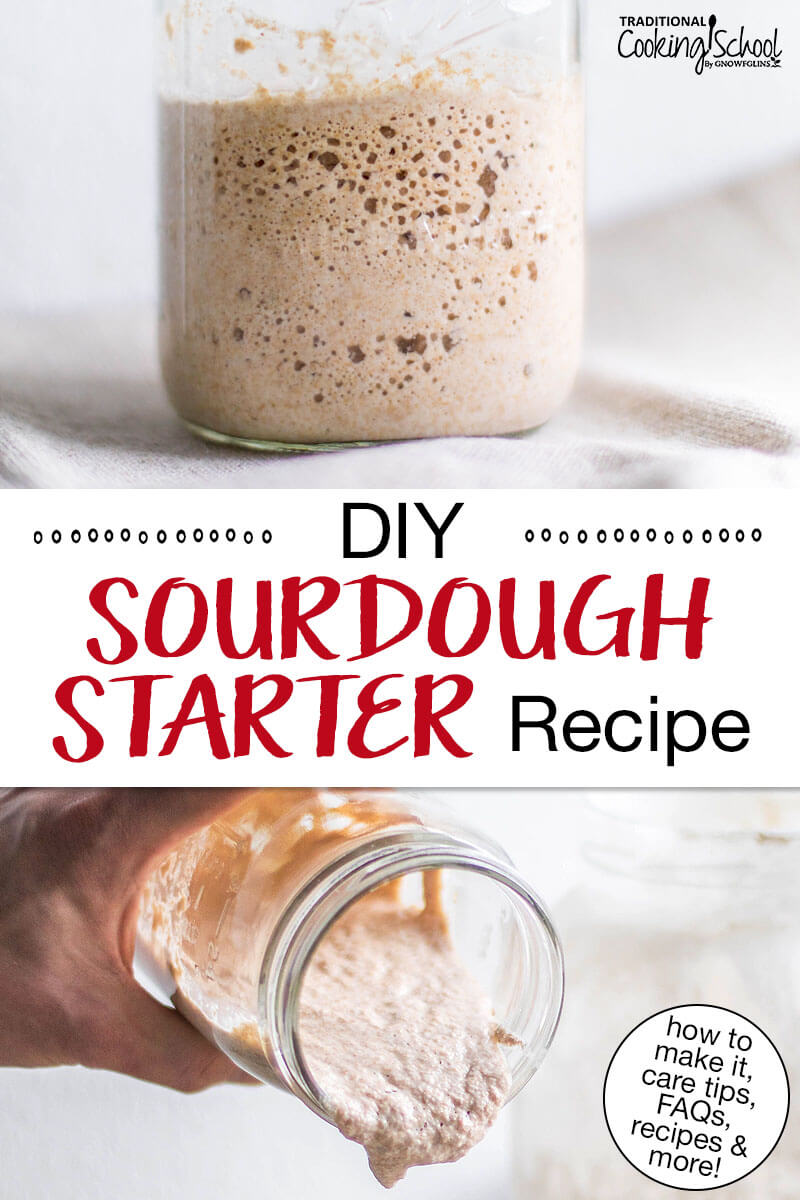
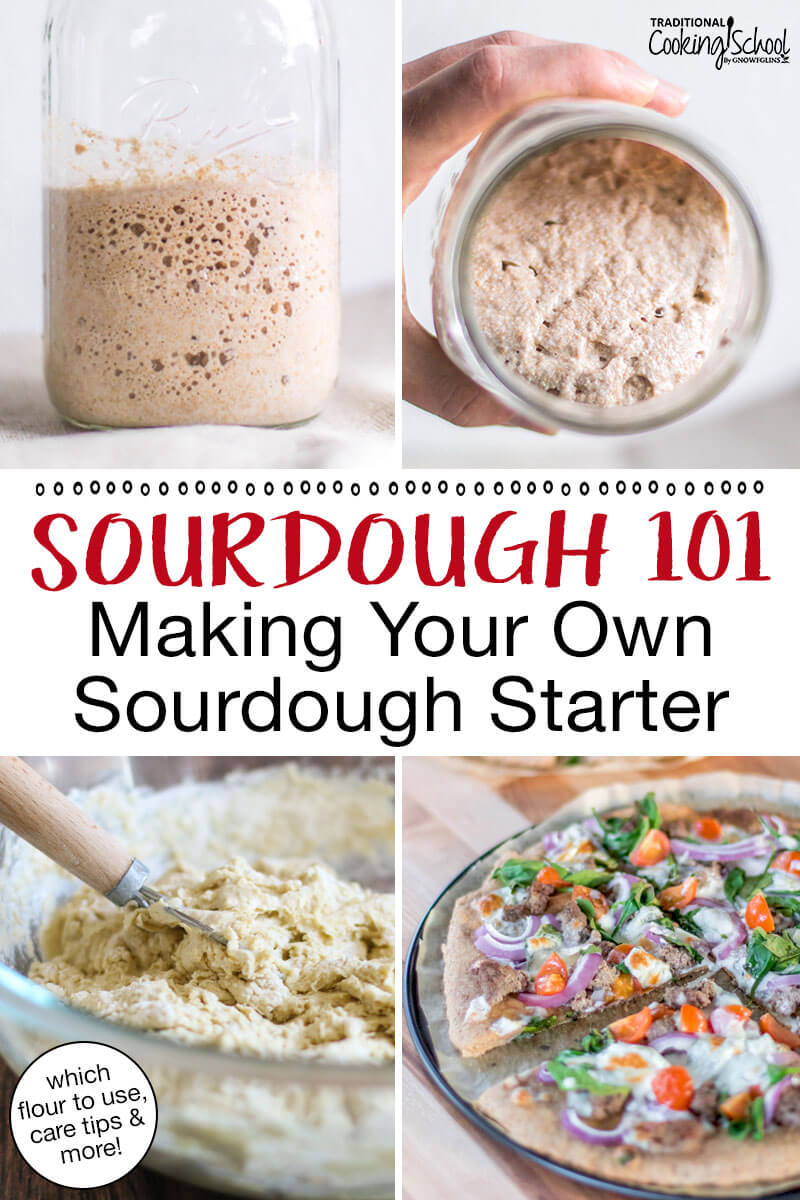
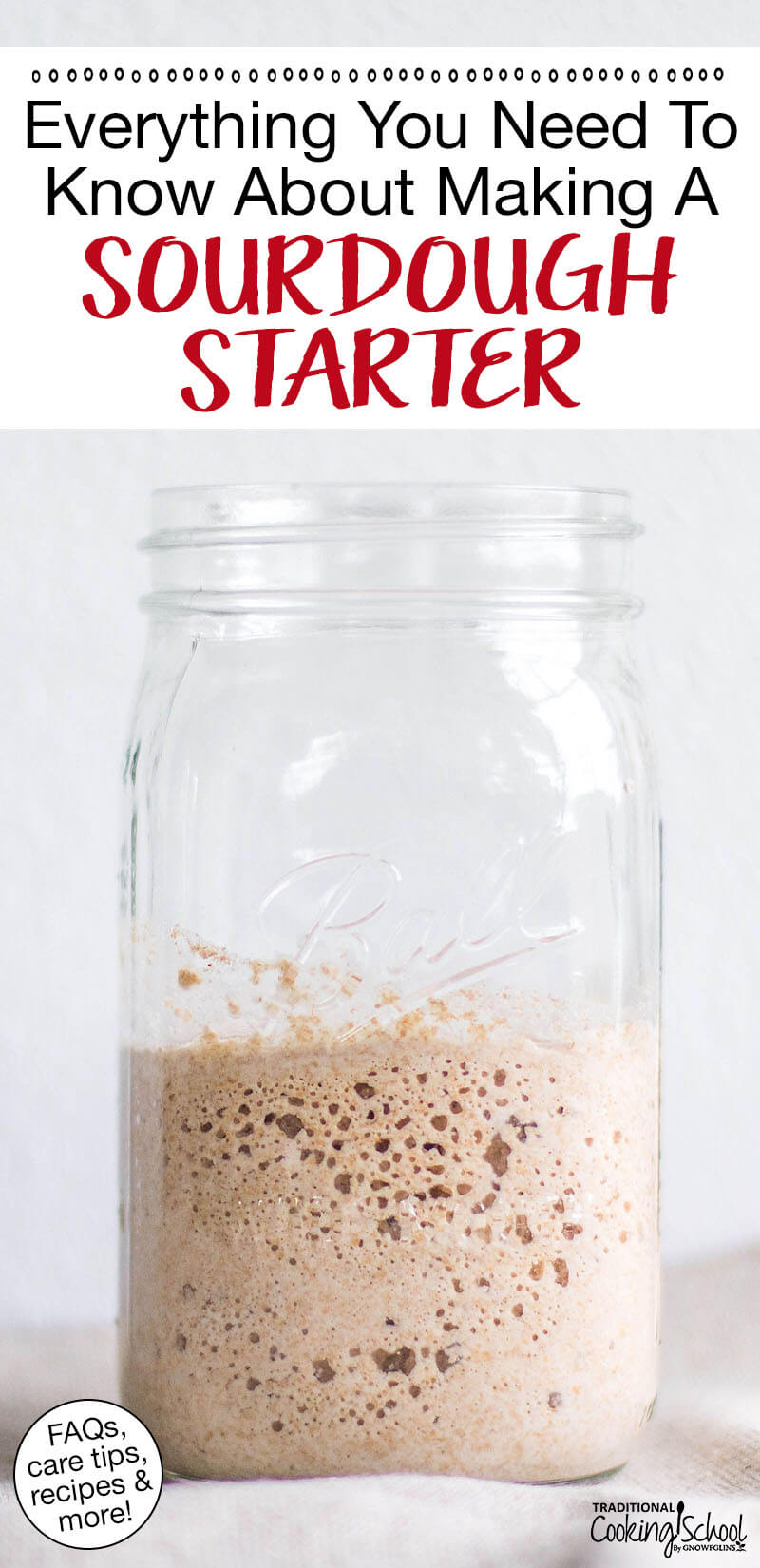
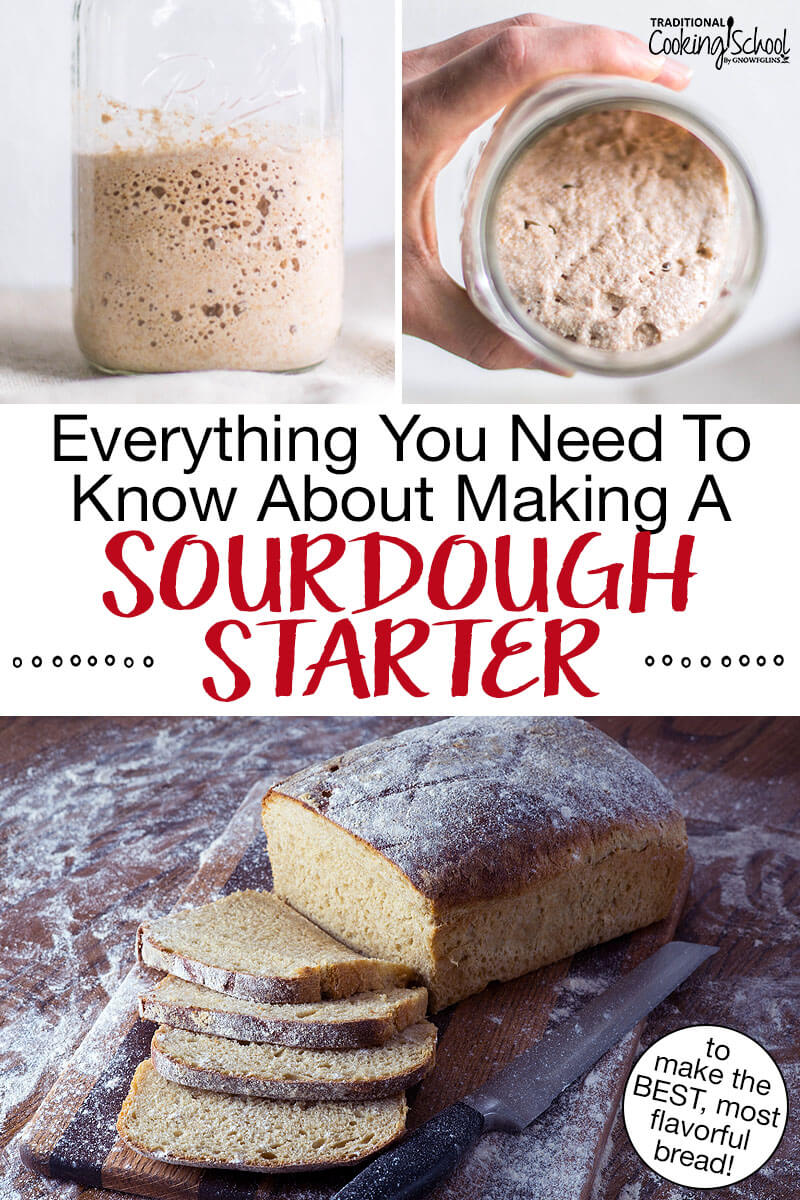
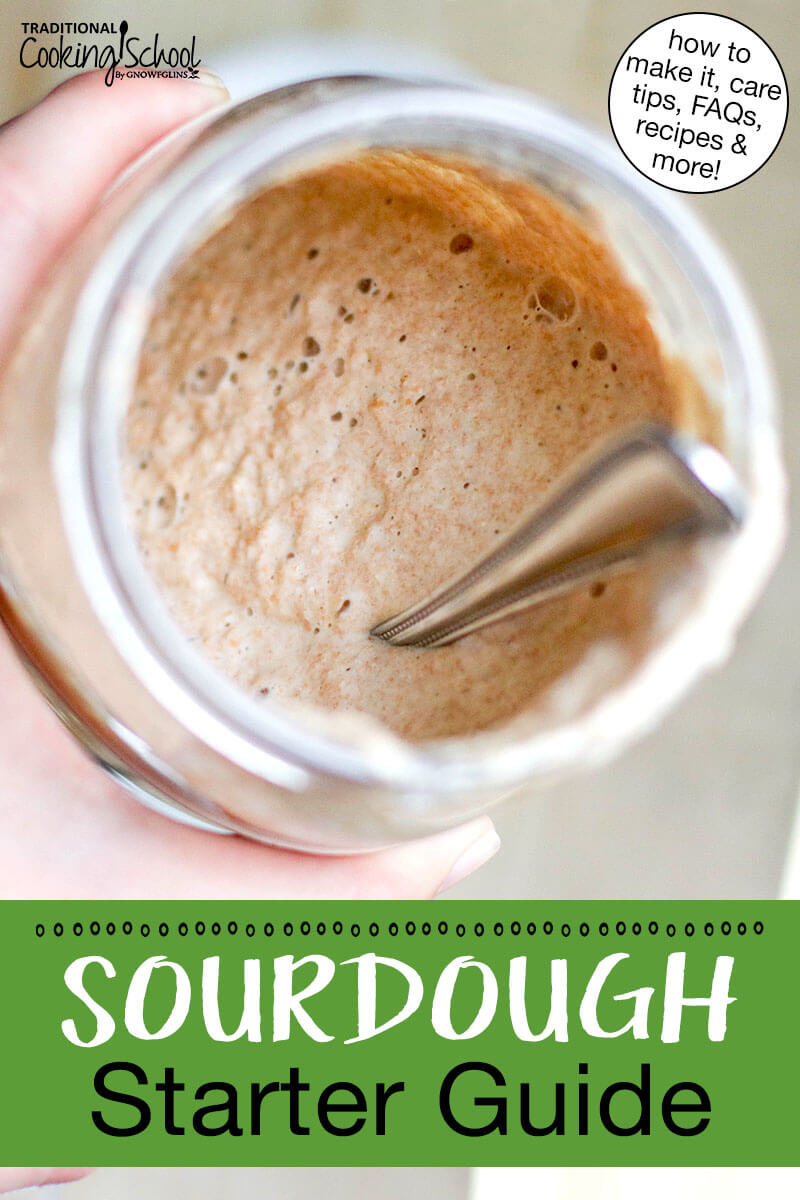
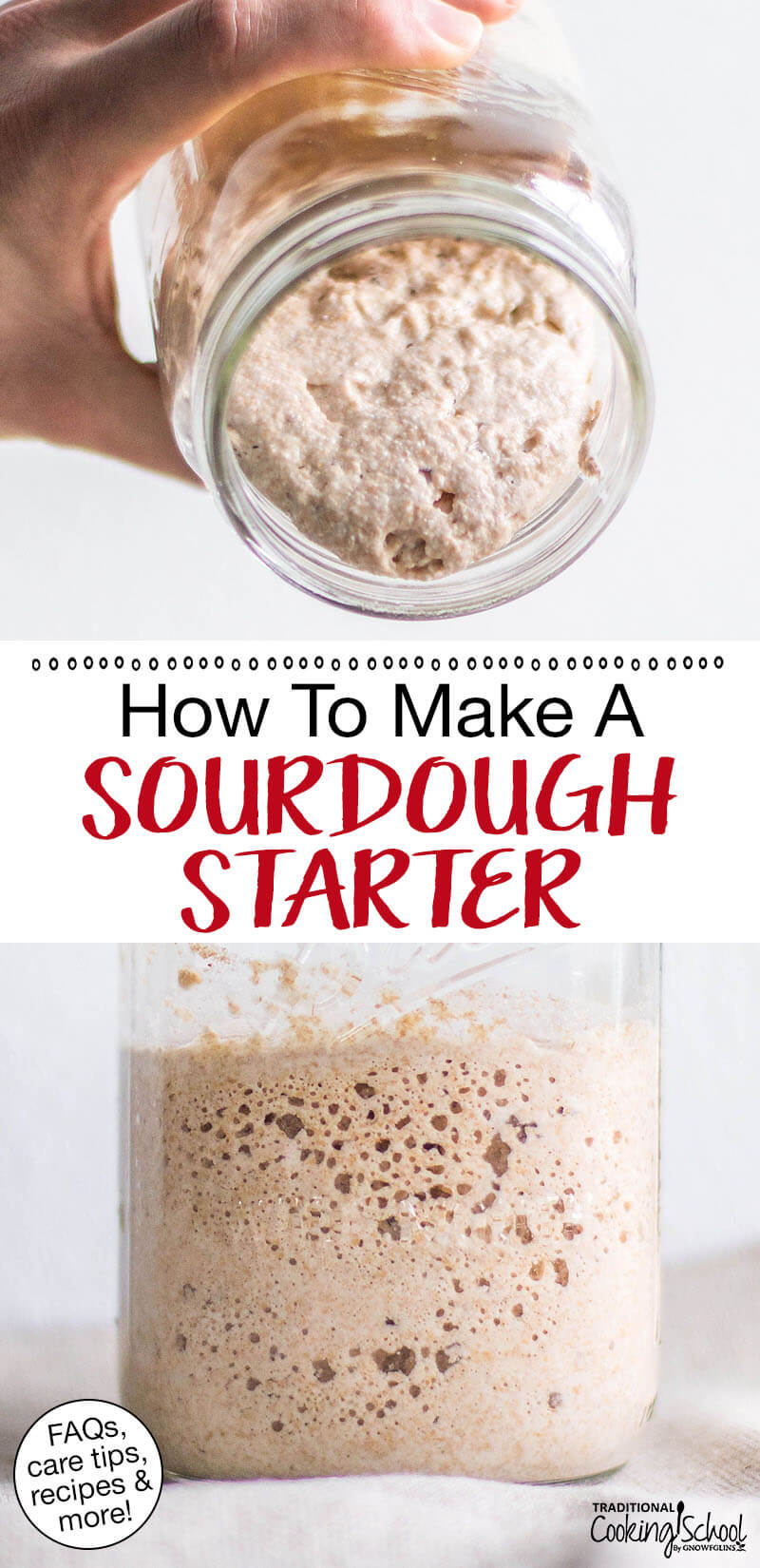
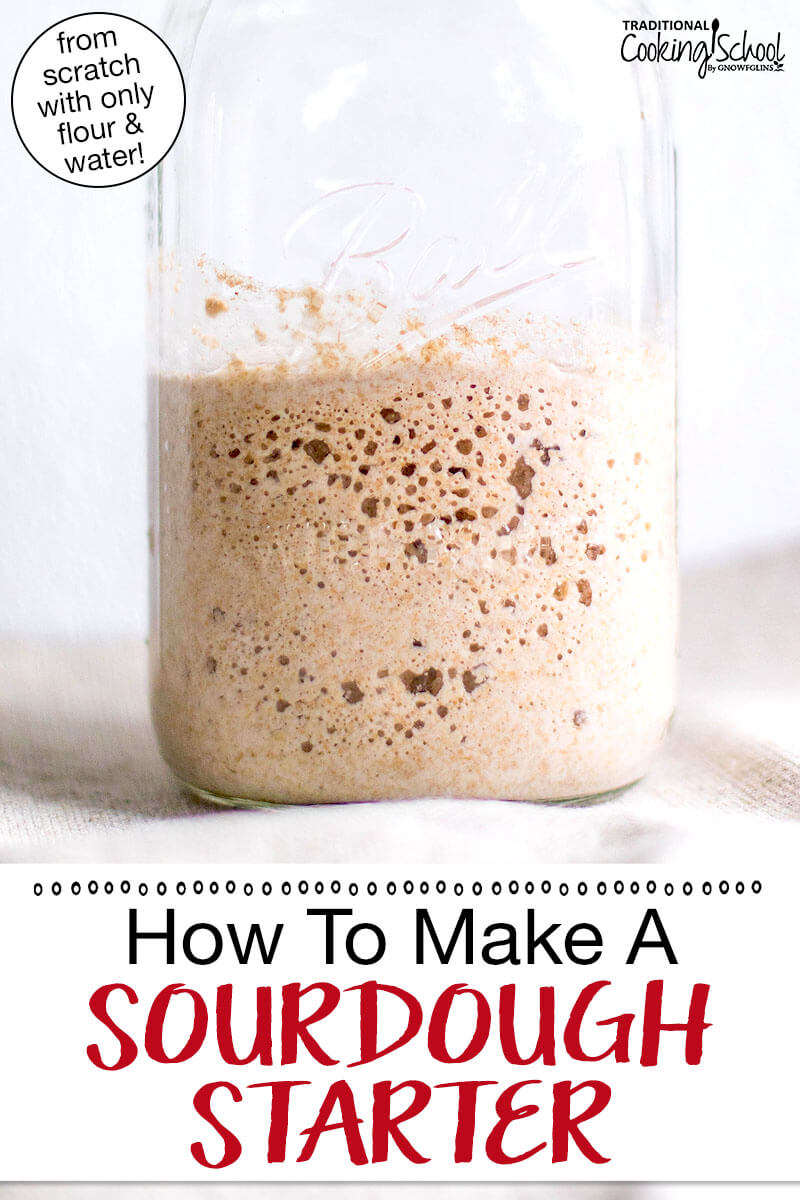
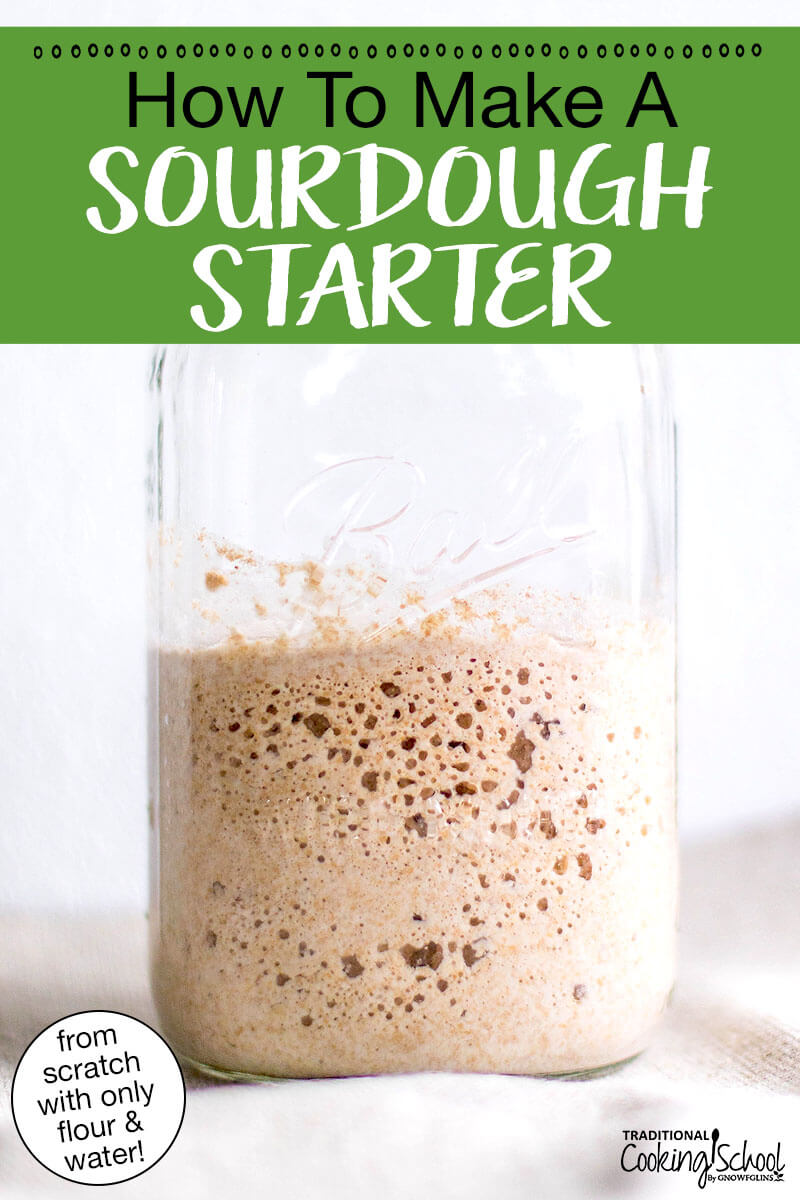
An active starter has these qualities: It’s bubbly, domes slightly, produces hooch (yellow liquid) and smells fresh and sour. It may even double in size, though often that depends on the type of flour used.
As you follow the instructions below, keep an eye out for these qualities to let you know that your starter is on the right track. 🙂
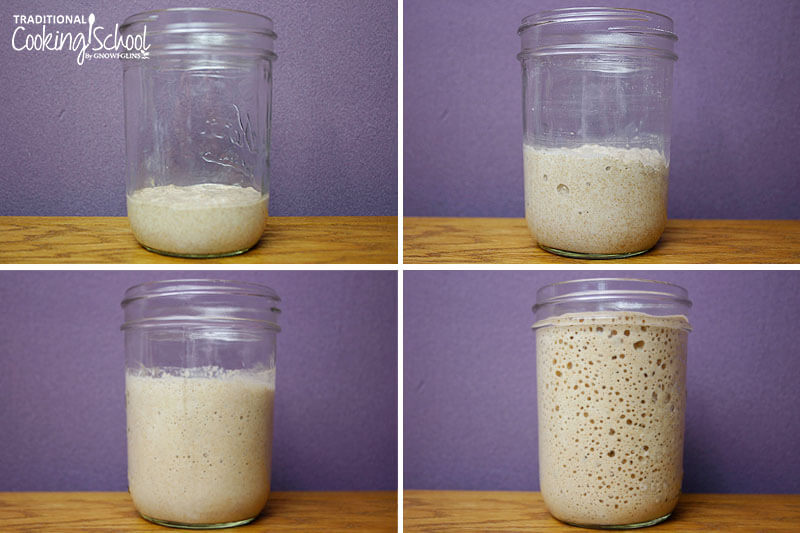
- The Beginning. Put 1/4 cup water and 3/8 cup flour (1/4 cup + 1/8 cup) in a clean jar such as a pint-sized Mason jar. Stir vigorously. Scrape sides. Cover. Allow to sit for 12 hours.
- Feeding One. 12 hours later, if you don’t see life, stir again. Scrape sides. Cover and allow to sit for 12 more hours.
If you do see life (a few bubbles), add 1/4 cup water to the jar. Stir well. Add 3/8 cup flour. Stir vigorously. Scrape and cover. Set aside for 12 hours. - Feeding Two. 12 hours later, if you still don’t see signs of life, dump out this mixture and start again.
If you do see life (a few more bubbles), remove 1/2 of the starter, add 1/4 cup water, and stir. Add 3/8 cup flour and stir. Scrape and cover. Allow to sit for 12 or so hours. - Feeding Three. Remove 1/2 of the starter. Add 1/4 cup water and stir. Add 3/8 cup flour and stir. Scrape and cover. Allow to sit for 12 or so hours.
- Feeding Four. Remove 1/2 of the starter. Add 1/4 cup water and stir. Add 3/8 cup flour and stir. Scrape and cover. Allow to sit for 12 or so hours.
- Feeding Five, Six, Seven… Continue feeding with this routine until your starter consistently shows signs of life, grows double in size between each feeding, and is at least one week old.
If, after day three or more, your starter does not show much activity 12 hours after its discard/feeding, try giving it a good stir without discarding and feeding. Sometimes this pause gives the organisms a chance to catch up and the starter an opportunity to take off.
Your sourdough starter is now ready to use! Enjoy the journey!
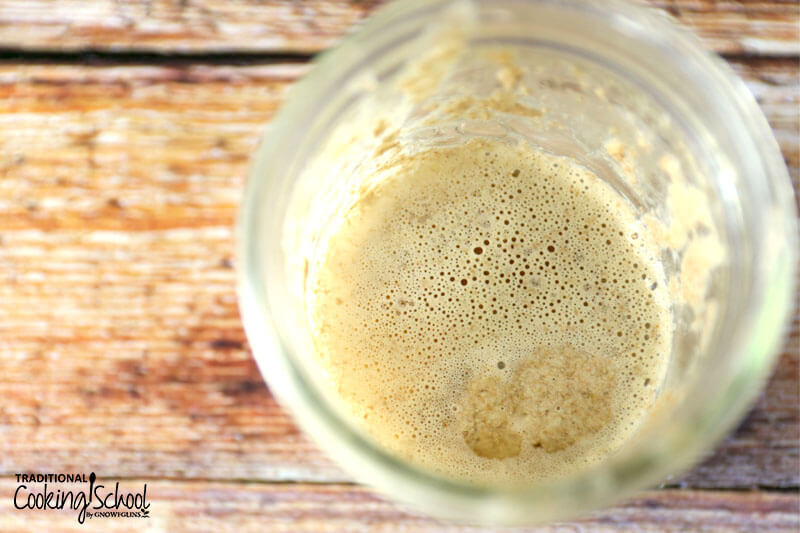
How To Maintain Your Sourdough Starter
To maintain your sourdough starter so it thrives, keep two things in mind: warmth and food. (And air, but that’s a given, right?)
If you do these two things well, the starter will be very happy and make great food for you. This information works for a starter that has become part of a dough, too. (Meaning, you’ve already made the dough and it’s “rising” or doing its thing.)
1. Warmth
A sourdough starter likes to be warm while it is working. Ideal temperature is right around room temperature, or between 65 and 85 degrees Fahrenheit.
An oven with the light on or a food dehydrator with a low temperature setting (below 90 degrees Fahrenheit) are good places to put your starter and/or sourdough dough.
I also like the spot on my counter right next to the oven vent, near the wood stove, near a turned-on slow cooker, or on top of the refrigerator. Even right out at room temperature is fine.
Because I know my starter likes warmth, I choose water and flour that facilitate this: warm water (yet comfortable to the touch) and flour that is warm from milling. Don’t add cold water or cold flour to your starter, else you’ll lose time while the entire mixture regains room temperature in order for the wild yeasts to begin flourishing again.
If you can’t mill your own flour, at least don’t use cold flour. Room temperature flour is fine.
Note: If your kitchen is in the 90 degree and above range, you might want to seek out a cooler place for your starter, use cold water for its feedings, or maybe even use a cool water bath.
2. Food
The wild yeasts in a sourdough starter feed on the starches in flour. (Actually, they will eat sugars in fruits, too, but for baking bread, we’re concerned about flour.)
There are many schools of thought on feeding a starter; I prefer to keep this simple.
Feed your starter whatever whole-grain flour you’re using. Certainly, a starter may do the best on rye flour (some people claim this) and while this may be true, it doesn’t mean that whole wheat or whole spelt flour will not perform. I know from experience that whatever whole-grain flour I feed my starter keeps it happy, healthy and thriving.
But you can’t just feed it flour alone, or it will eventually get too thick to work. So feed it equal parts flour and water. Or if using spelt flour, use 3/4 to 7/8 cups of water for every cup of flour. This is because spelt produces a thinner starter.
Here’s something else to keep in mind, and it makes sense when we remember that we’re trying to keep the starter alive. Don’t overwhelm the starter during a feeding.
Practically speaking, don’t feed it flour more than 3 times its current volume. Here’s an example…
If I retrieve 1 cup of starter from the refrigerator, I feed it not more than 3 cups of flour (and therefore 3 cups of water) at a time. If I need 9 cups of starter for a batch of bread, I will feed it in successive feedings, spaced out throughout the day by several hours each.
Of course, if you keep a greater quantity of starter on hand at all times, say 4 cups, then you could feed it up to 12 cups of flour (and 12 cups of water) without breaking this rule.
Feed the starter at least weekly, if storing it in the refrigerator. I recommend storing 1 cup of starter in the fridge, and building up its volume as needed. It is much easier to find room in the fridge for storing it in this small quantity.
If you like to keep your starter out at room temperature, feed it every 12 to 24 hours with equal parts flour and water, discarding as necessary to keep the volume to less than half of your container’s size. Keep it in a fairly warm spot.
One More Thought: It’s Flexible!
Now, all these guidelines are flexible. Your starter probably won’t die if you feed it cold flour, or if you overfeed it. So relax about it, and don’t stress out.
I’ve come up with these guidelines because I have a simple goal of keeping my starter alive by keeping it fed and warm. If you depart from something I’ve said, do it while keeping in mind the starter’s main needs of warmth and food.
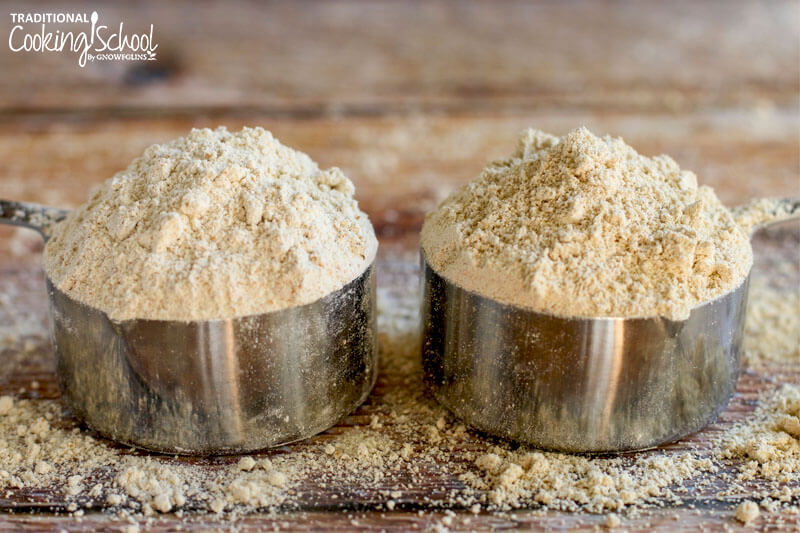
Sourdough Starter FAQs
Over the years, members working through our Sourdough eCourse have contributed many clarifying questions. We’ve compiled the best here for you!
Can I use all-purpose flour instead of whole grain flour?
For new starters, whole grain is preferred to all-purpose flour because it is more abundant in wild yeasts and Lactobacilli, which we’re trying to catch and nurture into a sourdough starter. The process of refining flour removes the microorganisms, which are on the outer hull of the grain.
That said, it’s not the end of the world to use all-purpose flour, and if that’s all you have, give it a try! If your starter doesn’t seem to be taking off and you’re using all-purpose flour, switch to whole grain and see if that helps.
For mature starters, I feed my starter whatever flour I’m using for the recipe in front of me, or whatever flour I’ve got leftover at the moment.
Do I have to discard my sourdough starter?
Yes! While building a starter, if we just keep adding more flour and water, we will soon outgrow our jar. Within a week it would fill up the house!
That would be much more wasteful than removing a small amount before each feeding. If you still aren’t convinced, here’s more information and some recipes to use sourdough discard.
I forgot to discard 1/2 my starter. Did I ruin it?
It’s fine! Next time, discard first (you can discard 3/4 of the starter instead of 1/2 to get it back down to manageable amount), but don’t worry about it this time.
My starter isn’t bubbly! What should I do?
It’s okay! Stir vigorously, feed as normal, and give it time!
There are ebbs and flows to starting a starter. Even seeing a lull after activity is normal as the organism balance shifts as it gets reestablished.
Hang in there!
Why isn’t my starter doubling in size? It looks so flat.
Not everyone gets doubling or tripling in volume. It depends on the flour and water ratio, among other things. You could try making it even stiffer.
The other thing is, you might be missing when it gets high because often a starter collapses at the end of the 12-hour cycle. Don’t give up and don’t worry. If it’s bubbly and active, it’s doing great!
How long do I have to discard starter?
You’re only discarding during the first three to five days of creating a new starter. After that, “discard” actually goes in your recipes as the starter it calls for. Always remember to hold some back!
When is a starter considered mature?
If it’s bubbling, producing hooch, doming up/enlarging in size, and has a fresh/sour smell, you can bake recipes with your new starter when it is five days old.
Once all of those things have been happening regularly for three weeks, it is considered established and mature… at which time we say it’s ready for bread-baking!
My starter smells unpleasant. Is something wrong?
If it’s a new starter, off smells are within the realm of normal. The organism balance is shifting … please give it all time. Also, if you have your new starter near an established starter, this can cause it, too.
If your starter has an alcohol smell, then you might have to do a little troubleshooting. The wild yeasts need oxygen. If oxygen is not given to the sourdough starter yeasts, other organisms which don’t need oxygen are encouraged to proliferate instead, such as the yeasts that make beer and wine. Try using a cover for your jar that encourages more airflow.
My sourdough starter has spots of mold growing on it. What should I do?
Bummer! It’s probably best to toss it, although sometimes you can just skim it off and with TLC the mold won’t return. It’s okay to start over, too!
When should I give up on my starter and try to make another one?
It’s hard to tell whether or not you should start over. It’s kind of a heart decision.
If you’ve checked all the variables — what kind of flour you’re using, what kind of water you’re using, the temperature of both and the temperature of your house, that it’s not too close to other ferments, etc. — and your starter still isn’t showing signs of activity, then it would be clear that you should start over.
Recipes To Use Your Sourdough Starter
Pretty soon your sourdough starter will be bubbly, active and ready to work.
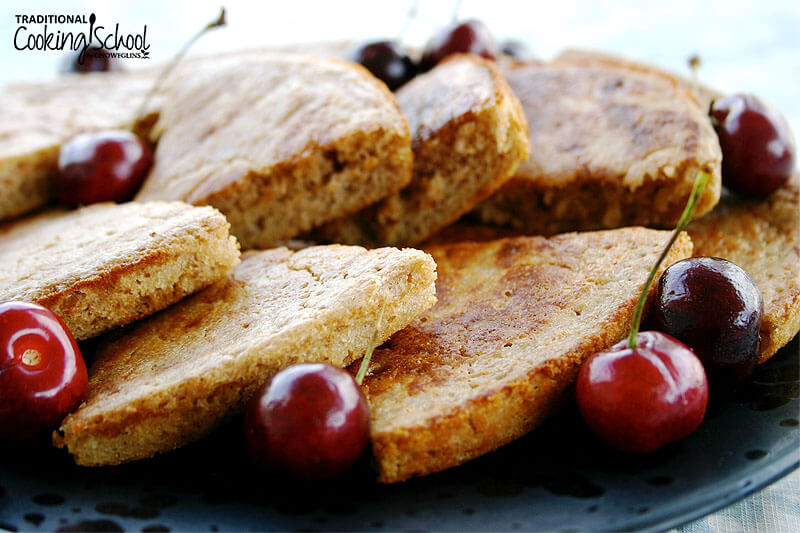
Once it is five days old, use it in any of these yummy, easy, recipes, great for beginners or experienced bakers alike: fluffy pancakes (pictured above), waffles, English muffins, crepes, chocolate cake, spice cake, or pizza crust — all free recipes right here on this blog.
Once your starter is mature (has been active for three weeks or more), you can move on to sourdough bread! Some of our favorites include this whole-grain artisan loaf, this super fluffy, not-so-sour loaf, and this einkorn sandwich bread.
Because we add more all the time, feel free to go here for a current list of all sourdough articles.
The recipes linked above — as well as the additional recipes in the eCourse and eBook — always call for the entirety of the flour to be “soured” by the sourdough starter. This ensures maximum reduction of phytic acid and pre-digestion of gluten.
You can bet that these recipes are the healthiest around!
If you have more questions on how to care for your new sourdough starter, check out these blog posts…
- 2 Sourdough Routines With Einkorn (Daily & Weekly Care) #AskWardee 052
- When Is A Sourdough Starter Ready For Baking? #AskWardee 145
- Why Won’t My Sourdough Bread Rise? How To Know When Your Starter Is Strong Enough For Bread-Baking
- Sourdough Tips, Troubleshooting & Frequently Asked Questions (KYF092, 167)
- How To Freeze Your Sourdough Starter {Best Way} #AskWardee 059
Want your own copy of these instructions? Click here and I’ll send you a free sample chapter from our Sourdough A to Z eBook for FREE.
You’ll get…
- an explanation of the science behind a sourdough starter
- a glossary of sourdough terms, including what hydration means
- a 5-day photo journal of starting a sourdough starter
- plus a digital copy of our favorite fluffy sourdough pancake recipe!
Have you made a sourdough starter before? Now that you’ve seen why sourdough is so much better than modern bread baking practices, what do you think? What’s your favorite thing to make with sourdough?
Sourdough Starter Recipe
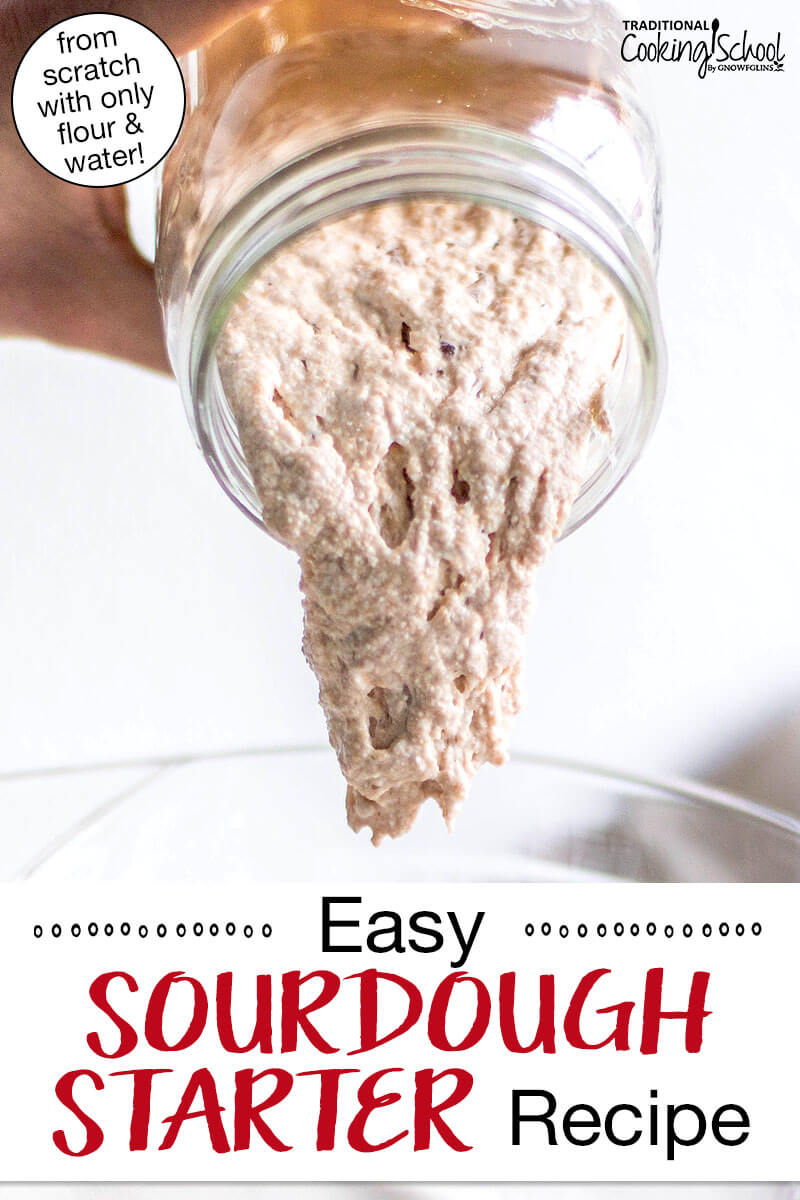
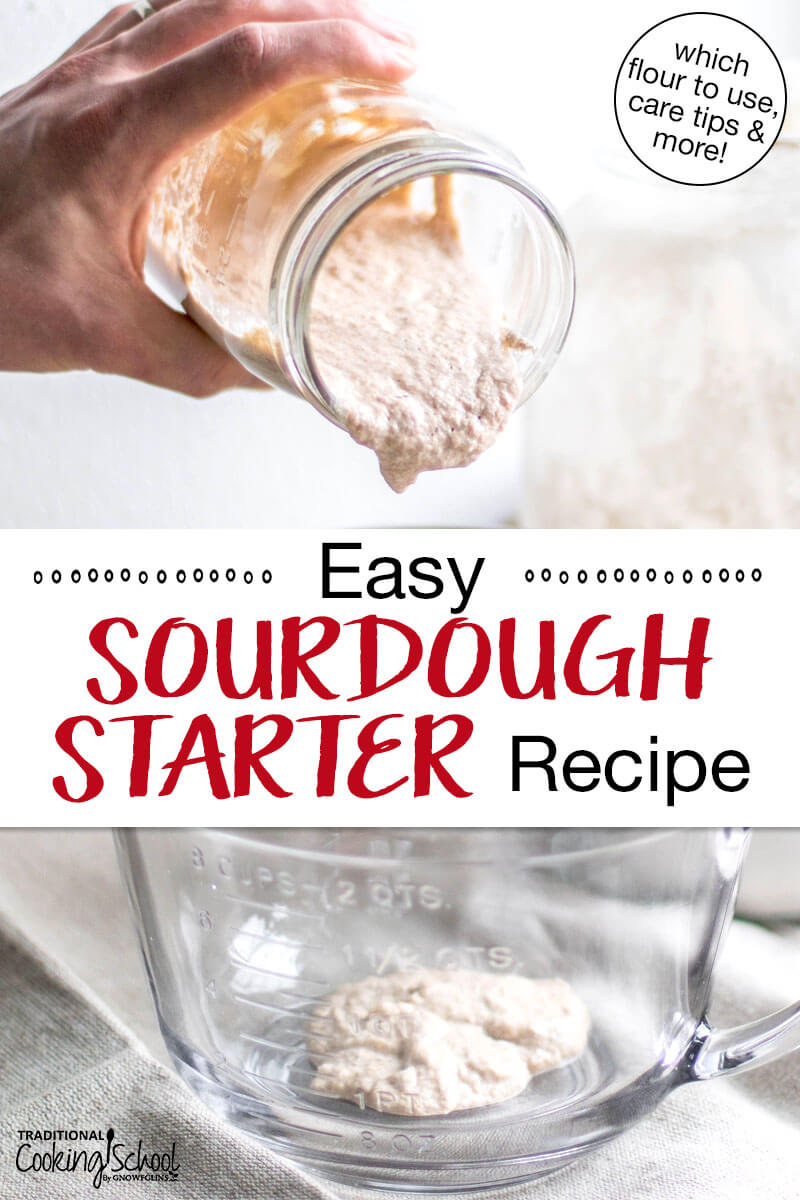
Bubbly and gut-friendly, a sourdough starter makes the best, most flavorful bread! So, how do you get one? Here's how to make a sourdough starter from scratch with only flour and water.
Ingredients
- whole grain flour of choice such as whole wheat, spelt, einkorn or rye
- pure water
Instructions
-
Put 1/4 cup water and 3/8 cup flour (1/4 cup + 1/8 cup) in a pint-sized Mason jar. Stir vigorously. Scrape sides. Cover. Allow to sit for 12 hours.
Feeding One
-
12 hours later, if you don't see life, stir again. Scrape sides. Cover and allow to sit for 12 more hours.
-
If you do see life (a few bubbles), add 1/4 cup water to the jar. Stir well. Add 3/8 cup flour. Stir vigorously. Scrape and cover. Set aside for 12 hours.
Feeding Two
-
12 hours later, if you still don't see signs of life, dump out this mixture and start again.
-
If you do see life (a few more bubbles), remove 1/2 of the starter, add 1/4 cup water, and stir. Add 3/8 cup flour and stir. Scrape and cover. Allow to sit for 12 or so hours.
Feeding Three
-
Remove 1/2 of the starter. Add 1/4 cup water and stir. Add 3/8 cup flour and stir. Scrape and cover. Allow to sit for 12 or so hours.
Feeding Four
-
Remove 1/2 of the starter. Add 1/4 cup water and stir. Add 3/8 cup flour and stir. Scrape and cover. Allow to sit for 12 or so hours.
Feeding Five, Six, Seven...
-
Continue with this routine until your starter consistently shows signs of life, grows double in size between each feeding, and is at least one week old.
Recipe Notes
If, after day three or more, your starter does not show much activity 12 hours after its discard/feeding, try giving it a good stir without discarding and feeding. Sometimes this pause gives the organisms a chance to catch up and the starter an opportunity to take off.
This post is a combination of two posts originally published and written by Wardee Harmon on 6/2/10 and 4/20/11. The posts were combined, updated, and republished on 4/7/21.
...without giving up the foods you love or spending all day in the kitchen!

2 free books:
Eat God's Way
Ditch the Standard American Diet, get healthier & happier, and save money on groceries...
We only recommend products and services we wholeheartedly endorse. This post may contain special links through which we earn a small commission if you make a purchase (though your price is the same).


I LOVE this! I’ve been wishing I could take your sourdough eCourse (too busy and not enough $$ in the budget right now…) as I enjoy baking with sourdough. I feel like my homework has been done for me in just this one video since on my to-do list is “research how sourdough works.” Thank you!! Will be posting a link to this. 🙂 Blessings, ~Lisa
Lisa — I’m glad you found it helpful and thank for sharing it with others. 🙂
I agree totally! Thank you, Wardee!
Thank you for your clear and easy instructions
This was very helpful.
Hi Wardee! Thank you for making this available for free! I would like to start some sourdough, but need a gluten free starter. Do you think I would have more success with oat flour or millet flour?
Thanks for the help.
Lydia
Lydia — I’m not sure. I will ask Sara Kay (our gluten-free sourdough guru) to stop by and advise you.
Hi Lydia!
I personally haven’t made starters with either of those flours. The GF starter recipe I use is here: http://glutenfreesourdough.blogspot.com/2010/01/boosted-brown-rice-starter-gluten-free.html There are also lots of tips in the Sourdough A to Z book, which I would highly recommend getting if you’re going to be doing lots of GF sourdough baking!
I suspect that you could use millet flour to feed the starter once you have it established, but I found that oat flour gave it a funny smell and taste when I used it with sourdough, not sure why? Do you have a particular reason for avoiding rice flour?
Thank you Sara!
I wasn’t really avoiding rice flour, it’s just that the bread I’ve made so far turned out best with millet and oats, however they weren’t sprouted or soaked. I’m just now getting into the soaking part of our food prep. I will check out the link you provided.
By the way, Wardee, I am planning on purchasing the e-books for fundamentals and sourdough. Just as soon as I have some pennies scraped together!
Thank You Ladies, God Bless you and your loved ones!
Lydia
Thank you Wardee. Your video added some more tips for managing my sourdough starter. I made the gingerbread from your sour dough book a few days ago. Sooo delicious and the sourdough shy members of the family didn’t even guess that it was sourdough! 🙂
I had a day in the kitchen recenty and had the starter sat near the woodstove which was fired up for baking. It was fizzing away and I was able to use some and refeed it during the day with just a few hours between feeds. It was like having a wee friend in the kitchen as I baked. 🙂
A wee friend…yes! Sourdough is a whole community of “wee beasties” as I’ve often referred to them. They’re like a team united in purpose to make our grains’ nutrition more bioavailable.
Hi! I just started my starter, I am brand new to this! Once it’s established and it’s doubling in size, how often to I feed it? Can I transfer it to the fridge?
Hi, Maren.
Here’s our care routines: https://traditionalcookingschool.com/food-preparation/weekly-kitchen-tips/sourdough-routine-with-einkorn-aw052/
~Danielle, TCS Customer Success Team
I was blessed with some mature starter from a good friend of mine and I’m really enjoying it! I’m going to have to find the extra $$ in the budget so I can take this ecourse. This video was very interesting! I’ve always wondered about the “mechanics” of sourdough.
Here’s a question for those who leave their starter out all the time: Do you find that your house has a yummy, sourdough-bready kind of aroma all the time? When my friend gave me that starter I took a big whiff and it smelled so good! I couldn’t wait to start making something with it. I think some people might think it doesn’t smell good, but I find it comforting and homey. When I walk into my house (through the kitchen) I am greeted by that lovely sourdough smell and I love it. It kind of reminds me of my grandma, although I’m not sure she worked in sourdough. She did teach me how to knead and make bread though and every time I make bread I’m briefly transported back to when I was a little girl, kneading along side my grandma and being fascinated with the dough rising in the round, white-enameled pans with the black rims….sigh…I’m glad she’s still alive, but I know she won’t be forever and I will always cherish those memories.
Dawn, that’s so beautiful! It inspires me, because I’m teaching my 10-year-old granddaughter about sourdough bread baking. I hope it affects her as it has you, and that one day she will pass it on to another blessed recipient! Do you have a starter originated by her? They do improve over time.
GREAT Job with your video !
Sure helped this beginner !
Thank You…
Thank you so very much! I’ve always liked the taste and smell of sourdough bread better than regular whole wheat, but now I understand why! I can’t wait to get started on my Starter! Thank you for all you do!
Just wanted to say thanks!! I had been wanting to do this for a while and for homeschooling we are in the middle of learning about bacteria and fungus so this video will be the perfect lesson for tomorrow!
This was so helpful. I’m wondering what to do if my starter isn’t doubling in volume and forms a hard crust on top?
Sarah, it is okay if it forms a hard crust. Are you in a dry environment? Just stir that stuff back in. To get it to double in volume, you can make a thicker starter (they rise more). Keep up with the feedings and over time the organism concentration will increase and it will perform better.
I love sourdough bread but we eat bread so infrequently is one loaf a month that it is not economical to keep a starter. I have been baking with kefir as my sourdough stater. What is your experience with that? We like the kefir sourdough bread but it does not rise as well. Any tips for that ?
Hi, Kim! 🙂
My only thought is to add a bit of baking soda just before you shape the loaves. I haven’t tried it, but it could help give a nice lift. It will react with the acid in the kefir. Start with small amounts and work up from there. Also keep in mind that it is fast-action and once it rises, won’t rise again. So really you want to work it in quickly, shape the loaf, and let rise undisturbed, then bake. Just an idea… let me know if you try it and how it goes. 🙂
Hi Wardee, When making the starter, will it still Wok if I happen to let it sit till 18 to 20 hours to feed it?
Sarah — It might, but it probably isn’t the best idea. You want to baby it to get it going and that means regular care every 12 hours. If it was the winter and cooler temps, it’s more likely to work at that time of year than the hot summer.
Thanks for this helpful explanation! I was just wondering if I got the proportions right? If I use 1/4 cup water and 3/8 cup flour I get a really thick paste, not liquid at all. Is that okay?
Karen, yes you get a pretty thick paste with those proportions. 🙂
Am I not getting something here? I have the typical size of measuring cups. How is it that you measure 3/8 of a cup? Just thought that was a strange measurement.
Hi – I had the same query too…
After doing QUITE a bit of other online research, I discovered that this is a 100% hydration starter which basically means the ratio of water to flour is 100% (it’s the way bakers discuss proportions/ingredients).
So, get out your weight scales and measure THAT way… exactly the same weight of flour and water.
The other complicating factor for me was that Australian Metric measurements are significantly different to US/Imperial measures…
So, discovering the bakers measurment method, was a godsend, literally.
So I started mine with 100g each of flour and water. At the first feed, I added another 100g each of flour and water, which brings the total weight of the starter to 400g.
Once the starter is established, each dispose/feed cycle, I weigh out 200g starter into a crock with a lid, then feed my original starter with another 100g each of flour/water. Into the crock, I add however much water/flour I need to bring the starter up to the amount required to make whatever it is I’m ‘extending’ it for…
(does that make sense?)
Hi, just wondering how the baking affects the lactobacilli? How does it have enough time to break down phytic acid in a dough before it gets put in the oven? Or does it just neutralize the phytic acid within the starter?
Thanks!
Megan — The lactobacilli and yeasts work when the flour is souring with the starter. We recommend 8-12 hours to make it the most effective. The organisms don’t survive the baking.
Wardee, I’ve had an accident with my sourdough starter, I am so sad! I was making pancakes the other day and I accidentally put milk in my leftover starter. Is there any way to save it? I started another one right away and set it beside the old one in hopes to catch the wild organisms a little easier than the first time around. It seems to have gotten bubbly a lot faster than the first time I grew one. I am sure you can understand my disappointment, I’ve had it going for about 3 years from when I originally took your e course 🙁 Rhonda
Hi Rhonda,
I’ve done that also! Here is what I did for my starter; I gave it flour equal to the amount of milk. Then a few hours later I gave it a small feeding of water and flour. The next day I gave it regular feeding. My starter bounced back and was fine. Like you my starter was a few years old and fairly strong. Hope that helps.
Millie
GNOWFGLINS Support Team
You said something about keep it out not refrigerated a young starter. If and when do you refrigerate it?
Just as long as you don’t have a “sick” house to sabotage your efforts. I tried and tried. I’m going to go to my parents and tend one over there. That and a ginger starter .
I don’t eat much bread. Too many carbs.
Great easy listen video and quite a commiment should one choose to do this.
Ernest
Thankyou for your wonderful blog! It’s a great blessing to me.
Rachel Iverson Fasnacht
Just got a new sourdough started! Looking forward to trying bread again!
Victoria Alexandrovna Murathodzic I thought this might interest you 🙂
Amanda
Oh Wardee… HELP! I don’t know what I do wrong, but mine never turns out. I’ve tried it 3 different times. What kind of flour do you use? Do you grind your own?
The very first time I tried to establish a starter, it didn’t work… So I did HEAPS more online research, and since then I’ve never had a problem.
Here’s what I do:
Put equal amounts (by weight) of water and flour into your large jar. I’m in Australia, so we use grams. I use 100g each of flour and water. 12 hours later, I add the same amount – 100g each flour and water which gives me a starter weighing at 400g total. Each and every 12 hours, for the next however many days it takes (about 4 from memory) at every feed I measure off 200g (half of the current amount of starter) and add another 100g each of flour/water.
* I cover my jar with cling film/saran wrap
* when it’s winter time (like it is here right now) and daytime temperatures are around 12C/53F and it drops close to zero/frost point overnight, I pop my starter/s into the cupboard above my oven. I add a tealight wamer underneath a HUGE ceramic serving bowl so that the ceramic bowl can be gently heated and radiate said heat throughout the entire cupboard.
This week, however, it’s been even colder, so I used a polystyrofoam insulation box to warm things up a bit… Mine is huge (I get groceries home delivered from time to time, and they put the frozen things into the large foam boxes) and I heat my wheat bag in the microwave, and pop it into the foam box at one end, then pop my starters/doughs/etc at the other end. They stay much warmer inside the box and go pretty much ‘nutso’! *laughs*
Whatever you can think of to keep your starter warm enough (or cool enough if you’re in a particularly hot climate) is the other key to getting one established easily…
Hope this helps.
Thanks..I need to get a new one started. I have been growing one with yeast, but from scratch would be better.
David
Thank you so much for this awesome site, Wardeh, and your podcast. I’m a big fan and love your down-to-earth nature.
A quick question if I may… I have the Sourdough A-Z book and haven’t seen the answer there… apologies if this is answered somewhere else (just point me in the right urldirection if that’s quicker for you *grins*)
Regarding GF sourdough starters and baked goods…
Is it ‘safe’ to keep a GF starter in the same kitchen/cupboard/area as a regular wheaten starter – or would the GF one become contaminated and therefore unsafe?
Also, would I have to treat GF starters and baked goods as if they were kosher? Keeping a separate set of utensils/baking trays etc for baking the GF products in? Two of my outlaws (mother, and mother-in-law of two of my sisters in law) are newly diagnosed coeliac and I was really wanting to bake them some GF breads and cakes that they could freeze and have on hand instead of having to buy GF baked goods…
Thoughts?
*hugs*
Vashti
This video was absolutely amazing!!! So so well explained! I’m looking into making my own sour dough bread so this was so helpful! I’m considering takin your course in the near future! Soo happy an thankful Renee introduced me to you!
I will watch this video but just curious, does anyone know if sourdough bread can be done gluten, dairy, and egg free? Allergies make fermenting a little tough…
Yes, absolutely!
The sourdough a-z ebook (& class) explain how to establish a gluten free sourdough starter, and how I modify all the included non-gf recipes.
For what it’s worth, I have two gluten sensitive family members that thrive on regular wheat sourdough bread, and the loaves I make (in my machine) are allergen free (per your list) and many recipes in the A-Z book are too (or can easily be amended).
God Bless,
Vashti
Can’t wait to start one
It seems that the link to the written instructions isn’t working?
Hi Michelle,
The link to the free sample chapter? It should work as a popup when you click on it that will allow you to enter your name and email to have it sent to you. You may need to make sure you have popups allowed. If you still have troubles you can email [email protected] and I can send it to you. 🙂
Millie
Traditional Cooking School by GNOWFGLINS
Support Team
I’m on day 4 of my starter. On day 2-3 I had quite a few bubbles but now before feeding there are almost no bubbles. I’m grinding my own white wheat. I was wondering if the proportions need to be different since I’m grinding my own because it seems so thick? Any ideas?
Should the starter rise and then fall? Mine was rising so well at first and then fell! If this happens, I cannot remove any and compost because it grows and then shrinks! I am thinking this means it isn’t healthy? I will say, it is a cold NY winter! Is that okay? Thank you!
Great video!!! Thanks. Is it feasible to use this recipe for a starter (as well as other recipes) with Einkorn flour?
Melanie – Yes, you can! It might act differently – like be a little gloppy and less activity showing. But it works. 🙂
I started my starter with spelt and now I use einkorn flour to feed it.
Thanks so much for the information. I am wondering if using sprouted wheat/spelt, etc. will be started or continued differently?
Sorry, I didn’t go into enough details. When I mentioned that the first starter I tried worked, I was using Sharon Kane’s Gluten free recipe. Also, now that I listened to your podcast, it certainly helped to explain that I need to be more patient, since I do live in a colder climate.
But, I also noticed when trying to make a starter that as much as I stir and clean off the sides of the bowl/jar, after a couple of days it gets hard like cement around the bowl or jar. I then transfer it to another bowl. Is this normal and is it the right thing to do? Also, if Einkorn starter may be less active than regular flour, when would I know it’s ready to use in a recipe? Thanks again! Your knowledge is truly a blessing!
I’m planning on using fresh ground wheat. What would be the best to use to make the starter? I have hard white, soft white, and einkorn.
Thanks!
Hi Christine,
You could use any of the flours to start your starter. The einkorn may be a little more finicky in the beginning so you may wish to start with one of the white’s and then you could change over to einkorn after your starter matured (by changing the flour you feed).
Also, we’ll be out of town for a few days during the starter growing period. What do I need to do so that I don’t ruin it?
During the time a starter is beginning it does need special care. I would suggest you either take your starter with you so you can feed as needed or wait until you return home to start it. Once a starter is mature you could put it in the fridge while out of town with no worries.
Wardee, I am enjoying your “science” lessons of how chemistry works in foods. Thank you for your efforts!
Inez
Help! I’m using a 2 cup jar. Started last night. Looked good after 12 hours so I fed it. In less than 3 hours it was already at the top of my 2 cup jar. I wasn’t sure what to do so I just removed half. At the next feed this evening I’ll move it to a larger jar. Did I ruin it already? Should I start over? Why did it grow so fast?
Using stone ground rye to grow the starter.
Hi Christine,
You’ve got some happy starter! Rye can often be active quicker than wheat. I doubt you’ve ruined anything. Move it to a larger container and proceed with giving it the TLC it needs as a new starter. 🙂
Millie
Traditional Cooking School
Does sour dough rise as much as traditional yeast loaves? I usually let my regular loaves rise till almost double before putting n the oven
Hi Tammy,
Sourdough can rise as much as commercial yeast loaves but it can take longer. You can let them rise until they double if you time it accordingly.
~Danielle, TCS Customer Success Team
Hi! Instead of whole wheat flour, would it work to use rye, oat or barley?
Hi, Lisa.
Rye flour behaves differently. Here’s a link with details on using rye flour: https://www.culturesforhealth.com/learn/sourdough/using-rye-flour-sourdough-baking/?a_aid=56e447f050113.
~Danielle, TCS Customer Success Team
Hi, I’m a beginner to make my own starter. I’m new in this, I’ve just create my own starter lately on 20/10/19 but this morning I saw there’s a layer of black mold on the surface of my starter. It’s been 1day and 18 hours. Yesterday, my starter it was fine and started the bubbly fermentation but this morning it became a layer of mold on the surface. I use cotton cloth to cover the top. I don’t know what to do whether to discard it fully and start a new one or discard half of it where there’s mold on it and continues the process ? Please advice.
Hi, Rachael,
Since your starter is fairly new I am so sorry but if you do find mold on your starter you will want to throw it out and start over.
~Peggy, TCS Customer Success Team
Hi, I started some start yesterday. I was following a different website that said to only feed it once/day. When I watched your video it said 2/day. Do I need to start over, or can I feed it 2/day from here on out? Thanks
Hi Angela, I would just start feeding it twice a day and watch it. Make sure you are discarding half during the first 4-6 days until its established.
Here’s a link for why you should discard: https://traditionalcookingschool.com/q-a/discard-half-my-starter-at-each-feeding-aw113/
~ Vicki, TCS Customer Success Team
My sourdough bread used to be nice and tart but now has hardley any sour taste. Has somethng gone wrong with my starter? I didn’t know about keeping my kambutcha fermentation jar 5 feet away. could the cross contamination have ruined my starter flavor?
Hi Cathy, Yes it’s possible that your sourdough starter has cross contamination from your kombucha.
I suggest that you move your starter away from your kombucha and continue to feed it. You should notice a change in the flavor of your starter in about a week.
~ Vicki, TCS Customer Success Team
Hi,
I srarted a sourdough starter for the first time a week ago, and everything was going normal and great until this morning when I opened it to feed it. It had a different kind of alcoholic type smell, but I fed it and kept going. Then this evening when I went to do my second feeding (day 8), I noticed the smell again and began taking a closer look. I flipped the lid over and noticed that some white-grey mold had started growing in the seams of the plastic twist-on lid. A few days earlier my starter ran over and out of the jar, and without thinking I simply wiped the lid clean and put it back on. Looking back, I should’ve washed the lid, but didn’t realize it would be an issue. The mold was growing in the twist-on cracks of the lid where the sourdough overflow just got wiped off. I also noticed faintly that the hairs of white-like mold were just starting to try to grow on the sides of the jar twords the top where I hadn’t wiped it. I know now to keep it dry and be much more careful.
I made a couple of mistakes there, but I’m wondering if my starter is okay? It didn’t have visible mold on the starter itself, just a bit in the rim of the lid and the beginnings of it wanting to grow on the inner top of the jar above the starter itself. Although, it could’ve been on the top layer I guess but not yet visible to the eye. I did scrape of the top of the starter, very lax, just incase, but the stirred it up and fed it.
Does this all sound okay? Can I keep my starter or is it bad? If it smells okay in the morning is it okay?
Thanks!
Hi, B.
There are a couple of options for dealing with mold. Either try to save the starter or discard the starter and start over.
There are some great tips in this article for dealing with mold: https://www.culturesforhealth.com/learn/sourdough/troubleshooting-sourdough-starter/?a_aid=56e447f050113
~Danielle, TCS Customer Success Team
Hi! I have made a sour dough starter and the bread was super sour, is that normal?
Hi, Kellie.
There are a few factors that can make sourdough too sour.
Here’s a link to learn more: https://traditionalcookingschool.com/fermenting-and-culturing/sourdough/6-tips-to-prevent-sour-sourdough/
~ Danielle, TCS Customer Success Team
How can I make the sour dough gluten free?
Hi, Beverly.
We have a special recipe just for creating a gluten-free stater. Once you request the recipe above for the 5 minute starter you can email us at [email protected] and we’ll send you the gluten-free version. 🙂
~Danielle, TCS Customer Success Team
have been making sourdough bread for a number of years. At the same time I just realized that the sourdough bread may be causing canker sores. Making a sourdough starter from scratch means, there is no way of knowing if there are any bad micro-organisms, may be not bad by themselves, nor poisonous, but maybe producing some chemicals than can upset the micro flora of the guts?
Hi, Luc.
It’s possible to have bad micro-organisms but they are outcompeted by the desirable organisms. Also, the acidic environment helps the ecosystem to stay healthy and non-harmful. Plus, you cook the sourdough bread and that kills all organisms in the starter anyway.
~Danielle, TCS Customer Success Team
Can all-purpose white flour be used to start with? And does sourdough make the white flour bread “healthier” than regular white bread, or is it best to completely stay away from processed white flour?
Hi, Jeanetta.
Yes, you can use white flour to make a starter. While we recommend avoiding white processed flour, if that is all you have available, souring it is still beneficial and can aid in digestion.
~Danielle, TCS Customer Success Team
I am eating a low-carb keto diet to regain good health and lose belly fat at 52 years old. I am following Dr. Berg’s recommendations on his site about not eating any grains. He says that all grains are not beneficial, especially for the digestion, and that they are high in carbs. I am interested in what you are saying about the process of what sourdough does to the grains and sugar in the bread. I would love to eat bread again (after I lose the weight), but I don’t want to gain the weight back again by consuming a high carb diet. Also, my husband is a diabetic, and he, too, needs to avoid breads and starchy foods. Right now, I am eating 7 to 10 cups of vegetables a day, along with a moderate amount of protein, and healthy fat. What are your thoughts on the grain issue, and how does sourdough make grains healthy to consume?
Hi, Jeanetta,
You will find some helpful posts Wardee did on sourdough and grains here:
https://traditionalcookingschool.com/food-preparation/do-sprouting-culturing-or-sourdough-reduce-carbs-aw095/
https://traditionalcookingschool.com/food-preparation/grain-cooking-chart/
https://traditionalcookingschool.com/food-preparation/sourdough-bread-low-glycemic-askwardee-035/
We also have a traditional cooking school program if you would like to learn more and get the help you need with traditional methods of cooking. ~Peggy, TCS Customer Success Team
Thank you so much, Peggy!