
Gut-friendly, probiotic, fizzy water kefir is naturally fermented and bursting with flavor! This ultimate guide to all things water kefir will answer your burning questions — how to make it, store it, flavor and bottle it for a second ferment… plus troubleshooting and my 5 best brewing tips!

Trying to kick the soda habit?
Water kefir is an incredibly delicious fermented drink — the perfect natural soda!
Think gut-friendly probiotics + refreshing fizz + endless flavor possibilities… AND it doesn’t leave you with a sickly sweet upset stomach. 🙂
We’ve been teaching TCS members how to make water kefir for over a decade now, and along the way we’ve accumulated quite the list of FAQs, like…
- Which sweetener is best?
- How long to ferment?
- How to flavor it?
- Is it different than Kombucha?
- Is it different than dairy (or milk) kefir?
- And sooooo many more!
So, in the same spirit as our ultimate Kombucha guide, we’ve put together the ULTIMATE water kefir guide to answer all of your burning questions, help you troubleshoot, and share brewing tips!
Let’s start at the beginning…
Table Of Contents
What is water kefir?
Similar to Kombucha (although not quite as popular), water kefir is a fermented beverage. It is…
- dairy-free
- rich with probiotics to aid a healthy digestive system
- quick to brew
- a beneficial alternative to soda with endless flavor possibilities!
Essentially, we put water kefir grains (a symbiotic colony of lactobacilli and yeast) into a sugar water solution. The beneficial bacteria and yeast eat the sugar (sucrose), and over two to three days of fermentation the sugar water transforms into a mild, fizzy drink.
So, even though we start with sugar water… by the end, very little sugar is left!
We can then flavor it with fruit during a second fermentation to create a unique drink of whatever flavor you choose! We love grape, cherry (like this cherry-lemon flavor!), and ginger.
The second ferment is what makes water kefir really fizzy, so I do recommend making the extra effort to do this step. It’s well worth it, I promise.
As long as you take care of your grains, they can be used indefinitely. This means natural soda is frugal as well as healthy!
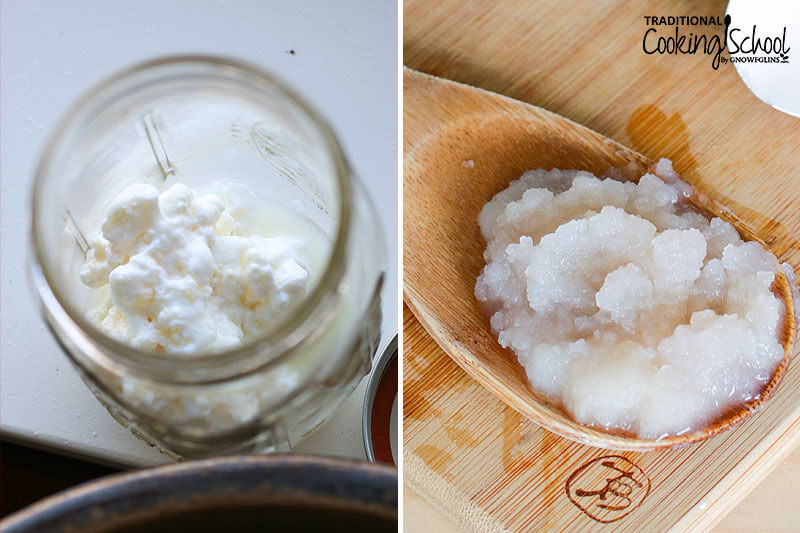
pictured, left to right: milk kefir grains, water kefir grains
Water Kefir Vs. Milk Kefir (Dairy Kefir)
Water kefir is not the same as milk or dairy kefir.
In both types of kefir, the grains feed on sugar, leaving behind an acidic, fermented, slightly alcoholic (less than 1%), probiotic-rich beverage. Water kefir grains feed on whatever sugar is used in the sugar-water base, while dairy kefir grains feed on the milk sugar lactose.
They do both have a mother culture called “grains”, which are colonies of bacteria and yeast living together symbiotically. However, because the microbes vary in each culture, they look different.
Dairy kefir grains are rubbery, whitish clumps that look like cauliflower. Water kefir grains are somewhat translucent crystals or sharp little pebbles, and remain separate from each other.
Of course, the most obvious difference between them both is… the dairy! Water kefir is dairy-free, dairy kefir is not.
And guess what? You can actually use dairy kefir grains to make water kefir through a conversion process.
The same grains won’t work indefinitely, but since dairy kefir grains grow like gangbusters in milk, if you keep them going in milk on the side, you’ll have an endless supply — without investing in water kefir grains!
Learn how to make dairy kefir here!
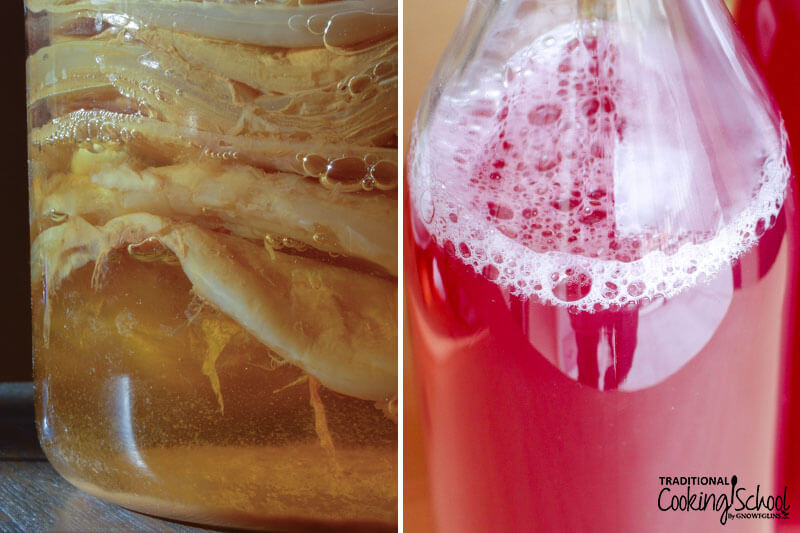
pictured, left to right: Kombucha scoby, bottled water kefir
Water Kefir Vs. Kombucha
Water kefir and Kombucha are also different. Although, both fermented beverages yield fizzy, probiotic, deliciously flavored drinks! 🙂
Yet, the mother cultures differ, and therefore the finished drinks do, too.
As mentioned above, the process of making water kefir relies on water kefir grains (a symbiotic colony of bacteria and yeast), whereas Kombucha requires a SCOBY (a different symbiotic colony of bacteria and yeasts).
Other differences include…
- Water kefir is quicker to brew than Kombucha.
- Kombucha typically has caffeine due to using green tea or black tea in the base liquid.
- Water kefir has a more plain base liquid (from the first fermentation), making it more adaptable to soda flavors that most people like and expect. Both can be an acquired taste, but water kefir less so!
Learn how to make Kombucha here!
5 Brewing Tips For The Best Water Kefir
Water kefir can be a bit finicky. The grains don’t grow as quickly as dairy kefir, and they tend to need a few special things to truly thrive.
Let’s talk about 5 tips for keeping your grains happy. 🙂
#1 — The Best Water
Water kefir grains love minerals, so the best water to use is clean, pure, and mineral-rich spring water, well water, or filtered water.
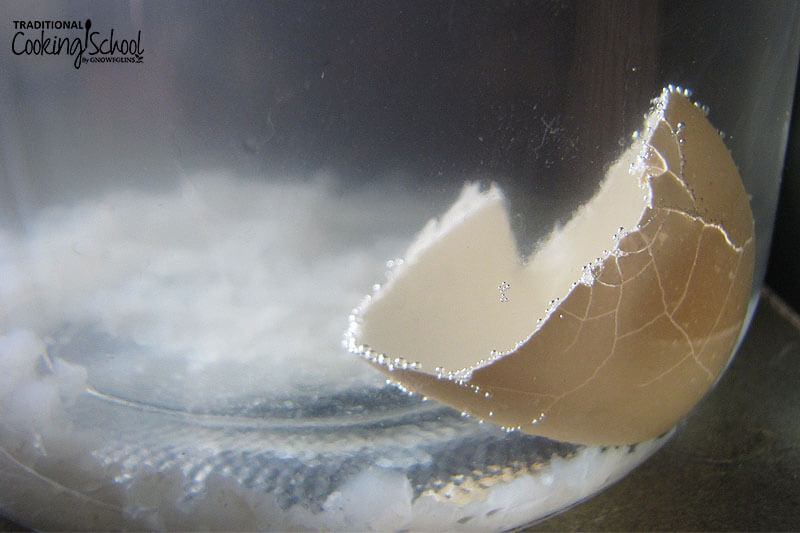
If your water lacks minerals (such as water filtered by reverse osmosis), you can use mineral drops or a clean, rinsed eggshell to add minerals back in. From a food safety standpoint, you will have more confidence when using a raw, but rinsed, pastured egg shell if it comes from a healthy poultry farm.
The water purification system from Radiant Life that we personally use has a remineralization step built in, making it the perfect water for ferments! More info here.
Is chlorinated municipal water all you have? Boil it, allowing the chlorine to vaporize. Then let the water cool to room temperature before making water kefir. Another option is to use a blender and blend the water; the aeration will encourage the chlorine to vaporize.
#2 — The Best Sweeteners
Water kefir grains love minerals!
So, the less refined (and mineral-rich) your sweetener, the better. Rapadura or Sucanat (unrefined cane sugar) are best.
However, this sugar has a distinct flavor that some may not enjoy… so you can also use evaporated cane juice which is more refined with a milder flavor, yet still contains minerals!
Considering using alternative sweeteners? Check out this article to answer the question “Can I Use Alternative Sweeteners in Ferments?”
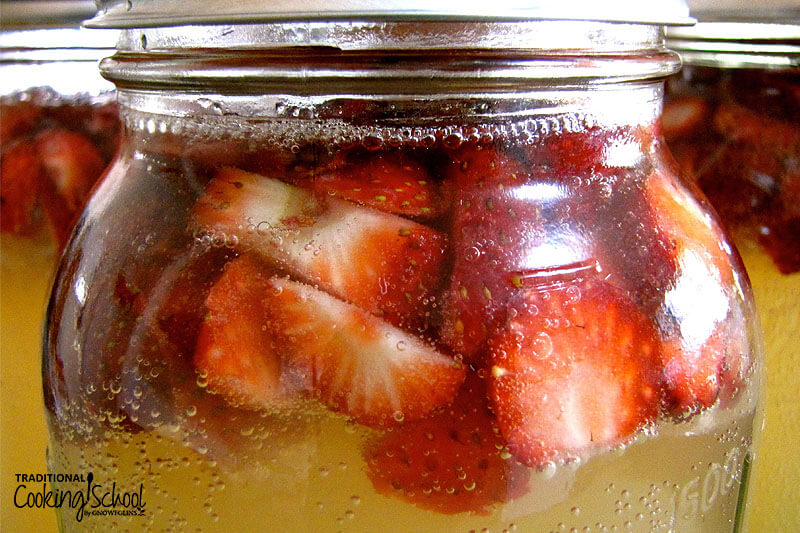
#3 — The Best Flavor Ingredients
For the health of the mother culture, please choose organic ingredients as much as possible. Chemical residues on conventional fruits and sugars can harm the culture.
During the second fermentation (which is optional), you have an opportunity to “flavor” your water kefir with fresh or frozen fruit or fruit juices. Choose organic for these, too!
#4 — The Best Tools
Choose non-reactive utensils and containers. This means glass jars and wood, plastic, or stainless steel utensils and strainers.
If you’re going to use stainless steel, keep its contact with the grains to a minimum — quick stirring or straining rather than prolonged contact. (Stainless steel is the least reactive of the possible metals you will find in kitchen utensils.)
Most people, whose grains don’t multiply rapidly, will benefit from using a cotton muslin bag for holding and keeping grains together. Not only can you transfer the grains from batch to batch easily, but you won’t have to spend time and effort separating them from the egg shells.
However, if your grains are thriving and multiplying rapidly they can fill the bag quickly, and cease to thrive. For those whose grains are growing by leaps and bounds (both through multiplying and through individual grains growing large) it is actually best to let the grains bounce free in the batch.
They will literally bounce up and down in the jar during fermentation if they’re happy! It’s fun for children to watch!
#5 — The Best Environment
Brew at least 5 feet away from other cultures, to prevent cross-contamination. (Learn more how to tell if your ferment has become contaminated in this article.)
Water kefir needs an environment around room temperature to ferment well. Ideal room temperatures are between 70 and 85 degrees Fahrenheit.
Fermentation times will be longer with the cooler temperatures and faster with warmer temperatures. With temperatures much over 80 degrees Fahrenheit, be vigilant to prevent spoiling.
When water kefir ferments too long, you can tell because the grains and the beverage seem “slimy” or syrupy and possibly more yeasty in smell and taste. This doesn’t always mean it has gone bad, but letting the kefir get to this point should be avoided because it’s not pleasant to drink.
Rehydrating The Grains
Unless someone shares grains with you, you’ll have to purchase water kefir grains. (We recommend getting them from Cultures for Health.)
Rehydrate according to the package directions. It takes 3 to 5 days in sweet water to rehydrate them and get them going again. The package from Cultures for Health gives enough grains to make around 3/4 gallon of water kefir at a time.
How To Store Water Kefir Grains
Water kefir grains may be stored, when not in use, in the refrigerator in a small amount of sugar water.
Dissolve 1-1/2 teaspoons of sugar in 1/2 cup of water. Allow to cool, then pour into an airtight glass bowl.
Add the bag of kefir grains (about 1/4 cup) and put the container in the refrigerator. This will keep for one or two weeks.
If stored much longer, I recommend draining the liquid and replacing it with fresh, cool sugar water, or transferring the grains to the freezer for long-term storage.
How To Flavor Water Kefir
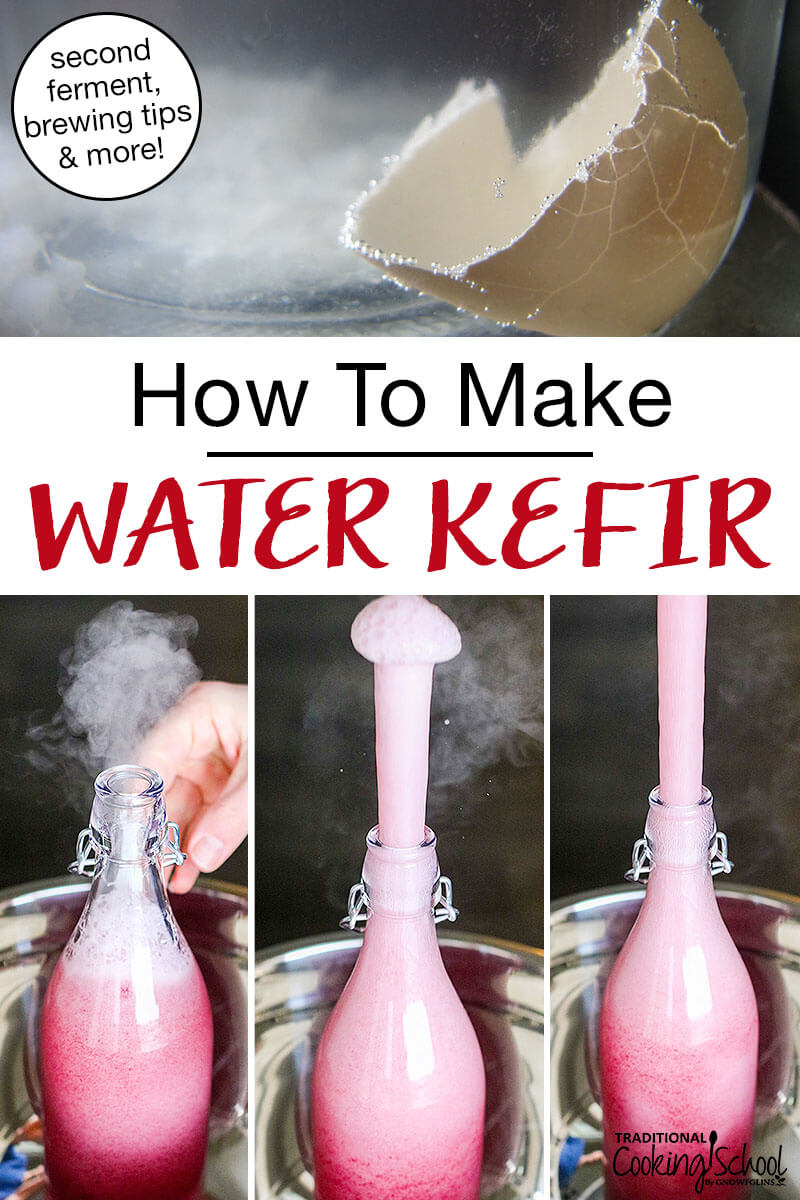
Flavoring water kefir is also known as second fermentation, or bottling.
It’s really easy, and means that your homemade natural soda will have WAY more fizz!
You can use almost anything to infuse water kefir with delicious flavors:
- fresh, frozen, or dried fruit
- fruit juices, like grape or cherry
- splash of homemade vanilla extract
- fresh rhizomes and herbs, like grated ginger
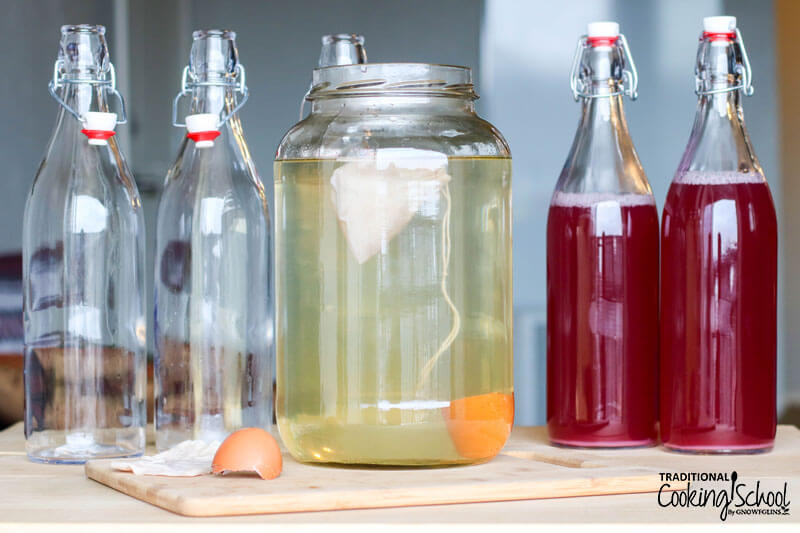
To bottle (aka second ferment), all you need are glass swing-top bottles and fruits and/or spices of choice. Simply place 6 to 10 pieces of cut up, dried fruit (or about 1/4 cup fresh or frozen) into the bottoms of the glass bottles.
Then, fill with water kefir, close, and set in a warm place for 1 to 3 days. If your home is cold, a seedling warming mat will help.
How To Store Finished Water Kefir
Though you can’t see them, water kefir contains tiny bacteria and yeasts that will continue to feed on the remaining sugars, even after the brew is finished. As long as it has warmth, sugar, and oxygen, the fermentation process will continue.
Remove one of these factors, and fermentation stops… Which is vital if your water kefir tastes just like you want it to and you’re ready to store it!
Thus, it is necessary to store finished batches in airtight containers in the fridge, especially so they don’t explode after building carbonation for days on end!
The best way to store it? Glass, swing-top bottles in the fridge!
These are airtight, and you can safely store finished water kefir in them in the refrigerator for months and months.
If you don’t want to purchase swing-top bottles, the next best thing is brand-new seals for Mason jars. It doesn’t matter if the ring is new or not; but the seal needs to have plenty of wax on it to keep air out.
Water Kefir Troubleshooting
If you ever find yourself scratching your head, wondering, “Where did I go wrong?!” on your water kefir journey, you’re not alone! And, we’re here to help.
Let’s run through the common water kefir issues and how to troubleshoot them.
Why Is It Still Sweet?
There are a few reasons this could be happening, like…
It hasn’t fermented long enough. If this is the case, give it a few more days or move it to a warmer spot to speed up fermentation.
Your location wasn’t warm enough. As with all ferments, water kefir loves a warm — not hot — spot. Its ideal temperature is between 70 and 85 degrees Fahrenheit.
Colder months can be an especially hard time for kefir grains because they’re cold if your house is cold. Try relocating them to above your fridge or oven, to an upstairs room, or to a high shelf.
This is also when you might find a seedling warming mat handy!
The grains aren’t getting enough minerals. Minerals are a MUST with water kefir! Revisit my best tips, above, to see if your water and sugar choices could be tweaked. Perhaps you need to add an egg shell or mineral drops to boost mineral content?
Your grains need more time to acclimate. Assuming that there are plenty of minerals (egg shell, water, sweetener), it is possible that your grains are still getting used to your setup.
You can start fresh, perhaps with a smaller batch of sweet water, and keep acclimating them until they’re working. If your setup lacks minerals, investigate increasing the amount of minerals — through mineral drops, adding a bit of molasses, using an egg shell, and a less refined sweetener.
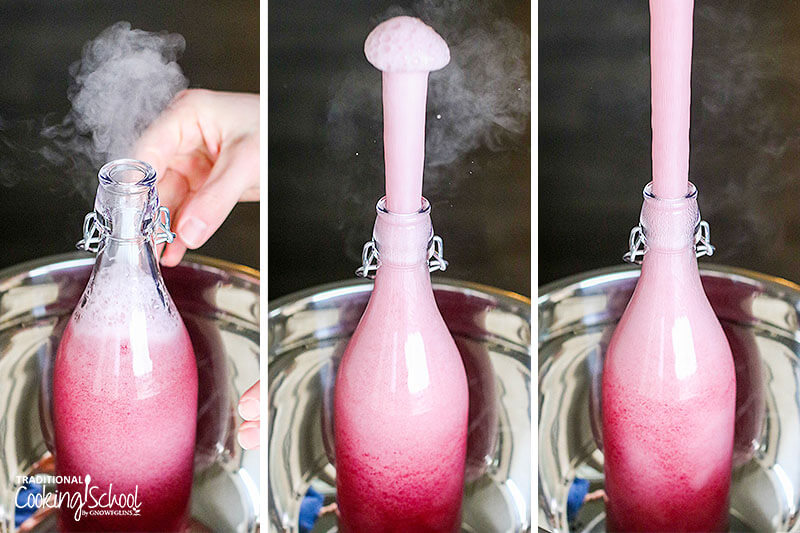
Why Isn’t It Fizzy?
It’s a huge let-down to hear all about the wonderful bubbliness of homemade natural sodas… only to experience flat water kefir when you make it yourself. Here are a few reasons why you might experience a lack of fizz:
It hasn’t fermented at all or hasn’t fermented long enough. No fermenting = no fizz. Again, give it more time and/or move it to a warmer spot to encourage those bacteria and yeasts to get to work.
It isn’t warm enough. Water kefir ferments best at a temperature between 70 and 85 degrees Fahrenheit. Give the beneficial microorganisms a boost by relocating them to above your fridge or oven, to an upstairs room, or to a high shelf.
This is also when you might find a seedling warming mat handy!
Your grains aren’t getting enough minerals. They need to be eating and growing to create a nicely carbonated beverage. Add an egg shell, mineral drops, or molasses to boost minerals.
Or, change to a more mineral-rich sweetener like Rapadura. Make sure you’re not using reverse osmosis water, too.
The container for the second ferment isn’t air-tight. If air can get out, it can’t build up.
That’s why we recommend doing a second ferment in glass, swing-top bottles or in Mason jars with tight lids. Just make sure not to leave them at room or warm temperature too long or you *might* have explosions.
Why Aren’t My Grains Growing?
Here are the most common reasons kefir grains could fail to thrive.
Not enough minerals. Make sure you’re using mineral-rich water and sugar (see my best tips, above). Also, consider adding an egg shell, mineral drops, or molasses to further increase minerals.
They’re out-growing their muslin bag. Although a muslin bag can be helpful to keep your water kefir grains all in one place, if you’re using one and your grains were thriving but suddenly they aren’t anymore, this could be why.
Ditch the bag and let your grains float freely instead.
They’re running out of food. Water kefir grains are more sensitive to being neglected — whether in the fridge where they need to be fed every one to two weeks or at room temperature where they should be fed about every two days.
Keep to a normal routine, as detailed in this post, to make sure your grains are healthy and fed!
Why Is It Slimy, Thick, or Syrupy?
Slimy water kefir is another common issue. Here are a few reasons this could happen.
It fermented too long. Allowing your kefir to ferment for longer than necessary (24 to 48 hours, or up to 5 days if the temperature is cool) can encourage an imbalance of yeast to grow, resulting in a slimy, thick, syrupy beverage with a yeasty smell or taste.
It may take a few batches to fix this, but persevere. Stop the first ferment earlier, and either move your water kefir to the fridge, or proceed to the bottling step.
You can also rinse your grains in pure, uncontaminated water before beginning another batch. If the issue doesn’t resolve within a few batches, I would toss the grains and start with fresh ones.
The temperature is too warm. Fermentation happens much more quickly at warm temperatures, and for water kefir, you have to be vigilant to prevent spoiling at temperatures over 80 degrees Fahrenheit.
The signs of over-fermenting due to temperature are the same as above: slimy or syrup-y beverage, and possibly a yeasty smell or taste. Move your ferment to a cooler place if possible.
Over the course of a few batches, stop the first ferment sooner. You can also try rinsing your grains in pure, uncontaminated water to help reset the microorganism balance.
Again, if the issue doesn’t resolve within a few batches, toss the grains and start over.
Can I Do Anything Else With Water Kefir?
Besides drinking it, you mean? 😉
Sure! If you really have lots of extra water kefir, here are some ideas…
- Use it as the acidic medium for soaking grains and beans, like you would with Kombucha or raw apple cider vinegar.
- Use instead of whey as a dairy-free starter culture for ferments such as cranberry relish.
- Make a water kefir granita.
- Use it as the liquid base for smoothies.
- Make water kefir tea.
- Boost your gluten-free sourdough starter (flavored or unflavored water kefir works for this!).
Homemade Water Kefir
Gut-friendly, probiotic, fizzy water kefir is naturally fermented and bursting with flavor!
Ingredients
- 1/4 cup water kefir grains fully hydrated
- 3/4 gallon pure water
- 3/4 cup sweetener
- 1/2 pastured or organic egg shell rinsed
- 2 cups grape juice organic; or other flavoring options (see Notes)
Instructions
For the first ferment...
-
Dissolve 3/4 cup of sugar in about 1 cup of water, by bringing it all to a boil in a 3 to 4 quart pot.
-
Fill a gallon-sized glass jar with about halfway with cold water.
-
Once sugar is dissolved, remove from heat, and pour sugar water solution into the gallon jar.
-
Add additional cold water to fill the gallon jar to about 3/4 full, or about to the shoulder of the jar.
-
Add 1/4 cup of hydrated water kefir grains to the jar. These can be free-floating, or in a cotton muslin bag.
-
Add egg shell (or mineral drops stirred into the water before adding the grains).
-
Cover with a paper towel or cloth napkin and secure with rubber band.
-
Let water kefir culture, at room temperature, away from other ferments, for 24 to 48 hours, or even up to 5 days if temperatures are cool. The amount of sugar will decrease over time, as the grains consume it.
-
Stop this fermentation when you’re happy with the amount of remaining sweetness. There may or may not be bubbles. Don’t depend on bubbles for a sign that this is working — depend on reduction in amount of sweetness.
-
When you are happy with the first fermentation, remove water kefir grains* (either pull out the muslin bag or use a strainer to separate them from the water kefir).
-
Store grains in the refrigerator or freezer (see Recipe Notes below), or use to start another batch. All you need is 1/4 cup of water kefir grains to make 1 gallon of water kefir, so feel free to share any extra with friends!
-
Retrieve the egg shell(s) with a wooden spoon.
For the second ferment...
-
To the gallon jar, add organic grape juice.
-
Carefully (using a funnel) pour the flavored water kefir into Grolsch-style swing-top bottles. VERY IMPORTANT: Fill only to the shoulder, or slightly below! Leave room for the carbonation to build. Do not overfill.
-
Allow to sit at room temperature for 1 to 3 days.
-
Burp every 12 hours or so, using caution to release the pent-up gases. You can do this in a large bowl to catch overflow so it's not wasted.
-
When you're happy with the flavor and carbonation level, store in the refrigerator or in cool storage. Enjoy!
Recipe Notes
Water Kefir Grain Storage
Water kefir grains may be stored, when not in use, in the refrigerator in a small amount of sugar water.
- Dissolve 1-1/2 teaspoons of sugar in 1/2 cup of water.
- Allow to cool, then pour into an airtight glass bowl.
- Add the bag of kefir grains and put the container in the refrigerator. This will keep for one or two weeks.
If stored much longer, I recommend draining the liquid and replacing it with fresh, cool sugar water, or transferring the grains to the freezer for long-term storage.
Flavor Ideas

Looking for more yummy probiotic-rich drinks?
- Honey-Sweetened Ginger Beer {probiotic, non-alcoholic, GAPS-friendly natural soda!}
- 50+ Probiotic & Fermented Drinks Beyond Kombucha & Kefir!
- Is Jun Right For You? All Your Questions Answered!
- How To Make Beet Kvass
- Spontaneously Fermented Sparkling Apple Cider
- 5-Minute Probiotic Mixed Berry Switchel {paleo, GAPS, AIP}
- Gut-Healthy Cherry Lemon Water Kefir (refreshing natural soda!)
- The ULTIMATE Kombucha Guide {how to make it, store it, flavor it, SCOBY care, troubleshooting, and MORE!}
This post was originally published and written by Wardee Harmon on 12/17/09. It was updated and republished on 7/03/20.
...without giving up the foods you love or spending all day in the kitchen!

2 free books:
Eat God's Way
Ditch the Standard American Diet, get healthier & happier, and save money on groceries...
We only recommend products and services we wholeheartedly endorse. This post may contain special links through which we earn a small commission if you make a purchase (though your price is the same).












I tried water kefir and my fellas didn’t like it, BUT I didn’t try it with the second ferment with the flavorings. I have 2 jars of water kefir with the grains still in it. They’ve been sitting in my pantry with a lid on them for months (Like 5 months…yikes!). I kind of forgot about them and wasn’t sure if the grains were still good or not, so I’ve kept them anyway…just in case. Do you know if they’re still good to use to try again? Or would it be better to order some new grains and start over?
.-= Susan´s last blog post… Venison Pot Pie =-.
Susan – I would bet they’re no good anymore. 🙁 For the future, if you want to store them, put them in some sweetened water (1/4 cup of sweet per 4 cups of water) and store in the fridge. The sugar will keep them alive, but the cool temp will slllooooowww them down. I’d probably change the sweet water every few weeks. I think your family would love the second ferment! It changes the beverage quite a bit.
The grains may be ok. I had grains sitting on a counter for 2 months in a old first ferment and strained them and did a couple batches.. After the 3rd batch they came back nice!
1st ferment 48 hours room temp
2nd ferment 24 hours at room temp
it is now 4 months later and we crank out a gallon every 2 days for the family!
good luck 🙂
I put my grains in the fridge to rest a couple of weeks ago. I think I’ll get them out again. Our favorite is ‘lemonade’. I haven’t tried the lemon/ginger combo but I’d imagine I would like it and the rest of the family would not. 🙂
.-= Millie @ Homespun Oasis´s last blog post… =-.
Thanks Wardee! I kind of figured that, but thought I’d ask…just in case. I’ll have to order some more grains after Christmas. The second ferment sound so good and I hope it will make it more to my fella’s tastes.
.-= Susan´s last blog post… Healthy and Easy Mac and Cheese =-.
Hi Wardee,
Thanks for the information. I converted about 3 tablespoons of my milk kefir grains to water kefir grains (not the same as real water kefir grains, but just as effective)
For my first ferment I add the converted kefir grains to a mason jar filled about 2/3 full of filtered water, 1/4 cup evaporated cane sugar, and 10 dried natural cranberries. I let this sit for 2 days in a dark cupboard,swirling the contents a couple of times daily.
After two days I extract the grains and discard the cranberries. I divide the kefir water into two-1 litre grolsch bottles and top it off with about one-two cups natural grape juce. After capping it, I place it in a dark cupboard that is somewhat warm from my furnace vent. This second ferment is usually about 12 hours, and then I place it in the refrigerator. This is so delicious. I love it!
.-= Marly´s last blog post… Christmas Butter Cookies =-.
Marly – I’m glad you shared how you’re doing that – it will be helpful for people wondering how to make water kefir from dairy kefir grains!
Wardee,
There has to be a “conversion” process for the milk kefir grains which takes a week or so. If anyone is interested I will explain it.
.-= Marly´s last blog post… Christmas Butter Cookies =-.
Just ordered a 2nd batch of water kefir grains from CFH. I’ll be giving your recipe a try as soon as they get here. I was also excited to find 7 old flip top beer bottles that I had forgotten that I bought at a garage sale last summer. They’re still in excellent condition (except for needing a good hot bath!). I’m going to try using them so we hopefully will get some nice carbonated kefir soda…which will be a BIG plus with my fellas…they really like the fizzy stuff. Thanks for posting about this, I think this batch will work out so much better!
Hugs & Blessings!
Susan
.-= Susan´s last blog post… Healthy and Easy Mac and Cheese =-.
Marly – I’d love to hear about the conversion process, but only if its not too much trouble to share it.
Susan – That’s great! 🙂
Can I use honey as the sweetner? I try not to use anything but that in my cooking.
Tara – Yes, I believe you can. At least I have read about people using it. I also run across things that say that honey is naturally anti-microbial, so it will eventually kill the mother cultures. However, I have read that when diluted, this isn’t likely. For myself, I would be willing to risk it. I’d love for you to keep in touch about how it goes with honey.
Wardee, I am so eager to try this and have been for months. Just reading through your process, I’m assuming that if you choose to do a second fermentation, the water kefir grains have been removed by that point, right? Or do you keep them in for the second fermentation, too? I love the tip about the egg shell! I’ve never read that anywhere else, and I’ll have to try it!
—Sonya
Sonya – You’re right – you remove them no matter what after the first fermentation. Start a new batch with them, proceed with the one in progress… Enjoy!
I have been using Milk Kefir to make sodas. I don’t know anything about the conversion process but I read on one blog that you can put them in milk in between uses to keep them alive which sounds like a different method. That is what I’ve been doing. I have some kefir that I use just for sodas. I store mine in milk in the fridge when I’m not using them. It seems to work very well. I made some delicious plum “cider” with them a few weeks ago.
Great post! I really like strawberry kefir soda, and dried cinnamon apples kefir soda…kinda tastes like apple cider.
Erin – Those sound good. How do you do the apple/cinnamon flavor – do you dry the apples with the cinnamon or add the cinnamon to the water kefir with plain dried apples?
This was such a great post; I loved how you broke down the kefir-making into very clear steps.
I’m really disappointed in my water kefir grains, though. I ordered some, and rehydrated them and all that… and I’ve had them for probably a month and a half now. I keep feeding them, but I always end up tossing the end result. Is water kefir supposed to taste GOOD? Mine tastes like vinegar sometimes, and just kinda icky other times. I like milk kefir just fine, so I don’t think it’s that I’m terribly picky about taste.
Mine never seems to be hardly carbonated at all, either. I use Rapadura as a sweetener; I’ve also tried raisins. Maybe the eggshell trick would make a difference?
I guess I’m just wondering if water kefir is totally an acquired taste, or is it actually fairly pleasant tasting?
HoopQueen – What kind of water are you using? If filtered or chlorinated, or if for some reason the water lacks minerals (soft), the grains don’t do that well. Read this post for more info on water: https://traditionalcookingschool.com/2009/12/18/whats-so-great-about-water-kefir/ . The eggshell should help alot if the minerals are lacking.
I think our water kefir is very pleasant tasting, like a mildly sweet sparkling drink and then flavors added depending on the second fermentation.
I would love to try this because of the probiotic effects without the dairy. I can’t eat Rapadura or honey…any other sweeteners you can recommend?
Amy ~ It has to be a real sweetener, with sucrose and/or fructose. I will look around to see whether you can use straight fruit for the first fermentation.
This is a great overview, Wardee! After several months, I was able to find some local water kefir grains and am on our 2nd batch of water kefir. I haven’t tried your advice yet, but I will with our next batch. I am excited to share this with my parents (who don’t drink pop, but do drink soda water) as a healthy alternative.
2nd Ferment: We’ve tried mango and cherry so far. And just started a 2nd ferment with 1) Orange/ginger, 2) Date/Dark Raisin, 3) Apple/Cinnamon. So we are excited to taste those. I’m glad to see you suggest leaving the 2nd ferment out longer than the info I had – I did this anyway with our first batch to strengthen the flavor. Wardee, can I add the vanilla after the 2nd ferment is done? Do you use bean or extract? Jessica, I’d love to hear about how you made your plum cider.
1st Ferment: Marly, I’m excited to try the cranberries, that sounds delicious. I have been using raw cane sugar and applejuice for the first ferment. The original recipe also included some banana slices, but the woman I got the culture from changed that, she said it made it too slimey but the woman she got her culture from loved it that way. So maybe I’ll try the banana slices sometime. Has anyone tried alternative sweeteners like agave or maple syrup for the first ferment? I wondered about the honey too. We’ve never tried it in our other cultures, like kombucha, for the reason you give.
I have a few questions… about water – we have filtered water we use. I have mineral drops I sometimes add to our water… maybe I should add to the water kefir water? I am also trying to get it fizzier without ordering the Grolsch bottles, does anyone have suggestions?
Faith – You can add the vanilla at any time. I have not used vanilla bean. I would absolutely add those mineral drops to your filtered water. We have filtered water, too, but think we may not have to much longer, which is why I haven’t gotten any mineral drops. I have used agave for the first ferment – using up the last of a big supply. I just recently switched to using Rapadura and I have noticed right away that the water kefir is more bubbly with the Rapadura. BUT it still worked and tasted wonderful with the agave. Thanks for your flavor ideas!
I use 1 T. unsulfered sorghum molasses, 1/4 c. Raw sugar for first ferments. It’s not bitter, we like the flavor combo. At first taste, it smelled and tasted sweet. Second, it had a slight alcohol smell and taste. Third, no sweet, no alcohol.
@ Susan… you could always try to reuse your grains. The good thing about cultured liquids is that it is very obvious in appearance and smell if they go bad. So you should be able to tell fairly soon if it’s good or not. However, if the grains have a bad smell already in your fridge I would not use them.
I say this bc there have been many times (pregnancy, moving, etc.) when we have left some of our kombucha cultures for months in our fridge with a small amount of kombucha in jars and they have always worked great when we finally get back to using them. I think some of them were left at least six months with no problems.
Wardee,
I dry the apple slices with cinnamon sprinkled on both sides. It is a great flavor to the water kefir. I also tried some organic grapes when I was able to find them on sale this summer. I froze them and added them to the 2nd ferment. That’s another good one to try. Enjoy!
Hey everyone,
Sorry I didn’t get right back with the conversion process, but I’m sorta busy with, you know, Christmas—Heehee. Anyway as soon as I have some time I will explain it all in detail for you. Have a wonderful Christmas.
.-= Marly´s last blog post… Christmas Butter Cookies =-.
Wardee~
Thank you for sharing about this.I was just wondering the other day where I might find a healthier version of pop. I want to try this so maybe we can break the “pop habit”.I’ll have to talk to my dh about me ordering the grains. I am going to pass this on to Nicole,too because she really loves pop. I think she drinks it way more than we do.
.-= Tina´s last blog post… Our middle ds~ the Boss =-.
Wardee,
I’m finally making my second batch of water kefir. My kids didn’t like the first batch, Pineapple flavor. So my husband and I drank all of it. I am starting a berry flavored batch next. I was just wondering if you drink it at a certain time, and how much you drink. My husband and I both had a cleaning out experience from this stuff. I’m wondering what that was about? It makes more sense with me, but not with my husband. And it was at very different times, so it couldn’t have been something we ate.
I also tend to get a bit of a stomach ache when I drink this, not sure why.
I do enjoy experimenting on myself though:)
Thanks again for all of your insight!
Tiffany
Tiffany – We drink it about once a day, and usually with a meal. I drink mine in the evening or when I know I’m sitting down – it lowers my blood pressure just like Kombucha does, and both quite strongly.
If you’re cleaning out, I think it must be doing good work! Kombucha is supposed to cleanse.
Keep letting me know how it is going. 🙂 Hope your kids like the berry flavor.
Wardee,
I thought of another question. I am going to share some water kefir with a friend who is nursing her baby. Are there any recommendations for pregnant or nursing mothers and kefir?
Tiffany – I haven’t read anything about pregnancy or nursing. If you find something, please let me know.
My daughter in law drank kefir water throughout pregnancy and while breastfeeding and baby had little to no colic
Tiffany – one other thing 🙂 I wanted to clarify my answer about how often we drink this. Actually, our goal is to have at least a small glass of a beneficial beverage at every meal. And we also have Kombucha around. So it works out to be two cups of Kombucha and one cup of water kefir a day. Not everyone does 3 glasses a day, but we each do at least one, and it tends to be with a meal.
honey WILL indeed kill the mother grains eventually. honey is not the right kind of sugar to feed those little guys. kefir likes diglycerides like white sugar or molasses (there are plenty of other options).
however you CAN use honey in your secondary ferment as long as you don’t leave any kefir grains trailing.
I really need some advise. I don’t want to give up on my new water kefir grains, but so far I haven’t made anything that doesn’t taste alcoholic. I started out fermenting for 2 days and then another day or two sans the grains, plus vanilla and/or fruit for the 2nd ferment. Then I cut back to 24hrs on the 1st ferment. I’ve even cut back to 12hrs and it still tastes alcoholic. The most recent batch tasted better, but I’m concerned with the still present, although not quite as strong, alcohol-y taste (I’m expecting and just don’t want to take any chances). Is it supposed to taste like alcohol? I’ve tried using both rapadura and turbinado w/ a touch of molasses. I may be crazy, but I’m pretty sure that after just a couple of weeks, my grains have multiplied…I thought they were usually pretty stubborn about multiplying. I’ve been getting well water from a neighbor to make my kefir. Could it be that the water is so mineral rich that the grains are fermenting/multiplying faster? Any advise would be appreciated. Thanks for your time! (btw, this is my first time commenting, but I love your blog!)
Casie – Hi! A couple thoughts. First, perhaps that you’re confusing the fermented smell/taste with alcohol? It is true that water kefir contains a smidgen of alcohol – it is a byproduct of the natural process. To us it does smell and taste a bit like alcohol, but it is not an alcoholic beverage. It is a fermented beverage. If you’re using rapadura and molasses – both rich with minerals – I am not surprised that your grains are multiplying. And yes, that well water could be doing it, too. It sounds to me like you’re doing everything right. What I suggest, since you’re expecting, is to drink a small amount of it. Sit down or lay down so you’re not doing anything else, and pay attention to how you feel. Alcohol would have a noticeable effect (at least it does me as I don’t drink it very often 😉 ).
But, to possibly confuse you more – Kombucha, for instance, has a blood pressure lowering effect that can be confused with the loopy feeling one would get from alcohol. Not all people notice it, but I do because I already have lower blood pressure. Water kefir affects me the same way, so I think the same thing is happening.
When I started making water kefir, I only had agave syrup to use (was using it up and haven’t replaced it). The grains were stubborn. In fact, I don’t think they were eating much of the sugar because the water kefir after 5 days was still pretty sweet. Now I use Rapadura – the beverage is much more bubbly, fermented-tasting, and not sweet at all after 3 to 4 days.
Hi Wardee!
After reading your post on Kefir, I ordered the starter kit from CFL. I noticed in the directions they give a range of 3-4 days for original rehydration, and 24-48 hrs. for fermentation. I’d like to have more of a carbonated drink if possible, so should I go with the shorter or longer end of the time ranges? Also, my directions don’t say anything about a second fermentation, will I get a better flavor, and more carbonation if I do the second fermentation? It’s a little intimidating!! Thank you SO much for your blog, it’s been life changing:) Still working on trying to find raw milk, Argh!
Thanks!
For raw milk, check your local Amish or Mennonite communities. Also check your state laws, it may be illegal to sell raw milk for human consumption in your state. However, you might still be able to purchase it to feed your animals.
Well, not quite sure how I got to this particular page but I must say, I’m glad I did. This sounds like something that I want to try. And this Kombucha thing… I’ve heard of it but never realized it was cultured.
I really must break my son of this soda habit. He doesn’t get that much, and for very good reason. Sugar…does things to him.
Thanks for this entry 😀
Thanks, Wardee. I guess the fermented taste will take some getting used to. I’ve only had sips so far since I’ve been a little worried about the alcohol taste, but I’m going to keep experimenting with flavors and ferment times until I get something I’m comfortable with (or until I acquire a taste for it!). If these grains keep multiplying the way they have been, I’ll have to find someone to share with soon!
hi
i accidently put sparkling water instead of still water. can you please let me know if i made them all dead?
thanks,
audrey
Audrey – How long has it been? Are you rehydrating your grains, or making a full batch with plumped up grains?
If it were me, I’d check two things:
1) I’d smell the batch – does it smell fresh and a little fermenty, but not repulsive? Then they’re probably okay.
2) Depending on how long it has been, I’d taste the liquid. If it has been two days and the grains are working, the liquid should be much less sweet and a little carbonated (a little “bright”).
If both those things are good (good smell and decreased sweetness), then I would think the grains are okay.
Regardless – if I wasn’t sure if they were okay or if I thought they were, I’d put the grains in a fresh batch of pure, sweetened water – and be sure to add a rinsed eggshell if it is a full batch (not just the first stage of rehydrating). The best sweeteners would be Rapadura or Sucanat because they’d have alot of minerals to get the grains going again if they’d been suffering.
Let me know how it goes!
Hi Wardee,
I have a metal strainer- is it okay to use that to remove the grains? And also to use a metal spoon?
Thanks,
Michelle (Health Food Lover)
Michelle – You shouldn’t use any metal, even stainless steel, with cultures. Best to use wood or bamboo. I like those little muslin bags to store my water kefir grains – it makes transferring from batch to batch super easy. (See the Resources page for sources.)
Hi Wardee,
Yesterday I poured out my first batches of water kefir to drink.
I made two types-
One with- dried figs cut up, half a lemon, water and 2 tablespoons rapadura sugar.
the other- dried figs cut up, half a lemon, water & 2 tablespoon raw sugar.
So I tried the rapadura one- im not sure if it is because of the sugar or the figs but it really smelt quite unpleasant, however it tasted a bit better than it smelt. It was also a bit thick, kind of syrupy, something I wasn’t prepared for. I also didnt really like the dark colour of it.
The Raw sugar one- smelt much nicer and didn’t seem to be as thick and had a pleasant colour.
So I’ve concluded that using raw sugar yields a nicer kefir aesthetically, albeit not as nutritious as one made with rapadura. I also tested the alcohol content with my hydrometer (I use it normally to make apple cider vinegar) and the specific gravity was around 2-3 percent (after 24 hours). So it contained around 2-3 percent of alcohol. I’m quite concerned about alcohol content.
I’ve now made a new batch containing juice of half a lemon, half a lemon (whole), 2 tablespoons raw sugar and half a clean egg shell and water. My aim is to made lemonade. So I’m going to see how that goes.
I’m thinking I might make a ginger beer next time if this lemonade goes successfully! I’ll let you know!
Michelle –
The water kefir will be syrupy from the sugar, and less syrupy the longer you let the grains “eat”.
Did you add the lemons, figs, etc. during the first fermentation? I am confused because you also added sugar. Perhaps you had a reason for doing so. Every time I do a second ferment, I just let the grains eat fruit – no need for more sugar.
I am shocked at the amount of alcohol! Will you please keep checking it and letting me know if this is consistently the result?
And I agree – the more refined the sugar, the more aesthetic, EXCEPT in terms of bubbliness. The less refined sweeteners produce more bubbles because the grains love the minerals.
Thanks for the update!
Hi Wardee,
I’ve been experimenting a bit more with my kefir grains this week.
The kefir I talked to you about last time has lemons, sugar, figs, kefir etc..so I added sugar aswell as fruit. But I only to a primary fermentation and then bottle it.
I’ve made a really nice ginger beer (fresh ginger tea-made and then cooled & strained- a few pieces of fresh ginger, a piece of egg shell, a 1/8 teaspoon of bicarb soda, kefir grains, raw sugar & spelt syrup (instead of molasses)) which has turned out wonderfully! It has quite a nice fizz and tastes alot like bundaberg ginger beer (which is a really popular brand here in oz).
I tested it for alcohol two other times now and they have been between 0.5 & 1%. But I will keep testing it to see if i get the same results.
You know drinking the water kefir has greatly improved my appetite (normally its really low) since I started drinking this kefir at the begining of the week (yes I’ve only started drinking it at the begininng of this week!). But it’s been a great experiment.
I want to make a really nice lemonade in a week or so. Have you made nettle kefir? I saw it on Dom’s site and I’m thinking of trying it but not too sure.
Michelle – So you’re adding the fruit to the first fermentation. Gotcha.
The ginger beer sounds wonderful.
Interesting that the alcohol content is lower now. I’m glad about that. 🙂
Wonderful its affect on your appetite! I have not seen nettle kefir. You are such a great experimenter – please let me know if you try it! I’d like to use some of your ideas in the eCourse lesson on water kefir. I’ll be referring everyone to this post for ideas beyond what I demonstrate in the class, so whatever you add here will be a great benefit to everyone – thanks!
I’m new to water kefir, though I’ve successfully brewed a few batches of the lemon/fig recipe. I’ve been drinking it on its first fermentation, but am interested in other flavors. In searching for recipes, I found your blog, and made sure to read through all the comments. Now I can’t wait to start making second fermentations so that maybe my children will enjoy the drink, and the health benefits as well. 😀
As for the nettle kefir, my friend wrote a post about it on her blog long ago, though I’m not sure she still makes it. http://www.rebuild-from-depression.com/blog/2007/09/fermented_nettle_tea_an_iron_b.html
Thanks to everyone for sharing their thoughts, ideas and recipes!
Hi! I’ve been experimenting with water kefir for a couple of weeks now, and have found your directions better than the others on the web. My water kefir gets very bubbly during the second fermentation, but when I strain that into a bottle, it looses all it’s fizz. Any ideas n what I could be doing wrong? Also, it’s much cloudier than the one you have pictured above, which is clear and sparkling. Thanks for any additional tips!
Nancy – I’m glad you found the directions helpful. 😀 Pouring it releases the fizz – it is gas that escapes. Are you pouring it into a Grolsh-style bottle or into a non-air tight bottle? If the former, it will build up fizz again. If the latter, it probably will stay pretty flat.
For your second question, what sweetener are you using? In these pictures, I used evaporated cane juice (a sugar that is more refined than Rapadura). Now I use Rapadura and this results in a darker, cloudier water kefir. Let me know if any of this helps!
I’m doing water kefir for a short while and started yesterday a new batch, this time putting the grains into small muslin bags. However, now the bags float on the top and my dried fruits, raisins, are on the bottom. Doesn’t that affect/slow the fermentation?
Martin – That is totally right. The grains in the bag do float – they give off gas which gets somewhat trapped in the bag, giving it buoyancy. If the grains were free and doing well, you’d see them dancing up and down in the jar. It is really cool! And yes, the fruits do stay at the bottom. Have fun!
Thanks Wardee,
but I have the strong feeling that the fermentation takes much longer when the grains are in the bag as when they are loose. Maybe because they are in close contact with the fruits when loose? What is your experience about this difference in fermentation time?
Best,
Martin
Martin, you could be right. I can’t say I’ve ever compared it. However, if it is slowed, it isn’t detrimental, to my knowledge. I get a full fermentation of water kefir within 48 hours (almost no sweet left) and I use a bag every time. Perhaps it could go faster… I don’t know. I’d be curious to hear from you if you do a side by side and find anything interesting.
Also, I don’t typically use fruit while the grains are in the brew. I do a first fermentation with just grains. Then I put the grains in a new batch, completing a second fermentation on the original batch with dried or fresh fruit (no grains).
I’ve been making kefir water for a month or so and the last two batches got a little long (like 6 days), so the taste is more like wine or vinegar (not the least bit sweet). Have you experienced this and do you still drink it?
Thanks,
Anna
ps – I use grains from CFH and my sweetener is Sucanat. I was doing a quart at a time, but this most recent batch my grains had multiplied enough to do nearly a half gallon.
Anna – That sounds normal. We do still drink it even though there’s no sweet left. However, I think for the longevity of your grains that you should normally avoid a 6-day long fermentation, especially in warm weather. Though it does sound like your grains are thriving if they’re multiplying, so let your taste and their health be your judge.
Wardee and anna…
the winey/vinegary taste is completely normal, but i tend to not drink it. what you should do is keep it in the fridge, closed, for an extra week or two. you will be shocked at the yumminess that is produced from that vinegar stage. it actually goes EVEN sweeter, and somewhat syrupy if you let it process off the vinegar.
but i suppose you could use it as is to make salad dressing! i never tried but always wanted to!
Hi Wardee,
Thanx for all your recipes and advice. I read through alot of the posts and some of my questions were answered. However I still have a couple:
1. I read somewhere that you can freeze the grains, if so how would I do it?
2. I am new to this and received my grains from a co-worker. The directions she gave me did not call for lemon or raisans and she also told me to use piloncillo (sugar). I have been having somw heartburn and I wonder if it is because I failed to use these items and am not measuring my amounts. What do you think?
I tried the 2nd fermentation process and I think my mango was over ripe because the batch smelled rancid instead of fermented. I tossed this batch out but the batch before was made w/ firmer mango and blackberries and it was good.I have also started using (1st process) organic lemon and raisans and an extra cube of sugar (last 2 batches) and I found it to have an even STRONGER vinegary taste than before, (the process is usually 24- 30hrs). I am not sure why, not sweet or anywhere near sweet but I still drink it. I also spent yesterday in bed w/lightheadedness and nausea and I know when the body is releasing toxins it may be reacting to it, do you think this could be it? I know you are not a Dr. I was just asking for your thoughts. 🙂
Sincerely,
Evelyn
Evelyn wrote:
“I tried the 2nd fermentation process and I think my mango was over ripe because the batch smelled rancid instead of fermented. I tossed this batch out but the batch before was made w/ firmer mango and blackberries and it was good.I have also started using (1st process) organic lemon and raisans and an extra cube of sugar (last 2 batches) and I found it to have an even STRONGER vinegary taste than before, (the process is usually 24- 30hrs). I am not sure why, not sweet or anywhere near sweet but I still drink it. I also spent yesterday in bed w/lightheadedness and nausea and I know when the body is releasing toxins it may be reacting to it, do you think this could be it?”
hi evelyn!
i think you should basically be careful with any fruits that are viscous by nature, ie that don’t have some form of protective layer keeping the juices locked inside instead of freely mingling with the kefir. i have used dried apricots successfully but had no luck with fresh apricot slices, where the inner flesh was making contact with the sugar-water media. similarly, i’ve had perfect batches using raisins but some cloudy icky batches using sliced-open dates. the solution basically turned the dates into mush, which also left behind thin shreds of date-flesh throughout my mixture.
lemon and citrus fruits seem to work, but most other ‘slippery’ or surface-wet fruits tend to ruin the brew (bananas, kiwis, pineapple, sliced-open bits of melon, banana, etc). anything with a skin (apples, grapes, whole blueberries etc) holding in the juices should work.
if you are still a new kefir taster, your sick feelings may indeed be your body adjusting to the ‘good bacteria’. you may have overdone your intake, which CAN cause heart-burn and bloating, sometimes diarrhea and stomach ‘gurgling’, and in rare cases, usually in people with a lowered immune system, it could cause nausea.
i was SO bloated for 2 months after making my first brews, but other than that, i felt no discomfort.
it sounds ridiculous, but when you first start consuming kefir, try not to ingest more than a tablespoon per day. if your symptoms continue, try to reduce to a teaspoon. if you’re STILL reacting badly to it after a month of 1 tsp per day, you may want to consider avoiding kefir altogether. but if you feel none or only mild discomfort at 1 tsp per day, slowly increase until you feel your system has fully adjusted.
even though i’ve been drinking my kefir for about a year, i still try to control my intake, and limit it to about 250ml a day, and it’s suggested to take a one or two day ‘breather’ if you can.
so, many people drink kefir 5 out of 7 days a week only, though it’s not completely horrible if you have just a bit each day. it won’t kill ya, but the good bacteria in your gut will work better if you give it a couple of days off.
i hope that gives you some insight!
Thanx Dee!
I have been drinking about 14-16oz a day, I started at around 6-8 for the 1st week. I am already drinking this much so I guess I will stay here for a while and I will take your advice and give it a break every few days. My water kefir has been extremely happy since I started adding extra and the lemon wedge. Thank you so much for the help.
Evelyn — I am sorry for being tardy to your questions!
On the freezing, I put my grains in a bit of sugar water in a Ziploc and freeze. It has worked well so far.
dee gave great advice on how to get used to kefir and also about fruits. I would suggest fermenting for less time to avoid the heavy fermentation smell/reactions. I would also suggest NOT using any fruit during the first fermentation.
Hi,
does anyone has experience with large batches of water kefir? The recipe should scale linearly, shouldn’t it?
I started a batch two days ago in a 25 liter (~6.6 gallons) fermentation container using 4-5 cups of grains and ~1.6kg sugar. Seems to ferment well, however this morning (~36 hours) there was still a good bit of sugar left. However, the grains were stored in the fridge for a couple of days beforehand, so they will need time to recover first.
I will keep tasting to see when it’s finished.
I have had some water kefir brewing on my counter for almost a week now. I put in eggshells and it is starting to get a bit of bubbles but I noticed a bit of ‘film’ almost like a SCOBY on top. Reading through the posts, I haven’t seen anyone ask that. It is still very sweet to me, I am thinking of putting it in a bigger jar and adding more water. Would that hurt any progress? Thanks
I didn’t mention that I have about 32 oz brewing 🙂
Ceitllyn, I don’t think that film is a good sign. I could be wrong, but I think your fermentation has been too long. You should never go more than 5 days, and usually about 3 in warm weather is the max. If it is still sweet, it would seem the grains are not thriving because they’re not eating. I would try to start a new batch, perhaps smaller just in case you have to go through several to revive them.
Martin, I start a few batches of water kefir at once. Yes, it scales. If I’m making two gallons, I dissolve 2 cups of sugar in a bit of water (by boiling). Then I add water to cool it down. Then I pour the sugar water equally into the gallon jars, and fill to the top with more fresh water. Add the grains, etc.
It’s not clear in your instructions how much kefir grains to use to 3/4 gallon of water… you say that the packaged amount is good for that big of a batch, but not a measurement for those of us not using the package…
Can you advise?
KeeNan — Sure! About 1/4 cup of rehydrated grains per 3/4 gallon of sweet water. It is flexible, though, you can use more or less and be fine.
I was able to obtain some water kefir grains recently, but they are not dehyrated. They came to me in a small half-pint jar that is very full and bubbly…and no instructions. I’m keeping it in the frig. Now what???
Sherri — proceed with the directions in this recipe. You need about 1/4 cup of hydrated grains for a 3/4 gallon batch of water kefir. If you’re in the Fundamentals eCourse, you can see video demonstrations of the whole process.
PS Your comment went to spam — I just now found it.
Hi Wardee.
I’ve been on a few months hiatus from WK (my last comments on this post were in Feb. which was around the time I last made it). I noticed in your last comment to be above you wanted to share some of my ideas in the eCourse, I know this is late but I would have said that is fine :).
I’ve recently procured some more grains and have been making and drinking it lately. I’ve now established a few WK ‘formulas’ that have worked for me:
To make basic water kefir-
I dissolve raw sugar in bottled water, add a pinch of bicarb and the grains. I let it sit out (i.e. on the counter) in a glass jar with a cloth and a rubber band around the cloth to ferment for around 24 hours. Once that time is over I strain the kefir water into another clean jar and then add flavourings for a second fermentation.
Flavourings I’ve liked and tried (added to the second fermentation w/out kefir grains):
-a dash of vanilla extract (though fresh vanilla bean would be devine)
-zest of 1 lemon, it’s juice and the rest of the lemon chopped up
I’m now making a ‘fanta’ flavoured WK: it has orange peel, orange zest, juice from the orange and the rest of the orange chopped up and added to the kefir water for second fermentation. It had a tight lid on to increase it’s hold of gas. It’s currently ‘brewing’ so I’ll let you the results of it soon!
I’m going to again check the alcohol content of my WK brews sometime soon and I’ll also let you know about that too.
By the way, when you first started making WK did you ever notice a cheesy smell and taste? When I first started I did, but now I find that smell and taste almost completely goes upon refrigeration of the kefired water.
-Michelle.
Health Food Lover
healthfoodlover.com
Hi, Wardee! I just acquired water kefir grains. I have them fermenting with a little organic refined sugar and some unsulphured organic molasses until I restock my sucanat next week. As I was reading over this post and comments I wondered about the mineral content of my water. We have well water, but do run it through a softener (it’s not terribly soft, though). We have our own chicken’s egg shells to use, so that is good, but I wondered if I could add a little Azomite powder to a batch? In my mind it makes sense but I’m wondering if you knew for sure yes or no.
Funny thing about this first batch is I was tired while I was getting it going last night and 1-1/4 cups sweetener in 1/2 gallon of water for 2/3 cups of rehydrated grains. Yikes! Read this post and immediately added another 1/2 gallon of water – there were already some beginning bubbles and some of the grains were floating. Looking forward to this (and getting my kombucha going again).
Oh, one more thing – is it okay to culture this right next to my milk kefir? Both jars are covered with coffee filters…
Thanks!
Kimarie – Fun! As far as I’m concerned, additional minerals are an excellent idea. I think you should do it. When I first started making water kefir (as in this post), I only used egg shells. My grains did okay, but they never multiplied and the water kefir wasn’t that bubbly. Now I add mineral drops to each batch and the grains are sooooo happy. They bubble and move up and down and multiply like crazy. I no longer use a bag because they grow so fast they crowd themselves in the bag.
I’m glad you added more water! But it would have been okay, probably. It may take your grains longer to get through the sugar. 🙂
I would move the water kefir away a bit. There are different organisms and they can cross over, even though coffee filters… Just best practice. I’ve had some experiences lately with sourdough and cheese not behaving well in the same room together that I’m pretty careful about keeping things at least 5 feet apart, but more if I can.
Thank you! I’m on my second batch of kefir now (this is MUCH faster than kombucha!) – I added some vanilla to the first batch and let it ferment under lids for less than two days, we keep tasting it and love it. It has a slight fizz. Don’t have sucanat until Thursday so I’m using organic sugar plus the eggshell for the second batch. I think I’ll toss some Azomite powder in there.
One more question, do you strain it through anything finer than a plastic strainer? There’s a bit of sediment in the bottom – I don’t mind, but I’m wondering if I’m “wasting” tiny new grains… 🙂
Fermentation is so fun!
Kimarie — That sediment is normal (a by-product of the fermentation) and to my knowledge you couldn’t successfully strain it out anyway; I don’t. I just strain the grains through a normal strainer and the sediment accumulates in the jar.
Yours sounds super good! I’m glad you’re liking it! Yes, it is much faster than Kombucha. 🙂
Thanks for asking about the azomite, I was wondering about the same thing. The issue I have had with using eggshells is that they seem to slow down the conversion of sugar to acid by neutralizing the acid. That seems to make sense because they are mostly calcium carbonate (same as limestone). The lower acidity allows molds and things to take hold…at least that has been my experience. Some people consume azomite directly so I plan to try it, maybe in a coffee filter pouch to keep the brew from being too “gritty”. Have you tried using the azomite yet? I’d love to hear how it worked for you.
Why can’t I figure out this WK thing??? lol
I have only got 2 bacthes that aren’t syrupy, thick, yeasty garbage…. Hmmmmm What am I doing wrong? I have been at it 3 weeks now….
My grains aren’t multiplying, I have been very careful to monitor temp (76 to 80 degrees) I have tried several combinations/ratios of sugar to grains, raisians, Black Strap Molasses, etc etc….
Recently a few grains have started to float to the top….but I see no dancing grains….no growth, and the taste sucks….
Any ideas??
Nate — I’m sorry it is giving you trouble. You’ve tried everything, and now I suggest you up the ante. 🙂 Give those grains some more minerals. Here are the drops I use: Liquimins. At one period, I was producing slimy, syrupy water kefir and grains that didn’t multiply. Then I started adding 1/8 teaspoon of mineral drops to each batch and the difference was like night and day. Be sure to rinse your grains well and give them some more time to recover in case they’ve been shifted out of balance by another organism.
Thx for the tip….and yes I feel like I have tried everything 🙂 It’s discouraging always pouring it down the drain….
Question tho… I see so many conflicting things on the interent….. Should I or shouldn’t I rinse the grains befor each new batch….. 🙂
Maybe you could kindly type out your recipe for me and I will try it 🙂 Thanx so much…
You only rinse if you feel that the grains are compromised. Otherwise, no.
My recipe is in this post… Except now I add 1/8 teaspoon of mineral drops to the sugar water. One of these days I’ll update this post. 🙂
I have video of WK in the eCourse: https://traditionalcookingschool.com/ecourse
Thx so much…I will give it a whirl 🙂
I use unsulfured sorghum molasses, I suspect your black strap molasses has sulfur. Heard that should not be used. Someone else may have a more helpful answer.
Have you ever considered using one of the pitchers with the fruit infusion tube you can put down the center? It would sure make taking out the eggshell and kefir grains easier. Do you think it would work? It is plastic, but bpa free. Here’s a link to one at amazon:
http://www.amazon.com/Prodyne-Infusion-93-Ounce-Natural-Pitcher/dp/B0023UL86A/ref=sr_1_9?s=home-garden&ie=UTF8&qid=1296951702&sr=1-9
Our favorite flavor right now is Cherry vanilla. We use 1 cup organic Just Tart Cherry Juice and add some vanilla at the end.
Kim
All I’m getting is yeast-smelling water, no bubbles at all. I use filtered water and an eggshell. Mineral drops are too expensive. I’m about to give up, as I can’t bring myself to drink this, and it’s expensive experimentation.
Kim — You could try adding baking soda, which offers some minerals. I seem to remember reading that 1/2 teaspoon per gallon is a good ratio. Give that a try and let me know if you can revive those grains. They sound to me like they’re starving for minerals.
Hi,
I have a problem with my water kefir, maybe you know what’s happend:
I stopped brewing water kefir for a while (3 month) and recently started again. My grains were in stored in the fridge in sugary water. I put them into new sugary water with some lemon juice to recover for a couple of days.
My brewing method is as follows: I put the grains in a muslin bag and this in a 5l fermentation plastic vessel (both from a home (beer) brewing store). I add 250g white, normal sugar (~50g/liter) and some lemon juice. After 1-2 days at room temperature (unheated room, so a little colder than normal) I remove the bag and a ~170g raisins. After another 1-2 days I bottle, i.e. fill it in a 5l wine-in-a-bag bag with tap and put this into the fridge. So far this resulted in a nice yellow water kefir. The color is of course different for different dried fruits, but always yellow for raisins.
My last batch turned out to be not very yellow, just a little bit but quite slimy. When I removed the raisins with a sieve the liquid didn’t flow very good so I put a spoon in the stream and it was quite solid. I tasted it and it didn’t tasted bad but not like normal finished water kefir. One other funny thing is that the white muslin back got a large brown spot on it where I made the knot to close it.
I dumped both the water kefir and the used grains to be on the save side and set up a new batch with some backup grains I kept in the fridge. Let’s see how they turned out.
Do you have any idea what happened? Maybe I got some contamination of other bacteria in it? Is this bad or nothing to worry about it? I like to avoid this to happen again with my other grains.
i have done a few successful batches of water kefir and we love it plain! I just did a batch with lemon juice(fresh squeezed) and grape juice. they sat on the counter for 3 days (w/o grains), bottled them, popped one open and it splattered all over my kitchen! it smelled wine(ish) but didn’t smell bad, just like wine. tasted o.k. not sweet at all like the plain kefir. will it have some alcohol content just after those 3 days? is it o.k. to drink?
Is the plain water kefir supposed to get fizzy like that? because mine never does.
Thanks for your help!
I also experienced the slimy disgusting water kefir. I got tired of all the effort and no one would drink it. So I froze my grains in sugar water. I pulled them out of the freezer about a week ago and started a new batch. They don’t seem to be fermenting at all. No bubbles. The water is still very sweet, though it is beginning to smell like kefir. My grains are no longer firm. More like mush. Did I kill them??? Can I revive them? I would really like to try again now that I know a bit more about how to make it.
Hey there,
I googled it for you in case I run into the same issue in future. I hope it’s okay that I mention another site, ‘Cultures for Health’ has an article on their site entitled ‘Rehabilitating Water Kefir Grains’ based on the article, the slime is one of the indicators that your kefir grains are stressed.
http://www.culturesforhealth.com/rehabilitating-fixing-repairing-damaged-water-kefir-grains
Hope this helps!
Caroline
Hi I’ve been working on making water kefir for the past few weeks and every time I make it it is always super bitter and tart and loses almost all carbonation once I bottle it. Do you have any suggestions to help make my kefir more drinkable? Every time I make more I can barely stand to drink it and usually end up pouring it out.
I’m new to the WK and just finished my first batch. I’m wondering how I should store them? Thanks!!
Hi Wardee,
Thanks for the information on Water Kefir. We are just getting started with it and it was great information. I’m actually writing just to complement you and thank you. For the last year and a half, we’ve been struggling to isolate some food allergies with our kids. They are strong, beautiful, healthy children for the most part, but our trials in balancing their diets have driving us to the brink of frustration. We wife has slowly been pulling me into the world of organic/natural and sustainable living and we are doing our best to move that direction. Anyway, getting to the point. The picture of your daughter for this article is amazing…she looks so healthy, warm and vibrant. It truly inspired me in wanting to give that to our children.
Thanks for the inspiration and great job helping others break out of the system 🙂
Shawn
I notice you say to do the initial ferment for 3-5 days. I got my water kefir grains from http://www.culturesforhealth.com and they have an FAQ page on their website about it. In the FAQ section thay include this info:
“Q. Can I allow the kefir to culture for longer than 48 hours?
A. We strongly recommend against allowing the kefir grains to culture for longer than 48 hours as over time it will damage the grains by potentially starving them (particularly in warm weather when the culturing process is sped up due to the heat).
I notice with my grains that after 48hrs it still tastes sweet but also tastes and smells very fermented (almost a spoiled taste/smell that you would get from dairy only it’s not bad). I’ve been flavoring it with lemon juice to make a sort of “lemonade” and it tastes pretty good.
Are my grains differnt from yours? Should allow mine to ferment longer to allow the grains to “eat” more of the sugar?
Thanks!
Lisa — It is risky to go so long on a continual basis. It doesn’t mean it can’t be done, though. You have to play with it so the sugar is gone, but not so much that the grains decay. In summer, no more than 3 days. Cooler room temp can means a bit longer, but we do that at our own risk. I have had grains decay and fail to thrive because I pushed them too much.
Oh yeah, and one other question…I’ve never gotten the carbonated “soda” feel with my water kefir. Does that only happen if you allow a second fermentation period? I haven’t experimented with that yet as I’m very new to this.
Thanks!
Lisa — You’ll only get carbonation with the second ferment, where the container is sealed at room temperature building up carbonation.
Just found this article. I’ve only managed to get my kefir to be bubbly after the second ferment one time. Is there any way to do this more consistently?
I was given grains. How much should I add to this recipe?
Kelli — I need more info. 🙂 How many grains were you given? Are they hydrated or dehydrated? 😉
I have a ton of grains. At least a half a cup. And they are hydrated. For some reason your response got sent to my junk mail. I’m glad I found it! Also, I am doing Kimi’s no sugar challenge. Is there any sugar left after the kefir is ready to drink? I might have to make it for my family until I am done with that.
Kelli — Use 1/4 cup of grains per 3/4 gallon of water kefir (or up to a gallon). How much sugar is left depends on how long you ferment it. After three days in warm temps, there’s not much left. Taste it and you can tell if it has any residual sweetness.
I just made my first batch of kefir water….I rehydrated my water kefir grains that I bought, then put the grains in 2 quarts of water that had 1/2 cup of palm sugar dissolved in it. Then I let it ferment for 24 hours, then added 1 quart of strawberry juice to it…and then bottled it in grolsch flip top bottles…and let these bottles sit on the counter for 18 hours….and absolutely NO carbonation at all! I was advised to not go longer than 18 hours because it might “explode when I open it. Should I have let the bottles sit longer? would that have caused carbonation?
Danielle– Where are the grains? Did you remove them before adding the strawberry juice? How did it taste after the first 24 hours, was the sweetness gone as if the grains had been doing their work?
Yes, I removed the grains before adding the strawberry juice. I didn’t taste it after the 24 hours…should I have?
Danielle — Yes, you should taste it to see if the grains were eating the sugar. If it was still sweet, it needed more time to ferment, both to reduce sugar and to populate the beverage with beneficial organisms for the next fermentation. I’d try it again. 🙂
I let my last batch of kefir water ferment in the grains for about 31 hours…and there was a greyish film on the top of the water. Is that mold? Should I throw out this batch?
I have tons of water kefir grains to share if anyone is interested. email me at jneddo76 at yahoo dot com with your address. —Jenn
Why do you add the egg shell? would I use that instead of mineral drop? And do I need either? And by pasteurized eggshell do you mean from a grocery store as opposed to my local farm?
Thanks!
The egg shell is for minerals. You can use mineral drops instead.
“Pastured” egg shells means shells from an egg that came from a free range chicken that was allowed to freely eat green stuff growing outside. As far as I know there are no “pasteurized” eggs thank goodness.
Funny! I read “pasteurized” when I first read it as well — went back and saw that it was “pastured”. Brain getting ahead of eyes!
Hi Wardee,
How often do you make water kefir now? I’m getting more grains and I’m gonna get back to making more now!
How is your kefir so clear? Mine always looks brown from the sugar.
I am assuming water kefir is safe for pregnant and breastfeeding women, is that correct?
I drank ginger water kefir for most of my first trimester. it helped so much since I had weeks of not being able to keep food down.
I’m so confused about the sugar. If I use raw cane sugar, it needs to be disolved first? What sugar do you usually use?
Thanks so much. I already do MK and KT so water kefir is new to me. Just ordered grains and am trying to prepare ahead of time 😉
I have a question about the sugar to use. I normally buy Florida Crytals, cane sugar. They sell two varieties, one is natural and the other is demerara. Which one do you think would be better for making kefir? Thank you!
Hi Wardee,
Can you tell me what sweeteners I can use other than cane sugar?
I tried coconut sugar, but it become very foul smelling within a day.
Would maple syrup work?
I understand that honey does not because of all the active enzymes.
Thanks so much for your help!
Deborah
I really want to try water kefir with my daughter, however, she had a nut allergy and on Cultures for Health is states it is manufactured in a facility that processes nuts and many other allergens like wheat, shellfish etc. Just wondering if there is another brand that you know of that has a more separated process for manufacturing? I have an email into the COH company to get more clarification so thought I would check with you as well. Thank you so much for you all of your information and your great site. C
Should say she “has” not “had” a nut allergy. 😉
So my dad gave me a jar of water kefir ready to go and said it would be ready to drink in 24-48 hours. I put it in the back of pantry and forgot about it!!! It’s been a couple weeks. From what I’ve read the grains are dead now but what about the liquid? Is it drinkable? Thanks!!
Hi Lori,
After that amount of time, with the grains in it, I don’t think it would be drinkable. It has probably fermented to an unpleasant stage.
Millie
Support Team
Traditional Cooking School
I hope this is still active! I have had grains from 3 sources and the first lot it just went thick and syrupy with scummy looking (not mould) bubbles on top. After 3 batches I threw them out.
Second lot I thought I had contaminated with an old jar that had dill pickles in it that went bad as it got this layer on the top that was white and smelled odd…. But it was just a strong smell of the grains as I got some new ones just after I threw them out!
Third batch with new grains I have been careful for no cross contamination but it is no longer sweet after only 24 hours and it is getting that same scum!!! I use organic coconut sugar and bottled spring water. I’m so frustrated as we need more probiotics in our lives but it won’t work!
Lisa, I’m not real experienced at brewing kefir but I haven’t had any problems so far. My thoughts are that the kefir needs minerals. I use our well water, raw (turbinado) sugar, simetimes a half of lemon and recently, a half of a clean farm egg. I use a few TBS of kefir, 1 QT. Water, and about 3 heaping TBS. sugar. I leave it in my mason jar with a napkin over it for 2-3 days. I’ve never sterilized but just washed things. If you’re still having problems, try rinsing your grains and try again keeping things simple. And don’t use metal at all stirring, straining or brewing. Let us know how things are going.
Hi there, My son is fructose intolerant…so my question is when making water kefir, if I add fruit will the fermentation take the fructose out and safe for him?
Was there ever an answer from Marly about how to convert milk kefir grains to water kefir grains? I would really like to know as I have plenty of milk kefir grains…
Tonya, would you be willing to share the milk grains? I have kombucha I could trade.
How long would it last for in a bottle? Could I make a batch and keep it to go away with?
in the fridge, a couple weeks to longer i suppose, air tight
I do mine the easy way, i dont add any flavourings to the second ferment just bottle it and after a couple of days put in the fridge. When ready to drink I put a little lemon juice in the drinking glass and sometimess some ginger juice with the lemon and pour over the lovely and hopefully bubbly kefir, yum!
I know this thread started a long time ago but I’m wondering if old fashioned canning jars (with the rubber and wire seals) would work for the second fermenting. Would anyone know?
Linda
Trying that now….
Do the kefir grains leach the minerals out of the egg shell, which requires a new shell half for the second ferment?
I have just started making water kefir and the guy I bought my grains from said I should add 2 tsp. molasses to give the grains the minerals they love. Would this preclude the need for the egg shell? Or would it be beneficial to do both?
This article is my first time hearing of adding egg shell. I was just using molasses and sugar to feed my grains, since Sept. of 2016. I too am curious do we omit the molasses or add along with the egg shell?! I’m a little concerned about changing things up though. I’ve heard the grains can be picky. I also enjoy the hint of molasses in my second ferment. Maybe i’ll just add the egg as well. Thank you!
Hi Charis,
Molasses serves the same purpose – minerals. You can use both together if you think your grains will benefit. 🙂
Millie
Traditional Cooking School Support
I was given some water kefir grains Sept of 2016. I have been experimenting on flavors every 3 days since then. Below I’ve listed my favs. I have 1/4 cup of grains that I keep in a quart sized jar feeding 1/4 cup sugar and 1 tsp molasses every 2 days. I was using reverse osmosis water up until January when I read an article that you shouldn’t use that type of water because it is void of almost everything. So I’ve switched to my filtered through the ice-box water. I haven’t noticed any multiplication in the grains at all. There are still bubbles when I ferment the grains, so I guess I’m doing things correctly.
My favorite flavors for the 2nd ferment are:
-splash of vanilla and rootbeer extract
-1 or 2 tea bags of Celestial Seasonings Raspberry Zinger with an ice cube of pure lemon juice
– fresh/frozen mango
– dried cranberries
I bought a packet of dehydrated water kefir grains on the internet about a month ago and followed the directions that came with them to activate them. Since then, they have been sitting in the bottom of the jar, but do not seem to be multiplying. I have changed the sugar water solution a couple of times to see if it would make any difference, but it does not. The liquid continues to taste sweet, so I assume that it is fermenting very slowly, if at all. I don’t know if my grains are dead or just getting off to a very slow start, as the temperature does tend to be a bit cool in here this time of year. I started a batch of kombucha, also new to me, at about the same time, and by comparison, that has really taken off. Should I start over with new kefir grains, or wait a while longer until the weather warms up? How often should I change the water if it always smells and tastes sweet? Thanks.
Hi Debbie,
Water kefir is trickier than Kombucha and your experience is something we see a lot (and Wardee has experienced).
You can give the batches longer for more time for the grains to consume sugar, however, if it’s ever thick, syrupy water kefir, that’s a sign of overfermenting. It’s important not to deprive the grains of sugar.
Wardee would make batches repeatedly to give the grains time to rehydrate and get used to new conditions, instead of give them too long (because this is a culture that suffers if left too long). Sometimes the grains don’t grow much, but the most important thing is they should be fermenting the sugar and making water kefir as a judge of whether they’re working.
~Millie, TCS Customer Success Team
Can I make water kefir in my pickl-it jars? I am having a hard time getting my new grain from Culture for Health to consume the sugars. They look healthy but my solution is super sweet.
Thank you!
Hi Karen,
Although Wardee is not a Pickl-It user, Ishe did search and found this post:
http://divinehealthfromtheinsideout.com/2012/09/water-kefir-anaerobic-method/
It looks like the answer is Yes.
~Danielle, TCS Customer Success Team
When using the raw and rinsed eggshell, which is a great idea that I like, should we be concerned with any germs/contamination into our water kefir?
We buy our eggs from the grocery store, they aren’t homegrown right now, but we do buy Vital Farms organic pasture-raised eggs – so they’re great quality.
Also, do you save your shells up for this project, could you freeze them – or what would you recommend?
Thanks!
Brittany,
If you’re using an egg from a pasture-raised hen that is well-rinsed in hot water you do not need to worry about germs.
Yes, you could freeze the egg shells for future use. 🙂
~Danielle, TCS Customer Success Team
I have been making water kefir for 2 1/2 years. I have an Aquasana countertop water filter as I am on city water. (It is portable so I can take it with me when we travel by car). I took a community ed class recently and the instructor’s instructions were to fill the glass container (1/2 gal (I fill it with 5 cups)) with the filtered water, add the kefir grains, and add 1 scant tablespoon of organic cane sugar for each cup of water in the container (5) and about 1/4 teaspoon organic blackstrap molasses, also about 1/8 teaspoon sea salt. (For minerals) Stir it with a wooden spoon. Cover it with an unbleached coffee filter and secure with a rubber band. No heating of water necessary. It works just as well as when I went to the trouble of heating water and dissolving the sugar, but much less work. I let it go for 3 days. Then I stir, use a plastic strainer to strain out the kefir grains and I put the kefir in used glass juice bottles that Knudsen juices come in. The caps from the bottles are secure and tight so the bottles must be “burped” daily to let out pressure. I add juice of one lemon the each bottle and make sure it has about 1 1/2 inch of room at the top. In 3 days I am ready for the next batch and refrigerate the kefir already in bottles. I have let my kefir grains go for 4 days a few times but I think they are pretty hungry by then. If I am going to be gone for a week or two I make a fresh jar, cover it as usual and put it in the frig. Then I throw that kefir water out and make another fresh jar when I get home.
Regarding use of tap water for water kefir, you may not know that many cities have abandoned chlorine treatment of tap water for chloramine instead. So the question is, what works for removing chloramine at home prior to making water kefir?
Thanks for any info. I know you are busy.
Best
L
I should add that, whereas a simple charcoal filter removes chlorine from tap water, charcoal does not remove chloramine.
Hi, L,
Great question. 🙂 You will want to check out this post Wardee did on water filtration systems. The Radiant Life filters remove chloramine and they have many options: https://traditionalcookingschool.com/food-preparation/whole-house-water-filtration-system-aw134/
~Peggy, TCS Customer Success Team
Hi Wardee,
I have 3 black things about the size of the end of a pencil floating in my kefir jar. It is ready to bottle, should I throw this batch out grains and all? or How do I tell if this batch is contaminated or safe?
Hi, Kay: I’m not sure what the black things could be, but to be safe, I would discard the batch, rinse your grains really well, and start fresh. If you see the black things again, you might need to discard the grains and start over with new grains. But if you don’t, and if all smells good and otherwise looks good, it should be fine. —Sonya, TCS Customer Success Team
I am very thankful to have found this article. We love water kefir, but my grains degrade over time and I have to start over every so often. I believe the problem is that I’m using Berkey filtered water and I need to add minerals. I live in Florida, so temperature isn’t the issue, and I do use mineral rich sugar, but that is apparently not enough. So I want to add mineral drops since I already have them in my cupboard, but would like to have an idea of how many you recommend adding? Thank you in advance for your help 🙂
Hi Chris,
Yes I have to add mineral drops back to the reverse osmosis water I use for my kefir and kombucha.
Your mineral drops should tell you how many drops to add per gallon of water. Just scale that up or down depending on how much kefir you’re making.
Just for reference, my mineral drops have me add 30 drops to a gallon of water.
~ Vicki, TCS Customer Success Team
There is froth later coming in my water kefir after 24 hrs of ferment .. Wat shud I do..??
Hi Deepika,
If by froth you mean bubbles that’s just the carbonization building up. Be careful opening the bottle as the water kefir could sprew out from the carbonization.
~ Vicki, TCS Customer Success Team
I`m thinking about overfermentation.
If you let they consume all the sugar, at the end the culture will eventually die and it will end up with a highly carbonated beverage, a process just like “priming beer”.
Since the culture will be dead, what are the benefits of drinking it?
Hi, Fernando. I’m happy to help! If kombucha ferments too long it will become like a vinegar. It still has many benefits, although it would likely be too strong to drink straight. 🙂
Also, if you’re referring to water kefir, I’ve made a lot of water kefir, and I never over fermented it. I suppose you’re right that if you let it go long enough and the culture has consumed all of the sugar and has no more “food,” it will die.
I’m not sure it would be highly carbonated, though. It might actually be flat. And there probably wouldn’t be a benefit to drinking it at that point. Which is why I never let mine get to that point. 🙂
—Sonya, TCS Customer Success Team
I want to add fruit juice or fruit puree to sweeten my water kefir when it is done fermenting. If I refrigerate it, will that prevent a secondary fermentation? I want to bottle them in plastic bottles without them exploding and maintaining the sweetness. Thanks!
Hi, Mario.
Refrigeration slows down the fermentation process but does not stop it completely so it will continue to ferment but at a slower rate so as you consume it you should not notice as much loss of sweetness.
~Danielle, TCS Customer Success Team
I have not seen detailed enough directions on the second batch? I made my first batch, the grains I bought said first time to add molasses to the sugar, the water is very dark. So, I strain off the water and use that for my drink, but if I don’t want to store the grains in the fridge, just straight to another batch, do I use a little of the leftover liquid to start the next batch? Do I rinse the grains completely and start over? Do I add molasses again?
Hi, Annette,
You would follow the instructions for the first ferment, you do not need any liquid from your first ferment to start a second batch. There is no need to rinse the grains. You can keep adding molasses if your grains are loving it and you don’t mind the flavor. I use repudura sugar and I do not add molasses to mine and they seem to be doing great. 🙂
~Peggy, TCS Customer Success Team
Hi Wardee, I have a different water kefir recipe on my book using 1 datte + filtered water 1,5L + kefir 20g + 50 non refined sugar. A recipe that had worked perfectly the first time and the their dattes looks pretty large and infused with water.
I have done another batch of kefir with the same recipe, using the same pack of dattes I bought for the first time (=less fresh), using boiled water from the tap that I let cool down (to keep the mineral). And now, the dattes look still small, not infusing water, hairy, like it had rotten in the water, however the water does not smell that bad, it actually smells less than my first batch. Any thoughts about it? I don’t know if I should throw them away and start from the bottom, but where did it go wrong?
Thanks a lot for your article, one of the best I read about kefir 🙂
Hi, Audrey,
There are different factors when fermenting, ingredients, time, temperature, tools, and the live cultures being used. I am not sure what happened, if you don’t see any mold and all looks good, smells good, and tastes good it is probably fine. I would try another batch and see how they do.
~Peggy, TCS Customer Success Team
Is it possible to use too much molasses? I don’t always measure, but it seems when I use more molasses, it makes a more delicious water kefir. And my grains are multiplying like crazy. Like doubling every batch. Do you think it’s ok to continue as I have? I’ve read various places not to use too much molasses, but my grains seem to love it!
HI, Anna.
If your grains are thriving and you are satisfied with the results I would keep doing what you’re doing. ?
~Danielle, TCS Customer Success Team
How much sugar is actually left after the fermentation process? Is there less after the second ferment?
Hi, Linda.
As a very broad and general rule 2-6 grams per 8-ounce glass of unflavored Kombucha. However, there are so many variables – original amount, length of fermentation, temperature, etc. It’s really hard to say.
~Danielle, TCS Customer Success Team
Awesome information! I’m giving water kefir and bookmarking this for reference. Thanks!