
Soaking and dehydrating nuts and seeds is not only easy… but yields a deliciously crispy, raw, and nutritious snack! Scroll for a helpful soaking chart, plus simple directions so you can learn how to soak and dehydrate nuts and seeds with only a few minutes of hands-on time!
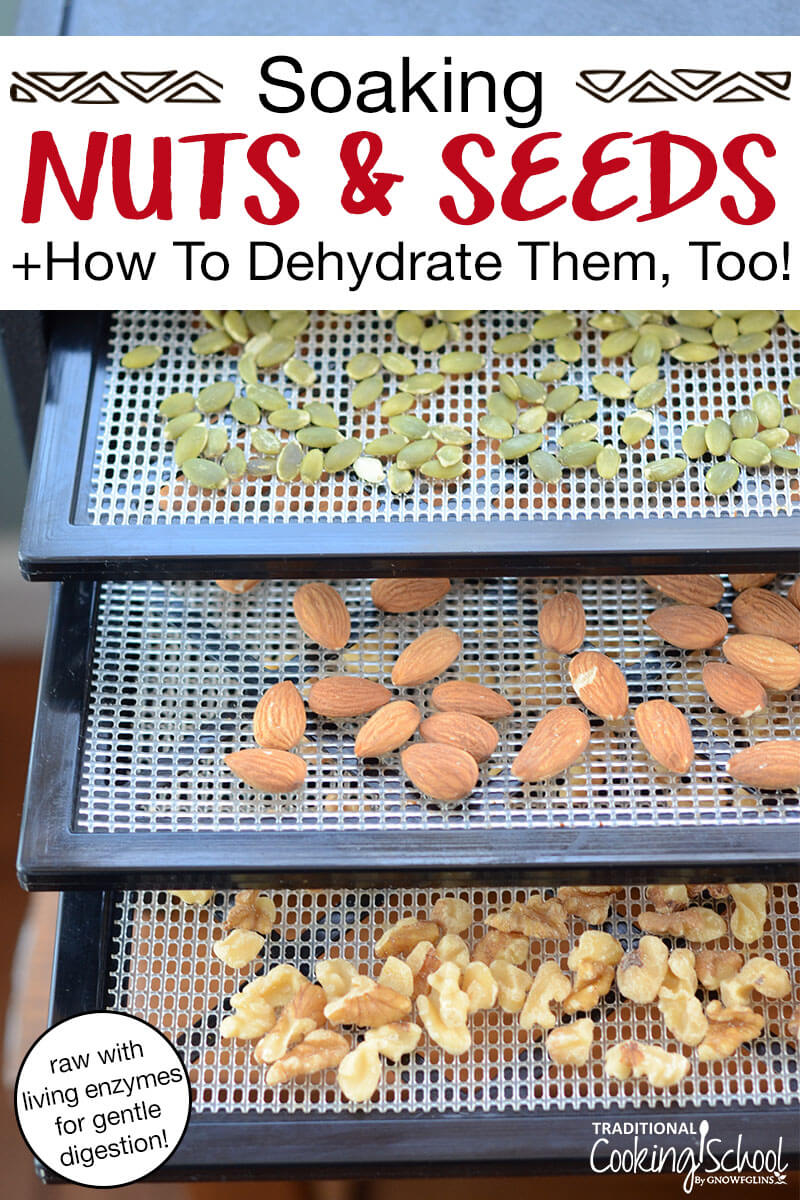
Why is soaking and dehydrating nuts and seeds important? Is it even possible?
I want to tell you two things:
- It is important!
- And you — yes, you! — can do it.
Table Of Contents
Why is soaking and dehydrating your own nuts and seeds important?
Just like many grains, raw nuts and seeds contain enzyme inhibitors.
While these are have an important role to play in the life of a plant, enzyme inhibitors, such as phytic acid, can act as an anti-nutrient to humans. They are considered anti-nutrients because of their ability to impact the absorption of other nutrients (Source).
Besides impacting the absorption of other nutrients, enzyme inhibitors make nuts more difficult to digest.
Because enzymes are unstable, they are locked up in the seed until needed for the plant to grow after germination.
Having the enzymes locked up in this way keeps the seed from prematurely sprouting. This is quite an amazing feature when you think about it!
The only trouble is, it effects our digestion.
This germination process is what we attempt to mimic in our kitchens with soaking.
During soaking, the water tells the seed to soften up and get ready to grow. Then, voila, the enzyme inhibitors go away and the enzymes are free to use.
(I realize this isn’t a scientific explanation of the process, but it does help us to imagine what happens.)
Dehydrating the nuts after soaking is optional, but recommended. It not only returns them to their enjoyable crispy state, but if you keep your dehydrator below 115 degrees Fahrenheit, the nuts will be raw as well. And still rich with enzymes!
It’s possible to soak and dry a variety of nuts including sunflower seeds, walnuts, almonds, pecans, brazil nuts, and more.
A soaked nut is usually more nutritious nut than a roasted nut. These nuts are also referred to as “activated nuts.”
Activated nuts that have been dehydrated can be used in nut butters, baked goods (such as muffins and breads), trail mix, granola, energy balls, and general snacking!
What types of enzymes are we talking about?
Two types of enzymes are at play here — digestive and metabolic.
The human body cannot create a limitless supply of either type of enzymes. It’s best to eat foods rich in digestive enzymes to reduce the burden on the body, and also free it up to make more metabolic enzymes — which run the systems of our body.
Guess what? Germinated, raw nuts and seeds are excellent sources of digestive enzymes!
In the book Enzyme Nutrition, Dr. Howell claims that when the body is too busy making digestive enzymes (that we could be getting from food) to make enough metabolic enzymes, we tend toward modern diseases.
To read more about this concept, see Enzyme Nutrition and Nourishing Traditions.
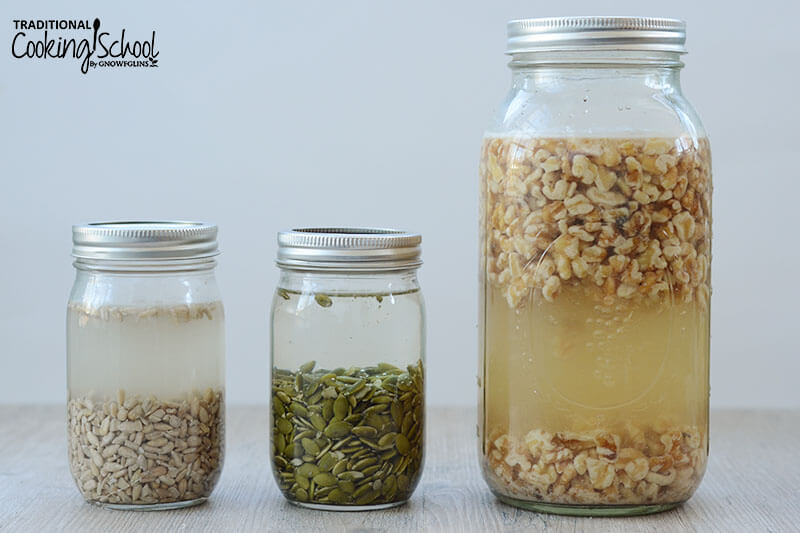
Is soaking nuts a myth?
Some claim that soaking nuts is a myth. If you read the above, you know that we don’t agree!
While there are not many scientific studies on the topic, much anecdotal evidence suggests that soaking nuts is a helpful practice and very beneficial to the digestive system.
History records that some traditional cultures have gone to great lengths to prepare nuts before consumption (as noted in this article).
While these practices may not be considered evidence for the validity of the claim that soaking nuts enhances their digestibility, we feel there is something to be learned from them. It is likely they felt a physical benefit from preparing nuts in this way.
It’s also important to remember that every person is different and responds to foods in a unique way.
Someone with a very healthy digestive system, who includes a limited amount of nuts, may not notice an extreme difference. However, someone with a weaker digestive system, or who eats nuts regularly, may see a significant change.
The best way to know is to experience it yourself! If you’ve never soaked nuts, why not give it a try and see if you notice a difference?
How To Soak Nuts Before Eating
We discussed the importance of soaking, but what does that actually mean? If you are wondering, “What is soaking and how is it done?” read on.
Soaking nuts is a process by which raw nuts are submerged in salted water and left to soak for a number of hours. Nuts are then drained from the water and dried.
As mentioned above, this process activates (or germinates) the nuts, allowing the important enzymes to work. This makes them easier to digest.
Soaking nuts before eating must be done in advance. This is not a step to perform 5 minutes ahead of time, as many nuts require at least 7 hours of soaking before they can be dehydrated.
For this reason, we encourage you to work soaking and dehydrating nuts into your weekly or monthly food prep routine.
Keep these important steps in mind when soaking nuts…
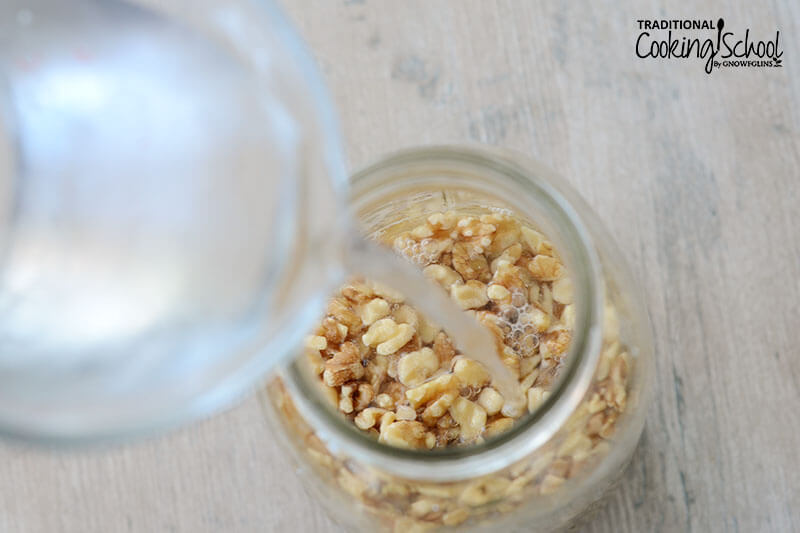
#1 — Pure Water
When soaking nuts, it is vital to use pure water. Regular tap water contains chemicals that we don’t want absorbed into the nuts.
If you are going to invest the time and effort into soaking and dehydrating nuts, use filtered water to ensure the best and most nutritious end result.
For more information on choosing the best water filtration system for your household, see this article.
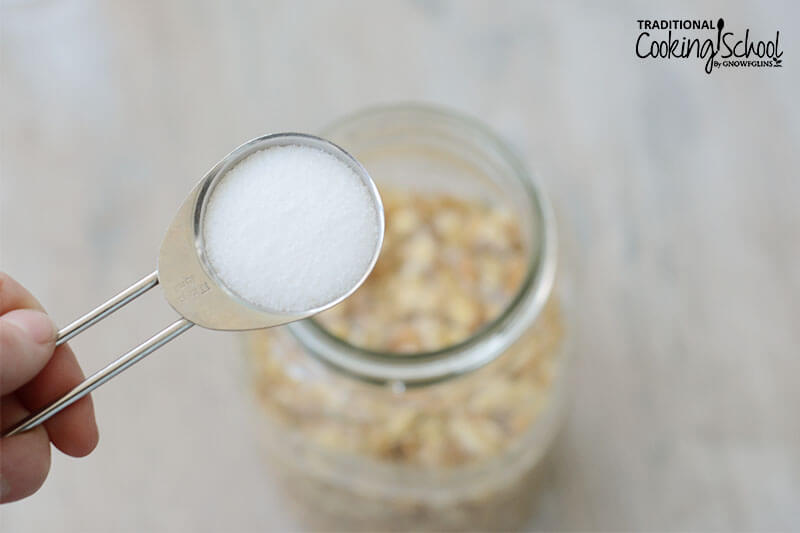
#2 — High-Quality Salt
Choose a high-quality salt such as sea salt for minerals and flavor. We never recommend table salt as it is devoid of nutritional value.
Salt may also be an important part of the enzyme-activating process. According to Nourishing Traditions, “Salt in soaking water activates enzymes that neutralize enzyme inhibitors.”
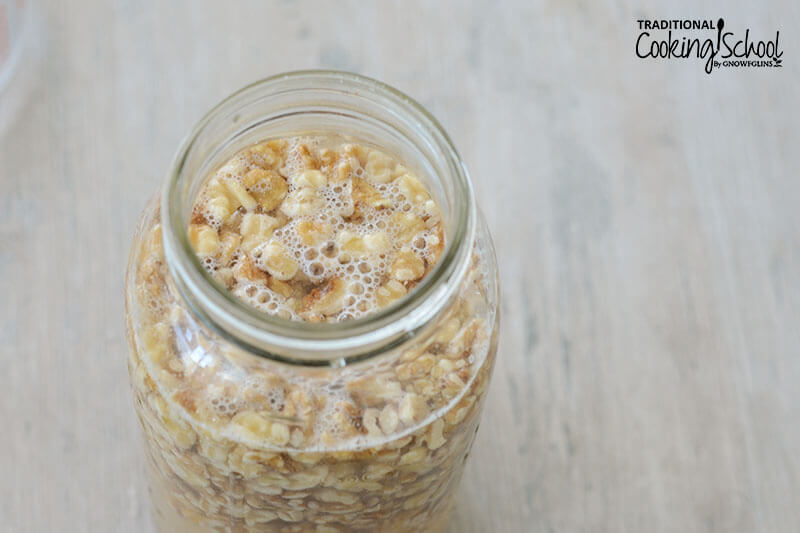
#3 — Soaking Time
Soak most nuts for at least 7 hours or overnight to fully activate enzymes.
However, some nuts (like cashews) need a shorter soaking time or else they will become too soft and develop a poor taste. Cashews should be soaked for a maximum of 6 hours.
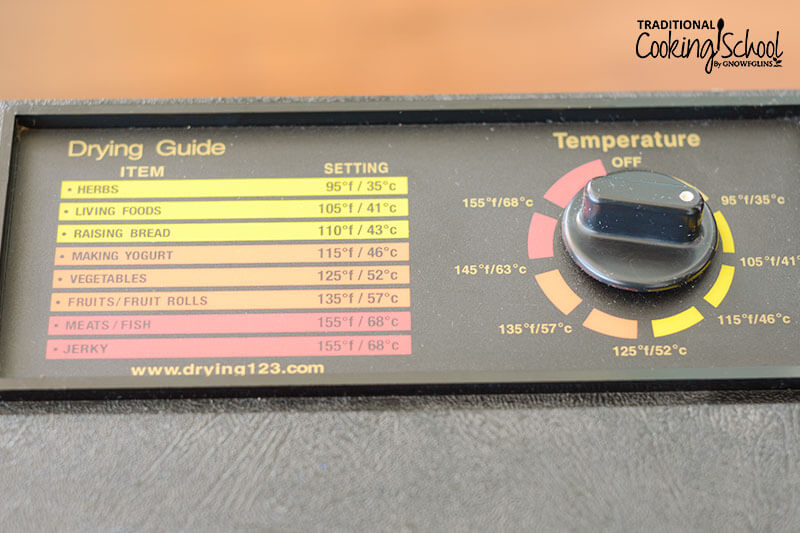
#4 — Dehydrating Temperature
For best results, use a dehydrator set between 95 to 100 degrees Fahrenheit. This will ensure the enzymes stay active but also provide the best conditions for a crisp and crunchy result.
115 degrees Fahrenheit is the highest temperature considered safe for maintaining a “living” food and not damaging the enzymes.
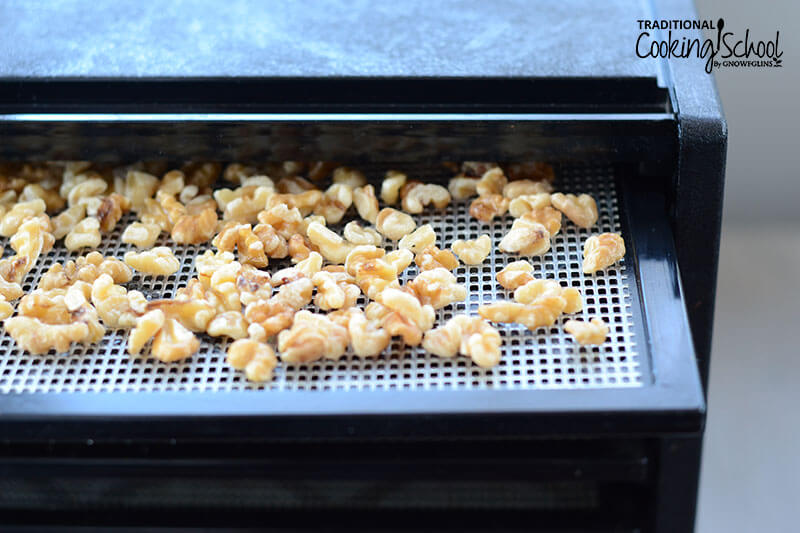
#5 — Dehydrating Time
Dehydrate for 12 to 25 hours. This varies depending on the size and density of the nut.
You’ll know they are done when nuts are thoroughly dry and crisp.
The best way to check if they’re done is to eat one! Is it crunchy?
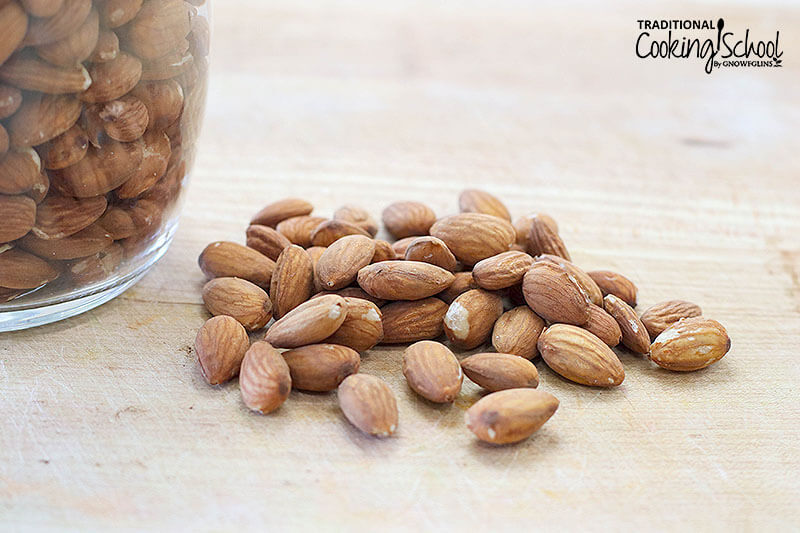
#6 — Storage
Store dehydrated nuts in an airtight container. If they are thoroughly dry, nuts will keep for a number of weeks in the pantry.
You can extend the shelf life by storing in the fridge. If the dehydrating step is skipped, or nuts aren’t completely dry, storage will be much shorter (only a few days).
Soaking & Straining Tips
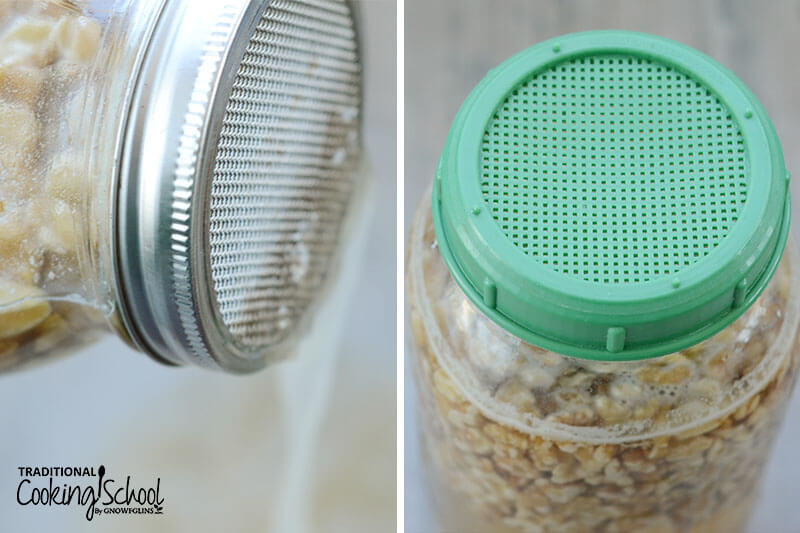
Soak nuts in a jar or bowl. Using a 1/2 gallon jar is helpful as it is easier to strain and takes up less room on the counter than a wide bowl.
Sprout screens are extremely handy when straining from a jar as they fit right on the lid. This way you can strain right over the sink (or garden) and not have to get another bowl dirty!
If you don’t have a sprout screen, set a colander inside a bowl and strain that way. Just be sure the bowl is large enough to hold the water!
Alternatively, you can set a colander in the sink and strain there too.
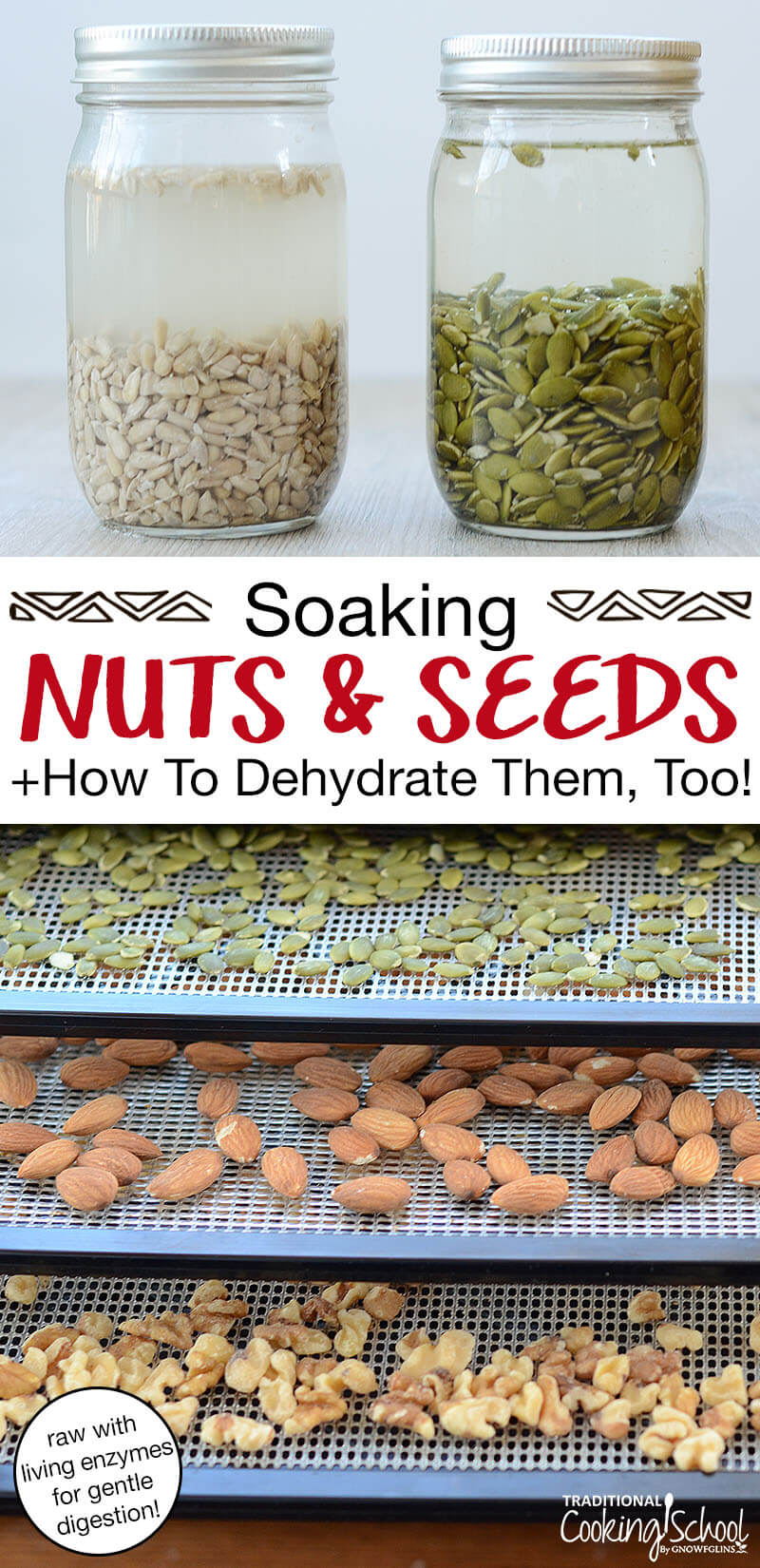
When spreading soaked nuts on the dehydrator try, be sure they are on a single layer with room for the air to circulate. This helps them to dry quickly and completely.
How To Soak & Dehydrate Nuts And Seeds
Soaking and dehydrating nuts and seeds is not only easy... but yields a deliciously crispy, raw, and nutritious snack! Scroll for a helpful soaking chart, plus simple directions so you can learn how to soak and dehydrate nuts and seeds with only a few minutes of hands-on time!
Ingredients
- 4 cups nuts or seeds (raw and organic)
- 1 tablespoon sea salt
- pure water
Instructions
-
Put 4 cups of any raw, organic nut or seed in a 1/2 gallon Mason jar.
-
Add 1 tablespoon of sea salt.
-
Fill with water to the top of the jar.
-
Swirl the water around to dissolve the salt.
-
Let the nuts/seeds sit in the jar sit overnight, or for at least 7 hours.
-
Drain the nuts/seeds.
-
Rinsing is optional. Using a sprout screen with metal band really makes this easy.
-
Remove skins, if desired.
-
Spread the nuts/seeds in a single layer on a dehydrator tray*.
-
Dry at 95 to 100 degrees Fahrenheit until crispy. This usually takes about 24 hours, depending on dehydrator and other conditions.
-
Check by taste. Are they crunchy and free of moisture?
Recipe Notes
*If you don't have a dehydrator, you can use the sun during sunny months. Set out a tray full of soaked nuts/seeds in sunlight. Keep it covered with a light cloth to keep out dust and bugs.
Or, you can also use an oven between 115 to 150 degrees Fahrenheit to dehydrate nuts and seeds after soaking. Keep the nuts and seeds in the oven for 12 to 24 hours, stirring occasionally, until completely dry. Unfortunately, this does kill enzymes -- but you will also have nuts and seeds free of enzyme inhibitors.
If you don't want to (or can't) do it yourself, I highly recommend Wildly Organic's pre-soaked and dried nuts and seeds! Click here for more info.
Uses For Soaked & Dehydrated Nuts And Seeds
Anywhere you would use nuts, use these!
Use them chopped in any recipe that calls for nuts. Remember that if it is a cooked recipe, you’ll lose the enzyme benefit from the heat of cooking.
Grind them into nut and seed butters.
Snack on them! Mix them with dried fruits for a trail mix.
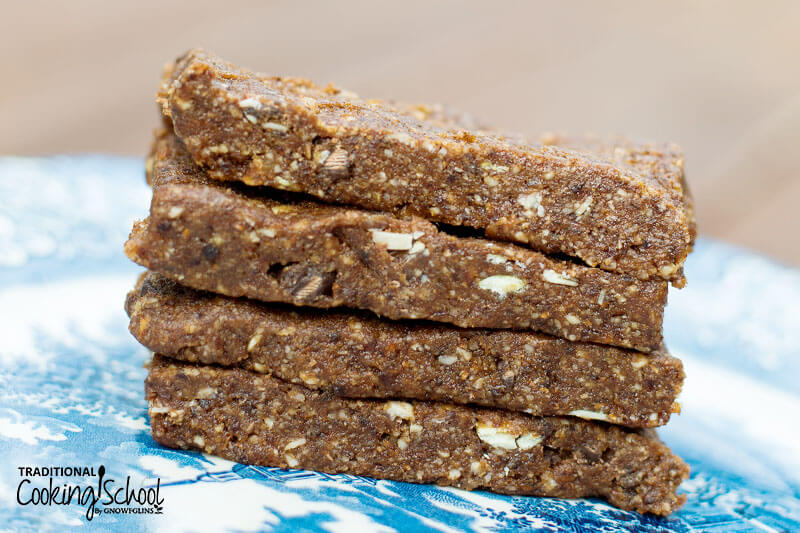
Add them into raw nut and fruit snacks, such as my homemade enzyme-rich Larabars (pictured above).
Eating raw, soaked and dehydrated nuts/seeds with a meal provides digestive enzymes to help the body digest that meal. Chop soaked walnuts or cashews for your salad, sprinkle on your morning (soaked) porridge, or eat a couple of whole nuts alongside any meal.
I keep quart size jars full of various nuts and seeds ready to go in my pantry cupboard.
Is a dehydrator really necessary?
Yes, and no.
You can always soak nuts, pat dry, and use them that way. This works well if you intend to use the nuts immediately, but is not optimal for long term storage.
Soaked nuts that are not dehydrated will last only about 5 days.
Besides extending the shelf life of the nuts, dehydrating returns them to the crispy state that is called for in most recipes.
So, a dehydrator of some sort is essential if you want your nuts/seeds crispy while keeping the enzyme benefits of raw, germinated nuts. (But remember if you use the raw, germinated nuts in a cooked recipe, the enzymes will perish from the heat of cooking.)
You can get around having a dehydrator if you live in a sunny area where you can dry nuts/seeds outdoors year round or can build a solar dehydrator.
An oven is also an option, but is more likely to destroy some of the beneficial enzymes due to the heat. If dehydrating in an oven, temperature should be kept below 150 degrees Fahrenheit.
If you are considering purchasing a dehydrator, I recommend reading How to Choose the Best Dehydrator #AskWardee #152. Its full of tips to help you choose the best dehydrator for your family.
And remember… If you don’t want to (or can’t) do it yourself, I highly recommend Wildly Organic’s pre-soaked and dried nuts and seeds! Click here for more info.
Soaking Nuts and Seeds Chart
Reference the chart below for specific soaking and dehydrating instructions for each type of nut or seed. This chart assumes the use of a dehydrator unless noted.
Note: Add 2 to 3 teaspoons of sea salt per 4 cups nuts to the soaking water. Adjust to your taste.
| NUT/SEED | SOAKING TIME | DEHYDRATING TEMP. | DEHYDRATING TIME |
| Almonds | 7 hours or overnight | 95-100°F | 12-24 hours |
| Brazil | 6 hours | 95-100°F | 12-24 hours |
| Cashews | 4-6 hours | 200-225°F (oven) | 12-24 hours |
| Hazelnuts | 7 hours | 95-100°F | 12-24 hours |
| Macadamia | 7 hours | 95-100°F | 12-24 hours |
| Peanuts | 7 hours | 95-100°F | 12-24 hours |
| Pecans | 7 hours | 95-100°F | 12-24 hours |
| Pine nuts | 7 hours | 95-100°F | 12-24 hours |
| Pumpkin Seeds | 7 hours | 95-100°F | 12 hours |
| Sunflower seeds | 7 hours | 95-100°F | 12-24 hours |
| Walnuts | 7 hours | 95-100°F | 12-24 hours |
Should all nuts and seeds be soaked?
All this talk about soaking may leave you wondering if you can ever eat a raw almond again! We are not here to be the nut police. 😉
In fact, many of us nibble on an unsoaked nut from time to time. The point of this whole process is help you achieve the most nutrition from the food you eat on a daily basis.
We encourage you to soak the majority of nuts and seeds you consume, but please don’t fret about an occasional unsoaked nut here and there.
It’s also important to note that not all nuts and seeds are suitable for soaking.
Flax seeds and chia seeds, for example, gel if soaked. This is helpful in many instances as they are great for thickening (and flax seed makes an excellent egg substitute in baked goods).
Yet the gelling effect would not be suitable if the seeds are needed for items like homemade granola.
Cashews are another nut that improves with soaking, but must be done for a shorter length of time. Cashews are already exposed to heat in processing (in order to neutralize a toxic oil in their shell), so it is not necessary to use a low heat, such as a dehydrator, to preserve the enzymes.
In most cases, soaking nuts is helpful. However, your specific needs and time available will make the final decision.
Does soaking nuts remove pesticides?
The purpose of soaking nuts is not to remove pesticides, but rather, increase their digestibility. That said, you may still wonder if it might help.
Because of their thick shell, most nuts aren’t considered to have too many issues with pesticides. The soaking step will not do much to further remove any that are present.
What do soaked nuts and seeds taste like?
In general, they actually have a lovely buttery flavor. The dehydrating step provides a nice crunch that is similar to roasted nuts, but with the live enzymes still intact!
As mentioned earlier, some nuts require less soaking time. Be sure to note this when making your next batch as over-soaking certain nuts will result in a bitter flavor.
What about sprouting?
Some nuts can also be sprouted, which will reduce the enzyme inhibits even further, but this does not result in a nut you can eat like a nut, as it will begin to grow. These sprouts work well in salads.
That said, sprouting is usually reserved for seeds, such as pumpkin seeds and sunflower seeds.
You may see packaged nuts sold as “sprouted nuts,” but in this case it generally refers to soaked and dehydrated nuts, or “activated nuts,” as many like to call them.
How To Make Nut Milk With Soaked Nuts
To make almond milk or any other nut milk with activated nuts, use a high-powered blender to blend 1 cup nuts with 4 cups filtered water. Strain through a fine mesh sieve or nut milk bag.
Store in the fridge for up to 3 days.
What about you? How do you use raw nuts and seeds? If you haven’t already, are you willing to learn how to soak and dehydrate nuts and seeds?
Want me to show you how to do this on video? Sign up for my completely free Traditional Cooking video series — you’ll get this video tutorial plus 4 more!
This post was featured in 26 Egg-Free Ice Cream Recipes + 17 Toppings!
More Posts You May Enjoy
- How To Make Pre-Soaked Oats — NOT Rock-Hard Or Glued Together… And GREAT For Trim Healthy Mama! #AskWardee 094
- Homemade Sourdough Croutons In The Dehydrator
- How to Dehydrate Apples
- Soaked Granola Recipe (raw & enzyme-rich!)
- Cocoa Almond Crumbles
- Homemade Jerky
This post was originally published and written by Wardee Harmon on 12/2/09. It was updated and republished on 1/20/20.
...without giving up the foods you love or spending all day in the kitchen!

2 free books:
Eat God's Way
Ditch the Standard American Diet, get healthier & happier, and save money on groceries...
We only recommend products and services we wholeheartedly endorse. This post may contain special links through which we earn a small commission if you make a purchase (though your price is the same).


I’ve been dying for a food dehydrator for some time! I’ve been wanting to sprout and of course for preserving God’s bounty from my garden!
.-= Diana@Spain in Iowa´s last blog post… Week of Christmas Giveaway’s – Green Pasture’s Fermented Cod Liver Oil =-.
I want to dehydrate pecans, walnuts, & chestnuts so that I can powder them for certain recipes. Once dry, you put them into a coffee grinder, set it to expresso, and get a really nice powder. I also am wondering due to the instructions, would I need to use the salt like instructed, or I can fore go it which I would prefer?
My first attempts at soaking nuts a couple of years ago were a failure, so I gave it up – I didn’t have a dehydrator and the lowest setting on my oven was 200 degrees, so they ended up overdone. Yuck! I couldn’t understand why people said the ‘crispy nuts’ in NT were so good. Then a year later, I decided to try again. By that time, I had aquired my Excalibur (LOVE it!) and now it’s a totally different experience. So quick and easy!
The kids noticed that the nuts are tastier when soaked and dried – it takes away a bitter taste that nuts have (which I never noticed until eating them prepared properly).
I routinely soak all of our nuts – last week I did twelve cups of almonds, this week I did twelve cups of cashews (with nine kids, I have to prepare large amounts :)). We use them to bake and cook with, as well as to snack on.
Btw, Wardee, I bought my Excalibur on ebay – it was a reconditioned unit with a ten year warranty, shipping included, for $150. Reconditioned doesn’t mean it was used – it wasn’t. (I posted about it when I got it last October – http://oceansofjoy.wordpress.com/2008/10/23/my-newest-kitchen-appliance/) It doesn’t have the timer, but that’s worked out fine for us. Now I use this for so many things that I can’t imagine not having it!
.-= Avivah @ Oceans of Joy´s last blog post… Mock Larabars (grain free) =-.
Diana – I hope you get one! You need a dehydrator and I need a garden. 😉 Then we’d both be set.
Avivah – That is a great deal! I did get a deal on mine, but not quite as good as yours. Mine was a brand-new customer return and it was discounted quite a bit (and included the warranty). You have 9 kids! I agree that the crispy nuts taste so much better than raw.
I regularly snack on raw nuts to help with my blood sugar, so this is a very interesting post. My oven *seems* to run at 100 degrees, although I’d like to confirm that’s really what it’s doing by getting an oven thermometer. It’s just warm to the touch though – seems like a good sign! I’ll have to try this out. 🙂
.-= sara kay´s last blog post… Thankful =-.
Sara Kay – That’s great that your oven may hold such a low temp. If only every oven did this – but then again, how could we bake if we were always using our ovens as dehydrators? 😉
I love this very simple and effective explanation about the why behind the how. I think that is so important – educating others is really how to make a change.
Kitchen appliances – I just got a VitaMix and LOVE it. They had them at Costco for a significant discount so my husband put it in the cart. 🙂
The food dehydrator is on the list. Hopefully next. I’ve been talking about it forever so maybe I’ll get it for my upcoming b-day. I have to giggle at your el-cheapo. I understand how important having quality kitchen appliances is – even if it means you have to wait and save up. Needless to say, I can’t wait to dehydrate my own nuts and seeds.
Thanks for linking to my truffles, too.
Amy – How exciting to get a Vita-Mix! I got mine from a Costco demo, too.
Yum! Ever since I tried nuts soaked with sea salt and dehydrated, I’ve been hooked. They are so delicious. The taste alone makes me want to eat nuts this way, but thanks for reminding me of all the nutritional benefits too.
Right now I’m making chili lime flavored almonds in the dehydrator and soaking almonds for a maple sugar recipe that will also be dehydrated (we just got 50 lbs of raw organic almonds so we are going all out on almond recipes!). I also love making raw vanilla cream from cashews soaked in unsalted water and not dehydrated.
I’ve been very happy using a dehydrator I got for about $30, it’s lasted me for about 5 years and still going strong. I’m only limited a bit in presentation of what I make, not quality. Mine is donut shaped so I can’t do large pizza crusts or “meat”loafs. But it still tastes great in smaller portions. I think the most important thing is to find a dehydrator with a temp control that goes as low as you want, mine goes down to 90 degrees.
Faith – I would LOVE, LOVE, LOVE to see some of your recipes!
This is a great post Wardee! I haven’t been a very good soaker of nuts and seeds, we normally eat them raw, but it’s a good reminder of why I SHOULD start doing so! Maybe I can borrow my mom’s dehydrator . . . 🙂
Best,
Sarah
.-= Sarah´s last blog post… Coconut Macaroons =-.
I asked this before at Nourishing Gourmet but I wanted to know where everyone gets their nuts. Almonds are pastuerized unless you get them directly from the farm via mail. Even the almonds that say raw aren’t raw.
I thought I’d get nuts in their shell (they can’t be pastuerized in their shells, can they?) But then I thought after I got all the nuts from their shells I’d still have the skins on them. Do you all soak nuts with skins on them?
I’ve conquered a lot with the Nourishing Traditions but for the love of God, I cannot crack the nut thing.
Would you mind listing the various nuts which soak and dehydrate well? On hand I have raw almonds, walnuts, peanuts, pecans, pine nuts and pumpkin, sunflower and sesame seeds? Will each of these do well? I know there are many other nuts though. Great post, Wardee, and comments.
Mom (Martha) – In Nourishing Traditions, these are the nuts/seeds that have “recipes” for making them crispy (soaking/dehydrating): pumpkin seeds, pecans, peanuts, almonds, macadamia nuts, filberts (hazelnuts) and walnuts. Cashews are also mentioned, but they’re a special case. We can’t get raw cashews, so there’s no enzymes to save anyway. They shouldn’t be soaked longer than 6 hours or they’ll get slimy. Sally Fallon Morell recommends soaking them in salt water and then lightly toasting them.
And one other thing: storage. Almonds, pecans, cashews, macadamia nuts and peanuts are pretty stable, and once soaked and dehydrated may be stored at room temp in an airtight container. Walnuts are more susceptible to rancidity and should be stored in the fridge or freezer.
Sara B – I haven’t make those raw flax crackers, but was just eyeing a recipe yesterday. I was wondering how to soak the flax seeds first because they get so gelatinous. I’d love to hear what you recipe asks you to do. With the Excalibur, the directions say to do crackers on the Paraflexx sheets (or parchment paper) and “flip” them halfway through the dehydrating. This is when the crackers peel off easily, not when they’re still sticking to the parchment paper/plastic sheet.
I usually soak flax seeds overnight with salt and then put them in the blender and make it into a paste, then I dehydrate them at a low temp (about 115F) to make a cracker. They turn out great and I believe I still get the effect of sprouting the flax seeds and then dehydrating them when I am making the cracker.
I usually add other seeds to it and put them all in a big bowl the night before to soak, and then put it in my high-speed blender (I usually don’t drain the water), and then into my dehydrator. My go-to recipe that our family likes (particularly my 2year old son) is:
Hemp seeds
Chia seeds
Flax seeds
Salt (to taste)
I now have my mom’s old style dehydrator, so I should give this a try! I would love to have an Excalibur, but a Vitamix is on my list first.
Speaking of dehydrators, has anyone had success with making those raw flax crackers in their older dehydrators? I have the solid piece that you insert for fruit leathers etc… Would I use that?
Does anyone know if the raw brazil nuts you get at the health food store can be sprouted and dehydrated? Love brazil nuts, they’re supposed to be one of the richest sources of selenium. Also once a nut has been shelled (we buy them shelled) how do they sprout since they’re not a whole nut anymore (thinking of pecans, walnuts in particular).
Cindy- It’s quite difficult to actually sprout any nut besides almonds from what I’ve heard. I have not tried it. But they can be soaked to activate germination. I love brazil nuts particularly in a nut milk drink and you are right, they are so nutritious.
They are one of the things I am very happy to buy non-local as they are one of the only Amazon crops which must be grown wild in the rainforest, thus you are helping to preserve the rainforest when you support brazil nut harvesters!
i’m curious if anyone has tried using a convection oven for the drying?
thanks susan
Susan – that’s a great question. I hope someone will answer. I’m asking your question on facebook and twitter – hope we’ll get a response from someone who’s done this.
I’m wondering why the convection would make a big difference — I have the option for convection on my oven, but it still won’t set below 180º, and in my experience convection runs a little hotter than conventional settings (so the lowest temp on my oven probably runs closer to 200º).
It would be great to know if there were a way to make it work without killing enzymes, though — I’m still dehydrator-free!
I’ve been using my oven to dehydrate. It has both a convection setting and a regular setting. I usually use the regular setting because the convection fan is a bit noisy. The oven has a digital display that will accept any temp I put into it, but at this point I have no idea if it actually heats to that temp. If I set it to 110 though, it gets hot but not hot enough to burn my hand, so I suspect it’s working. I have done nuts and grains in it, seemingly successfully, but it probably really depends on the oven. Hope that helps…
hi. I just finished soaking and drying cashews but I feel as though something went wrong. I used raw cashews, soaked in salted water for about 5 hours, rinsed, and placed on 2 cookies sheets lined with foil in my toaster oven on 200 degrees for about 13 hours. I stirred about 3 to 4 times throughout. They are wonderfully crispy and don’t smell bad to me, but they seems to have roasted. When you bite it in half the inside is brownish color and the outside has a gray brown type color. Did I over cook? What are they suppose to look like? Are cashews this sensitive? I’m feeling like I should throw them out. My husband is concerned. He thinks we heated them up too much/high and now the oils inside the nuts are rancid and unhealthy (inflammatory). Any ideas? Thanks in advance!
I don’t know if they’re rancid, but 13 hours is too long to dehydrate at 200 degrees. I soaked sunflower seeds overnight and expected to have to dehydrate them for 18 hours at 100 degrees. But though I set it for 100 my convection oven was actually heating to 220 degrees or so, and the sunflower seeds were dehydrated/toasted in 2 hours. I’m guessing your cashews would have been ready in 3 or 4 hours tops.
I have several sugar pumpkins I am making pumpkin soup with tonight and would love to do something with the seeds. I have soaked and dehydrated nuts and seeds according to NT for over 2 years, but have never dealt with fresh seeds. Should I air-dry them then soak and dehydrate. Or just soak the fresh seeds and dehydrate? 🙂
Just FYI- your site is priceless and precious to our family! Every bit of it! ?
Kirsten — I soak pumpkin or squash seeds right away in salty water and then toast/dehydrate. Delicious!
I got an Excalibur dehydrator for Christmas and want to try dehydrating nuts. However, I’ve read two different ways to store them afterward. One says they have to be stored in the fridge after dehydrating because of the fat content, but others (like yours) say store in the cupboard. Could you clarify this for me.
Thanks
Kathy — This is what I know (I’m quoting from Fundamentals eCourse materials):
I hope this helps!
Wardee, concerning walnuts, pecans, and chestnuts once dehydrated, and grounded is there shelf life any longer than if just dehydrated?
Hi Michael,
When ground, the shelf life is shortened even more. Best to keep refrigerated or frozen.
Hi Faith,
I would like to know where you order your brazil nuts.
Gabrielle
I think I’ll give this a try. Thanks for all the information. I’ve been educated with this post. Very nice!
Can you please give me more details on how long flax seeds should be soaked?
I googled soaking flax seeds and all the info I found on it said to soak them at least 6 hours, and then keep the resulting gelatinous mixture in the refrigerator. Would you suggest soaking for 3 minutes then straining and drying the seeds? Thank you.
gramycarol — Actually, with flax seeds I prefer to lay them on a paper towel and mist with water. Repeat that every 12 hours. That really helps cut down on the whole gelatinous thing. 🙂
Thank you for your quick reply! So, I put them on paper towels and then mist them every 12 hours for how long? Or mist them several times within 12 hours?
You mist every 12 hours. How much depends. Get them pretty wet each time. When they get big enough you can pull them off the paper towel and rinse them off. You’ll have to play it by ear how much to mist.
Thank you, I will try misting some right now. I am totally new to soaking nuts and grains and I greatly appreciate your help. I just realized I need to buy a new spray bottle and use well water.
Can you tell me more about drying nuts below 115 degrees F? Where is the source that you found this information? I thought it was 118 when enzymes get destroyed, but can’t remember if that is wet heat. Nourishing Traditions says dry nuts below 150, but I can’t remember why or if that is for dry heat. Any thoughts?
I’m mostly asking because I don’t know if I can quite afford a dehydrator just yet. I found a source of soaked and dried nuts, but the company said they dry them below 118. So reading your article is the first I have heard about the threshold being lower at 115. I would like to know the reasoning for this and a source if possible.
Susan — I have read several sources and because the range is 115 to 118 depending on who you ask, I prefer to play it safe and stay below 115.
Hi,
What kind of Nuts should I buy? Do I have to buy raw nuts since I am taking them back to their natural state? I just bought some ‘raw peanuts’ to make peanut butter with. I don’t know if they are really raw because I don’t think you can buy true raw nuts from within the USA. I know you can order nuts from Spain but these are raw Virginia peanuts. Plus, my raw nuts have to be kept cold which I find very odd.
Too bad it doesn’t matter, since all nuts sold in North America are pasteurized anyway and labeled as ‘raw’
http://www.nctimes.com/lifestyles/health-med-fit/article_12a273f9-1bc9-5e16-a87f-7dca51afaf18.html
I’ve read a lot about soaking nuts but every recipe I’ve seen says to soak them in salt. I personally don’t care for salty nuts and really enjoy them plain. Is there a way to get the health/nutrition benefits from soaking them without using the salt? I’m curious that it could be possible because of your statement that “The salt is for taste and has no effect on whether the enzymes become available or not”. The salty taste is the only thing preventing me from soaking and dehydrating my nuts currently. I have a nice dehydrator that I bought for this purpose, but then tasted some soaked nuts that my sister-in-law made and was really turned off by the saltyness.
Lisa — You can leave out the salt. 🙂
Wardee, what do you do if you over-soak your nuts and seeds? Will I need to start over or is there another factor I can consider (like smell)?
I just dried some almonds overnight in the oven. A good bit of them have black spots on them. Do you know what would cause this? Is that mold?
Hi there I just found out that soaking nuts and dehydrating them was healthier, however I do not have a dehydrator. My oven only goes as low as 150 degrees, if I kept the oven door open will that lower the temp, or is that just too high? Thanks.
Becky — That high and the enzymes will die, but the soaking still solves the phytic acid problem. So you’re much better off anyway. 🙂
Two Questions:
1. I’m assuming this includes sesame seeds too? do you still soak and dehydrate those too?
2. In order to keep the enzymes in the nuts, it can’t get above 115 F? Is that right? That is lower than I thought…
Correct and Correct. 🙂
Is it ok to do unsalted water? I am low on salt till tomorrow and soaked a bunch of peanuts 24 hours for roasted peanut butter. Hoping just a sprinkle while they roast is ok?
Never mind, that wW already covered. 🙂
Hello, thank you for this, it’s very informative! I’m wondering, if I am baking with nuts and grains, does it make sense to do the whole process of soaking, dehydrating, grinding, baking? This is what I’ve been doing and i read now that the enzymes will be killed when the bread/waffle/cracker etc. is cooked at high heats. Is there any reason for me to do this whole process then, or should I just grind my nuts/grains and bake away, leaving out all the other processes?
Rachelle — That’s a good question. 🙂 If your baking steps include soaking, then no, you don’t need to do it beforehand. Yes, baking will destroy enzymes anyway, but the purpose of soaking nuts/seeds/grains is to reduce anti-nutrients such as phytic acid and enzyme inhibitors. Dehydrating at low temperatures preserves enzymes but if you’re going to cook with heat, you may as well skip that.
Does the water used to soak the nuts have any nutritional value or uses?
Tanja, no not really. It usually has dust and debris from the nuts and most people choose to discard it. If you rinsed the nuts really well before soaking you could use this soaking water in cooking or something. But keep in mind the salt content. 🙂
Any chance I can dehydrate in the stove / toaster oven? I cant afford a dehyrdator – even a cheapo one at the moment. Can you do it in the stove with just the light on [use that to make coconut yoghurt] overnight and get fairly warm – but no air ventilation like a dehydrator machine
You’d need to put it on the lowest temp (preferably 200 or less), crack the door, and check frequently. They’ll dry a lot faster and can burn quickly. Just with the light on is probably not warm enough.
Unfortunately, the only place we had to put the large Excalibur is our basement. So it’s cold and a bit humid down there. I do dry my nuts at around 100 degrees, but it takes at least 48 hours due to the location. I’ve only done walnuts, almonds, and cashews so far. The walnuts take at least 48 hours, the almonds and cashews take at least 3 full days. I have to plan wayyyyy ahead when to make nuts!
I have a large pecan tree in my back yard and every year it produces lots of pecans which the birds just love. While they are up in the tree, they knock some down. So I have taken to picking them up. Some are covered with the green husk and others aren’t. What is the simplest way to prepare them for human consumption? Can I soak them with the husk on and for how long? After the soak, how long do I have to dry them out and what is the process? I am very new to this so I absolutely know nothing about this. Can you give me some hints?
I didn’t read every post here but I just wanted to add that if you don’t have a dehydrator you should check out yard sales. I got one for $10 right across the street from my house. Loving it!
Is it true that almonds can’t be bought raw anymore? If this is true, is soaking them a waste of my time? I get raw almonds from Trader Joe’s, but I’ve read that it is not possible to buy truly raw almonds. Also, should pine nuts be soaked? I’ve read in some places that they should, and it other places that they shouldn’t. All of this info is confusing me!
Thanks for this great blog! I love reading it.
Is it OK to add other things to the salt brine for added flavors – such as herbs, spices? Or would these affect the breaking down of phytic acids & enzyme prohibitors?
I’m wondering about Chia seeds. Do they need to be soaked and for how long?
Thanks,
Hi Theresa,
You don’t need to soak Chia seeds unless you want to make Chia seed gel which is a great thickener.
Millie
GNOWFGLINS Support Team
I’ve been soaking and drying nuts for about 14 years, when I was introduced to the Weston Price Foundation. They are soooo delicious that way! Where I currently live, the lowest oven temp. is 200 degrees, so this is what I do: I put the cookie sheet of nuts in the oven and turn on the oven at 200 for 5 minutes. Then I let them sit in the oven, which retains a mild warmth, for two hours. Then I turn it on again for another 5 minutes. I repeat this cycle until they’re dry (usually takes less than 12 hours). I figure that in five minutes the oven has barely reached 200 degrees and then it goes off, so hopefully minimal damage done to the enzymes. If you have an older gas oven with a pilot light, just leave the pilot light on and leave the nuts overnight. Works well too.
Do nuts need to be whole to soak? Can I (or should I) soak sliced almonds?
[bump]
Been using my Excalibur for eight years. It’s the best. Almonds come out perfect. Just made some almond flour (for my gluten-free carrot bundt cake) in my Blendtec using dehydrated almonds. Wow, what a healthy dessert.
Hello,
I have gluten, dairy and egg intolerances. I make my own almond milk using blanched almonds. I buy in bulk and freeze them, I do soak the almonds overnight prior to make the milk. Can I soak the almonds, dry them and then make the almond milk without re-soaking? Sometimes I forget to soak and am without almond milk. I’d rather do more prep work on the weekends so I have one less thing to do during the work week.
Linda — Sure, you can do that! It would be a great time saver. 🙂
From what you are saying, it sounds like you are saying that the nut, which is a seed, was not intended for eating, it was only intended to grow another plant. So, if you are going to use them for another purpose other than growing another plant, you should soak them. My question would be this, were nuts eaten as far back as remembered, did they soak them in ancient times and how do we know, or is it a modern discovery that they were not actually originally intended for consumption.
Hi, I’m new to soaking and sprouting and I have two questions please. Do you put the lid on the jar to soaking the nuts or leave it open? And, Do you soak them in the refrigerator or on the counter? Thank you for the step-by-step instructions!
Hi Bethany,
It is a good idea to loosely cover the jar to keep out any dust. I use a cloth and rubber band for this. You can soak them on the counter. Enjoy!
i forgot my nuts were being soaked in the refrigerator and left them for 6 days! are they okay, can you dry nuts on top of stove as I do not have a dehydrator, yet that is. i plan to have one by wednesday, but is there a way to preserve the nuts until then??? did not do my usual research first. am getting the excalibur 9 tray dehydrator. pls provide a way to save my nuts!
is there any use for the soak water when done soaking the nuts?
Have you ever done sunflower seeds? I have been wanting to make my own sunflower seed butter, but the seeds are way to small for my dehydrator.
does 4cups of soaked nuts fit on one tray of ur excalibur? im goin to do multiples and am trying to gauge how many recipes worth will fit in my excalibur!
>Add 1 tablespoon of sea salt
For what? Is it healthy???
I live in Thailand where there are no dehydrators around to buy so we soak the almonds, walnuts, pecans and macadamias in the sunshine which is pretty hot here…like 95 degrees and that seems to work…any comments?
Hi,
I am new to this so just have a few questions.
Just wondering if I soaked the nuts and used them (without dehydrating them) in some snack recipes which i then froze for my children’s snacks for during the term would this be ok? or do they need to be dehydrated first to be stored even in freezer?
Also is it pointless to use activated nuts in a cake recipe because of the heating?
Thank you
Katie
Hi I am not sure if this has been covered. I have soaked my almonds overnight, and some have black dots on them after the process. I have read elsewhere that this means the almonds were not raw and have already been heat treated? true? Is it mould? Should i throw them away or will it be ok after i have put them into the oven?
Hi Simon,
Black dots shouldn’t be mold. Was it fuzzy? Fuzzy would be a concern. If they aren’t fuzzy and smell okay, I’d move forward with drying.
Millie
Traditional Cooking School
I am eating 10-15 almonds a day which has soaked in water overnight and I have few queries regarding the dehydration
1.Is it good to eat the soaked almonds with out dehydrating them?
2.Won’t soaked nuts have higher enzymes than dehydrated one’s?
3.What are the other traditional methods for dehydrating the almonds other than putting them in oven or heating?
Hi Sunil,
You can eat soaked almonds without dehydrating. They do not keep very long without dehydrating but you can keep a few days in the fridge.
When dehydrating if you keep the temp below 115 the enzymes are preserved. Above 115 degrees is when the enzymes are lost.
You could try drying them in the sun. You’d want some sort of dryer that will protect them from bugs, dust, etc. 🙂
Millie
Traditional Cooking School
I am wanting to get recipes for sprouted nuts. Is there anywhere I can look to get them. I have been trying to google and not being successful. I just purchased some Cheesy garlic almonds and would love to make them.
Hi Brenda,
Any recipes that use soaked nuts can use sprouted. A great place to look is eatbeautiful.net ~ Megan often uses sprouted nuts/seeds.
or her book Eat Beautiful: http://tradcookschool.com/megan
Millie
Traditional Cooking School
The temperature is 105 degrees in my garage today. I’ll see how that works.
Do you have to use salt to soak the nuts in? I soaked some pecans in iodized salt and dehydrated in the oven and I felt a little sick after eating them. Maybe it was the salt as I just learned that it has dextrose in it which is from corn. I don’t think I liked the taste of the salt.
Can you put in a 170 degree oven?
Hi Lisa,
You can leave the salt out. If you do use salt, you’ll want to use sea salt: http://amzn.to/1b0cNEl.
You can dehydrate in an oven but because the temps are higher the nuts won’t remain raw. Keep an eye on them because they may dehydrate quite quickly. Cracking the door can help.
~Millie, TCS Customer Success Team
I’ve been researching about using vitamin c powder and salt to kill the mild on almonds. I got some non-organic almonds and soaked them overnight in the Vit C and salt solution then dehydrated in the oven overnight on the lowest setting 75C.
I woke to find that many of them had some blackening occur on thee skin. Is this mold? I forgot to rinse them after the soaking so I’m afraid that it’s the mood spores surviving the whole treatment. Are they say to eat?
Thank you!
Hi Jinya,
We are not sure.
Normally we don’t recommend eating anything that might be spoiled. But we arenot familiar with using Vitamin C.
It’s possible there could be a reaction and that could cause the black but we don’t know.
~Danielle, TCS Customer Success Team
Sometimes blackening can occur if the nuts are not raw. Perhaps check the source of your nuts
I collected pumpkin seeds almost 3 weeks ago. I rinsed them and spread them on a tea towel on a baking sheet and covered them with another tea towel to dry, intending to bake them. They are still sitting in a bowl in the open air since halloween. Can I still dehydrate or bake them? I am wondering if they are still good to ear or stale and not worth it. Thanks!
Hi Mandy,
They are likely stale and rancid. I would not advise eating them.
I’m sorry.
~Danielle, TCS Customer Success Team
Thank you!
Best. Pecans. Ever. I will never eat them any other way! So easy, too. I don’t know why I thought it would be too hard. It’s just a little time consuming but worth the wait.
Another way to dehydrate the nuts is in the oven with just the light on. The light is warm, but mine doesn’t get above 115. I incubate my yogurt this way. I use a thermometer to check on it and turn it off to keep it from getting too warm.
Hi, I haven’t been able to find an answer to these questions, so I hope you can help:
1. I buy organic, non-irradiated walnuts and almonds in bulk and store them in the freezer. I soak and dehydrate them in smaller batches, so some of them are in the freezer up to a year (or more). Is it better to store raw, fresh nuts in the freezer or to soak and dehydrate them and then freeze or refrigerate?
2. How long do soaked, dehydrated nuts last in the fridge?
Thanks!
Hi Lynn,
On #1 – you could either. It comes down to what works better for you because we think the shelf life is similar either way. As for how long…
UC Davis PDF says:
up to 2 years in freezer
1 year or more in fridge
http://ucfoodsafety.ucdavis.edu/files/44384.pdf
🙂
~ Millie, TCS Customer Success Team
Has anyone considered using a small house fan to dry their soaked nuts/seeds? I know it would depend on the humidity in the room, (and they would have to be stirred,) but that’s an important part of the dehydrator and its purpose is to circulate the air, moving the moisture away, causing the nuts/seeds to dry. Don’t think you’d have to worry about getting too hot this way. 🙂
I know that if I didn’t have my Excalibur, I would be giving this a try. (Yes, sometimes I get desperate -or- just creative.) Hope this helps.
Also, I seem to remember reading somewhere that the purpose of putting salt in the water is not really for taste, but for use as an antibacterial substance. An antibacterial agent is one that inhibits the growth and multiplication of bacteria. (https://thesaltsuite.com/how-is-salt-anti-bacterial). When I ferment foods, I use sea salt because the brine is salty enough to kill off harmful bacteria.
Thank you for helping teach others about the importance of soaking/sprouting.
Has anyone used an air fryer to dehydrate?
Hi Pat,
We don’t have any experience with air fryers so we can’t comment on whether or not they can be used as dehydrators.
~ Vicki, TCS Customer Success Team
Am new to soaking, drying nuts. Supposedly with a group bought raw nuts directly from a California grower. Have salt soaked and dehydrated some of the almonds then moved on to making delicious nut butter in my Blendtec mmmmmm! But the process created so much heat the nuts became so hot I think the desired enzyme effect was destroyed. Please comment. Thanks, GramD
Hi, Donna.
This is one reason why Wardee prefers to make nut butter in a food processor. It gets warm, but not hot. I don’t know of another way to avoid the heat, unfortunately. The process of grinding (with appliances in our homes) introduces heat.
~Danielle, TCS Customer Success Team
Hi. Is it a good idea to set the dehydrator to a temperature of 140 – 150 degrees for the first two hours of drying soaked nuts, and then lower it to under 115 degrees (as Wardee suggested for something else) to speed up the drying time? Thanks!
Yes, Sam! This works for soaked nuts and grains, as well as for other items, because of the extra moisture in the initial stages of drying. Just be sure to turn the temperature down to around 115 after the first two hours. 🙂
Sonya, TCS Customer Success Team
I have an old round dehydrator with four trays. do you know of anyway to check the temperature, or would it just be good practice to keep repositioning the trays – top to bottom?
I don’t know of a way to check the temperature and when I had a round dehydrator I would rotate trays as you suggested.
🙂
~ Danielle, TCS Customer Success Team
I have a stash of soaked/dehydrated nuts that I have stored in the pantry. I don’t remember how old they are, could be 6 months or older. How would I be able to tell if they are still good or not? They were a lot of work to dehydrate, and I don’t want to waste them. I have almonds, pecans and walnuts. I assumed that the dehydrating made them pretty impervious against mold, but thought I would ask. (I always dry mine until super dry and crispy.)
Thanks,
Christine
Hi, Christine.
The shelf life for soaked and dehydrated nuts in the pantry is a few weeks. Maybe a bit longer if it is cold and dark but at six month they are likely too old.
When they’re off, they smell a bit and taste a bit bitter, like similar to when olive oil spoils – it gets bitter.
~Danielle, TCS Customer Success Team
I noticed the temperature for cashew is higher than what would be considered raw and was wondering the rationale behind it?
Hello i have a question. Is it necessary to dry nuts ? Can i just skip dehydration and just roast them in the oven after soaking ?
Thank you ))
I want to ask several questions
1, what happen to nut and seed if you let them soak for longer than 8 cause sometimes I let them up to 12hours
2, until now I have let my pumpkin seed and Brazil/pecan nuts in open space after dehydrated
3. How to do soak hemp seed, what to do after that
4. Can I combine my pecan and brazil nut when I soaked or dehydrated or store them
What is the reason that the nuts needs to be soaked in salty water, rather than just plain water? Thanks!
HAI
IF WE SOAKED THE ALMONDS FOR 7 HOURS AFTER REMOVE THE PEEL THE ALMONDS DEHYDRATED THE NUTRITIONAL VALUES INCREASE OR DECREASED OR NORMAL
PLEASE Clarify
I just received a new dehydrator and have some almonds soaking. I’m wondering if it is better to dry them on the mesh wire trays or line them with parchment paper? Mine don’t look like the ones in your photos that look like plastic mesh. Will the parchment paper slow the drying time down since it will block the air flow? I was thinking of ordering parchment paper squares for easy clean up for fruit slices, etc. later on so wondered how they would work for the almonds. Thank you for all the great tips!
Thank you for sharing your great information. I read your blog daily . It give me so much knowledge and ideas.
I’m not sure that the nuts stayed warm enough while soaking. How soft should they be once finished soaking? Is there any other indicator that they have been thoroughly soaked?
Thank you.
I just noticed that this recipe doesn’t mention putting the nuts in a warm place to soak, that was in the soaked granola recipe I was looking at. Does it really matter how warm the nuts are while soaking?
It seems like I read that you could start the dehydrating process at a higher temperature because initially soaked nuts won’t actually get as hot as the air surrounding it because they are so wet. What is the starting temp and how long can you keep it at that temperature?
Thank you.
Thank you Wardee Harmon
You shared such a wonderful knowledge about Dehydrating Nuts it helps me a lot after reading your article i am using Sun light Wooden mini Dehydrator for my home usage.
Thanks so much
Do nuts not absorb the salt from soaking! The linked presoaked nut list no sodium content. I need to watch my salt carefully.
Can you use an air fryer oven that is also a dehydrator I can’t find anything on this and wouldn’t know what temp and how long?
Thanks foer the quick and easy table. So many in this arena don’t know how to write so audiences can get things quickly when we’re all short on time, but you do!
I read in an article that instead of soaking nuts you could also boil them instead for 3 minutes and it will eliminate the phytates. I have been doing this for quite some time now but I have never seen it mentioned in any other article but that one. What are your thoughts on this? My almonds and walnuts taste the same as when I used to soak them overnight.
Hi, Roberta. Do you pop the skins off? Most anti-nutrients are in the skin so I think this could work if it removes the skin and/or you manually pop them off once loosened.~Danielle, TCS Customer Success Teamn