
Beans and winter go hand-in-hand…
So come winter time, we do quite a lot of bean sprouting! Sprouted beans even digest as vegetables — and yield a nutritious burst of enzymes and vitamins.
According to Janie Quinn in Sprouted Baking,
“During the sprouting process, the starch molecules, or complex carbohydrates, are broken down into smaller parts, referred to as simple sugars. Simple sugars are the building blocks that make up complex carbohydrates but in a form that the body absorbs more easily. The body recognizes and readily digests simple sugars for quick energy, as opposed to starches that can be stored as fat. The [seed] sprouts, transforming itself into a plant, and we know that plants consist primarily of simple sugars that easily digest in the body in the form of vegetables.”
This same concept applies to sprouted beans, as well! So, check out How To Sprout Beans, and then read on to discover 5 yummy ways to use sprouted beans.
#1 — Use Sprouted Beans As A Topping For Salads (Raw)
Toss a handful of sprouted beans atop your salad greens. They add nutrition, crunch, and flavor. Depending on your preference, you can use mature or less mature sprouts.
Check out Sprout, Purple Cabbage, Pumpkin Seed, & Tomato Salad, as well as 3 Dishes Made From Sprouted Lentils.
#2 — Use Sprouted Beans As The Salad Itself (Raw)
Run out of greens or other salad fixings? Toss a variety of sprouted beans together with your favorite dressing, nuts, and cheese.
Other things to add: olives, diced sweet onions, and crushed garlic. Like a bean salad, only better! If you want to pass it off as a bean salad, use younger sprouted beans that are barely sporting a sprout. But older sprouts can be used in this salad as well.
#3 — Use Sprouted Beans In Dips & Spreads (Raw Or Cooked)
You can use barely sprouted beans — either raw or cooked — as a substitute for cooked beans in any bean dip/spread recipe. The flavor may be a little different (if used raw), but I’ve always found these bean dips to be very tasty!
#4 — Use Sprouted Beans In Soups & Stews (Cooked)
Sprouted beans — just a few days old, with barely a sprout peeking out — make a great addition to a soup or stew. They take only about 30 minutes to cook, too!
If your sprouts are a little older, you can still use them in stews, but if you have any picky eaters around, they may be able to tell the difference. 😉
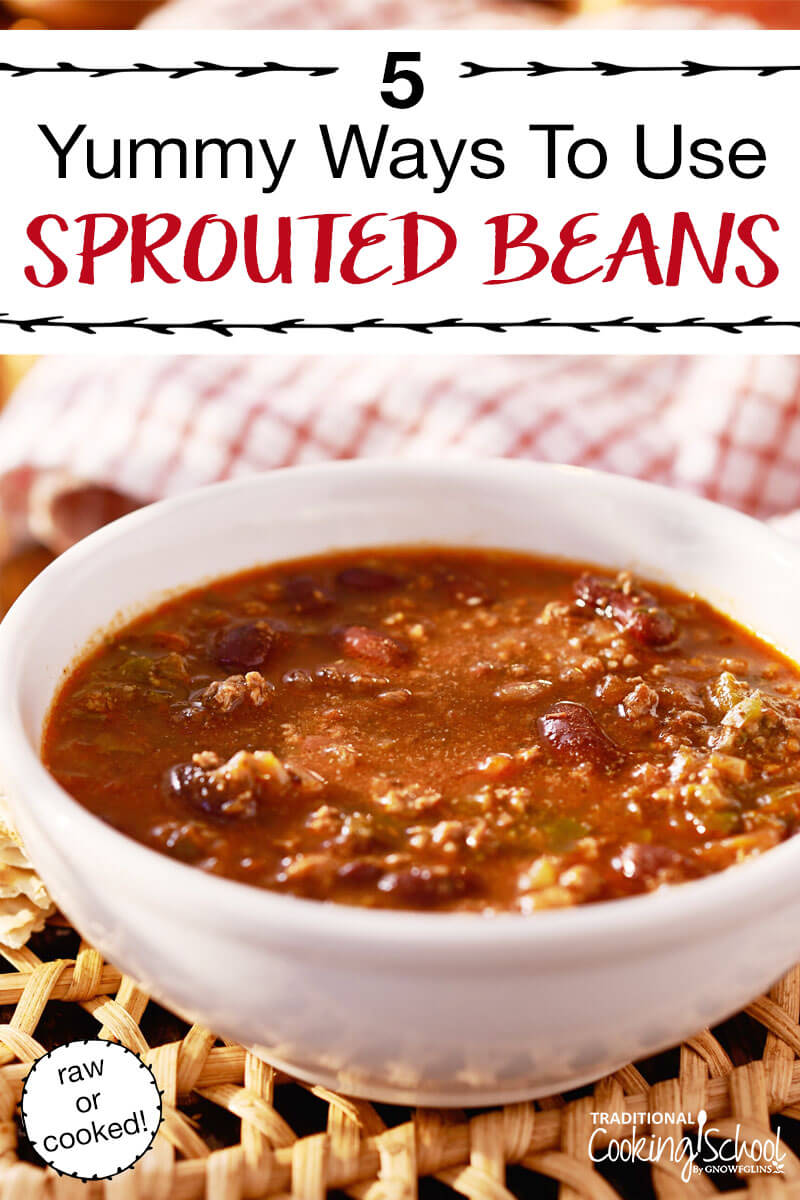
Check out our Basic Sprouted Chili!
#5 — Use Sprouted Beans As Flour (Raw Or Cooked)
Sprout, then dehydrate beans, then grind into a sprouted bean flour. Then use as a substitute in recipes calling for bean flour.
Or, as demonstrated by our 1-Ingredient Gluten-Free Tortillas, skip the dehydrating step and turn your sprouted beans directly into tortilla batter. So easy!
How do you use sprouted beans?
...without giving up the foods you love or spending all day in the kitchen!

2 free books:
Eat God's Way
Ditch the Standard American Diet, get healthier & happier, and save money on groceries...
We only recommend products and services we wholeheartedly endorse. This post may contain special links through which we earn a small commission if you make a purchase (though your price is the same).


I don’t usually eat beans, but I always make a batch of sprouted chickpea hummus for family gatherings. I take dried chickpeas, soak them overnight, rinse them, and lay them out on a cookie sheet that I’ve covered with a kitchen towel. Then I dampen another towel and drape it on top. Twice a day, usually when I wake up and right before I go to bed, I’ll remove the top towel, rinse the chickpeas, place them back on the cookie sheet, and re-dampen the top towel. I do this for several days until the chickpeas have started to grow tails. At that point I boil them until tender and then sit down with a nice movie and pick all the skins off. I guess skinning isn’t *entirely* necessary, but it makes a noticable difference in the smoothness of the finished product. To make the hummus, I start out using about 2 cups of the skinned chickpeas, 1 clove of garlic, the juice of 1 big or 2 little lemons, 1/3 cup tahini, 1/3 cup extra virgin olive oil, and a big pinch of sea salt. Put it all in the food processor and let it go. And go. And go. It will start to get warm, but you want it super smooth. Taste as you go and adjust flavors as necessary. I usually end up adding a little water too, for texture. This hummus always gets absolutely rave reviews and I am ordered to make it every time my family gets together.
.-= Elizabeth´s last blog post… Apple glazed turkey breast =-.
Elizabeth – Thanks for sharing how you do sprouted hummus. I especially like hearing how you handle the skins, which I have never bothered to remove. I wondered if it was really necessary!
I loved this post. Sprouted lentils in salad are great! So gratifying to watch them sprout. I wonder what sprouted hummus would taste like?
Kelli – I’ve had it once and it was really good. Once I tried to make it and it was really bad. But that’s because my sesame seeds had gone rancid. 🙁
I have tried sprouting red lentils recently (in the colander). When I used to sprout some in a Mason jar, they sprouted nicely in a couple days. This time, in the colander, they never sprouted. What am I doing wrong? I can get the other beans, chickpeas, black and white, to sprout that way fine. I had used the lentils in a crunchy roasted lentil recipe (eat them like chips) and they were really good.
Oh, and cumin tastes really good in hummus.
Thanks, Wardee, for the great tutorial on bean sprouting! Sounds like something I want to try now that fall is here and with winter fast approaching. I haven’t been online much (been very busy with my son’s college apps, visits, and all that good stuff!) but finally got to watch your little welcome video! – *sweet* ;o)
I almost always make my hummus with sprouted garbanzos. I don’t notice any difference in the flavor or consistency. I usually let the tails get about 1/4 inch long before cooking. I’ve peeled the skins off before and it does make for a nicer finished product but it makes the final quantity so much smaller and is so much work that I don’t do it very often. I like to do a really big batch of beans, and then throw the leftovers in the freezer for more hummus, falafel, soups, etc.
I’ll have to try the other sprouted bean options, particularly lentils. That sounds really good. I’m glad to know that sprouted beans digest like veggies. I don’t do so well with beans but love the frugal, healthy addition that they make to so many meals.
Rachel – I’m glad you said you don’t notice a difference in flavor or consistency. When sprouted beans are cooked, I don’t notice any difference either. But if I use raw (sprouted) beans in dips/spreads, then I notice a little difference. I guess I could edit that use up there to be for either cooked or raw sprouted beans. Thanks for bringing that to my attention!
Leesie – you’re so sweet. 🙂 I’m glad you peeked in here for some inspiration in spite of how busy (and wonderful) your life is right now.
Kelli – I agree! I love cumin and add it to just about everything. 🙂
I have never sprouted beans before so this was very informative for me. I have sprouted buckwheat groats, which I love. Has anyone ever sprouted them? I’m interested to see if you do it differently than I do.
Amy – I’m glad you asked that, because sprouting buckwheat is different from any other beans or grains.
I have done it before, and this is how I did it:
Part 1 – https://traditionalcookingschool.com/2007/09/27/sprouting-hulled-buckwheat-for-breakfast/
Part 2 – https://traditionalcookingschool.com/2007/09/28/successful-sprouted-buckwheat-breakfast/
Basically, I soak them only for 5 minutes, otherwise they get gelatinous (slimy). Then sprout for about a day or so. They grow really fast! We’ve really only had them for breakfast; they make a good cereal topped with cinnamon, honey, raisins, coconut and milk.
Edit: I have heard of people dehydrating the spouts and using them as breakfast cereal – this way they’d be a bit crunchy and granola like. I might try that soon!
How do you do yours? How do you eat yours? Thanks for bringing this up, Amy. I’m eager to hear how/what you do with buckwheat.
I love buckwheat, and have a fabulous gluten free pancake recipe.
I would like to know if sprouting buckwheat is a good way to hull it.
Buckwheat is easy to grow. And it is very nutritious. Now if I could figure out how to process my harvested buckwheat…
Also, am thinking of growing Einkorn. Does anyone have advice on harvesting/processing home grown grains?
Okay, I just want the soup, as I am sitting here feeling really cold.
Tiffany – come on over, we’ve got leftovers. 🙂
I sprouted buckwheat by soaking it for a couple hours, rinsing it really well, it is so slimy, and putting it in a collander on top of a plate (I learned this in Rejuvinate Your Life from aboverunbies.org) and rinsing a couple of times a day until the tail is about the size of the buckwheat. I made the buckwheat granola recipe in a dehydrator, which I suppose would be good if you were raw, but I am not and didn’t love it, its alright. Then I made a cereal, cocoa or cinnamon from Raw Food Real World, which you can get at the library, but beware that you’ll have a big agave mess to clean up in your dehydrator. I really like the cocoa version.
Great post. We don’t eat a lot of raw sprouted beans as we don’t like how they taste that well and Sally Fallon Morell recommends that you lightly steam sprouted beans before eating, but we do like them in recipes. I like your idea about sprouted bean flour too!
.-= Kimi @ The Nourishing Gourmet´s last blog post… The Healthy Dollar Menu & Gift Carnival =-.
Hi, Kimi – Thanks for mentioning that. I didn’t know Sally Fallon Morell recommended a light steam. Good to know – so thanks for pointing it out. 🙂
I do sprouted buckwheat sometimes and dehydrate with cinnamon and agave or raw cacao powder, sometimes with maple syrup or raw honey. We call them “buckwheaties” and we have them for breakfast just like any cold cereal. It takes some time though, so this isn’t a regular thing. Next time I do it, I’ll try to blog about it.
Also, plain or flavored dehydrated buckwheat adds an interesting crunch to desert things and as a sundae topping, a little like a candy bar crunch. I bet it’d be good in your coconut bark!
And a savory spiced or garlic variation might be equally interesting in a salad as a sub for croutons, especially if dehydrated with the buckwheat thickly forming a sheet you break apart when dried. Hmmm… haven’t tried that one yet, but it sounds yummy.
.-= Faith´s last blog post… The Vegan B12 Discussion =-.
Faith – Thanks for sharing how you do that! I’d love to see a pic/read your blog next time you do it…
From what I understand, you should NOT sprout kidney beans.
http://www.vegsoc.org/info/pulses.html
Search the page for kidney,
Do you have any recipes for breads etc yet with sprouted beans or sprouted bean flours? With dyour dehydrating ecourse and my local classes I’m getting really excited lol. We have done storage and some on sourdough just finished sprouting and are doing soaking next. (March 4th)
I have some sprouted whole red wheat and some sprouted chick peas in a borrowed dehydrator right now! 🙂
Hi, i’ve recently started sprouting beans (we use a colander on a window, in which i soak them for 24 hours, then rinse them once a day)
In my mix there are brown chickpeas, green and brown lentils, mung beans and sunflower seeds.
Do you (or anybody) have experience with the mung bean? because the first time we wanted to eat the bean batch (i let them sprout for three days that time) i found those beans very very hard and not sprouted at all, it was almost painful to chew on them.
Any advice?
Thank you very much, i’m only at my second batch this week so this blog is great!!!!
Hi Phoelyxjd,
Could your mung beans be old? That’s one reason they may not sprout well. Have you seen this article on how to sprout? https://traditionalcookingschool.com/2009/01/22/sprouting-beans-lentils-mung-beans-and-garbanzo-beans-chickpeas/
The tips in it may also help. Have fun!
Millie
Traditional Cooking School
I’ve sprouted beans until the tail was about as long as the bean, dehydrated them, then ground them up to use as flour or the protein in smoothies. Works great, tastes the same to me, and is easier on the digestion than regular unsprouted bean flours. It’s a bit of a process, but if you do a larger batch, you have enough end product to keep on hand for quite a few different recipes.
I make my Dave Fu Yung.
No meat, no gravy. So an Asian omelette/scramble. (I’m not vegetarian/vegan by any means; just lazy and the egg is the protein)
Sprouts, mushrooms, onions, green onions, diced bell pepper, soy sauce, and a hefty dose of hoisin sauce (peppers can add a bit of bitterness, and the hoisin counters that nicely) Stir fried. Then add in the egg.
(I’ll cook up the veggies mix, enough for a few rounds, ahead of time. Seems to keep OK in the fridge. Warm it up as I whip the eggs, and cook.) Typically have it at that time between breakfast and brunch.
Thank you Wardee,
Which sprouted beans can be eaten raw and which ones have to be cooked?
Hi, Alina.
We follow Nourishing Traditions recommendation that advises that we cook sprouted kidney, lima, and black beans because otherwise they are not fully digestible and in the case of kidney beans, may even be harmful.
~Danielle, TCS Customer Success Team