
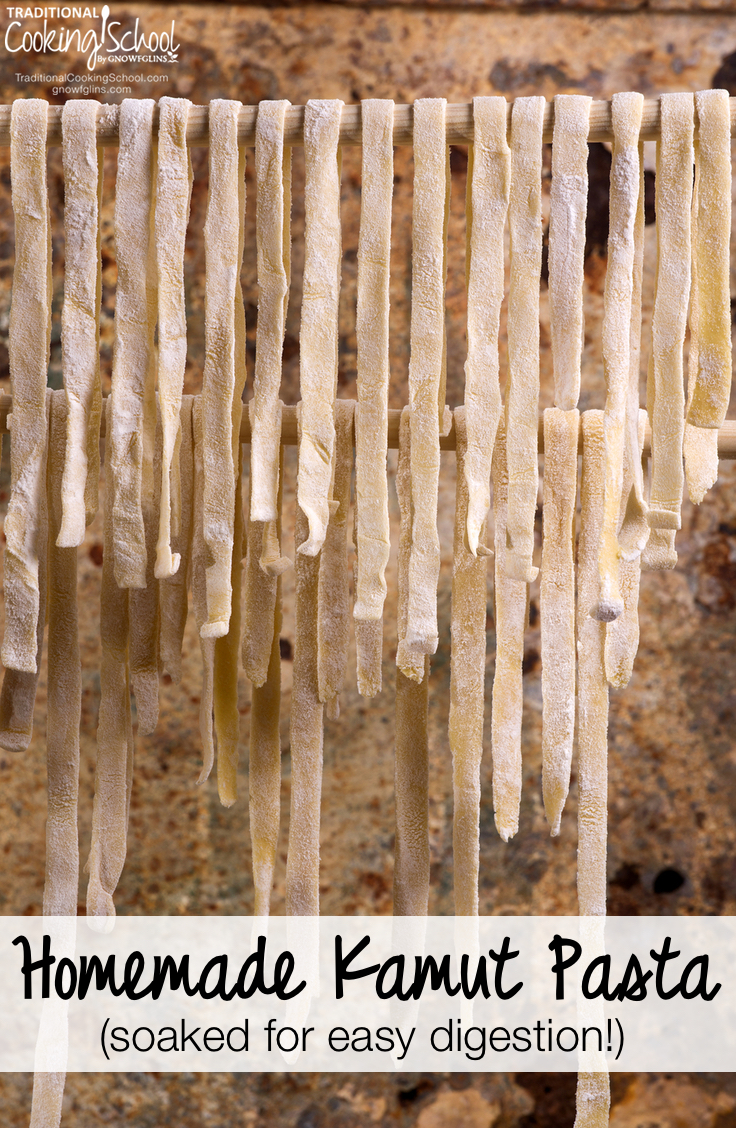
Have you ever worked with kamut before?
It’s an ancient variety of wheat — and so yummy to use for pasta because of its hearty, nutty flavor. Because this recipe calls for soaking the kamut beforehand, the phytic acid is neutralized and the gluten protein is weakened for optimum digestion.
Homemade Kamut Pasta
Ingredients
Soaking Stage
- 3 cups kamut or whole wheat flour
- 3 tablespoons raw apple cider vinegar
- 1 to 1-1/4 cups pure water
Cooking Stage
- 3 quarts pure water for boiling
- 1 tablespoon sea salt
- 2 tablespoon coconut oil or olive oil
- herbed seasoning salt optional
Instructions
Soaking Stage
-
Mix together kamut, apple cider vinegar, and water to form a stiff dough.
-
Knead for 6 to 8 minutes until smooth and elastic.
-
Cover and let rest for 8 hours or overnight.
Cooking Stage
-
Once dough is soured, dust a clean countertop.
-
Separate dough into 3 parts.
-
With rolling pin, roll out 1 section of dough to 1/8-inch thickness.
-
Use a knife or pizza cutter to cut the pasta into 1/2-inch wide strips.
-
Transfer to a baking sheet and lay out to rest.
-
Repeat rolling and cutting with other 2 dough sections.
-
Fill a 6 quart pot half full of pure water.
-
Add salt and oil.
-
Bring to a boil.
-
Carefully add the noodles to the water.
-
Use tongs or a fork to separate the noodles.
-
Bring back to a boil, then cover and let simmer for 5 to 8 minutes, until cooked.
-
Toss the noodles every minute or so in the cooking water to prevent sticking.
-
Remove from heat.
-
Drain by pouring contents of pot into a stainless steel colander in the sink.
-
Transfer noodles back to the pot.
-
Drizzle and toss with additional oil to prevent sticking.
-
Season with herbed seasoning salt if desired.
Enjoy with soups, stews, or spaghetti! Store noodles separately from the main dish so they don’t get soggy. Enjoy!
Do you make homemade pasta?
...without giving up the foods you love or spending all day in the kitchen!

2 free books:
Eat God's Way
Ditch the Standard American Diet, get healthier & happier, and save money on groceries...
We only recommend products and services we wholeheartedly endorse. This post may contain special links through which we earn a small commission if you make a purchase (though your price is the same).


Thank you for sharing this recipe! I haven’t ventured into homemade pasta yet, but this seems simple enough. I can’t wait to try the noodles! 🙂
I’m not a homemade pasta kind of girl, but this sounds wonderful. I like that you said it has a nutty taste. My son makes pasta all the time. I will have to give him this recipe so he can make me some. THANK!!! Geri
.-= Geri@heartnsoulcooking´s last blog post… " PORK AND CIDER STEW " =-.
Looks so good! You did a great job of cutting them out also.
I will try this recipe.
Ah…if kamut works well for pasta, then I just really need to show you how to make the quick and easy spaetzle that literally takes 15 minutes to put a beautiful bowl of homemade pasta onto the table! Ummmm!
.-= Julieanne´s last blog post… College Success Begins at Home: Seasoned Homeschoolers Share Their Experiences =-.
Julieanne – You’re on!!!
I make an egg noodle that is very similar, actually the only difference is the addition of eggs. I use wheat flour though, have not tried kamut. My question is, how much can you taste the vinegar?
.-= Marg´s last blog post… Crabapples galore! =-.
Marg – you can smell it in the dough, but not taste it in the noodles – at least not to identify it. The noodles are very tasty.
I LOVE making homemade soaked pasta dough! It’s one of our favorites, and you are right, it’s so frugal too. Thanks for sharing your recipe with us!
Wardee,
I really miss pasta! I don’t buy it anymore because I’ve realized the stuff in the store is NOT good for my family…and the whole wheat and brown rice pastas taste like cardboard. I will definitely be trying this recipe. I want my pasta back! 🙂 Thank you for showing me that it is possible.
.-= Tammy´s last blog post… Skype Call: Cheeseslave & GNOWFGLINS =-.
Tammy – you will love this pasta! (PS we’re making it in the eCourse if you can wait until lesson 4)
Oh! I can hardly wait…but I will. LOL! Would the recipe change at all if I used sprouted flour instead of soaking? Thanks for all you do Wardee!
.-= Tammy´s last blog post… Raw Milk Symposium =-.
have you tried drying these? how long can you leave the dough “soaking” before you roll it out?
Tammy – I have not tried drying these, but I have read it is not hard. Leave spread out on a clean surface and turn over to the underside when the top side is dry. At room temp, it should not take long.
I have left the dough soaking for 24 hours. I wouldn’t be afraid to go longer, either, unless it was very warm out.
Do you know if this recipe would work with an extruder?
Julie — You mean a pasta machine/roller? Yes, it should. I have not done it myself, but in my classes people have.
I have a KA attachment for making spaghetti and macaroni etc. You put in walnut sized pieces of dough in and it extrudes the shaped pasta. Just got it, and have yet to experiment with it, but hope to find a soaked recipe that works as we love pasta and I want it to be nutritious. I will likely be using hard white winter wheat as that is what I use for most of our bread baking.
I am wondering, too, how would you adjust if you use sprouted kamut?
Hi, a million thanks for this recipe, the kids and I made some fettucini pasta for dinner with kamut flour, it was ABSOLUTELY WONDERFUL !! I especially love it because it does not use eggs. This is a sure favorite from now on in my kitchen !!
going to try this with einkorn by decreasing 1/3 of the water. Any other suggestions? No kamut berries on hand…
HI Kristi,
Wardee has tried pasta and you need a lot of flour to make it stiff enough. Wardee hasn’t perfected the recipe yet, but your inclination sounds like a good place to start.
Millie
Traditional Cooking School
Hi there,
Which e course is this covered in?
Thank you!
Kelsey
Hi Kelsey,
Lesson 4 of the Fundamentals I eCourse covers pasta. 🙂
~Danielle, TCS Customer Success Team
Hi
i am eager to try this recipe.
how much does one cup of wholewheat kamut flour measure?
how much does a cup of water measure?
thanks so much!
Hi, Harry,
1 US cup of kamut flour volume equals: 119.00 grams (g) in kamut flour mass. One cup of water weighs approximately 8 ounces, which is equal to 225 grams.
~Peggy, TCS Customer Success Team
Hi Wardee,
My husband cannot tolerate regular wheat, so I use spelt for my homemade bread and cakes. The spelt pasta I purchased always breaks so easily. Kamut pasta however holds better. Since it is sooo difficult to even get kamut pasta, I’d like to try homemade. Your recipe has vinegar in it. I would like to use salt. Do you know if that works as well?
Jenny
Hi, Jenny: The vinegar in the recipe is what makes the pasta “soaked” so that the anti-nutrients are broken down. If you mean that you’d like to replace the vinegar with salt, you won’t get the same benefit. You could keep the vinegar and add some salt, if you’d like. The cooking water is generously salted, too, so you might not need to add salt to the dough. —Sonya, TCS Customer Success Team
Hello! Love it! Always been making fresh wholewheat and spelt pasta but now been diagnosed with anemia, oops! Learning about phytic acid now.
Could I soak in lime juice instead?
Hi, Irina,
We are so happy you love it! Yes, any acidic medium will do. 🙂
~Peggy, TCS Customer Success Team