
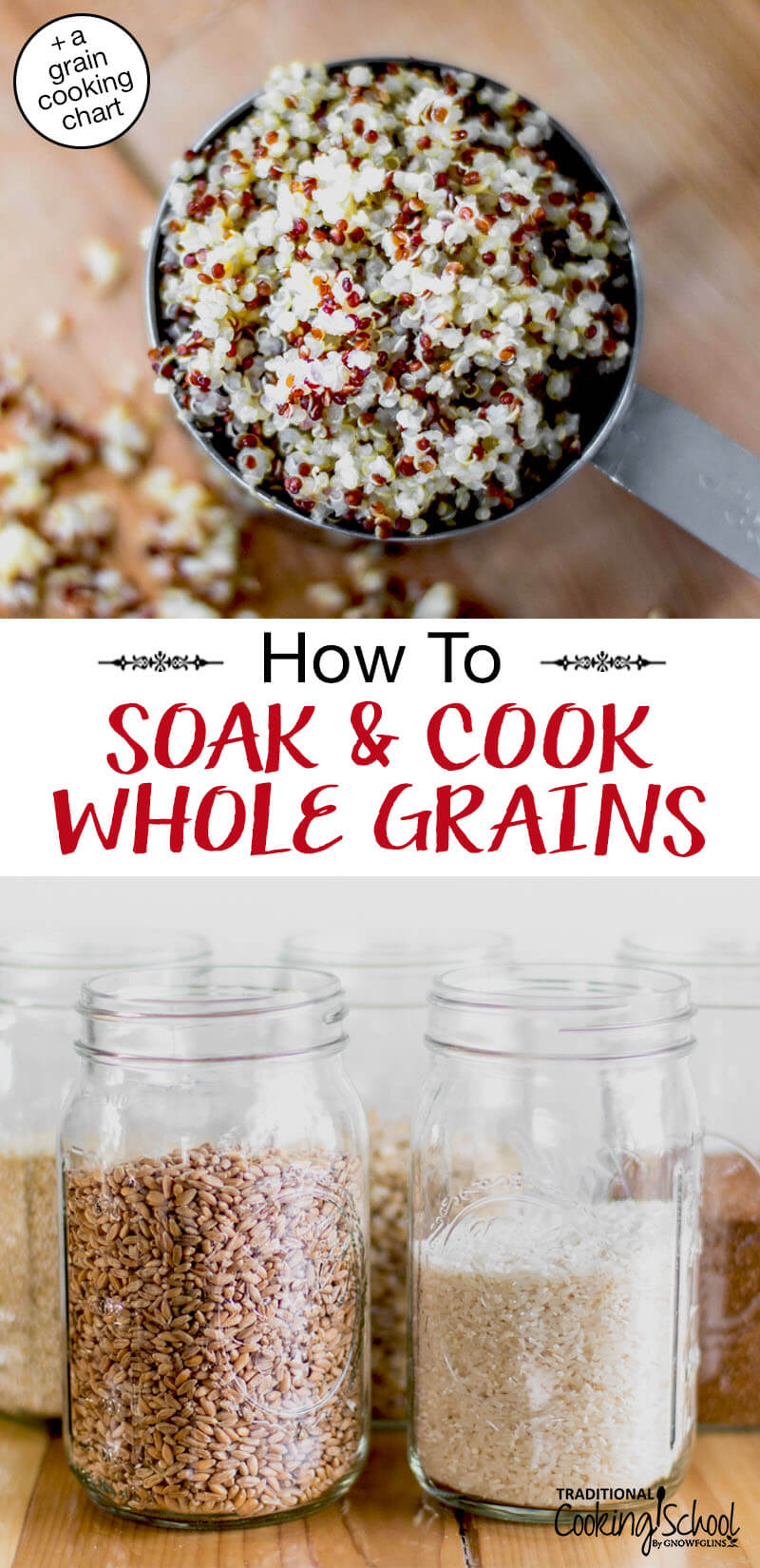
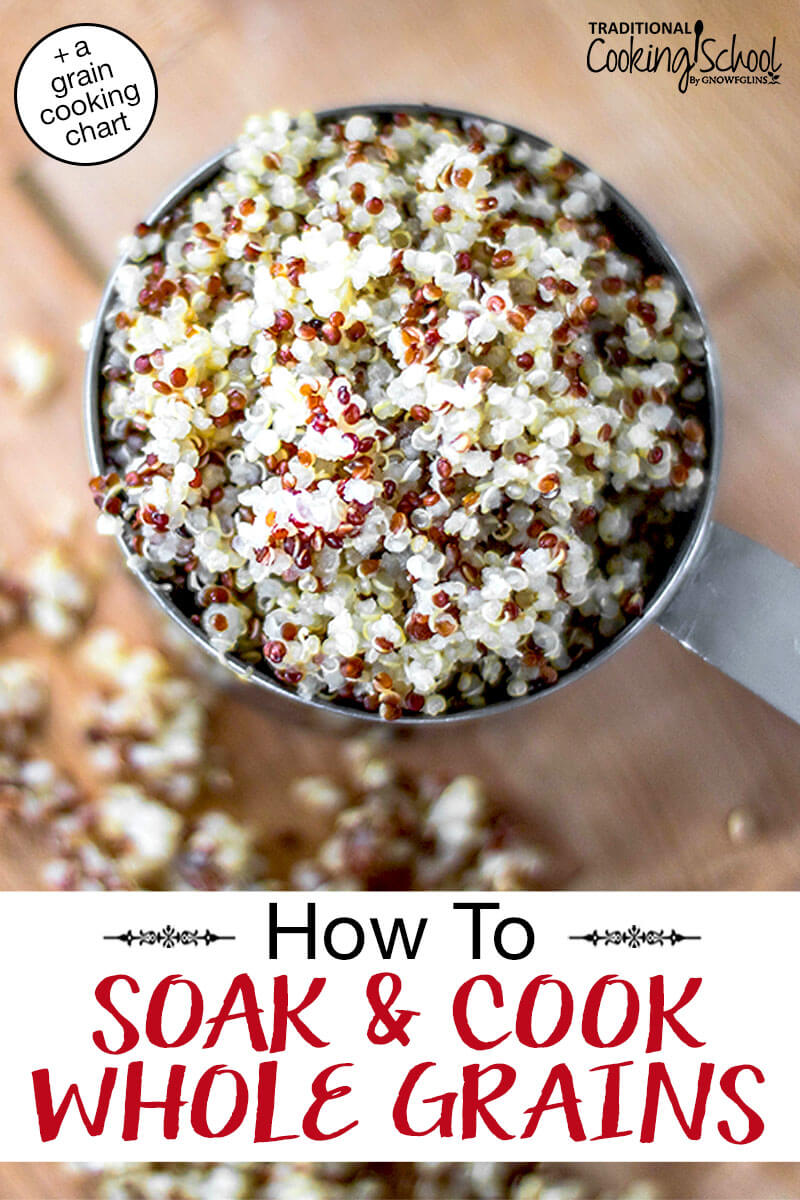
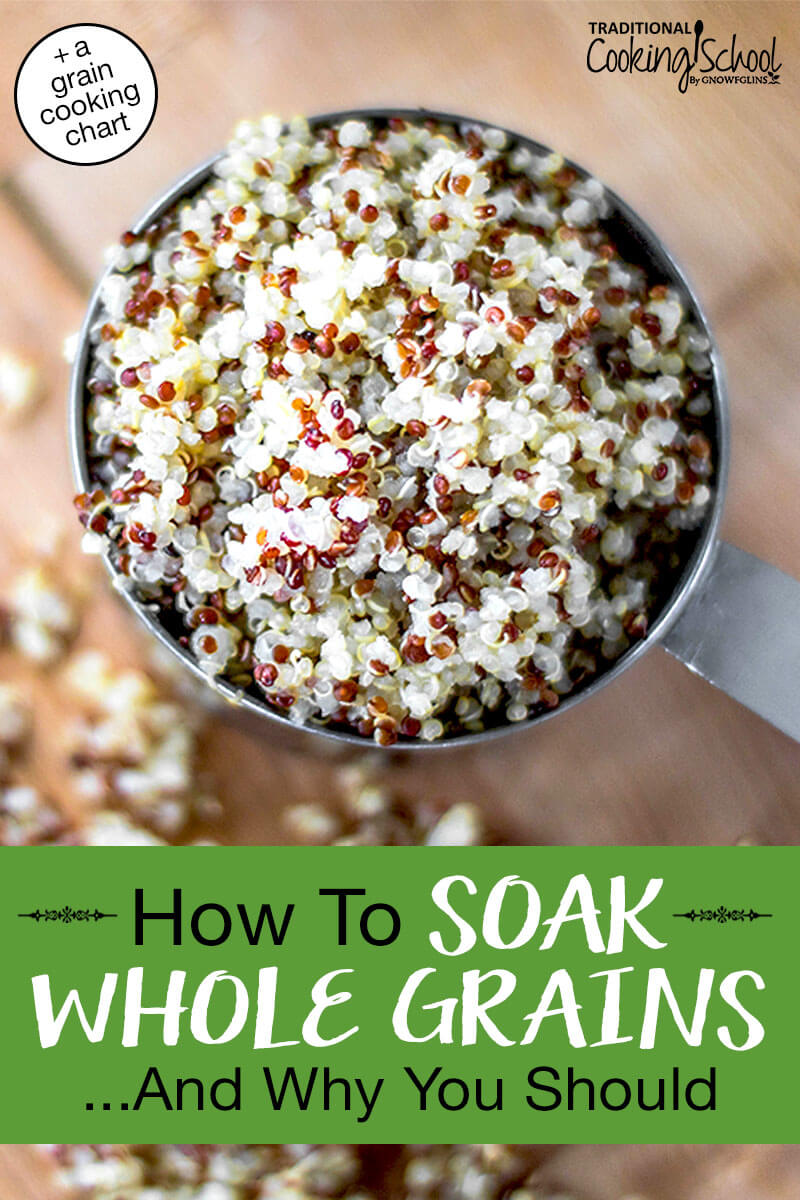
Fluffy, buttery, the perfect side dish for everything from your favorite chili recipe to a breakfast hash, cooking whole grains like rice and quinoa is easy… and worth doing the *right* way! Including a grain cooking chart, here’s how to soak and cook whole grains to aid digestion, boost nutrition, and even halve cooking time!

Table Of Contents
Why Soak Grains?
Do you know why grains should be soaked overnight — prior to cooking?
Not only does soaking reduce cooking time, but it also aids in digestion!
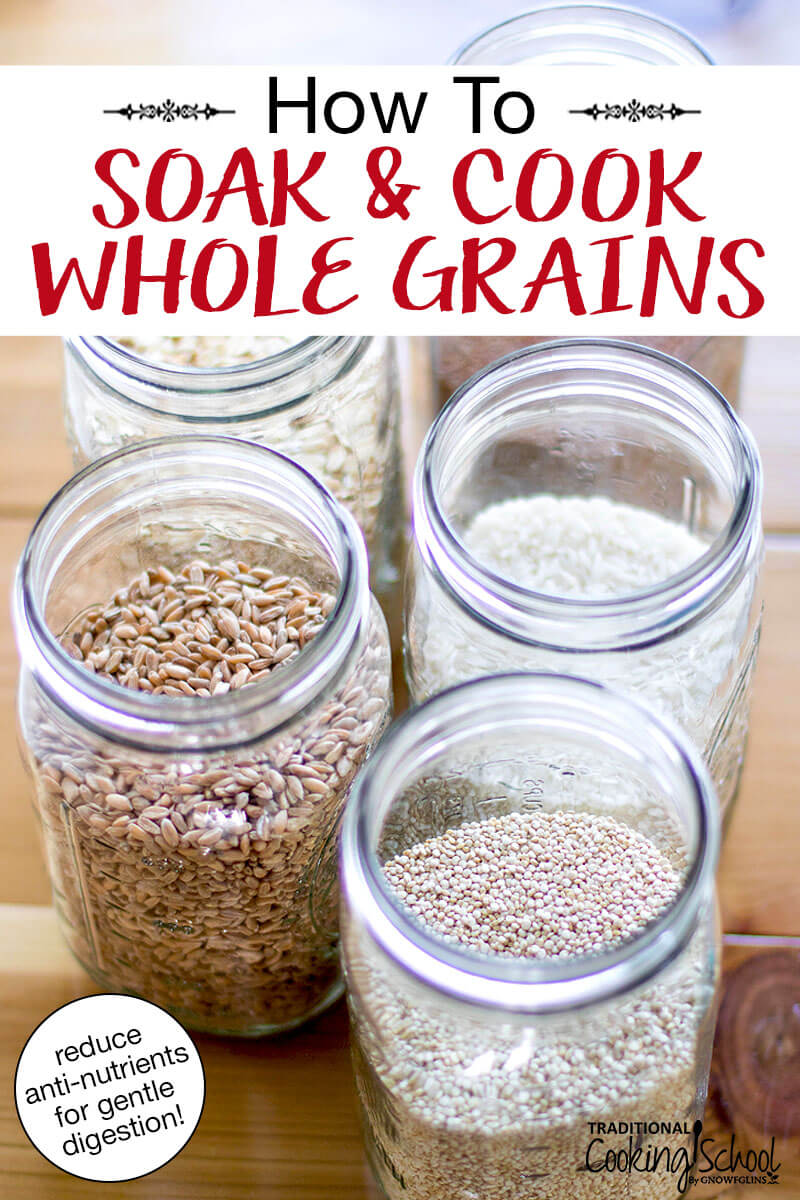
How? Well, grains are seeds that contain enzyme inhibitors and anti-nutrients such as phytic acid. The basic step of soaking the grain in warm water and an acid (like raw apple cider vinegar or lemon juice) for a minimum of 7 hours neutralizes some or most of the phytic acid.
Both the soaking and the cooking deactivate enzyme inhibitors for whole grains, while cooking deactivates them in cracked or rolled grains. This is great because we need enzymes in order to properly digest the foods we eat.
This basic recipe can be applied to cook many grains, whether whole, cracked or rolled.
Ingredients
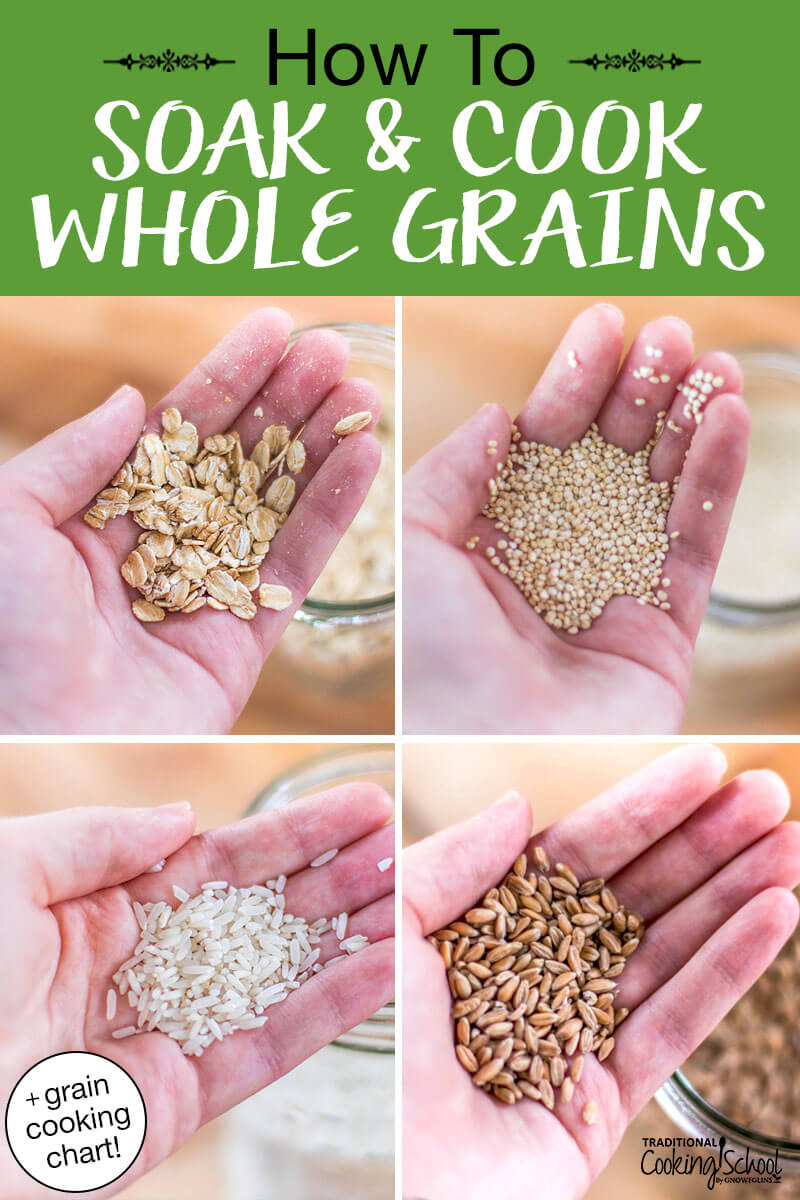
- Grain of choice – These can be whole, cracked or rolled.
- Pure water – Choose filtered water free of contaminants. Warm water is best! You may also replace half of the water called for in the Grain Cooking Chart, below, with homemade broth or stock.
- Acid of choice – You may use Kombucha, raw apple cider vinegar, lemon juice, buttermilk, milk kefir, water kefir, whey, yogurt… even your sourdough starter in a pinch!
- Healthy fat – Although optional, we love adding a traditional fat such as grass-fed butter, lard, ghee, olive oil, or coconut oil to our soaked and cooked grains. It boosts flavor and nutrition!
- Sea salt – This is also optional, but highly recommended. Choose a mineral-rich salt if possible.
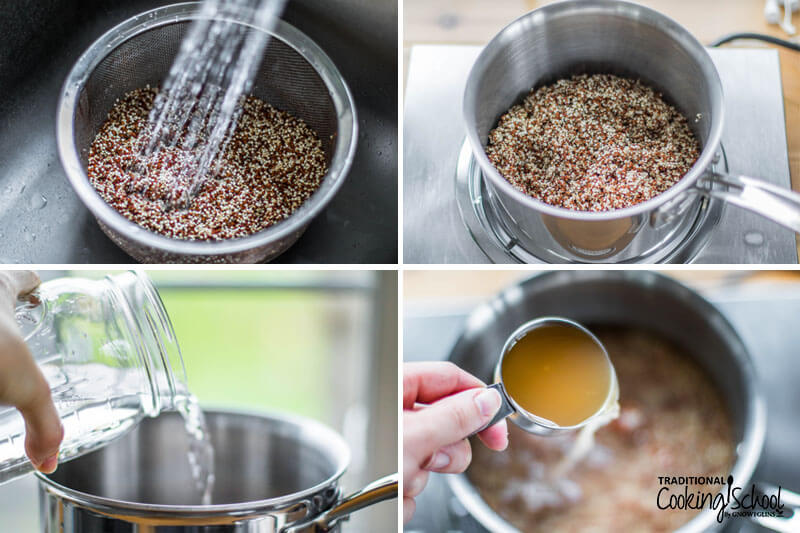
Soaking Grains
- First, choose your grain. The Grain Cooking Chart below tells you the amount of water required to cook (and soak) all grains, along with the cooking time. Please note that the cooking time listed is how long it takes to cook unsoaked grains; usually soaked grains take about half the time for cooking.
- Rinse the full amount of grain, if necessary (or desired).
- In the pot for cooking, combine the grains and the full amount of warm water along with an acid, such as Kombucha, raw apple cider vinegar, lemon juice, buttermilk, kefir, whey, yogurt, etc.
- Start the soaking the night before, so the grains will soak for at least 7 to 8 hours. Keep the mixture warm (in the oven with the light turned on should be just fine).
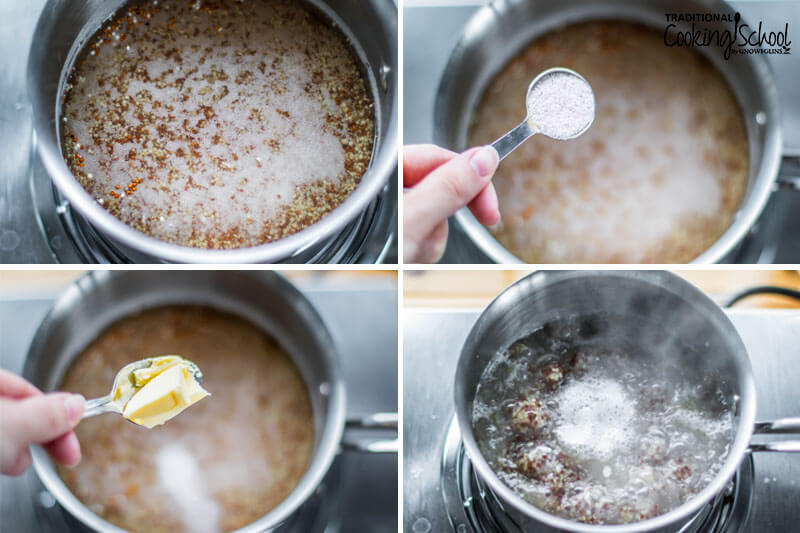
Cooking Whole Grains
- After the soaking time has passed, you may drain the water, if desired. This is optional, however, to reduce the sour taste, some prefer to drain and rinse the grains, then replace the amount of water that was drained.
- Add a traditional fat and sea salt.
- Bring to a boil. Reduce heat to low and cover. Do not lift the lid during cooking time, except very quickly once or twice to make sure it is simmering gently.
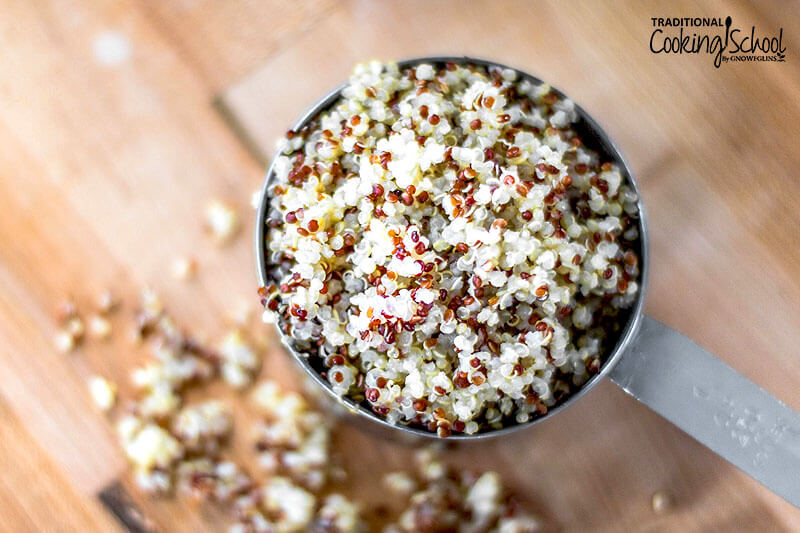
- The grains are done when all the liquid is absorbed and they are quite tender, which is usually about half the time normally required for cooking dry whole grains.
- When done, turn off the heat and remove the pot from the burner.
- Let sit for 10 minutes, covered. Fluff with a fork.
Choosing The Right Acidic Medium For Soaking
You have many options when it comes to soaking whole grains in an acidic medium! Any of these can be used: white vinegar, raw apple cider vinegar, whey, lemon juice, kombucha, water kefir, milk kefir, buttermilk, yogurt, clabbered milk and even sourdough starter.
In fact, any fermented beverage or soured dairy should work because of the proliferation of lactic acid-producing bacteria. Choose one based on your needs.
- Need dairy-free? Go with raw apple cider vinegar, lemon juice, Kombucha, water kefir or sourdough starter.
- Want to increase the soaking power of your acidic medium? Choose a biologically active acid: raw apple cider vinegar with the mother, Kombucha, water kefir, milk kefir, buttermilk, yogurt, sourdough starter, etc.
- Your family complains about the sour taste of soaked whole grains? Choose whey, Kombucha or water kefir for a less sour taste.
The bottom line is that you can pick and choose, depending on what you have in your pantry at any given time, and your family’s preferences! Play around with it until you find what works for you.
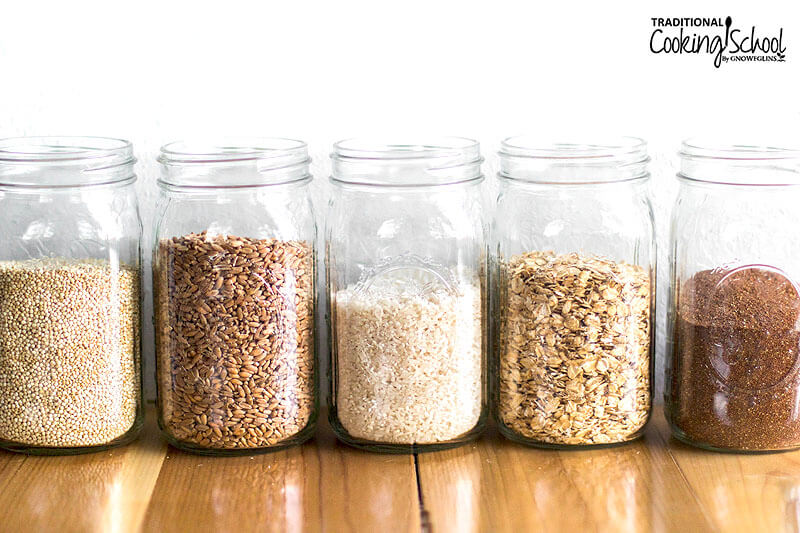
Grain Cooking Chart… Including Gluten-Free Grains!
information from “Enchanted Broccoli Forest” by Mollie Katzen
| RICE (1 cup) | WATER | COOKING TIME | YIELD |
| ^Brown Rice (long grain) | 2 cups | 35 to 45 minutes | 3 1/2 cups |
| ^Brown Rice (short grain) | 2 cups | 35 to 45 minutes | 3 3/4 cups |
| ^Brown Basmati Rice | 2 cups | 45 to 50 minutes | 4 cups |
| ^Brown Jasmine Rice | 2 cups | 45 to 50 minutes | 4 cups |
| ^Black Japonica Rice | 2 cups | 45 minutes | 3 1/2 cups |
| ^Wehani Rice | 2 cups | 45 minutes | 3 cups |
| ^Wild Rice | 2 1/2 cups | 1 1/4 hours | 4 cups |
| ^Manitok Wild Rice | 2 1/2 cups | 50 to 60 minutes | 4 cups |
| GRAIN (1 cup) | WATER | COOKING TIME | YIELD |
| ^Amaranth** | 1 1/2 cups | 25 minutes | 2 cups |
| Barley, Hulled | 3 cups | 1 3/4 hours | 4 cups |
| Barley, Pearl | 2 cups | 1 1/2 hours | 4 cups |
| ^Buckwheat/Kasha | 1 1/2 cups | 10 minutes | 3 1/2 cups |
| Bulgur* | 1 1/2 cups | 30 to 40 minutes | 3 cups |
| Cracked Wheat | 2 1/2 cups | 7 to 10 minutes | 3 1/2 cups |
| ^Cornmeal (Polenta) | 2 1/2 cups | 10 minutes | 3 1/2 cups |
| Couscous | 1 1/4 cups | 10 minutes | 2 3/4 cups |
| Kamut | 2 1/2 cups | 1 3/4 hours | 2 1/2 cups |
| ^Millet | 2 cups | 25 minutes | 3 1/2 cups |
| ^Oat Groats | 2 1/2 cups | 35 to 40 minutes | 2 1/2 cups |
| ^Quinoa** | 2 cups | 25 to 30 minutes | 4 cups |
| Rye Berries | 2 1/2 cups | 1 1/4 hours | 2 1/2 cups |
| Spelt | 1 1/2 cups | 50 to 60 minutes | 2 cups |
| ^Teff | 3 cups | 15 minutes | 3 cups |
| Triticale | 2 1/2 cups | 1 1/2 hours | 3 cups |
| Wheat Berries, Hard (Red) | 2 cups | 2 hours | 3 cups |
| Wheat Berries, Soft (White) | 2 cups | 1 1/2 hours | 3 1/2 cups |
*Soak, don’t cook. **Rinse first. ^Gluten-free (oats are gluten-free if purchased certified gluten-free).
Other Soaked Whole Grain Recipes
- Gluten-Free 4-Grain Breakfast Porridge (w/ easy soaking step!)
- How To Make Pre-Soaked Oats — NOT Rock-Hard Or Glued Together
- Perfect Soaked Rice {Instant Pot or any pressure cooker}
- Soaked Brown Rice Recipe (Baked & Stove Top Options!)
- Simple, Elegant Rice Pilaf
Did you try soaking your whole grains before cooking them? If so, please give us a rating on the recipe card below. Then snap a photo and tag us on social media so we can see!
How To Soak & Cook Whole Grains
Ingredients
- grain of choice see Grain Cooking Chart above for amount
- pure water warm (see Grain Cooking Chart above for amount, specific to each grain)
- acidic medium of choice 1 tablespoon per 1 cup liquid (such as Kombucha, raw apple cider vinegar, lemon juice, buttermilk, kefir, whey, yogurt, etc.)
- traditional fat 1/2 tablespoon per 1 cup grain (such as grass-fed butter, olive oil, coconut oil, etc.)
- sea salt 1/4 to 1 teaspoon per 1 cup grain
Instructions
-
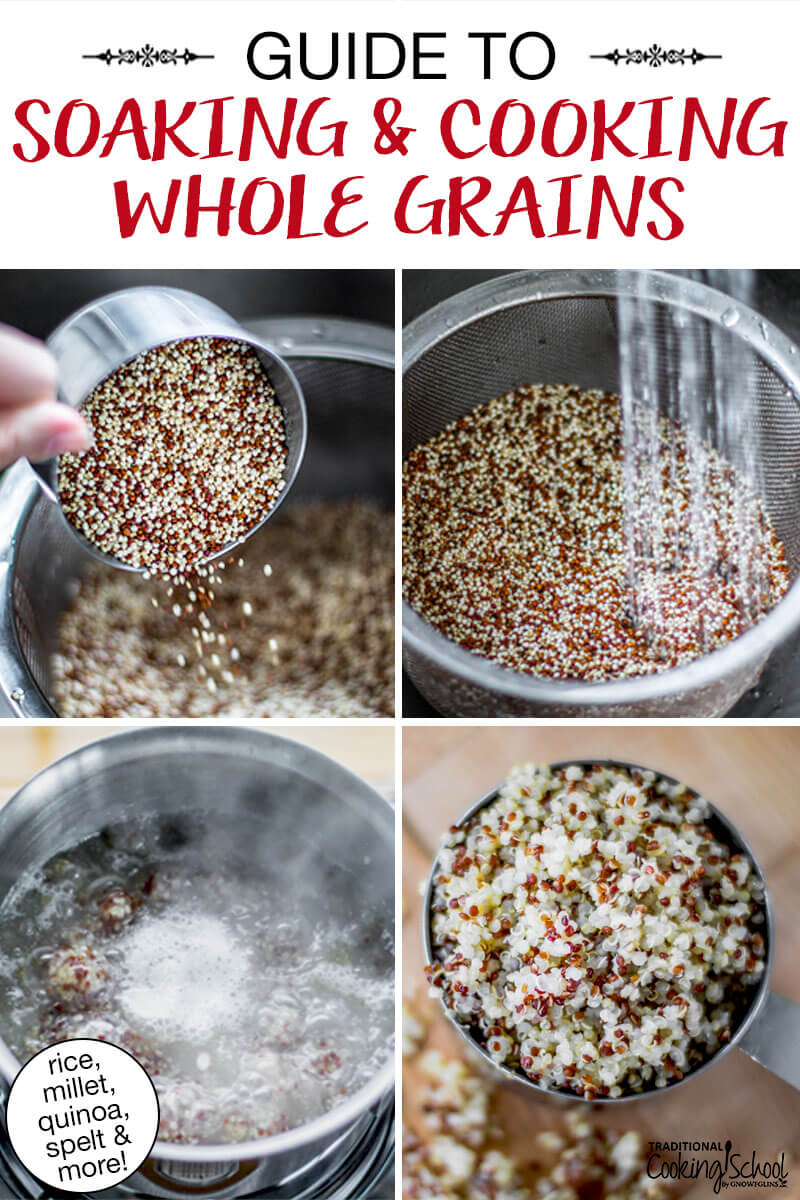
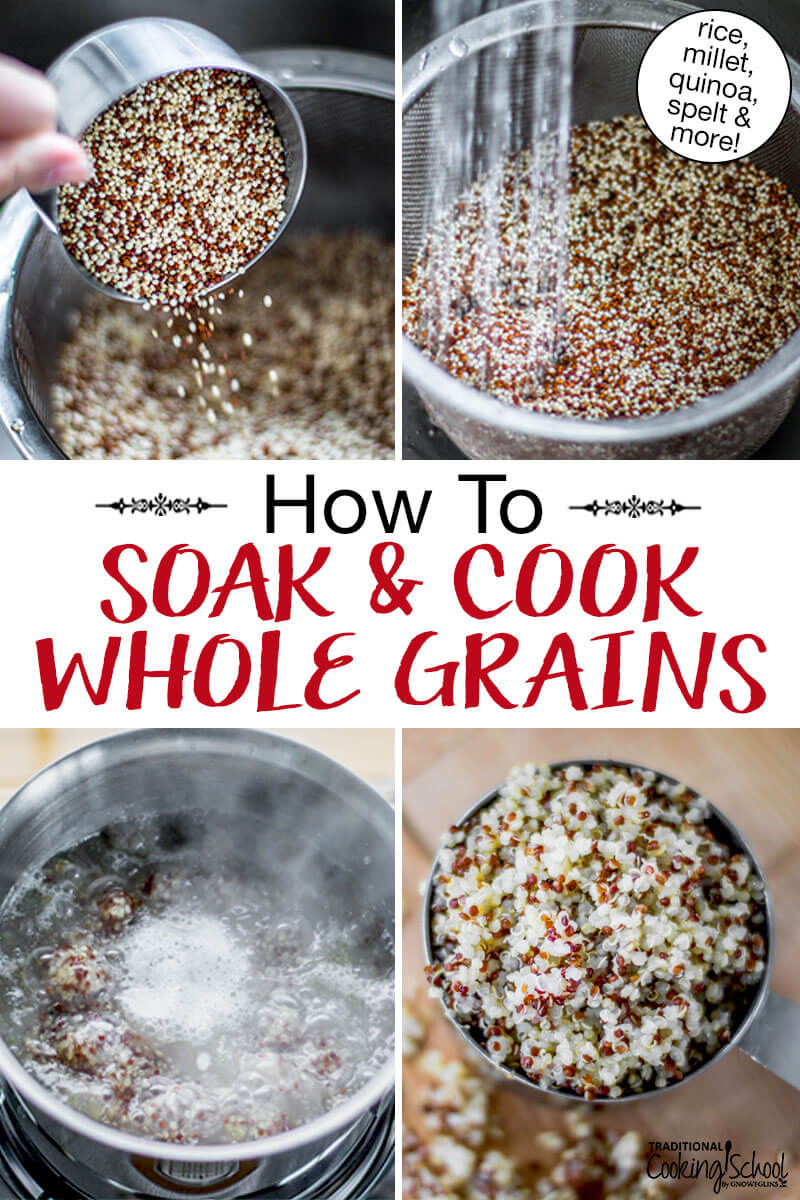
The night before, combine grains, water, and acid in a pot.
-
Cover pot and let sit out on counter for 7 to 8 hours, or overnight.
-
When ready to cook, add oil and salt.
-
Bring to a boil.
-
Reduce heat to low and cover. Allow to simmer for time listed (see chart below), or until grain is tender and all water is absorbed.
-
Don't lift the lid while cooking, except very quickly once or twice to check that it is still simmering gently.
-
When cooked, remove from heat.
-
Let stand, covered, for about 10 to 15 minutes. Fluff with fork. Enjoy!
Recipe Notes
Broth or Stock Variation
- Soak the grain in half the amount of water called for in the cooking chart, plus 1 tablespoon of acid per cup of water used during this soaking step.
- The next day, add the other half of the water in the form of broth (no more acid is needed).
- Cook as the basic recipe describes, adding salt or oil as desired, using the half the cooking time suggested for that particular grain.
This post was originally published and written by Wardee Harmon on 7/6/09. It was updated and republished on 3/24/21.
...without giving up the foods you love or spending all day in the kitchen!

2 free books:
Eat God's Way
Ditch the Standard American Diet, get healthier & happier, and save money on groceries...
We only recommend products and services we wholeheartedly endorse. This post may contain special links through which we earn a small commission if you make a purchase (though your price is the same).



Are these cooking times for soaked grains? I didn’t know that Molly Katzen soaked her grains. If so, I am going to have to check this book out of the library! Thank you for posting this helpful chart.
Kelli – no they’re not, I realized that after a bit. The cooking time will be less than the times listed here, sometimes by as much as half. Watch for tenderness and full water absorption.
Hi, thanks for this useful list of cooking times for unsoaked grains. Do you have or could you point me to a list of cooking times for soaked grains? I understand that the cooking times will be shorter, but a new list would be so helpful.
Wardee, I’m confused. Your listing for couscous has an asterisk that means, “Soak, don’t cook.” We always cook our couscous, so I’m not sure what this means? According to this chart, do we not cook couscous? Because the chart also says to cook it for 10 minutes.
Also, in the reply you gave to Kelli, you said that the cooking times will be less than what is listed in your chart, sometimes by as much as half. I’ve always been taught not to check rice until the time is up…not to lift the lid at all until the correct amount of time has passed. Otherwise, the rice can become sticky and gooey. Would you mind explaining a little bit more to us about what the cooking time actually means on the chart, and about not cooking couscous? Thanks! 🙂
Julieanne
http://www.homeschoolblogger.com/iLoveHomeschooling
.-= Julieanne Miller´s last blog post… When I Grow Up, I Want to Be a…Doctor! (e-book review) =-.
Julieanne – Thank you for pointing out those areas that need clarification!
Regarding the couscous –
the way I cook it is to pour boiling water over it, and let it sit covered, in the boiling water (but not on the burner) for 10 minutes. I do not believe this is a grain that needs to be soaked, because if it is made in a traditional way, the soaking/pre-cooking has already taken place before we get it. So, the process is really easy, just pour boiling water over it and let it sit.Oh, you know what… ignore me… when putting this together, I had a brain freeze, I guess… I was thinking of couscous as bulgur! So that is a mistake. Couscous does need cooking. I starred it by mistake.
As far as the cooking times, well… that is going to have to be a matter of experimentation. You’re right not to lift the lid unnecessarily. But, I find I have to break that rule. 🙂 What I do is take a quick “peek” about halfway through the regular cooking time to see if the water is all absorbed or not. I try to minimize the interruptions. In the case of rice, I find that it is cooked in about 25-30 minutes if it has been soaked overnight.
Hopefully this helps!
Totally just curious- do you routinely soak your rice? I have in the past a few times, but thought it was so low in phytic that it was fine not to soak. I usually fry my rice in coconut oil, butter, and/or olive oil before adding the stock, so soaking wouldn’t fit in with that practice. I love this chart- thanks so much!!! 😉
In His Name,
Kirsten
Kirsten,
I found a more effective way to soak brown rice, detailed HERE at my site. It’s really easy and gets rid of the phytic acid quite effectively (which is not actually that low in rice). Sometimes I do saute the rice in oil, then soak it – I have no idea if it still works for the phytic acid, but it does work for the end result! I end up cooking the same amount of time, about 45 minutes, as with unsoaked rice. I add new water to about 1/2 cup less since the rice has absorbed some water during the soaking process.
Hope that helps!
🙂 Katie
ohhh-this will save MANY a frustration in the kitchen. I’m going to print this out (if you don’t mind) and stick it on my fridge!
.-= c´s last blog post… blunders and absurdities =-.
C – No, I don’t mind! Enjoy! Let me know if you find any mistakes. 🙂 My site is set up so if you just hit Print (Ctrl-P), the post will print without all the sidebars, etc. It comes out formatted very nicely.
Umm good to know! I will remember that.
.-= c´s last blog post… blunders and absurdities =-.
Thank you sweet Wardee!! warm loving hugs
Do I understand correctly? The grains/rice are cooked in the same water they soaked in?
.-= Marg´s last blog post… The barn roof =-.
Marg – Yes! Though you may rinse them if you like.
As far as I’ve read, you should throw away the soak water as that has the phytic acid you just leached out, as well as whey or vinegar that you may not want in your cooked grains.
Hi Susan,
You can toss the soaking liquid if you don’t care for the flavor of vinegar in your rice.
The whey or vinegar offset or neutralize the phytic acid so it isn’t a problem to cook in soaking water.
~Danielle, TCS Customer Success Team
I need some troubleshooting help! I cooked spelt berries for the first time, and since I just came across this table, it’s the only instructions I had. I soaked 1 cup berries in 1 1/2 cups water (with a little whey) overnight and cooked them today – brought to a rolling boil, added a little salt and olive oil, and left the lid on 50 minutes. Lots of water left. 10 more minutes. Still lots of water left. 20 more minutes. Drained the things and gave up. They’re pretty chewy, in my fridge waiting to be a cold grain salad (inspired by your post last week!). But I’m wondering: did I do something wrong? Should all the water be absorbed? Should spelt be chewy? I often have trouble with my soaked rice not being tender after cooking 45 minutes and absorbing all the water. I use 2 cups water to 1 cup rice, but I’ve found that when soaked, it actually needs a little more to be totally soft. Have you really cooked a cup of brown rice with only 1.5 cups water? NT’s “basic brown rice” has a 2:1 water:rice ratio too.
Katie – I will have to edit that chart. I’ve had it for so long and got it from a Molly Katzen book. I use 1:2/rice:water just like NT. As for the spelt, it has been a long time since I’ve cooked them, but I remember them being very chewy after a long cooking time. Are you certain they’re not done or are they just chewy?
You’re reminding me – I made those biscuits the other day with water, not milk. They turned out pretty good. Not as good, but still good! 🙂
Hi Wardee! Thanks for this post; I sited it in my last blog. I’m just wondering, I always soak my beans overnight before cooking but only in water. Are beans different than grains in that water is sufficient or should I be soaking them in acid as well?
Raychel –
Refer to these instructions for soaking/cooking beans:
https://traditionalcookingschool.com/2006/05/12/cooking-dry-beans/
Wardee,
Does the quinoa end up being a bit mushy when it is soaked? Mine didn’t come out nice and fluffy for tabouli- the way it is when unsoaked. Did I do something wrong? Thanks.
Regina — Hi! Mine doesn’t usually come out mushy when I soak. Here are some thoughts for you.
1) There could have been excess water.
2) Did you let it stand for a good while to give up alot of its heat before digging into it? If it is still warm when scooped out, the grains will smoosh together. For tabouli, I let it cool waaaayyyyyy down before using it. I even chill it.
Let me know if this helps! 🙂
I am new to soaking grains so let me just make sure I understand this correct. I soak the grains in the same water (post above answered that question) that I am going to be cooking it in. I soak the grains on the counter with no covering, just the amount of water + rice in a bowl. I can soak for longer then 7-8 hours correct? If I wanted to start soaking tonight but couldn’t cook the rice until I got home from work around 5 would that be to long of a period to soak? If I ran late and didn’t have time to cook the rice before work I wouldn’t want it to be ruined. I would be soaking it almost a full 16-24 hours instead of 7-8.
Mariah — a 16 to 24 hour soak is fine. You might find it helpful to rinse the grains after that long because the soaking water is probably more sour and maybe a little scummy. Some people like to rinse after only 8 hours. It is a matter of preference, really. I wouldn’t say no cover during soaking — either a lid, plate or even a towel to keep dust and bugs out. Otherwise I think you’ve got it!
This is just amazing. I wish I could do the same.
I have a question. What if I (routinely) forget to start 8 hours ahead? Is there any point in a shorter soak?
Thanks!
Susie — Certainly a shorter soak will help, but the 7 hour minimum is ideal. 🙂
I am wondering about soaking rolled oats, the list says oat groats, is that because it is just better to eat oat groats or does that include rolled oats?
thanks for all of the amazing information.
Krista — You can do rolled oats as well. 🙂 The only oat I don’t recommend is quick oats because they’re processed and not whole. The rolled oats will cook much faster than oat groats.
Anyone know where I can purchase Manitok wild rice?
Jean — I don’t. I’m sorry. 🙁
I’m confused! LOL If I am going to mill wheat berries should they be soaked (and dried) prior to milling in my NutriMill?
I was just about to ask that same question. Hopefully, someone can clarify!
Hi Zena Sue,
Grains need to be properly prepared to reduce phytic acid. Soaking, sprouting, and sourdough are methods to reduce phytic acid. So depending on how you plan to use your flour will determine which method you should use.
If you wish to have sprouted flour to use for things like cookies then sprouting, dehydrating and then milling, would be the proper process.
Hope this helps!
~Vicki, TCS Customer Success Team
No need to soak before grinding. Soaking the flour (or using as sourdough) after grinding works just fine. If you sprout your wheat, then you’d need to dehydrate.
Hello, I have a question. I like to cook some of my grains with soy or almond milk. Can I just soak the grain in that overnight and then cook it, or will it mess up the acid balance? Should I soak in water and then pour it out and then add the soy/almond milk? Thanks for your input.
Yes, you can soak them in almond milk as long as you’re adding an acid.
We do not recommend using soy milk as the soy is not fermented and not a healthy, traditional option.
~Danielle, TCS Customer Success Team
Hi there I have just discovered about arsenic in rice does the soaking help for that and should I throw away the soaking water? So confused sorry
Janny
Hi Janny,
Soaking rice helps with digestibility and can help reduce arsenic levels.
You can drain the soaking water and replace with clean water before cooking.
No need to be sorry – we all get confused from time to time! 🙂
~ Vicki, TCS Customer Success Team
Does anyone have a recipe for “Cream of Wheat” using einkorn berries?
Hi, Gretchen,
Wardee has a great recipe called Soaked Einkorn Porridge in her #AskWardee episode 100 on Home Grain Milling 101: More Things Your Grain Mill Can Do!
You will find the recipe here: https://traditionalcookingschool.com/food-preparation/home-grain-milling-101-more-things-your-grain-mill-can-do-aw100/
Enjoy!
~Peggy, TCS Customer Success Team
How much water and cooking time for einkorn berries? Thank you!
Hi, Ashley,
Combine einkorn berries, water, and acid in a medium-size pot. For 3 cups einkorn use 6 cups of water and 1 tablespoon sourdough starter or raw apple cider vinegar. Give it a little stir, then cover and let soak for 7 to ? 8 hours or overnight. When the soaking time is over, add sea salt and coconut oil. Over medium-high heat, bring to a boil. Reduce to a simmer, cover and let cook undisturbed until all water is absorbed 40 to 50 minutes. Remove from heat. Let stand 10 to 15 minutes. Serve or chill for other uses.
Enjoy!
~Peggy, TCS Customer Success Team
Thank you for this information…and yes cooking time changes a lot once you’ve soaked.. I cook my millet in 10 minutes….(after boil point)
Just a quick question or two please..
I understand millet and buckwheat are not grains could you just use mineral salt for this soak??
Also do you have any information about popping (puffing) millet, buckwheat, amaranth please. I’m not quite sure if you would soak, dehydrate and then pop…however in saying that doesn’t millet and amaranth need to be cooked?
🙂
Hi Maroula,
We still advise soaking with an acid for millet and buckwheat.
We don’t have any information on popping, I’m sorry.
~Danielle, TCS Customer Success Team
ok thank you 🙂
I am confused. Can you bake with soaked grain? If so where are the instructions? I’ve got einkorn grain and am hoping to find a method of preparing it into bread, rolls, etc that will be tolerable for my daughter and I.
Hi, Susan.
It sounds like you’re referring to soaked flour rather than soaked whole grains.
Here’s a link to our archives of soaked flour recipes: https://traditionalcookingschool.com/?s=soaked+einkorn
You can also sprout your einkorn berries and then make flour: https://traditionalcookingschool.com/food-preparation/recipes/sprouting-grains-for-bread/
~Danielle, TCS Customer Success Team
Thanks for this! I’ve been soaking grains for a few years.
Now, asking a friend to pickup some organic brown rice for me on a recent shopping trip (during shelter in place!)—they got me “parboiled” organic brown rice (Trader Joe’s “quick cook”)…
I’ve searched high and low, and can’t find out if I should:
soak per usual
soak shorter (a couple of hours?)
rinse only
other?
can you help me figure this out at time I’m reticent to deplete ANY vitamins/minerals?
thanks!
Sharon
Hi, Sharon.
I’m happy to help. 🙂
With the bran being removed, some of the anti-nutrients are as well, so that’s a good thing. It also cooks up faster and has a lighter taste.
The downside it, it has less fiber to balance the meal. It still benefits from soaking (texture and reduction of anti-nutrients). You can soak for the same amount of time. 🙂
~Danielle, TCS Customer Success Team
Does pearl barley need to be soaked? All the information I’ve found is for regular barley. Plus which barley is better for you? Thanks in advance!
Hi, Sharol,
We prefer whole grains such as regular barley, with pearled barley the outer hull has been removed. Here Wardee explains it in more detail: https://traditionalcookingschool.com/food-preparation/recipes/a-grain-primer/?swcfpc=1
~Peggy, TCS Customer Success Team
Baked rice is also an option (would prob work w/other grains too). Use boiling water or broth! I do it at 350 for an hour at least. Cover tightly w/foil or glass lid.
Chicken & rice is an easy casserole type dish. I add S&P, onion, garlic, celery or bell pepper, mushrooms (or just 1-2), parsley, sage, thyme & rosemary and hot pepper vinegar. Raw chunks of broccoli are good too.
I’ve found any cracked/“steel cut” grains soak and cook the same. I soak any grain but rice for 24 hrs. Just as I do beans. Start w/hot water too and it’ll stay warm a long time.
I only don’t disturb rice and kasha. Oats I stir just like I was making rolled oat oatmeal. Grits you must whisk or you’ll have a solid lump (cornmeal and polenta are not the same, cornmeal is a finer grain, polenta is basically grits, which is cracked/“steel cut” corn).
I wouldn’t prob stir quinoa but I’ve made it 2x (rinsed it and everything) and thrown up w/in 10 min of ingesting. So not doing that again.
Cracked wheat/“bulgur” I’ve never cooked, just let it sit 20 min after pouring boiling water over it.
I’ve been making steel cut oats in my 3qt camping crockpot/thermos. Boiling water and let sit 8hrs at least.
Grits didn’t do so well, solid mass but redeemable—had to finish on stove tho so that didn’t work…
Rolled oats works too, but was very runny to us. We prob left it too long too. Good taste, just not right texture.
Kasha grits is my next venture. I toast them in a whole egg in cast iron pan first, to coat each kernel. No mushy kasha then! Old Russian trick. I also cook them in broth OMiWord! I generally add fried onion and garlic too, when it’s done.
I’ve got barley grits & rolled barley sitting here too and should look into trying them but I only buy enough to be the extra phytase in soaking oats.
Happy Grains, Guys!
What about white rice, jasmine or basmati. I don’t use brown rice as I thought I heard that it usually has more arsenic. Would you soak white the same way or just rinse it?
Hi Victoria, since white rice already has the outer bran removed there is no need to soak to neutralize the phytic acid. However, you certainly can still soak it so that the cooking time is reduced. Just following the same instructions for brown rice when soaking and cooking white rice. ~ Vicki, TCS Customer Success Team
I’m confused. Why do some websites say to just soak with apple cider vinegar, while some say to soak with sea salt? Do they “activate” or break down the anti nutrients differently? If so, in what way? Sorry, I keep searching for specific explanations regarding these two and can’t find any. I would greatly appreciate your response. Thank you!
Hi, Katherine.
Salt is optional. It has no impact on the anti-nutrients but enhances the flavor. Mineral-rich salt will also add trace amounts of minerals to your grains.
~Danielle, TCS Customer Success Team
I’m a little confused. Can you use this method to sprout grains or beans? They would have to soak for 24-48 hours.
Hi, Lynn: This is a different process for pre-soaking beans and grains before cooking to release anti-nutrients. If you want to sprout your beans and grains instead, that process is a bit different. Here are some links to help: https://traditionalcookingschool.com/?s=sprout+bean and https://traditionalcookingschool.com/food-preparation/recipes/sprouting-grains-for-bread/
—Sonya, TCS Customer Success Team
Hello,
I am new to soaking grains and everything traditional cooking. I have a few questions.
1. Do you need to soak couscous? I have conflicting sources.
2. Do you need to soak Jasmine rice? I have been soaking it and it has been wonderful but I was looking at some of the comments that said you don’t need too?
3. What are good places to get rice? Or where can I find good rice? I don’t have a Trader Joe’s or Whole Foods near me.
Hi, Joy:
1. Couscous is not a grain — it’s a tiny form of pasta made from semolina (wheat) flour. No need to soak it before cooking, but it does contain gluten.
2. If your jasmine rice is brown, you should soak it before cooking it.
3. I’m not sure what is available where you live, but you can often find organic rice at regular grocery stores. You might also check to see if there’s an Azure Standard drop point nearby so you can order in bulk. —Sonya, TCS Customer Success Team
What is yield? I mean, why does it says 1 cup in the headline, and then different yield amount for each grain?
The grain will measure more than 1 cup after soaking and cooking as it will absorb the water or whatever you cook it in and plump up. ~Peggy, TCS Customer Success Team
Toasting can bring out flavor in Farro – would you toast before or after soaking?
After soaking. 🙂
~Danielle, TCS Customer Success Team
Not everything lends itself to cooking/soaking. I like to use raw rolled oats in my homemade granola…isn’t it possible to reduce phytates by baking the oats first?
Hi, Dawn,
This soaking period mimics germination, and the enzyme phytase (present in some grains but not all) gets unlocked. The phytase neutralizes phytic acid. We do not recommend baking oats to reduce phytates.
~Peggy, TCS Customer Success Team