
Fresh, tart, and effervescent, milk kefir is a living food teeming with beneficial bacteria and yeasts for gut health! This ultimate guide to all things dairy kefir will answer your burning questions — how to make it, which milk to use, what to do if it’s too sour… plus troubleshooting and my 3 best culturing tips!

Milk kefir reminds me of yogurt, labneh (yogurt cheese), and other Middle Eastern flavors from my childhood.
The best part?
Even though we recommend starting with raw, pastured milk from a local dairy, you can take regular pasteurized milk from the store and transform it into a nutrient-dense, fermented food that is *so much better* than before!
We’ve been teaching TCS premium members how to make milk kefir at home for over a decade now, and along the way we’ve accumulated quite the list of FAQs, like…
- Which milk to use?
- How long to ferment?
- What should I do if my kefir is too sour?
- Is it different than water kefir?
- Is it different than yogurt?
- And sooooo many more!
So, in the same spirit as our ultimate guides to Kombucha and water kefir, we’ve put together the ULTIMATE milk kefir guide to answer all of your burning questions, help you troubleshoot, and share brewing tips!
Let’s dive in…
Table Of Contents
What is milk kefir?
Milk kefir, also known as dairy kefir, is a yogurt-like cultured dairy product made from milk and the “mother culture”: kefir grains.
These grains are home to symbiotic colonies of beneficial microorganisms — bacteria and yeasts — that are able to colonize the digestive tract, boosting gut health.
When you introduce a dairy kefir grain into any kind of milk, even a non-dairy milk like coconut milk, the microorganisms feast on the lactose (milk sugar), and as a result of this process, create a thickened milk with the consistency of thin, drinkable yogurt.
The beneficial organisms from the grains have spread throughout, giving a wonderful probiotic boost to the drinker! It actually has more probiotics than yogurt!
Kefir is low in lactose, while rich with beneficial bacteria and yeast, and high levels of vitamins, minerals, and enzymes. This fermented milk drink can be enjoyed plain, or used in a variety of recipes from potato salad to popsicles (see more ideas below!).
According to The Body Ecology Diet, kefir has many health benefits. It…
- is a natural antibiotic
- does not feed yeast, such as candida
- can be tolerated by those who are lactose intolerant because the beneficial organisms eat most of milk’s lactose
- provides the enzyme lactase to digest any remaining lactose
- coats the lining of the digestive tract, creating a nest for beneficial bacteria to colonize
What are kefir grains?
Before we start making kefir, let’s discuss the kefir grain or culture. You need to know this so when it comes time to retrieve the kefir grain from the cultured milk, you will know what to grab!
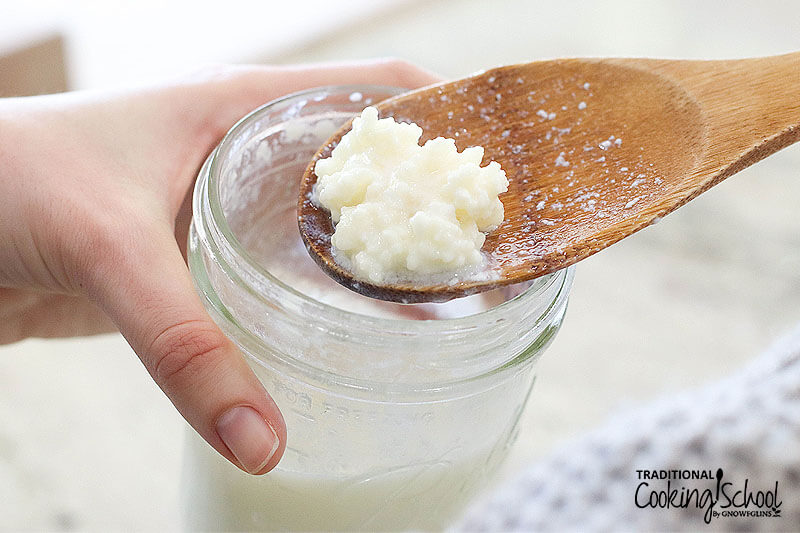
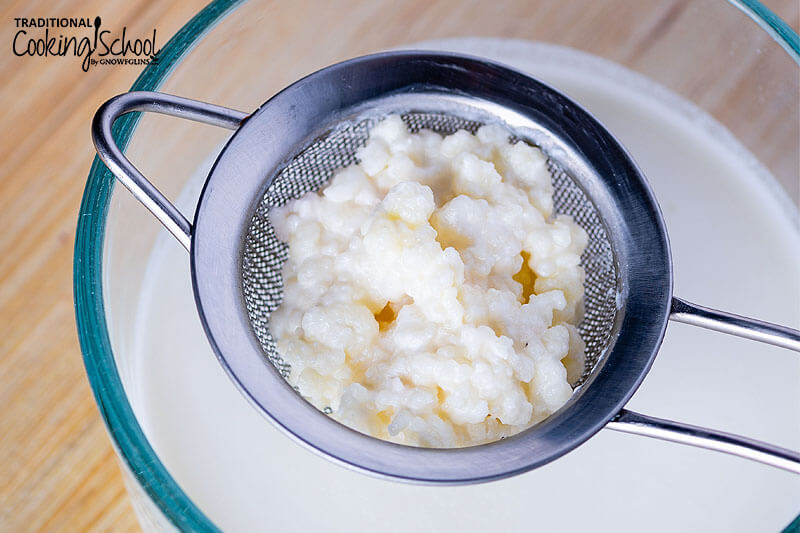
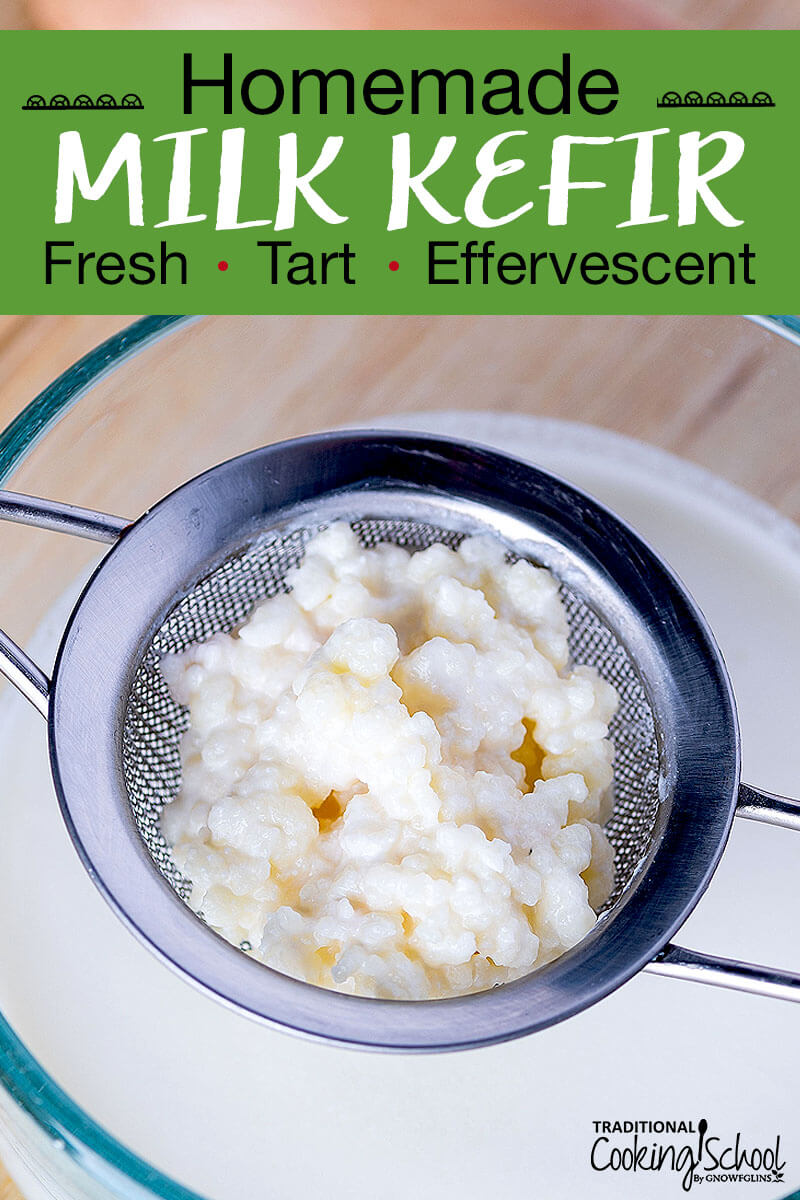
Kefir grains are a rubbery, somewhat translucent whitish/yellowish clump, and shaped like a cauliflower. These grains contain bacteria and yeast growing together, along with casein (milk proteins) and lactose (milk sugar).
They can be as small as a grain of wheat or quite large, like a hazelnut. You need only 1 to 2 tablespoons of kefir grain(s) to culture a quart of milk.
During culturing, the grains will be mixed in with the kefir itself, yet they are different and unmistakable, so don’t fear losing the grain. It can be found!
The kefir, when pressed with a finger, will collapse; its curds are fragile. Pressing on the grain feels rubbery and it springs back when released.
Milk Kefir Vs. Water Kefir
Milk or dairy kefir is not the same as water kefir.
In both types of kefir, the grains feed on sugar, leaving behind an acidic, fermented, slightly alcoholic (less than 1%), probiotic-rich beverage. Dairy kefir grains feed on the milk sugar lactose, while water kefir grains feed on whatever sugar is used in the sugar-water base.
They do both have a mother culture called “grains”, which are colonies of bacteria and yeast living together symbiotically. However, because the microbes vary in each culture, they look different.
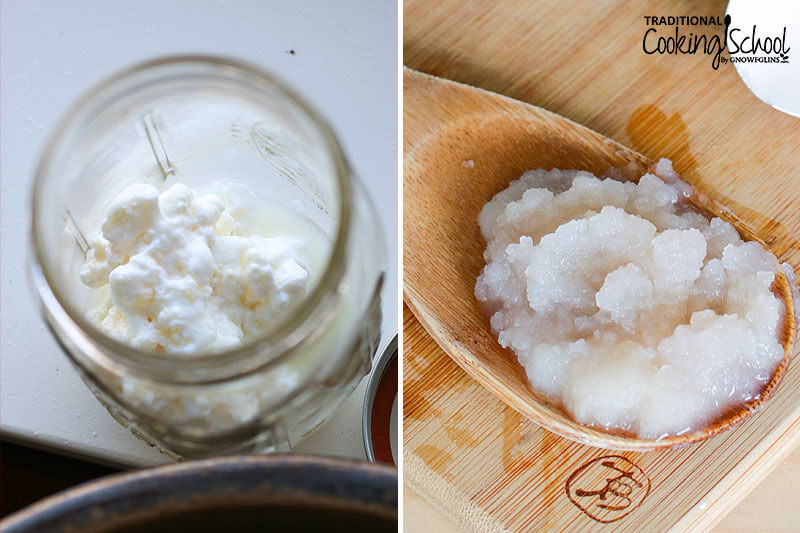
As mentioned above, dairy kefir grains are rubbery, whitish clumps that look like cauliflower. Water kefir grains are somewhat translucent crystals or sharp little pebbles and remain separate from each other.
Of course, the most obvious difference between them both is… the dairy! Water kefir is dairy-free, dairy kefir is not.
And guess what? You can actually use dairy kefir grains to make water kefir through a conversion process.
The same grains won’t work indefinitely, but since dairy kefir grains grow like gangbusters in milk, if you keep them going in milk on the side, you’ll have an endless supply — without investing in water kefir grains!
Learn how to make water kefir here!
Milk Kefir Vs. Yogurt
If you’re new to cultured dairy, you might be wondering whether you should make milk kefir or yogurt, or if it really matters! Both are fantastic cultured foods, however, they do have their differences.
Kefir is a thickened milk with the consistency of thin, drinkable yogurt. Its mother culture, kefir grains, are responsible for culturing milk into kefir.
It is typically more tart than yogurt, and actually has a far greater number of beneficial bacteria as well (almost five times more), in addition to yeasts!
These microorganisms are able to colonize the digestive tract, boosting gut health and keeping the colon clean. Some of the beneficial yeasts are especially powerful as they help the body resist pathogens and parasites. (Source.)
Yogurt is typically made in a warm location such as a yogurt maker, where its unique starter culture thickens milk into a spoonable consistency. In addition to being thicker, it has a milder flavor than kefir, and its probiotics pass through the gut (rather than colonizing it), providing food for the good bacteria there.
As you can see, both have their own special qualities! You really can’t go wrong, whether you make one and not the other, or both.
Learn how to make Instant Pot yogurt here!
3 Culturing Tips & Tricks
Here are three tips for keeping your dairy kefir grains happy!
No worries, though. They are much more robust than water kefir grains, and it’s pretty easy to help them thrive.
1. The Best Milk
With cultured dairy, you can actually end up with a food that is better than how it began!
Of course, the best kefir will result from starting with fresh, raw milk from pastured cows, goats, or sheep. But if you don’t have access to that, choose the next best milk you can and be assured that culturing it will make it very good for you.
In order of preference, the best dairy foods come from these forms of milk.
- raw, whole milk from a pastured animal
- non-homogenized, pasteurized whole milk from a pastured animal
- non-homogenized, pasteurized whole milk from a grain-fed animal
- homogenized, pasteurized milk (whole is better than skimmed)
- ultra-pasteurized milk (whole or skimmed) (not recommended for culturing*)
*The fifth milk listed, ultra-pasteurized (UHT) milk, doesn’t always work for culturing because excessive processing often renders it incapable of supporting a culture.
For the dairy-intolerant, full-fat coconut milk can be used to make “dairy” kefir. See coconut milk kefir instructions here.
2. The Best Tools
Choose non-reactive utensils and containers. This means glass jars and wood or stainless steel utensils and strainers.
Avoid plastic containers because, over time, the acidity of the beverage can cause the plastic to leach into the drink.
If you’re going to use stainless steel, keep its contact with the grains to a minimum — quick stirring or straining rather than prolonged contact. (Stainless steel is the least reactive of the possible metals you will find in kitchen utensils.)
I discourage using a cotton muslin bag for this type of kefir. It really makes a mess!
3. The Best Environment
Brew the dairy kefir several feet away from other cultures, to prevent cross-contamination.
Dairy kefir needs an environment around room temperature to ferment well. Ideal room temperatures are between 70 and 80 degrees Fahrenheit.
The fermentation process will be longer with the cooler temperatures and faster with warmer temperatures.
When milk kefir ferments too long, you can tell because it will separate into curds and whey. Yes, just like Little Miss Muffet!
It will also have a strong sour flavor that can be too much for some tastes. And of course, the texture is not what you were expecting either.
Over-fermented kefir hasn’t necessarily gone bad… but letting it get to this point should be avoided because it may not be pleasant to eat. Here are ways to use it up so it doesn’t go to waste!
Rehydrating The Grains
Unless someone shares grains with you, you’ll have to purchase dairy kefir grains. (We recommend getting them from Cultures for Health.)
Re-hydrate according to the package directions. It takes 4 to 7 days in milk to re-hydrate them and get them going again.
But, according to Cultures for Health, this process may take 2 to 4 weeks.
How To Store Milk Kefir Grains
Dairy kefir grains may be stored, when not in use, in the refrigerator in a small amount of milk. This will keep for one or two weeks.
If stored much longer, I recommend draining the liquid and replacing it with fresh milk. People report 50% viability results with freezing dairy kefir grains, so I recommend freezing several grains to ensure a backup.
You may also dehydrate grains for future use (or backup). Here is a step-by-step tutorial.
Once dry, store in the refrigerator or freezer.
Instructions For Making Milk Kefir
- Put 1 quart of the best milk you can buy into a wide-mouth quart size jar. This milk may be warm from the milking, or cold from the refrigerator. I’ve made kefir with goat milk and cows milk, and both are delicious! If you’re dairy-free, you can even make coconut milk kefir!
- Add (hydrated) dairy kefir grain(s) and stir briefly and gently with a wooden spoon. Use 1 to 2 tablespoons of grain(s) per quart of milk.
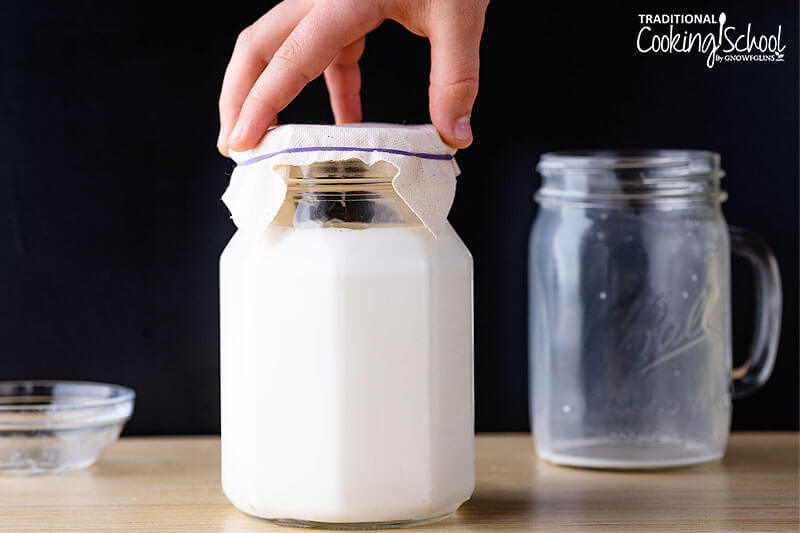
- Cover with a cloth napkin or paper towel and secure with a rubber band. Leave at room temperature to ferment the milk away from other cultures.
- Let culture until you are happy with how thick and sour it is. It will get thicker and sourer over time, as well as more effervescent. Eventually, its thickening will turn it into curds and whey. During long or warm culturing times, you might see threads of yellow liquid surrounding the kefir curds; this is the beginning of this separation.
- In cooler temperatures, the culturing process is slower. In warmer temperatures, it happens more quickly. If your jar of culturing kefir is in a warm place, such as near an oven vent, slow cooker, or toaster oven, it will culture more quickly.
- In general, 18 hours to 2 days is about what you can expect for the brewing time. It will be affected by your preferred thickness, taste, and the temperature of the room.
- In about 6 to 24 hour intervals, you can take a wooden spoon and gently “poke” down into the milk, at the sides of where the grains are. You can see where the grains are because they tend to float at the top, and they are bumpy whereas the milk is smooth.
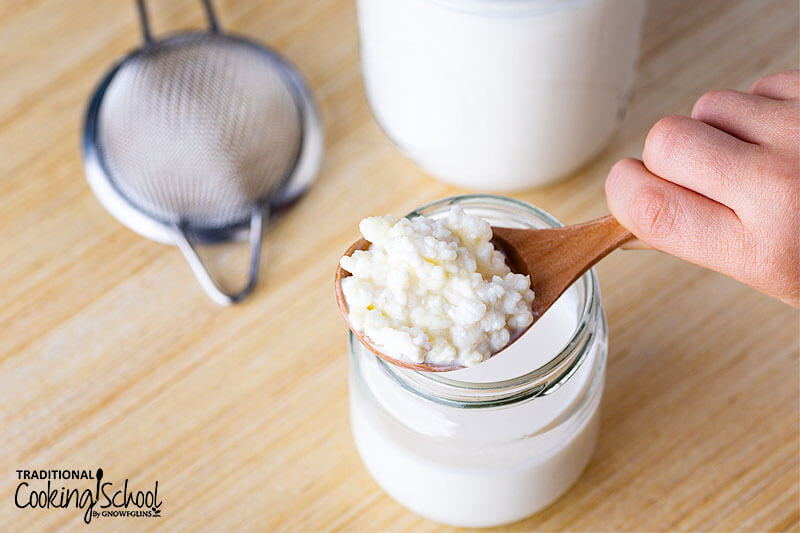
- Or you can stir gently. Frequent, but gentle stirring helps to achieve a smooth consistency, especially when trying to achieve a thick consistency.
- When you’re happy with the kefir’s taste and thickness, retrieve the grain(s) with a wooden spoon. You should be able to tell where they are based on the bumps in the kefir.
- Transfer the kefir grain(s) to a new batch of milk, or store in the refrigerator until needed (following instructions for storage above).
- You can also choose to separate the kefir from the grains using the strainer method. Set a strainer over a jar or bowl and pour the kefir into it. Let the kefir drip out over several minutes; also stir gently to help the liquid move out.
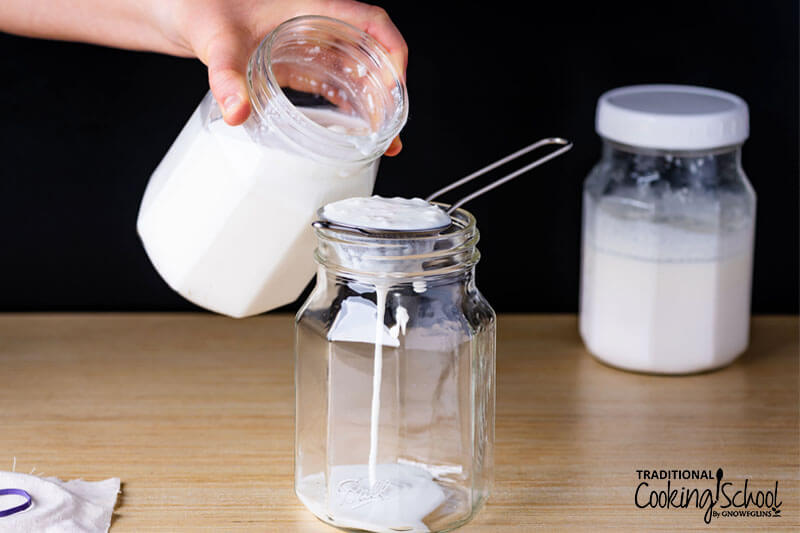
- Cover the finished kefir and refrigerate. Or let sit out at room temperature for 12 to 24 hours to develop carbonation, and then refrigerate. Enjoy!
Troubleshooting & FAQs
Let’s run through the most common dairy kefir issues and questions!
Can I Switch Milk?
Yes! If switching grains from one type of milk to another (such as from cow milk to goat milk), it may be helpful to make kefir the first few times with only 1 cup of milk.
This allows less waste of milk if it takes a few batches for the grains to acclimate to the milk. Follow the same instructions as for rehydrating when acclimating grains to new milk.
Also, if you get hydrated dairy kefir grain(s) and wish to use for non-dairy kefir, give the grain(s) a rinse before using in non-dairy milk.
Why Isn’t My Kefir Culturing?
It hasn’t fermented at all or hasn’t fermented long enough. No fermenting = no kefir. Give it more time and/or move it to a warmer spot to encourage those bacteria and yeasts to get to work.
It isn’t warm enough. Milk kefir ferments best at a temperature between 70 and 80 degrees Fahrenheit. Give the beneficial microorganisms a boost by relocating them to above your fridge or oven, to an upstairs room, or to a high shelf.
This is also when you might find a seedling warming mat handy!
The grains have been contaminated by another culture. If you’ve exhausted all other reasons for why your grains have stopped working, you may be dealing with cross-contamination.
Signs of cross-contamination include your grains changing texture or color for seemingly no reason, or if they stop culturing milk into kefir and no other conditions (milk, temperature, location, etc.) have changed.
If this is the case, rinse the grains well in pure, uncontaminated water before putting them into a new batch of milk to culture. This is only as a last resort — keep rinsing to a minimum.
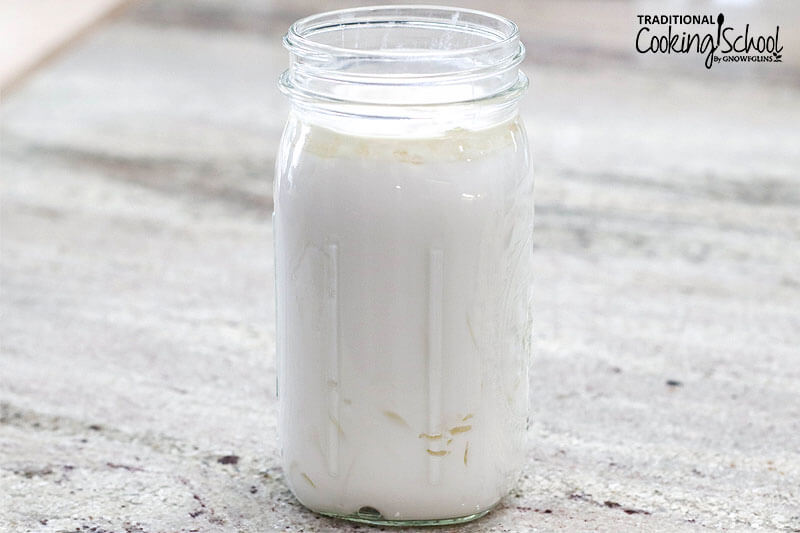
My Kefir Is Too Thin?
My family prefers thicker kefir, almost as thick as Greek-style yogurt. Here are three ways to achieve thicker kefir…
Let it ferment longer. Like all cultured dairy, kefir gets thicker and thicker the longer it ferments. The beneficial organisms produce acids as they digest the milk sugar, and these acids thicken (aka “curdle”) the milk.
So, let it go longer! It will eventually turn into curds and whey — don’t let it go that far.
In the summer, my kefir is done (for our preference) after about 24 hours or less. In the winter, 48 hours produces the kefir we like.
Gently rocking the jar and a taste test tells me that it is done. I am looking for thick milk (thicker than buttermilk and almost as thick as yogurt) and a fresh, slightly sour flavor with some effervescence.
Although this method does yield thicker milk kefir, some people don’t care for the extra sourness. That’s why method #2 is a great option, too!
Drip it through cheesecloth. Drip your 24-hours-old (or so), mild, thinner kefir through 2 layers of 90-count cheesecloth. You can also use pillowcase-weight cotton cloth.
After a couple of hours, you’ll have thicker milk kefir! If you let it drip for a day, you’ll have kefir cheese. Choose a time frame that results in the consistency you want.
Gently stir every 6 hours while it is culturing (at least during the day time). This helps achieve a more uniform, thick consistency.
Why Did It Separate?
Here are a few reasons this could happen.
It fermented too long. Allowing your kefir to ferment for longer than necessary (24 to 48 hours) means that the whey can spill out of the curds. There’s nothing wrong with this, except it can have a more sour flavor and texture-wise isn’t as pleasant to drink.
Shake the separated kefir well before using, to help it mix together, and make sure to stop the ferment earlier with your next batch.
The temperature is too warm. Culturing happens much more quickly at warm temperatures.
The signs of over-culturing due to temperature are the same as above: kefir that has separated into curds and whey, with a strong, sour taste. Move it to a cooler place if possible.
Also, stop the fermentation process sooner.
You don’t have to toss the over-fermented kefir, however! Here are my best ideas for using it up so it doesn’t go to waste!
My Kefir Tastes Too Sour?
This is an easy fix!
It fermented too long. Again, allowing your kefir to culture too long means the flavor is stronger, “cheesier”, and it may separate into curds and whey, as well.
Stop the culturing earlier with your next batch.
You aren’t using fresh milk. Kefir, as well as yogurt, cheese, and anything cultured, tastes better if the milk is very fresh, so I prioritize doing most of my culturing within a few days of milk pickup (even if we’re not going to eat it right away).
Why Aren’t My Grains Growing?
They’re running out of food. Dairy kefir grains aren’t as sensitive as water kefir grains, but they do need food in the form of lactose to grow.
Keep to a normal routine, as detailed in this post, to make sure your grains are healthy and fed!
They’re still acclimating to a change of conditions (milk, temperature, location). In my experience kefir grains do multiply quickly, but they go in spurts, too.
It is likely they’re still acclimating to your milk or just taking a breather. If they’re working fine, don’t worry about it.
My Kefir Grains Aren’t Floating?
I normally teach that kefir grains will float to the top… but this isn’t the case for everyone! Here’s why (hint: there’s probably nothing wrong).
The grains are heavier. Kefir grains that aren’t fully re-hydrated from being dehydrated aren’t as buoyant as older grains that are fully plumped up.
It can take weeks or months for dried grains to fully re-hydrate. (Which is okay, because you can still be making kefir all that time.)
How Do I Find My Missing Grains?
Kefir grains that aren’t floating readily at the top can be hard to find. Yet remember, kefir curds collapse when touched whereas grains feel rubbery and spring back when released.
You can fish the grains out of your finished kefir with a spoon, or pour the kefir through a strainer until you find the grains. I look for little bubbles at the top or bottom of my jar, where the grains are pressed up against the glass.
Has My Kefir Gone Bad?
Milk kefir, like yogurt and other cultured dairy, lasts longer than you might think!
In the fridge, the kefir activity slows down, yet the culture keeps working (albeit slowly) so the kefir will get more and more sour and “cheesy”.
As long as it doesn’t smell rotten then it can be eaten. Although most people won’t care for it when it smells or tastes this strong, I do have ideas for how you can use it up without it being too noticeable!
If the kefir ever develops mold on top, it’s possible that could be skimmed away and the rest is fine. (A smell and/or little taste will tell you for sure.)
In a nutshell, kefir lasts one to two days at room temperature, two to three weeks (or longer) in the fridge, or one to two months (or longer) in the freezer. See this article for more information.
Why Is It Slimy Or Stringy?
Kefir has gel-forming properties, and in certain conditions, slimy or string dairy kefir can occur.
The temperature is especially warm. Try to find a cooler location for the kefir to culture, and give it a few batches to adjust.
There are a lot of grains for the amount of milk you’re using. Decrease the amount of grains you’re using. Remember, you need only 1 to 2 tablespoons per quart of milk.
Or, if your grains are really hiding, search through the kefir in small batches as explained in this post on how to find kefir grains.
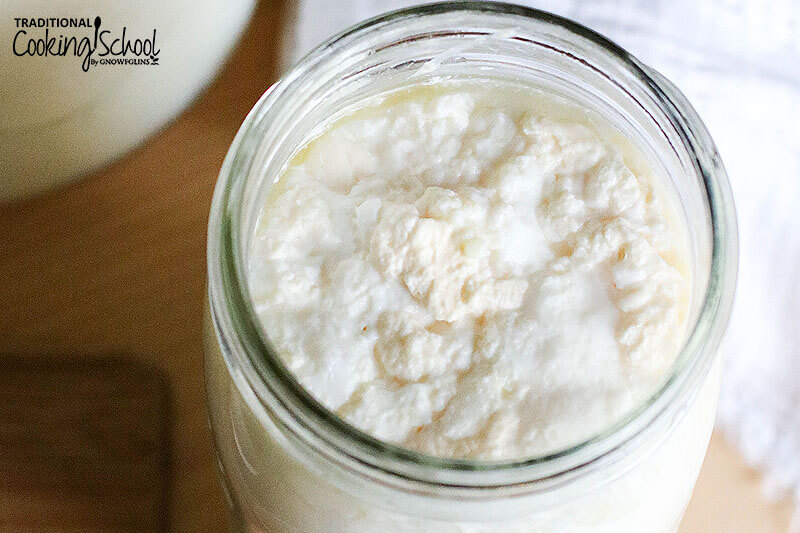
Why Is There A Thin White Or Light Brown Layer On Top?
This is a development of certain yeasts with access to oxygen; it is not mold, and not pathogenic. It is caused by a few things…
Over-fermentation of a batch or many batches over time. Re-balance microbial activity of the kefir grains by decreasing the culturing time.
Too many grains for the amount of milk. Reduce the amount of grains you’re using — down to only 1 to 2 tablespoons per quart of milk.
The temperature is warm. Find a cooler location for the culture.
Uses For Dairy Kefir

Well, you can always drink kefir… 😉 Besides that, here are some ideas!
- Use it as the acidic medium for soaking grains, like you would with Kombucha or raw apple cider vinegar.
- Make Middle Eastern kefir cheese balls.
- Boost your salad dressings with a hefty dose of probiotics.
- Make kefir parfaits for breakfast, lunch, or dessert!
- Use it as the liquid base for smoothies.
- Make probiotic ice cream or popsicles.
- Jazz up your favorite potato salad.
Milk Kefir
Fresh, tart, and effervescent, milk kefir is a living food teeming with beneficial bacteria and yeasts for gut health! Recipe easily scaled up or down.
Ingredients
- 1 to 2 tablespoons milk kefir grains
- 1 quart raw and/or whole milk ideally raw, but pasteurized is okay
Instructions
-
Put 1 quart of milk into a wide-mouth quart size jar.
-
Add (hydrated) dairy kefir grain(s) and stir briefly and gently with a wooden spoon.
-
Cover with a cloth napkin or paper towel and secure with a rubber band. Leave at room temperature away from other cultures.
-
Let culture until you are happy with how thick and sour it is (about 18 hours to 2 days). It will get more thick and more sour over time, as well as more effervescent. How quickly it cultures will depend on your preferred thickness, taste, and the temperature of the room.
-
In about 6 to 24 hour intervals, you can take a wooden spoon and gently “poke” down into the milk, at the sides of where the grains are. You can see where the grains are because they tend to float at the top, and they are bumpy whereas the milk is smooth.
-
Or you can stir gently. Frequent, but gentle stirring helps to achieve a smooth consistency, especially when trying to achieve a thick consistency.
-
When you’re happy with the kefir’s taste and thickness, retrieve the grain(s) with a wooden spoon. You should be able to tell where they are based on the bumps in the kefir.
-
Transfer the kefir grain(s) to a new batch of milk, or store in the refrigerator until needed (following instructions for storage above).
-
You can also choose to separate the kefir from the grains using the strainer method. Set a strainer over a jar or bowl and pour the kefir into it.
-
Let the kefir drip out over several minutes; also stir gently to help the liquid move out.
-
Cover the finished kefir and refrigerate. Or let sit out at room temperature for 12 to 24 hours to develop carbonation, and then refrigerate. Enjoy!
Recipe Notes
*I've made kefir with goat milk and cow milk, and both are delicious! If you're dairy-free, you can even make coconut kefir!
Dairy Kefir Grain Storage
Milk kefir grains may be stored, when not in use, in the refrigerator in a small amount of milk. This will keep for one or two weeks.
If stored much longer, I recommend draining the liquid and replacing it with fresh milk. People report 50% viability results with freezing dairy kefir grains, so I recommend freezing several grains to ensure a backup.
You may also dehydrate grains for future use (or backup). Here is a step-by-step tutorial.
Once dry, store in the refrigerator or freezer.

For more information about kefir and other cultured foods, check out our Cultured Dairy & Cheese eCourse, as well as our many free resources:
- 8 Yummy Ways To Eat Kefir
- Kefir Grains Or Kefir Powder: Which Is Better? #AskWardee 040
- How Do I Know If My Kefir Grains Aren’t Good Anymore?
- My Kefir Looks _______! Are My Kefir Grains Okay?
- How To Dehydrate Kefir Grains
- How to Make Coconut Kefir {3 Ways} #AskWardee 002
Do you know how to make milk kefir? How do you like to eat or drink it?
This post featured in 39 Nourishing Postpartum Freezer Meals To Prepare While You’re Pregnant.
This post was originally published and written by Wardee Harmon on 6/1/09. It was updated and republished on 9/18/20.
...without giving up the foods you love or spending all day in the kitchen!

2 free books:
Eat God's Way
Ditch the Standard American Diet, get healthier & happier, and save money on groceries...
We only recommend products and services we wholeheartedly endorse. This post may contain special links through which we earn a small commission if you make a purchase (though your price is the same).
















You can freeze any leftover kefir smoothie to make popsicles – freezing does not destroy the friendly bacteria. My little guy drank some of his caterpillar soup that he made with liquid from the bird bath and many live green caterpillars and has been unable to keep dairy down.
BUT I made him some healthy smoothie from kefir and froze it – he’s been keeping those down no problem! Which is great because it was the only thing he would put in his mouth (aside from the caterpillar soup, that is.)
He is doing better now but I was so happy to have kefir around to help nourish his body back to health.
Sustainable Eats – Oh, my! I read your comment five times before I got it! I was like… caterpillar soup? What an interesting recipe – what does it stand for? Then I realized it really was CATERPILLAR SOUP! Poor kid. I love your suggestion to make the popsicles with kefir-smoothies! I’m really glad that the kefir has helped your little guy so much. What a story! What an adventure!
Wardee,
The kefir sounds great! I have had it before and it is good, refreshing comes to mind. I don’t have any excuse as to why I have never made any myself. I guess I need to!
This is totally un-related but I have a question. I recently bought some evaporated cane juice crystals from Azure and was VERY disappointed when I recieved it. It looks like slightly tinted sugar. In the past I have always purchased rapadura. Which is very brown and granule looking. Do you know if there is a nutritional difference? I looked it up on-line but didn’t really get any GOOD answers. Just thought you might know.
Thanks in advance.
love,
Tiffany
Tiffany – I had the same experience recently. I admit to a general confusion regarding Rapadura/Sucanat and evaporated cane juice. Rapadura is supposed to be evaporated cane juice but what I gather is that not all “evaporated cane juice” is Rapadura. Here’s a chart with nutrtitional information of the different types.
http://mccaffrey.websitetoolbox.com/post?id=2200607
Yes, for real. Here is another caterpillar soup recipe: http://www.sustainableeats.com/?p=35. We’ve had our fair share of caterpillar run-ins lately.
Sustainable Eats – Oh, that was too funny (and a little gross)! What a great post! Your poor husband. It is good you can write and laugh about it!
Thank you so much for the chart!!! I knew that the stuff I recieved was not as good as rapadura, just by looking at it!!
Love,
tiffany
You may know kefir by the name lebni or labneh. It is one of my favorite ME side dishes! The way I prepare it for my family is with a spice mix called zaatar (mixture of thyme, oregano, roasted sesame seeds, sumac, salt) sprinkled all over the top of the kefir and then olive oil poured over that. We have a particular kind of flatbread that we dip in it. I like to make it with saffron rice, and a lovely stew called Murag that is made with meat, okra, green beans, tomato and a spice mix called baharat.
Now I am getting hungry! Thanks for sharing this helpful post. I think I might try my hand at making my own kefir soon! And eating lots of it! 🙂
Kimbrah – I love zaatar! The way you serve kefir sounds sooo amazing. But I did not know kefir was known as lebani, because the way my family has always made lebani is from yogurt (leban) which is put in a bag so the whey can drip out, at which point it becomes lebani. And the leban is a yogurt from a Greek-style yogurt culture, while the kefir is cultured via kefir grains. Are we talking about the same thing? Your spelling is a little different, but I would say the words the same way. Regardless, you’re making me hungry, too! Is your Murag recipe online somewhere – it sounds so much like a green bean stew (name is escaping me) that we make. But we don’t add a spice mix called baharat. Would you tell me more about that, please? And do you mix up your zaatar yourself? I would love to see a recipe for that, too (my zataar comes ready-made from my mom picking it up at a market). Oh, the fun in talking about ME dishes – I don’t get them enough – and wish I’d paid more attention when I was growing up.
Wardee-
I have a recipe blog that I have kind of abandoned (its kind of embarrassing actually. I had such great plans for that blog!) I plan on moving some of the recipes over to our new family blog eventually, but here’s the link for the Murag- http://felicitasrecipes.lifewithchrist.org/permalink/24574.html and the baharat recipe is linked within that post. I also have a great cookbook called The Complete Middle East Cookbook by Tess Mallos. It has recipes organized by region. Very thorough and it even includes desserts like baklava! 🙂
We lived in an area in San Diego that had a large Kurdish and a large Chaldean population. Luckily, a few of them took me under their wings and taught me how to cook. 🙂 We also have friends that moved to the Middle East a few years ago and they keep me supplied with REAL saffron when they visit. Unfortunately, I cannot find a middle eastern market here in the town we live in now (lots of Indian markets, but its just not the same) so when we go down to San Diego to visit I always stop by my favorite market there and stock up on zaatar, tea, and other things I can’t find here. I have even been known to hit up friends to send me stuff when I run out and can’t manage a visit. 🙂
I think you are right that kefir is different and that what I am thinking of is more of a Greek style yogurt. Hmmm. But it seems like it would still be good to eat like lebni. I had always heard that kefir and lebni were the same thing. I guess I stand corrected. 🙂
I just enjoy finding someone else besides my immediate family that enjoys Middle Eastern food! Too bad we don’t live closer or you could borrow my cookbook! 🙂
Kimbrah – It is so fun to talk about this with you – I’ll keep an eye out for that cookbook. I have one that was compiled by a group of Arabic women – it is called “Sahtein”. You are blessed to have such good friends to teach you and keep you in supply.
The other reason I know that kefir is different from lebani is that kefir is drinkable (thinner than yogurt) and lebani is yogurt cheese, very thick. (Leban would have a similar consistency though, just a bit thicker.) Then there is the difference in culturing. But the funny thing is, they taste so similar to me! 😉 So perhaps that is why people told you they were the same.
Thank you for the link to the recipe (by the way, love your recipe site!). It is similar to the recipe of which it reminds me, except for using tomato paste instead of (your) tomatoes and then the inclusion of baharat. I’ve got to ask my mom if she ever uses that.
Great talking to you about this! Thanks.
HI Wardee,
I looked up kefir grains on your site because I’m trying to figure out where to get my next batch. The farm I bought my last batch from is an hour away and I am having a hard time finding time to go.
I also realized reading your post that I was using a metal strainer so maybe this is something that contributed to them dying?
Also, do the curds go into the batch of kefir or do you strain them with the grains?
Can’t wait to get back to making it!
Sarah
.-= Sarah Schatz – menu planners for limited diets´s last blog post… A week at the beach, our gluten-free and dairy-free menu plan and some kid-friendly tips =-.
Sarah – I hope you find time to go to that farm! 🙂
It is possible that using a metal strainer contributed to their demise. What metal was it? I am not convinced that 100% stainless steel harms the grains. But other metals certainly should be avoided. All could be avoided to stay on the safe side.
What curds do you mean? The curds that come with the first batch of grains or subsequent batches? In any case, when I strain my grains each morning from a finished batch of kefir, I am not that careful to get all the curds off. Some go into the next batch. I *think* it gives the next batch a stronger starter – which we like because we end up with yogurt-thickness. I think it is flexible and you should play around with it to get your desired consistency.
Have fun!
Wardee, are the kefir grains made originally from pasturized cow’s milk? What would happen if you didn’t acclimate the kefir grains to your raw goats milk? You mentioned the strainer should not be metal, what is yours made of?
Thanks!
.-= Marg´s last blog post… More winter prep =-.
Marg, I think the biggest danger is that your grain could die. I don’t know how likely that is to happen, but to be safe, you start acclimating with a small batch. My first grain was grown on organic cow’s milk (probably pasteurized, but I’m not sure). It acclimated within one batch to goat’s milk. I am not convinced that stainless steel will harm the grains, but I take that risk myself – so most of the time I use a stainless steel fork to retrieve my grains. I was using a locally-handmade wooden fork, but it started growing something right away – got all these dark stains on it. So I’m not using that anymore, for the kefir. I don’t mind using it for cooking, but if it has some other bacteria on it, I don’t want to introduce it to the kefir. I also have a little plastic strainer – the kind that is meant to strain tuna out of the can (it is the same size). Sometimes I use a plastic or wooden spoon, retrieve the grains, and then place them in this strainer. That’s if I want to drain them more fully – but usually I just transfer them with everything that come with into the new jar of milk. Hope this helps you!
Wardee, I was interested to read that in the winter your kefir is more thick. I have had just the opposite experience. As soon as colder weather comes, my liquid kefir gets thin and grainy for a few weeks. It’s not a problem, but I do miss the consistency of the thicker kefir.
After reading what you have posted here, I wonder if mine would do better if I did not strain it as thoroughly. I have a plastic strainer that I use, and some of the little grains sneak through and end up in the jar of kefir I keep on the counter. I have quit refrigerating my kefir. Once every 24 hours I strain out the grains, put them back in the jar and cover with raw goat milk (maybe the warm milk would help too. I’ve been using cold from the fridge) and I put the strained out kefir into a 1/2 gallon jar that I keep covered with a coffee filter and rubber band. I just add more every day and when we want to drink some, I stir the contents of the jar and then pour out what we need. If the jar gets too full, I then can make kefir cheese or else just drink more kefir!
I have used liquid kefir to make whole wheat bread, like a sourdough, and it was very nice. I also use it instead of buttermilk in baking. I used to use it in pancakes, but now that I have a lovely sourdough going, I make sourdough pancakes. Oh, they are to die for!
I think it’s really fun that moms sneak the kefir into smoothies and no one notices. 🙂
I find that putting my strained or un-strained but fermented kefir in the fridge helps it set up and thicken or stay thick.
Hi Wardee! I’ve recently discovered your site and it’s just fascinating! Quick question about straining kefir. I’ve been making ours for 5 months now and have been loving the results, however I do use a metal strainer. I force it through with a wooden spoon, and within seconds I’m done. Do you really think that brief contact with metal adversely affects them? I really hope not…but I want to keep enjoying the benefits of kefir and don’t know if I’m actually slowly killing my grains! Any insight would be much appreciated!. ~God Bless
Eve — It is fine to have minimal contact with metal. We can’t be too rigid, and sometimes have to work around what we’ve got. You’re fine!
I wasn’t sure where to comment, I made my first batch of Kefir with 2% reduced fat Kosher certified milk from King Soopers. I fermented for 24 hours and refrigerated for 8 hours. I strained my Kefir and I couldn’t find any grains. Did I do anything wrong? I thought for sure I would have grains for my next batch. Should I ferment longer than 24 hours? By the way I added bananas & strawberries and a little stevia, it was really good. Any guidance would be much appreciated. How can I find Kefir grains that are used to make with water? I’ve seen the yogurt and kefir grains, but not for water. Thanks in advance.
Michelle
I know this was a while ago so probably no longer a help for you but perhaps for others. I’m not clear about whether you added your fruit before straining but that’s not what you should be doing. Make sure your strainer holes are small enough so smaller grains wont go through. There are different types/shapes of grains, some like mine are like individual grains of rice that clump together and don’t grow into larger pieces that need to be cut or torn. They will go through some strainers so maybe this was the problem? Also sometimes they get lost in the curds and you need to mix it up helping the thicker stuff through the strainer, the grains are hearty and fine with some rough handling. Once your batch is fermented, you can tell by taste for sure, to your liking is when you strain it (you can stick in the fridge to slow the ferment and strain later too) and after straining is when you add fruit and flavoring. Some people then do what’s called a 2nd ferment (2f) with the added items or just plain either on the counter or in the fridge, it’s all personal preference. Also if you feel like you can’t find your grains go ahead and feel around with clean fingers in the strainer or jar, the grains will feel rubbery and not crumble in your fingers the way curd does. I know someone who received grains that got over heated sitting in the mailbox. They seemed to disintegrate and dissapear but she kept making batches with whatever was left in the strainer after shaking stuff through gently rather than pushing or mixing through (seemed like sediment rather than grains, as though they had literally disintegrated) and after a few batches grains appeared. Her guess was that their was a little life in the remnants and then baby grains so small she couldn’t tell they were there until they grew large enough. Be aware though that grains wont grow from the starter powder places sell for making kefir, that will make a few batches but the strength dwindles out, it isn’t a live culture the way grains are that will live on.
Awesome post! 🙂 I have yet to work with kefir of any sort but am hoping I will be able to really soon! I have a question you might not be able to answer but I thought I would try!
I got a packet of kefir grains from our local farmer that we get everything from. But my husband picked it up and I have no idea if it is dairy or water kefir… Do they look different or would I not be able to tell which it is?
I also have no idea if it is the dehydrated variety and I am really hoping it is because it has been sitting out on the counter…. How would I be able to tell about that?
I can’t see what it looks like as it came in a sealed silver packet. I hope I can figure out what it is and use it because I haven’t been able to get anything else yet… If not i will just have to wait till we see our farmer next time.
Thanks!
Sally —
Water kefir grains are like little somewhat translucent pointy pebbles. When dehydrated they’re dry, when activated, they’re wet. They’ll be brownish when dehydrated and when activated they’ll either be clear (from using refined sugar) or brownish/reddish from using unrefined sugar.
Dairy kefir grains are clumps of spongy, somewhat clear, cauliflower like balls. When dehydrated they’re usually yellow (here’s a picture). When activated and wet, they’re whitish (here’s a picture).
Have fun! The other thing your packet might be is a powdered dairy kefir starter. Which will look like a powder. 🙂
My sister eats quinoa for breakfast with blueberries, kefir and apple juice. She says it tastes like cream of wheat.
I have a few questions about kefir. I was sent live grains (that had been frozen) through the mail. It arrived being about 2 tablespoons of flattened, grainy white liquid. I put it it raw cows milk as her instructions suggested to “wake it up” for 24 hours on the counter, strained, then another 24 hours. Each time I’ve strained it, it is more like cottage cheese in liquid (or curds) with no big pieces of grain. It tastes good in smoothies with fruit and greens and smells fresh, but I have yet to get the cauliflower look. I’m not sure if I am doing something wrong or maybe it just takes a while to get the grains to look like cauliflower. A few more questions:
1- Do you wash your jar out each time you start a new batch or just add back the grains with new milk?
2- What do you do with the excess curds? The last 2 weeks I’ve been doing this, the curds seem to be growing and growing. Should I seperate them or allow the growth to continue?
Salina —
1. My milk is always in a fresh, clean jar, and I add the grain to that.
2. When they get to be too much for the jar (about 1 T per quart), I split off and share or start new jars.
What you described as your kefir doesn’t sound like grains to me. Or at least, they’re very young. If you think they are growing and growing into bigger grains, then keep on. Otherwise, you may just be adding curdled milk to fresh milk each time. If your grains are like cottage cheese and mush up like cottage cheese, instead of sort of rubbery and springy, then I doubt whether they’re grains at all.
However, I would have to see to be sure. So take this with a “grain” of salt. 🙂
Selina, I had the same experience with my grains from posted to Canada from Cultured health. They were like squashy grainy whiteish blobs. Some of them turned into what looked like semi translucent sacks of squish. I originally got them to just try them out, I already had kefir grains growing and after regnerating them as per the instructions I added them to my healthy cauliflower like grains and used them as normal. After almost 2 months I could still see the squishy sacks in amongst the healthy grains. It seems like they never regenerated properly or something. It was weird. I picked them out and threw them away as they didn’t compare at all to my healthy ones. This probably isn’t very helpful but thought I’d share anyway 🙂
This sounds just like what I just described in my previous post.
I used 2% Kosher certified milk from King Soopers. I used Yo’gourmet freeze dried Kefir starter from Whole Foods. My starter packet was white powder looking, you use 1 5g packet per quart of milk, bring to 180 degrees and cool til 73-77F, sit for 24 hours and refrigerate for 8. I strained mine after 24 hours and I had no grains with substance, it all strained through as watered down yogurt. Should I use a different milk?Any guidance appreciated.
Hi Michelle,
If you are using the freeze dried (powdered) kefir it is going to be quite different from using kefir grains. The powdered kefir doesn’t produce grains. It does make kefir and I understand that you can save back some of the made kefir to reuse as a starter for a future batch (or maybe two) but it isn’t designed to for continual use and to multiply. To get that you need to have the actual grains. You can order those from Cultures for Health or possibly get grains from a friend. Hope that helps. 🙂
Millie
GNOWFGLINS Support Team
I came across your blog about kefir. Where I live, the only milk I can get is from the grocery store in the jugs. I just know that it has been processed to death 🙁 I don’t live anywhere close to a whole foods market or anywhere I can get good milk. I want to order a milk kefir starter to make my own kefir milk. Will it work with store bought milk from a regular grocery store? Please help!
Cynthia,
Yes, you can use milk from the store. Avoid ultra-pasteurized milk. Just use regular ol pasteurized milk.
In fact, when regenerating weak kefir grains its best to use pasturized whole milk for the first few batches (which you’ll throw out anyway) because the healthy bacteria in raw milk can compete with those in the kefir grains making it more difficult to cultivate a strong group of grains.
You can continue using milk from a regular grocery store if you don’t have access to raw milk.
I have been using milk kefir grains for awhile now and they are very healthy and thriving. My question is = My Kefir grains are bigger than a quarter now, can I break them in pieces? Will it hurt them? What do you do with them when they start getting so big?
Hi Shylee,
You can break them up. It won’t hurt them. 🙂
Millie
Traditional Cooking School
I am so glad you posted pictures of kefir grains vs. kefir curds. I think I was sold curds. 🙁
I used to make kefir several years ago, so I know what kefir grains looked like. When I received this from a different seller, I thought they were small. I figured they will grow over time. It’s been over 2 months and they never grew. In fact, they’re shrinking and I seem to have lost a lot as tiny curds in what I what I end up drinking. They still fermented into kefir, but I think I’ve been drinking second fermentation all of this time.
I thought about buying raw milk to save them, but I don’t want to waste my money.
Can you frenemt/ culture smaller amounts?, or skip days if not using 1 quart / day? What would I do with the grains on days not making a quart?
Hi Farhaana,
Yes, you can ferment smaller amounts by cutting the recipe in half or you can simply put your grains in the refrigerator (with fresh milk) and take it out when you are ready to make more. I would recommend refreshing the milk of your stored kefir at least one time per week.
~Peggy, TCS Customer Success Team
Do I need to do anything different/new if switching from using pasteurized milk to using raw milk for my kefir? Thanks!
Hi, Maureen.
Yes, you must introduce is properly for the grains to be successful.
Here’s how: https://www.culturesforhealth.com/learn/milk-kefir/introducing-milk-kefir-grains-raw-milk/?a_aid=56e447f050113
~Danielle, TCS Customer Success Team
Thank you so much for this, Danielle! Have a wonderful day!
Dear Wardee,
Thank you so much for the rich and life changing content. I love watching and reading your work. Regarding Kefir, I originally learned to strain the grains out and then do a second fermentation. This makes the kefir very sour and effervescent. Later I heard to take the whey out (which forms in this method), rather than to drink it with the kefir. I did see your video on using the extra whey, but I’m curious about if you feel it is “healthier” to take whey out, or if it is as good to just shake it up and drink the whey too? Also, what do you think about the second ferment? Thank you!
Hi, Jessica,
Thank you for your kind words, I have passed them onto Wardee. 🙂
Whey does have beneficial living organisms and if you consume it is very healthy. If you strain it out of your kefir they whey and enjoy it more without the whey you are still receiving health benefits from the living organisms. My thoughts on this are, if you will consume kefir more and enjoy it more without the whey it is best to strain it out. If you like the flavor with the whey in it, leave it in. Consuming probiotic foods should be enjoyable. 🙂
~Peggy, TCS Customer Success Team
I have always cultured our kefir for three days and yes, it separates, but I strain it for several hours (keeping the whey for other uses) and get nice, creamy, thick kefir as a result. I actually prefer it that way. Strain it even further and you can make quark, there’s lots of recipes/uses for it! I’ve been sulturing our own kefir from these grains for over two years now. When I get too many my son eats them (!!) but I’ve also used them to nurse sick chickens when they’ve gone off their feed. Chickens love them and they are a very good high protein treat for them!
I would like to add B Longum to my kefir. If I add it to the milk before culturing will my kefir grains pick it up and start producing kefir with B Longum?
Thanks
Cecilia
Hi Cecilia, I’m sorry but we don’t know the effects of adding B Longum on your kefir and grains.
~ Vicki, TCS Customer Success Team
Hello Wardee,
I’m hoping you are able to help me as I’m having trouble finding an answer for my kefir’s issue.
I’ve made kefir for many years but am suddenly and for awhile now having an issue with the ferment not being complete. Usually when it’s ready it’s a nice consistent top to bottom thickness. Now it will get thick at the top couple inches with the grains and below that section it’s just thin milk consistency. I shake it to break it up several times and eventually the same day it will thicken the entire batch but it’s grainy looking. Not smooth like it’s always been in the past.
What the heck is going on? I hope you know… Thanks tons!
Hi, Lorrie: It’s difficult to know exactly what’s going on, but here are some thoughts:
• Have your grains multiplied to the point that your kefir is fermenting faster? Perhaps you need to discard or share some grains.
• Is your kefir fermenting within six feet of any other ferments (yogurt, sourdough, etc.)? Sometimes cultures can cross-contaminate and throw each other off.
I hope this helps! —Sonya, TCS customer success team
Hi!
Do you have any advice for what to do with kefir after fruit flies invaded it? (I just saw that there was the tiniest opening to my kefir jar, and now apparently there’s about 10 little flies inside the jar ?)…. Do you think it would be fine if I just rinse the grains off with fresh milk, throw the old milk out, and start again? (With a better covering of course)
Thanks!
Hi, Hannah,
Some have rinsed and it was fine. Personally I would toss it and start new. Yes and a better lid for sure…they love to swarm around my sourdough starter! You might like this post: https://traditionalcookingschool.com/food-preparation/recipes/techniques-tutorials/free-video-homemade-fruit-fly-trap/
~Peggy, TCS Customer Success Team
Hi.
It has been two years since my milk kefir grains have all died, but I keep feeding the last of the kefir with milk, and vigorous fermentation has been going on since… The kefir tastes excellent to me, but I wonder, is my kefir/youghurt(?) as high quality as it was when the grains were present?
Thanks.
Hi, Ilan,
If it is culturing there are beneficial organisms in it but without grains, it is hard to tell what it might be.
~Peggy, TCS Customer Success Team
I have heard that kefir is a little alcoholic. I worry about children drinking it. Is this true?
Hi, M.
While it is true that alcohol is a byproduct of fermentation be it water kefir, milk kefir or kombucha, the amount of alcohol in the final ferment of a kefir drink is negligible.
~Danielle, TCS Customer Success Team
Hi,
Fortunately i have access to raw milk from local farm and i usually pasteurize it at home before consuming. I wanted to ask you which would be best for making kefir – pasteurized or unpasteurized milk? I usually don’t consume unpasteurized raw milk because I’m a bit worried about possible presence of bad bacteria. I’m wondering if there are any risks using raw unpasteurized milk for kefir?
Hi, Niharika.
Raw milk is preferred but you can use pasteurized.
If you have a good source of milk from a trusted farmer there is very little risk of bad bacteria in raw milk.
~Danielle, TCS Customer Success Team Lead