
We have not used a microwave for years…
We read enough about it to confirm a belief that our food would be more healthful if we did not use a microwave. The purpose of what I write here is not to convince you to do without one, but rather to help you make the adjustment to reheating foods without a microwave should you desire to go that route yourself.
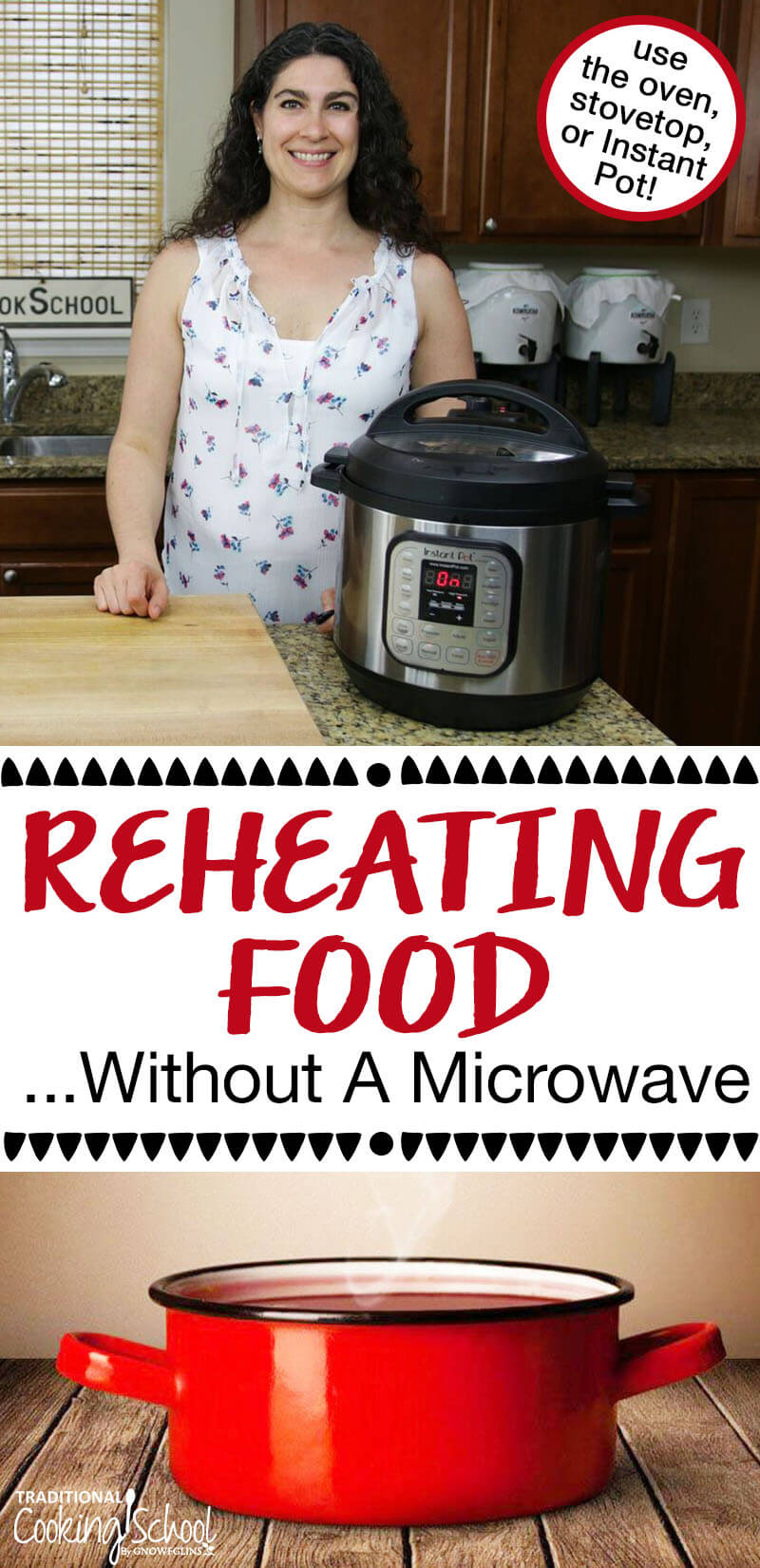
Want to reheat foods in your Instant Pot? Here’s how I do it. It’s like having a microwave again!
Even though I believed we would be better off without the microwave, it still took me some months to process my thoughts about how to make the switch. Okay, I’ll be honest. I needed that time to stop being stubborn — to let go of the “convenience” a microwave provided. Once I stopped being stubborn, the change was easy. Much easier than I thought it would be. I ended up only missing the kitchen timer feature on the microwave! The solution to that was easy — purchase a magnetic kitchen timer to hang on the refrigerator. As for convenience, I realized very quickly that it is just about as convenient to use the stove in reheating foods.
I do not miss the microwave one bit. I mean that. Practically speaking, I could say I have forgotten that microwaves exist at all. I use such easy, simple methods for reheating food without it. If I am at someone’s house, or if I read a recipe calling for the microwave’s use, or if I receive a question (as I did yesterday) about how to reheat something without a microwave, that will cause me to remember the microwave’s existence.
There are certain benefits to not using a microwave. This is not just about managing without it. For instance, removing a microwave frees up kitchen space, and most likely, in the form of precious counter space. Also, I can achieve more even heating of foods with frequent stirring, as opposed to “hot spots” from microwaving. Then there’s the belief that food is more healthful if not heated in the microwave. I could also say that I favor the simplicity of reheating my food with a plain heat source.
There are not many cons. In fact, I can only think of one and it is not hard to get around: I have more dishes to wash — those pots that do the reheating on the stovetop or in the oven. The number of pots can be lessened by planning. Often I will use one pot and reheat a meal whose components are combined as one skillet dish. Or I will take turns heating separate foods up with the same pot. Still, there will be at least one pot to wash every time I reheat a food or drink. This I overcome with a joyful attitude. God has given me — who used to dislike doing the dishes — an enjoyment from the feel of warm, soapy water on my hands. I use stainless steel or cast-iron cookware and both of these clean very easily most of the time.
Following I will share specifically how I reheat certain types of foods. You will see how easily this is done. In most cases, all that is required is additional water and medium heat.
Drinks
Drinks are very simple to reheat. Pour the drink in a pot which fits it. Bring to a simmer (or desired temperature) over medium to medium-high heat. You’ll find that the reheating time rivals that of the microwave for most drinks, such as tea. Alternately, one can fill a mason jar with the drink, set it in a pot of water, and let the water heat to a simmer, which will heat the contents of the jar. If heating a liquid that scalds easily, such as a milk, lower the heat to medium or medium-low and stir constantly until it is hot.
Foods In Sauce
The process is again simple for foods such as spaghetti sauce, or other main dishes with liquid. In a stainless steel or cast-iron pot that fits the quantity, bring the food to desired temperature over medium or medium-high heat. Add water if the the sauce thickened during refrigeration. How much water to add is something one must learn over time. Generally, add one-quarter cup of water at a time until the sauce reaches the consistency desired. Keep in mind that foods will become thinner when heated, for cold foods are naturally more thick than heated foods.
Foods Without Sauce
Put any foods that don’t have much or any sauce (meats, potatoes, steamed veggies) in a stainless steel or cast-iron pan. Add a little bit of water and/or oil (olive, coconut, red palm… ). Bring to desired temperature over medium to medium-high heat. One can also add broth or water along with additional seasonings and create a sauce with the leftovers. Alternately, put the foods in a smaller pan that nests inside a pan filled with boiling water. The water’s steam will heat the food. Add additional seasoning if desired.
Whole Grains
A well-seasoned cast-iron pan or pot is the way to go for reheating brown rice, millet, quinoa or other whole grains. The seasoning on the cast-iron is the perfect non-stick surface to prevent excessive sticking. However, if sticking does occur, it is easily scraped off as long as the food is not heavily burned or scorched.
Melt a generous amount of fat (butter, ghee, coconut oil, etc.) in the pan over medium heat. Add the grains. Stir/scrape frequently as the grains heat. I use the opportunity of reheating to season my grains with salt and pepper, herbs and/or the oil mentioned previously. Once the grain is all warmed and tasty, turn the heat to low and cover the pan. (You may sometimes want to add a bit of water or sauce.)
Pasta
All that pasta requires is a stainless steel pot and a bit of water and oil (olive, coconut, red palm… ). Heat it all over medium heat. As the water boils, it will evaporate, and its steam will reheat the pasta. Keep the pot covered, but toss frequently. Add water as needed. Too much water will make the pasta soggy. The idea is to add just enough for its evaporation to create sufficient steam for reheating. Season the pasta with salt, if desired.
Beans
Reheat beans in additional water and/or oil in a stainless steel or cast-iron pan. The beans will reheat much like the Foods in Sauces (above). Season if desired.
Porridges and Hot Cereals
Use either a stainless steel or cast-iron pot. Add the cereal and a generous amount of water to the pot. Stir to break up chunks. A bamboo stir-fry spoon works well to slice up the chunks, as does a potato masher. Turn the heat on to medium or medium-low. Stir frequently with a wooden spoon and cover in between stirs. Let the contents reheat, adding water as needed. If too much water is added, let the porridge simmer with the lid off so the excess water can evaporate. When the porridge reaches desired temperature, turn the heat to low and cover the pot.
Melting
Melt chocolate and oils which are solid at room temperature over low heat in stainless steel cookware. Stir constantly. Remove from heat when fully melted. Do not boil, unless a recipe calls for that. Alternately, one may put items to be melted in a small pot or container and nest it over a pot of boiling water. Stir and allow the heat of the steam to melt the food items.
Using the Oven or Toaster Oven
Reheat main dish leftovers in a covered casserole dish at 350 or 375 degrees for about half hour, until heated through to the center. Combine or layer different meal components in the same casserole dish to save space and clean-up.
For single servings, smaller quantities, or for fruit desserts, reheat for 5 minutes and check for temperature. Continue heating until the food reaches desired temperature.
Using The Instant Pot
I have a whole tutorial that shows you just how to use your Instant Pot to reheat foods. It’s like having a microwave again!
End Notes
Here is more information on reheating frozen food in the Instant Pot. If I can be more specific about any of these methods, please let me know. Also, if I missed any food type, I would love to help with that, too.
Have you gotten rid of your microwave? What’s your favorite method for reheating foods without a microwave?
...without giving up the foods you love or spending all day in the kitchen!

2 free books:
Eat God's Way
Ditch the Standard American Diet, get healthier & happier, and save money on groceries...
We only recommend products and services we wholeheartedly endorse. This post may contain special links through which we earn a small commission if you make a purchase (though your price is the same).

It is so great to read this post. Our microwave broke a couple years ago and in the process of doing research online to find a new one, I came to the same conclusion that it would probably be better for us to NOT use one after reading about health concerns, chemical makeup of food being altered, etc. I laughed when I read your remarks because the timer on the microwave was what I missed too! I don’t miss my microwave at all anymore and I fully agree that it isn’t difficult to use other reheating methods once you get the hang of it. I especially love the extra counter space that my microwave used to take up in my small kitchen.
Kelly, it is great to hear that our experiences are so similar!
When I am reheating a meal from the previous night, instead of using one pot several times, I use my electric skillet and just plop everything in each corner. Works like a charm! 🙂
that’s a great idea 🙂 i normally just pop it in a pan and throw it in the oven ….im gonna have to try that one
The extra dish is the only con I’ve found in my relatively short time of not reheating in my microwave. I’m glad to hear you now enjoy doing dishes, since it is one of my harder tasks.
By the way, I’ve been reading for a few weeks … and am finally saying hello!
I made your refried beans recipe this week and my whole family loves it. Next, I hope to make the pita bread and hummus.
Christie, hello to you! I’m glad you let me know you’re here and that you’re enjoying the recipes. You’re brave to try the pocket bread. The most important thing is…. very hot oven! 😀
I’m so glad you’ve been writing about this, Wardee, as I have been aspiring to give the microwave the boot for the same reasons you cite. It seems like a “big move” but you are making me feel encouraged to do it!
Another subject I’d love to see you address– I’m betting you not a Teflon user! We are terribly hooked on those darn non-stick pans, and yet I’m very concerned about the health ramifications, so my plan is to phase them out asap. It seems like non-stick and aluminum bakeware is everywhere in the stores too, it’s hard to find anything but.
I’m know our mothers and grandmothers did just fine in the pre-Teflon era, but I feel like I need a fresh infusion of the old-school lore on how to manage “non-non-stick” pans, wash them, season them, etc. Sadly, I’ve become overly reliant on the non-stick “technology” during my adult life! Any expert advice on making the switch?
Michelle, you’re a great encourager and I feel equally inspired by you! No, I’m not a teflon user. 😀 I will write something up about what I use in another post, soon.
Hi Michelle,
I absolutely love the old fashion Corningware Cornflower Pattern Skillets and Sauce pans. You can use them on the stove, in the oven and they are very VERY durable. My grandmother has been using hers for probably 50 years. Sometimes they can be hard to find, but I looked on Amazon and they have a few there.
I also like cast iron as well. It is heavy, but if you season it well it is another really good investment that will last practically forever.
Mathew
I agree Mathew. I love corning ware because it can be used in the oven, on the stove top and for storing food in the fridge. I still had a few from ages ago and added to my stash from estate sales. I really started collecting them because I wanted to stop storing left overs in plastic containers but soon discovered that the corning ware also reduced the number of pans to be washed!
I am 50 yo and gave up nonstick decades ago. The main tip to remember: make sure your pan is hot before throwing something in it. A little bit of safe high-heat oil goes a long way, use it sparingly to keep your foods lower in fat. Many times I cook with chicken broth instead of oil. It is an easy switch. Good luck!
We still have a microwave. My husband isn’t quite ready to get rid of it. :-)I don’t use it much at all anymore. If we’re having a bunch of leftovers, I place all of them(in oven-safe leftover bowls) on a cookie sheet and heat at 350 for about 20 minutes or so. This works great!
Thanks for this post!
So great that you could add what works for you, Mary Ann! Thanks.
Thank you so much for the tips. While working in food service, when they wanted to reheat pasta, they just tossed the cold, cooked pasta in hot water for about a minute. There’s another quick idea for you:)
That’s exactly what I was gonna say.reheat pasta by straining it in hot tap water.
I am almost microwaveless at home (I am working on going 100%!) and the tips are great. But my real challenge is how to heat up hot foods at work. Soups can be heated in the A.M and transported in a thermos, but what of veggie lasagna?
I’m a carpenter, I bring a small electric skillet to work and a big cooler with food. We prepare lunch from scratch in 10-15 minutes and 5 mins heating leftovers. We eat better than most people. Not hard to do.
Eat out of the pan! (just kidding , at least when anyone else is around! he, he, he) Seriuosly though pasta can be heated in a strainer or colander under hot tap water, or maybe to save water in bowl of hot water. Coolers keep food cold but without ice they can keep food warm when a thermos won’t suffice. Popcorn is so much more fun to make on the stove top using coconut oil and then seasoning with real butter or your choice of seasoning mixes. It literately takes maybe 3 more minutes and the results are phenominal and phenominally healthy. NonGMO popcorn can be found in supermarkets. I never liked the uneven heating of microwaving, haven’t used one in years and don’t miss it at all.
Back before I worked from home, I used to use a mini crock pot on my desk at work. Plug it in at the appropriate time and have a nice hot lunch ready and waiting. It was nice to have the little bit of extra lunch hour not spent on prep (translation: waiting in line for the gross old microwave :). Also, I noticed the other day on-line a nifty looking little outfit that looked like a little soft sided cooler with a heat platform in the bottom. It advertised heating up of leftovers and frozen entrées for a convenient lunch.
Mini crock pot or even a mini rice cooker can do the trick to reheat if allowed at a workplace.
At home I use a 3 piece steamer pot if heating up meat and/or veggies, things like plain pasta/noodles without sauce. I just put everything into the steamer basket (provided the food isn’t too small to fall through the holes in the steamer insert) and put the lid on. Items small, like rice or quinoa, would fall through into the water. And anything with a runny sauce like tomato based will most likely melt into the water.
To heat up quinoa once I placed a small plate on the rim of the steamer pot (happen to have the perfect sized ceramic plate) and then put the lid on top of the plate. The steamed water heated the plate. I could see steam condensing on the steamer lid, and that steamed the quinoa from the top.
In the toaster oven I use glass bakeware and add a very small amount of water so the leftovers don’t dry out.
Also in the toaster oven you can steam leftovers in parchment paper. You line glass bakeware with parchment paper, fill the parchment paper with any leftover then seal up the edges of the parchment. I also cook my steam fresh fish and chicken this way. Add lemon, spices and vegetables and seal it up. It’s called cooking en papilotte.
Hi, Barbara! Lasagna would be challenging and I can’t say I’ve ever packed that in a lunch, but here’s how I would try. You can take it or leave it! 😉
I would reheat it above a water bath or in the oven or in a toaster oven. Then I would gently spoon/scoop the lasagna into a tempered insulated food mug. It might end up like goulash, but I would try to preserve the layers as much as possible.
At lunch time, gently slide the contents out into a bowl, or eat from the container.
What do you think? 😀
I think its a great idea, and rather than lasagna, I would probably use penne or something for easy’s sake.
After a trip to my local BB&Beyond, I have another idea. What do you think of this:
Pack a lasagna (or whatever) in Corningware, Pyrex or or some other heat proof container, and bring along another, slightly larger, container (these kinds of dishes often come in nesting sets, so finding a slightly larger one should be easy.) To heat,fill the larger one 1/2 full of water and use a portable immersion heater to heat the water. Voila! Instant water bath at work. The larger container only can be dried and kept in a cabinet at work.
I will try this (when I get up the energy to cook!) and let you know how it works.
Barbara, it sounds like a great idea. However, what is a portable immersion heater? The only thing that concerns me is the glass being too close to a heat source, like a stovetop. So I’d watch for that. But then, I’m not sure what type of heater that is. P.S. Using penne or something easy will definitely help.
Thank you for publishing your re-heating ideas! With your permission, I’d like to link to this page from a frugality forum which may find appreciative readers on this topic.
Yes, that would be fine with me! I hope you all find it helpful. 😀
I’m glad more people are realising the redundancy of microwaves, but I have to ask.. do you really wash your cast iron in soap? I sincerely hope not. Your food will take on the flavour of soap when it’s cooked in cast iron if you wash your cast iron with soap.
No, I don’t! I wonder, did I say that in this article? I hope I didn’t! (Just looked.) I certainly implied it. I was speaking of warm soapy water in general. With cast iron, in particular, I scrape, rinse and dry. And reseason as needed.
-Wardee
What a great post! I’d like to personally invite you to enter this link in the Mind the Microwave in May Mr. Linky at http://www.kitchenstewardship.com/mind-mic-invite. I’m posting all month about microwave use and un-use, research, practical tips, etc. If you don’t mind, I’ll probably link to this post this week when I offer my own tips for avoiding the microwave.
Katie
HI, Katie! I do not mind at all if you link to this later in the week with your challenge. I think your challenge is great and hope that many people will be encouraged to Mind the Mic! 😀
Hey !!!
Thank you so much! I came to to this hostel in Delhi where i do not have a microwave and really needed to know how to reheat foods!
Love
Saamer
Saamer – I’m glad you found it helpful. Thanks for sharing.
One way to reduce the extra dishes to wash is to use those old Corningware dishes that are safe for the range. You heat your food in it, and then eat it right out of the same dish! I don’t know if they are still making them, but I bet you can find them at yard sales and thrift stores. They usually have little flower designs on the side and glass lids, and come in round pots with handles, or square casserole-type dishes. I love using them to reheat food, especially since I am a little OCD about my food getting cold–it stays nice and hot this way!
About heating food up at work.
Try using a electric coffee cup warmer?
I took a cooking class once and I thought it was a great way to reheat without microwave. put a stainless steel bowl on the heating plate and cover it.
Put it on when you get to work and by lunch time it will be smoking hot.
Wow and I thought we were going overboard by trying to eliminate the microwave! I quickly found out that I could heat the whole meal on the stove faster than I could each individual plate in the microwave! And those old white corning enamelware (w/ cornflowers), are SO perfect for cooking , then to the fridge, then back to the stove, then back to the fridge, no extra washing! I got most from thrift stores and ebay has them all the time for cheap!! A while back, watching tv at my mom’s, we saw the Mythbusters put lightbulbs in a microwave, turn it on, and they actually lit up! Oh also I found out that anything w/ curry powder in it tastes totally different in microwave as opposed to heated on the stove. From microwave it was pretty gross. Tasted ….dead. I hope more people will throw out that old fad-the microwave.
Sarah – I’m really happy you shared how switching from the microwave made life easier for you! That will be surprising to many people, but we both know it is true. 😉 Thanks!
Going without a microwave is great. Not many foods I make can be heated in a microwave without ruining them. The way I get around the extra pots and pans is to wash them, then and there, as soon as I put whatever I’ve heated into a serving dish. Whatever is in the pan will come off without much work and should cost you 10 secs at most. The pan will heat the water as it’s added – you only need a little – add some soap, swish…no extra dishes here! If you can use a grill or wrap something in foil and use the fireplace – what extra dishes?!?
got any tips for how to reheat bread products like shortcake without a microwave without crisping them into a crunchy mess?
Jessica – How about on a tray, in an oven or toaster oven, but put a stainless steel bowl flipped upside down over the shortcake, to prevent it getting crunchy?
A shallow bowl of hot water in the bottom of the oven may help. I’m thinking the steam would keep everything moist. Maybe a damp dish cloth over the products might work also.
I stumbled upon your post while googling….”Living without a microwave”. My 13 year old microwave stopped Microwaving on Monday night, as I was heating up left over mashed potatoes for dinner. I shrugged, got out a pan, a little more milk and warmed them up.
My son and husband wanted to know how I was going to “cook” without the microwave. For the record. I never cooked in the micro, I just reheat and make popcorn. Since I have given up processed foods I no longer make micro popcorn either so…just a reheating tool.
Funny thing is, I have been contemplating living life without serveral conviences, the past year, slowing down, living greener and simpler. I entertained the thought of replacing the microwave for half a day. Realizing that I don’t have to have it, don’t have to spend the 100 + to get a new under the counter model to replace it, or $40.00 for a counter one (I have little counter space, why give it up for that!), I am not to replace the microwave. I have a stove, oven, convection oven, toaster oven, steamer, pizza oven and roaster that will all suffice, I am sure I will not miss the microwave at all.
We can add this to the no cable, no home telephone and no cell phone that I have cut from my life. My husband thinks I am a little militant about this, I see it as reclaiming my life.
Thank you for your wonderful post. I will be linking it to my post about living without the microwave.
.-= Audra ´s last blog post… Murphy Strikes Again =-.
I like to use my microwave to hide stuff from the cats (ie fish fillets that are ready to go on the grill but the grill isn’t ready…, etc). The cats normally stay off the counters but sometimes the lure of salmon is too much for them. I also use the microwave as a good place to let bread rise. I am trying to limit the use of the microwave for reheating foods. I would like to get rid of it but the husband likes it. When it dies, it won’t get replaced.
Thanks for the article. A few weeks ago I came to the same decision, and have not used the microwave since – quit cold-turkey. However, my husband is still using it, and I will leave that as his choice.
Fortunately, I am old enough to have raised 3 kids in the pre-microwave age, so reheating foods without a microwave just took me back in time. It really is easy and your suggestions are right-on.
One thing I have done differently is to purchase as toaster-oven. Originally I bought it to dry sprouted seeds and soaked nuts – even made salmon jerky in it, as it maintains a low temperature. My oven’s min temp is 170 degrees.
So this will also help in reheating some casserole type dishes if I don’t want to heat the oven.
Thanks for all your help and advice. Much appreciated.
Thanks for your post, I’m like many others… thought about getting rid of it but now it has finally died and I don’t want to replace, but the husband sure does lol!! My one thing I’m wondering about.. I love the rice socks heated in the microwave to put on my neck or across my face when I have sinus trouble. Any suggestions for reheating those?
Sharon – I reheat my rice and flax seed packs in a glass covered dish in the oven, at 350 degrees until hot. This is not as fast a process and probably less energy efficient. I have a friend who does massage who talked about keeping packs warm in a crockpot – but I have not followed up with her to see how that works. I do wonder if they would get too hot.
I needed to read this tonight!!! We have been without a microwave for over a year now. I had been thinking about how easy it was to just heat the leftovers up and how much of a pain it was to have to wash ANOTHER pan. My husband is out in the field and I was feeling especially l-a-z-y. I am so grateful we made the decision to go without the microwave and no matter how inconvenienced I may feel, it is much better to do without it:)
Awesome tips on heating things up! I’ve never used the microwave much for actual cooking, but I confess I do still use it for reheating my tea, etc.
I will, however, say that we recently upgraded our appliances to stainless steel, including our microwave (at the time, I hadn’t yet decided to try and give it up altogether, and besides, we have an over-the-stove model, so we have to put something there, not to mention the vent), and after much research decided to go with a convection microwave. I didn’t really know anything about them before buying this one, but my hope was that I could maybe use it to replace the toaster oven which is taking up a huge chunk of counter space.
I must say that after a few trial runs using the convection, I LOVE it-in convection mode, it works just like a convection oven, and I now have no qualms about getting rid of the toaster oven, as it actually works better than the toaster oven-more even heating for things like pizza (although I might get a small toaster just for toast). Anyway, just wanted to throw that in there, because even if I never used the actual “microwave” again, I still have a small convection oven that isn’t taking up any counter space!
I just learned a great way of cleaning a cast iron pan that has stuck on bits of food as well as any rust (reclaiming a pan). Use a couple of TBSP of oil and some kosher style salt. Begin to scrub (I use my hands). It works great!! Rinse, place on the stove with medium heat to dry and you’re done!!
I wonder if an old fashioned hot water bottle would work for heating up your rice and seed packs? but then I guess that is a little redundant. Also a heating pad might work too.
.-= Sustainable Eats´s last blog post… Organic Vermont Maple Syrup Buy =-.
Ok, I must admit I’m being a bit lazy here. I read this entire post after reading the GNOWFGLINS faq’s PDF that I just got in my email today, but I didn’t read all of the comments.
My Question is:
So what’s up with the microwave being unhealthy and “Chemical Changing” happening to the food in a microwave? The first comment above by “Kelly” mentioned something about “…research about microwaves…” Can you tweet me a link that explains in detail about this?
If someone could tweet a link or something ( to @GanderCo), you won’t have to take up all that extra time to write an answer that you’ve probably already wrote (um, written..writed…wroted lol).
Thanks!
Gary Anderson II
aka- @GanderCo
P.S. I’m in the midst of writing “That Blog-Post” if you know what I mean 😉
P.S.S I’m LOVING this blog Wardee! Already planning even more changes in my own eating habbits as a result of your (this) blog. I hope God blesses you for doing this!
.-= Gary of GanderCo´s last blog post… First Post After Surgery | GanderCo News =-.
Probably everyone knows this, but I discovered it the hard way. If any water gets into the chocolate it will scorch.
Great Post! I really would love to finally kick the microwave habit….hopefully we’ll get there soon, one thing at a time though.
I love using the toaster oven though, we use it for a lot of things, it is the best way to reheat bread or pizza, or when trying to spread natural (cold) nut butters just plop the “nut” butter on the bread and turn the toaster oven on (not the toaster function though unless you want toasty bread) and literally in just a few moments it will soften it enough to spread it easily and you don’t have to eat it “cold”. 🙂
If you have some leftover steak you can thinly slice it and warm it in the toaster oven as well and put it on a sandwich or a salad. Also I love my pampered chef mini bar pan, it fits perfect and is a great alternative to those cheap aluminum pans they usually include in them.
It is a fact that the microwave ruins a lot of the food nutrients, so the alternate reheating methods is in everyone’s best health interest. So many people are not aware of this microwave disadvantage and continue to cook and reheat with it.
What about cooking vegetables? My mother-in-law uses the microwave and is not willing to give up her microwave for anything. We are presently living with her. And my kids really like her cooked to perfect vegetables.
Can you share any tips on how to eliminate drips when reheating liquids? Whether I use the mason jar in simmering water or a saucepan, I have a mess of liquid running onto the counter. Thanks for any advice.
We stopped using our microwave after I was diagnosed with DCIS (early-stage cancer) last year. I thought it would be horribly inconvenient, but it’s been great!
I want to second the CONVECTION OVEN idea! I store leftovers in Pyrex containers (the lids are Rubbermaid-type lids but they never touch the food and of course never get heated)… pop the Pyrex in the convection oven and it works like a dream. It takes a little longer than the microwave but is faster than a toaster oven.
Some foods are better reheated in cast iron, and I definitely use that for reheating certain meals, but the convection oven works great for other things.
Rochelle, I steam most of my vegetables… I have a little steamer that fits right over a saucepan so I can cook and steam at the same time. Steaming gives that same cooked-to-perfection flavor (not too raw and not too overcooked/mushy), without destroying as many nutrients and without cancer-causing plastic leeching into the food!
Rochelle – For cooking vegetables, I suggest steaming, or tossing them in a skillet dish (like stir-fry or saute). I think one is much more likely to get perfect vegetables on the stovetop than the microwave. Of course that’s my opinion – but truly, I don’t think not using the microwave for vegetables is a sacrifice.
Jude – Do you mean when pouring? Why don’t you try reheating in a Pyrex measuring bowl, and then ladle out the quantity into individual cups?
Wardee, we have only ever used our microwave a few times a week. Seriously – even long before we became aware of the dangers, we did not use it every day.
A few months ago I suggested that we attempt to use the microwave even less than we had before. Over time we stopped using it at all. We’ve not used it for cooking food now for several weeks. The only thing I can not figure out is how we are going to heat what we call our “Rice Paddies”. 😆 We made 6 inch by 6 inch squares and filled them with rice to use for warmth in late autumn/winter. During the coldest months we depended on these to help keep us warm because we keep our heat at 60 or 62.
How do you heat up yours? Hugs, Robin 🙂
.-= Robin B.´s last blog post… Goat Milk Soap =-.
That’s a good question, Robin! It is the one thing I’ve learned is difficult without a microwave. I warm it up in the oven, in a glass baking dish. It takes about 1/2 hour on 375, depending on the size of the pack. Not very energy efficient, is it? But I have wondered if the crockpot would work? What do you think?
Wardee, I think that a crockpot might work well, except we don’t have one. I wonder how fast they would heat up in the dryer? On really cold nights, we put our blankets in the dryer for 5 minutes right before bed. I guess they might be kind of noisy in the dryer. 😆 Maybe it would just be best [for us] to get used to not using the rice packs.
.-= Robin B.´s last blog post… Goat Milk Soap =-.
I would be worried that the tumbling in the dryer would cause the pack to burst eventually. If you still have your microwave, I don’t see much harm in using it just for the packs. It surely would save energy consumption overall.
Is it safe to heat soup in a closed-can that is in a low boiling pot of water?
Domingo — Yes, I think it is. If you’re talking about canned food. Those can be heated in boiling water. Just be careful, I’m sure there is always an exception. 😀
We have lived without a microwave before so now I’m making an effort to heat everything up without it and once I’ve stopped using it (and if DH agrees) I will get rid of it. I also have a small toaster oven, maybe I should get that down for some things. Can you use glass in a toaster oven if its oven safe?
My biggest concern (although definitely not bigger then health) is the cost of running the oven/stove so much for reheating-especially during the summer when its so hot here. Of course maybe I just need to get in the habit of serving more cold dishes during the summer. I know the oven is supposed to cost much more to run than a microwave, toaster oven, crock pot etc, so I’m wondering if there is a frugal solution to this-maybe using a hot plate (would this use less electricity?) in addition to the crock pot and toaster oven? Also, in talking about using it to heat liquids, if you had to heat them a lot-I worked in a daycare once where in stead of a bottle warmer we used a small crock pot kept on warm all day to reheat bottles, this worked well-I wonder if that would cost more to keep set on warm than turning the stove on to heat liquids and other things that you could heat in a smaller container? Maybe only if you were heating a lot or often? Any other thoughts on remaining frugal in your reheating while eliminating the microwave? (We did live without one for at least a year so I know its possible :)).
One thing I like to do, especially on Sundays, is use a crockpot/slow cooker! This is especially good for soups and casseroles, anything with a certain amount of moisture in it. I can put a leftover soup or stew in the crockpot before leaving for church, and that evening, dinner is all ready.
I have a few herbal heat pillows that need to be heated up and the only way I can think of doing that is in the microwave. Any recommendations? They usually take a good 6-8 minutes on high power.
I had wondered the same thing. I know my post is way outdated, but I have used my old crockpot (the old one because it doesn’t get SO hot) to reheat herbal pillows. Of course, no water is to be added. I have also used a heating pad/hot water bottle over the pillow for warmth. I wonder about the safety of those electric currents from the heating pad but it does wonders for aches needing moist heat and lasts much longer than water bottles. Anyway, hope this helped… somehow. 😉
I know this is WAY after the original post date, but I have to agree – I’ve been living without a microwave for 5 months, and I’ve realised how infrequently I actually use the thing. It essentially served the purpose of “bagel defroster” before. Now I just leave bagels in a ziploc overnight, then cut them up and toast them in the morning. Really not much of an inconvenience. And with a gas range, it takes no time to heat any of my food up.
Great post, and thanks for the tips!
Our microwave died about 6 months ago, it was getting extra hot when operating and a chemical kind of odor was coming from it, we got scared and tossed it out one day.
I do not miss it one bit, not even a little tiny..ok, there is only one thing I miss it for and that is heating my coffee up, but now I just drink it faster so it doesn’t get cold.
My hubby really misses it, he used it for all his meals, but most meals that are not good for us are types that have to be microwaved (middle of the grocery store type of meals) which is a huge factor in why I don’t want another one.
He really wants to replace it, but I am holding my own, I’m loving the extra counter space, and not having to clean inside it (god knows nobody else did this!)
Oh, and I re-heat lasagna by steaming it! Just as I do with asparagus, pot of boiling water with my stainless steamer on top and pop a lid on it, only takes a few mins and for the most part keeps it shape 🙂
I bought a cheapo ‘hot pot’ (generally used for heating up water for tea). Using a large mouth mason jar ring as the trivet and a 2 cup Pyrex measuring cup I can heat up food at work. Can also make tea, and store the ring and measuring cup inside the pot to keep everything contained. I used the measuring cup because I had it around. If I could find a handle-less Pyrex something of the same size, I’d use that instead to make it easier to get it in and out of the hot pot, but for now it works. (It is obvious that one puts water in the hot pot, right?)
The thing with microwaves as I understand it from my biochem-graduate daughter is that the microwaves ‘denature the proteins.’ Also, remember that there is some proof that popping microwave popcorn has been shown to cause lung ailments.
I also read a blog post recently that showed a science project a child had done for school…
She bought two identical plants from the store. Over the course of several weeks, she watered one plant with room-temperature water straight from the tap, and watered the other plant with room-temperature water that had been previously microwaved. It became obvious from the photos she took that over time, the microwave-water plant was not thriving, and actually ended up dying before the end of the project’s time frame, where as the tap-water plant was thriving.
It was a fascinating experiment, and very clever, if you ask me! =)
I don’t use the microwave anymore. We do have one, and my husband still uses it from time to time, but eventually I’d like to replace it with an actual hood for the stove.
Another option…a pretty far-fetched option for most people, I’m thinking…is a solar oven. Think ‘crock pot’, but without electricity. I have a friend who purchased one and uses it frequently so that she can become familiar with it in the event she would have no other option. That would be incredibly energy-efficient, especially in the summertime when the use of the oven becomes too hot to handle. I’m not sure how time-efficient it would be, though. =)
Greetings,
I came across your blog and smiled. I took discarded my microwave after procrastinating getting rid of it because of it’s convenience. I didnt use it very much at all anyway, but it was convenient, so I went to stove top reheating. I didn’t have help in this endeavor. I just intuitively thought of the double boiler method. But I don’t have a double broiler so I improvised. I put whatever food I’m reheating into heavy duty foil (which I wash and reuse a several times), and fold the sides over, then, in a pot I add an inch of water or sometimes my strainer so the foil doesn’t sit in the water. Then I put a lid on it, and in 5 minutes or so my food is steaming hot. No water added, no additional oil, just perfectly reheated food. I warm dinner for two in this manner, and may only have 2 or at the very most three pieces of heavy duty foil to wash off. the food doesn’t stick to the foil. II even used to have a microwave in my classroom to heat up my lunch, now I just use a little “hot pot” used normally for making tea water or heating up soup, I think, and i use the same foil method. It’s fast and easy. And I agree that the consistency of temperature is simply better than microwaving, not to mention the vitamins that are preserved in food that hasn’t been zapped. In addition, I used to eat lean Cuisine meals for lunch, and without the microwave Ive become more inclined to keep my meals fresh. It’s been almost a year since I gave up the microwave and I’m very happy that I did. Thanks for your blog 🙂
The microwave issue is a fun one, for sure! So many people never even think it’s an option not to have one. They wonder how the food will cook/reheat without such a “basic” staple of modern kitchens.
My in laws (including 3 elderly aunts and my MIL and FIL) visited last year for a little over 2 weeks. It was after about 10 days when the topic came up about microwaves and they all kind of looked up and said, “Uh, where’s your microwave? I didn’t see it in the kitchen.” I couldn’t help but smile knowing these folks had enjoyed three made-from-scratch meals for MANY days PLUS snacks innumerable which included reheated leftovers, hot desserts, and hot drinks all without the use of a “nuke-box.” I said there isn’t one and they then kept fervently mentioning they could never survive without one, yet they had without even noticing. Funny our perceptions…
Wonderful!!
I’ve forgotten about the microwave too – I’m going on 2 years without it!
Thank you for this article! I just moved to Germany a couple months ago, and the kitchens here are MUCH smaller in general than American kitchens. I just don’t have room for a microwave, basically because the amount of counter space that I currently have is about the size that would take a microwave to fill. I figure that they somehow managed to do things in the kitchen before the microwave was invented, so why can’t I? It really hasn’t been a challenge so far, but I haven’t had a lot of leftovers yet, which is what I was the most curious about what to do with. But now I have my answer. Thanks!
Thanks for posting about not using a microwave. ours is ‘built-in’ over the stove, so it’s there. It if take it down, there’ll be a big ugly hole. and the exhaust fan is in it too. I could put an oven hood there, couldn’t I? One of those cool, hi-tech stainless ones, with a real exhaust fan that exhausts to the outside, instead of into the ROOM!
anyway, I read an article about microwaving and what it does to WATER. It changes the properties of the water. This water than wreaks havoc with our cells. . . It’s complicated. But just realize, microwave energy CHANGES WATER!! So what is it doing to our bodies??
apparently, these dangers have been known for years. It is very important food for thought. . .
I kind of wish I could post a “picture comment…” Our spacesaver microwave doubles as a cabinet for my cast iron–I NEVER use it (yes, it works) as a microwave, but I have a dutch oven and seven (different sizes) fry pans in there! I also keep a 1-pint jar of coconut oil in there–when the light is on, it’s warm enough to keep it melted enough for me to pour for my cooking/baking needs. It truly is a spacesaver for me!
Hi Wardee,
Great post! What brands/types of dishes are safe to use in the toaster oven? I am having a hard time finding items to heat my food in!
Holly — I’m not sure. I would think if it is considered oven-safe, it would be fine in the toaster oven, too. You can always contact the maker to make sure. Also, don’t go from fridge/freezer straight to oven or you’ll get cracking.
Pyrex/Corningware dishes are good for heating in oven/toaster/microwave. Hit the thrift store and find an assortment of older ones. Newer ones I heard recently may have problems in some cases (search for info – I can’t remember the details).
thanks for the info! our microwave broke in our rental house this week so I have found myself wondering what to do with my leftovers and how we used to do things before the microwave. if I hadn’t found this, I would be calling my mom this weekend!
One way I sometimes reheat foods is to put my stainless steaming basket (the kind that folds us and fits into many sizes of vessels, with some water in a pot and just steam heat things. For a complete meal, you can also use a bamboo steamer over a wok that has water (it will have at least 2 levels, which makes it very versatile.)
I love this post. I don’t know if I can influence my hubby of the benefits of not having a microwave, since it is so convenient to pop food into it, especially pizza leftovers. What is your advice about pizza leftovers? Generally, it takes about 30 minutes to re-heat pizza leftovers and they often come out dry. Is there a quicker way to do that?
I reheat pizza in two ways. The first way is in a very hot oven, for a very short time (like using a toaster oven). I think its around 400 for less than 10 minutes. I’ve never timed it; I just keep an eye on it until the cheese is melted. Sometimes I reheat in a cast iron pan, cooked like a grilled cheese sandwich. My cast iron is seasoned well, so I don’t need to put in any butter or oil for reheating pizza. (Toast is also good on a cast iron pan.)
I agree with Christie. Pizza is quickly reheated at a hot temperature. We’re usually eating in less than 10 minutes.
If you have a pizza stone, you just heat the stone and turn off the oven. Place the pizza on the hot stone and in a very short time the crust is crunchy and the toppings are soft and warmed through. : )
Thanks for the pizza tips. I’ve been struggling with that one. Now I know I’ve been trying it on too low a temp with too much time.
should I preheat my stainless steel pot to reheat bolagnase sauce? Or should i put it in the pot then heat both the sauce and pot?
thepuppy — I’d suggest re-heating it with a water bath.
Hey, I had a question. I have this mix that I LOVE, but it uses a microwave to make. It’s a caramel that you make (and I know how one would go about making the caramel on the stove :), but than you pour the caramel onto Crispix. Than you have to re-heat the Crispix and caramel to get it fully coated and cooked the rest of the way. How would you go about doing that with the cereal??
Use a heavy pan on very low heat (a diffuser is good for this) you should be able to pour the Crispix into the pan you make the caramel in – maybe use a bigger pan – and add it slowly so you can stir it to get it coated. I grew up before microwaves and it hasn’t taken much to give them up again, except sometimes remembering to melt the butter when I’m making waffles or pancakes.
You can also reheat in a steamer – depending on the portion size/steamer size you also steam some more veggies. You can use the bowl you store the food in the fridge – just pop it in the steamer, good for stews, or wrap portions in foil and steam – stuffed pancakes etc. There are only 2 of us (both retired) so don’t need huge portions and don’t always want to use the oven just to reheat.
You didn’t cover rolls and biscuits.
As for pizza, I preheat the oven to 350 and then put the pizza slices in for anywhere from 5 to 8 minutes. If you want the outside crust to stay soft, then cover the outside of the crust with foil before reheating.
We’ve been without a microwave for 7 years now. We had a toaster oven that broke, which I miss greatly. The microwave is only usefull to me for defrosting frozen meat, but planning easily remedies taht problem.
We moved into our current home last summer and to our surprise the previous owners didn’t leave the microwave. I was so happy about that because I had already been trying not to use one. The space that was left (under the counter) is perfect for all my fermenting happiness and keeps some of the “science experiments”,as my husband calls them, off the main counter. We only “miss it” when folks are visiting and request to heat something up that way and we tell them we don’t have one and they look kinda perplexed for a minute. 🙂
I printed this out weeks ago and have degraded my microwave to a closet & seem to have no problem heating up foods at home & found many creative solutions, but the one thing I have yet to figure out is how to heat stuff up at work. I work full time and often am away for 12 hours at a time. I pack all my food & am not eating out, & don’t mind to eat much of it cold. However, in doing gaps, I’m not a real big fan of cold broth with a chunky layer of fat at the top. Any suggestions for heating up a mug or mason jar of soup or broth? I’ve looked into hot plates which seem only to keep beverages warm (& don’t work at actually “heating” them from cold). I’ve been putting them in front of a little space heater which seems to work, but don’t know if that’s the best…..any creative suggestions???
Thanks!
Beth —
This post has ideas for you (read the comments, too):
https://traditionalcookingschool.com/2008/01/14/beyond-sandwiches-packing-a-warm-lunch/
Beth — Actually, I meant to give you this link:
https://traditionalcookingschool.com/2012/01/09/video-qa-1-warm-lunch-without-microwave/
(More recent! Much more recent!)
I have an incredible thermos flask that keeps things hot for at least 12 hours (hubby has used coffee from it after 18 hours) the best one I have ever had, and its stainless steel. Liquid Solution. Amazing
Thanks so much!!! Liz–can you tell me the brand & tyoe of thermos? & Wardee can you tell me the brand/type of food jar you use? (the link just takes me to Amazon’s homepage) My stainless steel mugs (they are coffee mugs….not sure the difference b/t that and a food jar or thermos, maybe more insulation) don’t work. I can pour scalding hot liquid in and it is lukewarm in less than an hour. Also one thing I do to make life easier is portion out all my soups or dishes in mason jars (make a big pot of soup, then portion for 5-6 days) & trying to figure out how to reheat the jar rather than scrape everything into a food jar–could I get a crockpot & fill THAT with water and just stick the jar in it to heat up? Thanks again for all the suggetions!
http://shop.liquid-solutions.com/http/shop.liquid-solutions.com/vacuumbottles.aspx
use mine when I’m working in the store all day for soup – I got mine from a friend – it belonged to her father – I’ve just ordered another one so hubby can take it away on a hunting trip and I will still have one at home – I often fill it in the morning with coffee so I don’t have to keep stopping to make coffee (so it saves on electricity bills as well)
http://shop.liquid-solutions.com/http/shop.liquid-solutions.com/vacuumbottles.aspx
use mine when I’m working in the store all day for soup – I got mine from a friend – it belonged to her father – I’ve just ordered another one so hubby can take it away on a hunting trip and I will still have one at home – I often fill it in the morning with coffee so I don’t have to keep stopping to make coffee (so it saves on electricity bills as well) – I have the classic34
For soups, this little “Crock-Pot 20-Ounce Lunch Crock Food Warmer” idea works the best, or a thermos where you can pack hot soups.
How about a mini crock pot?
Hi, Wardeh,
About the only thing I use our microwave for is when my little kids complain that their food has gotten cold on their plates while they eat slowly, taking small bites. Even as I type, I can see that one solution to that is to serve them smaller portions at a time, offering more as needed :), but I am wondering if I replaced my microwave with a toaster oven, would that work just as quickly? Thank you and God bless! 🙂
SaraA — I don’t think that a toaster oven is just as quick. However, it is a great solution for small servings and is relatively quick if not as quick. 🙂
Wardee,
You might consider using an induction stove instead of a regular electric or gas stove. The reason I say that is because it uses far less electrical energy, and is safe to use with pyrex or other microwave safe cookware, plates, bowls, etc. See this.
The really nice thing about it is that with no pot or pan sitting on it, it doesn’t get warm at all which is a nice safety feature: No open flame, or really hot surface. But once you cook something with it, it will be hot, but it won’t present serious burn hazard.
Too, with no metal sitting on the surface, it uses hardly any electrical energy at all.
You’ll want this for use an interface disk with non-iron items such as pots, bowls, cups, etc. If a magnet isn’t attracted to an item, then very little to no heating will happen.
So, when heating leftovers, you won’t need to heat a pot, unless you want to. Instead just use a soup bowl, or dish, place that directly on top of the interface disk, and set the heat for the desired level, but not too high if item isn’t made to take that amount of heat.
I’ve had mine for about a year now, and I’m just totally satisfied with it. The only downside —if there is to be one— is that the heating surface is made of glass. But that shouldn’t present a problem for anyone who’s not a klutz! It just requires due care in handling. Also, you can’t place the unit on a metal surface for obvious reasons.
I’ve considered getting rid of my electrical element stove, and getting a four-place induction unit.
Thanks for the ideas, ET! 🙂
Thank You!!!
I use short cake pans, with aluminum foil. they are no stick, and they are teh size of a dish. much better than using dishes or pans to heat the food.
@ ALC,
I would ~very strongly~ advise that you never use so-called ‘non-stick’ cookware. The literature on the matter is abundant regarding the dangers.
See for example:
Deadly Chemicals: It’s What’s for Dinner if You Use Teflon Pans
http://www.draxe.com/deadly-chemicals-its-whats-for-dinner-if-you-use-teflon-pans/
Excerpted material:
—————————————————
Teflon and Your Health
Teflon is made from a chemical called PFOA or C8. This is a type of perfluorinated chemical or PFC. PFCs are also used to make stain resistant fabrics, certain packaging materials, and non-stick products.
In a study by West Virginia University of 69,000 men, women, and children in West Virginia and Ohio who live near a DuPont manufacturing plant it was found that there are serious, adverse health effects from being exposed to these dangerous chemicals.
In fact, it was noted by researchers that PFCs, used to make Teflon, impair a person’s immune system, liver, and thyroid and causes higher cholesterol rates in children.
—————————————————
Here’s a hint for you to have a safe non-stick surface for cooking, that’s also highly beneficial to your health: Use coconut oil.
Alternatively, you might use red palm oil. Both are highly nutritious, and are the very best to use for high temperature cooking. Here’s another thing: High temperature cooking with any other oils can be dangerous, simply because the temperature changes the chemical characteristics of the oil, turning it to a transfat, and transfats are a major cause of coronary heart disease, along with hardening of the arteries.
Whilst red palm oil is a safe alternative, it will however tend to change the colour of your food, because it is a deep red. But if you’re not concerned, then it’s just another choice.
But again: So-called ‘non-stick’ cookware should be avoided like the plague!
You’re trading your health for a mere convenience.
Whats good method to heat up baby food from the jar
If the baby food is sold in a glass container, then the easiest way would be by first placing the jar —with the lid still on— into a sauce pan, and fill the pan to 3/4 the height of the jar.
Remove the jar, and set aside. Then, using the lowest setting of your stove, bring the pan of water to the merest simmer, and then remove the pan from the heat.
Remove the lid from the jar, and carefully place the jar into the pan of heated water.
Let stand for about 5 to 10 minutes, occasionally stirring the contents of the jar to ensure a uniform heat.
A medical thermometer will definitely help you to determine the right temperature —between about 90 to 100 degrees Fahrenheit— which is closest to body temperature (98.6 degrees F).
If the food comes in a plastic or other container, then remove the food to a soup bow or a coffee cup, and use the same method as described above.
Other than that, I would ~never~ use baby food sold in a plastic, or plastic-lined container because of the BPA/BSP chemicals prevalent.
Hope that helps!
How do you heat up food at an office where there is only a microwave?
Here is a video that Wardee did sharing how her husband takes his lunches. https://traditionalcookingschool.com/2012/01/09/video-qa-1-warm-lunch-without-microwave/
Hope that helps. 🙂
Millie
GNOWFGLINS Support Team
Very useful post! I moved to a new apartment and decided to not buy a microwave. It was quite a shock to everyone because that’s the 1st thing people buy when moving and use to replace the same day something goes wrong with it. I made this decision because a) My kitchen is small and b) why not? So far so good. 😀 The only difference I noticed is that food tastes better with the traditional method.
It’s nice to know there are some of us that still beleive in the basics of life and are willing to share those beleifs. So many of us (me included) have either forgotten or never knew at all what it was like before the “modern” whirlwind took us to the land of Oz.
Thank you Very, Very much for this post and all the efforts put there in and as it is (at the time of this comment) the most celebrated of all seasons, I wish everyone a very merry Christmas and a Happy, Happy, Happy New Year.
Sadly microwaves are in reality a very dangerous appliance not only in regards to food. Microwaves are currently being used for many sinister purposes. I tossed my microwave completely and I too have not looked back, do not miss it and rarely even think about it. Thank you for the many tips for doing without when reheating various foods and drinks.
How is a microwave dangerous to foods it heats? Can you point me to research published on the subject? Or is it more of a feeling type thing?
Last night I quickly reheated a beef casserole, and cooked potatoes, carrots and peas in my pressure cooker, I have a divided pan, so things can be kept separate. Took 5 minutes, and hardly any clearing up. Love my pressure cooker.
What do you think of the new mini crockpots that reheat food? Are they safe? I’ve been thinking of getting one for my husband to take to work and plug in for lunches.
I stopped using a microwave about seven years ago. Don’t miss it at all. Not only does food taste better but it is just as convenient to do without it. We keep a tea kettle on the stove to boil water if needed. We also have oven proof plates and bowls to heat up single servings quick in the oven. I replaced our microwave with a toaster oven that broils, bakes, toasts, rotisserie and convection. In my opinion that is way better than a microwave. About the same price too.
Wow, I thought for a minute maybe I wrote that article! Such a similar experience! The only difference being, since our microwave is a built in I can (and do, daily) use the microwave timer! lol Plus, we use it for a bread box sometimes!
Ya know?
At this point in time, I’ve wondered why it is that some enterprising engineering firm hasn’t yet devised an inexpensive way to employ microwaves to heat (cook) foods without the RF (Radio Frequency) energy (RFE) actually touching the contents.
A while ago (a few years), I’d sent an email to Dr. Mercola (mercola.com), and suggested just this:
Manufacture a ceramic vessel with a carbon composition. The ceramic, you see, would be used chiefly on the exterior, and interior surfaces such as to be durable as would an other ceramic object.
Embedded within that ceramic would be a powdered carbon complex which would absorb the aforesaid RFE, and release it as heat energy.
Think about this: You place a metal pan on a fire, and the heat energy from the fire acts to heat the metal of the pan. The heat from the pan then heats the contents within, without the flame ever touching/reaching the contents.
That’s the very same principle: The carbon composite would completely block the RFE from every reaching the contents whilst passing along the heat energy, as long as the lid was kept upon the container.
In that way, the disposal of some many useful microwave devices would be totally unnecessary, and there would also be the attendant energy savings to boot!
What’s not to like about that?
Great that you don’t use a microwave. I have been microwave free for over ten years. Now please think about not using red palm oil as a suggested oil for re-heating: http://wwf.panda.org/about_our_earth/about_forests/deforestation/forest_conversion_agriculture/orang_utans_palm_oil/
Thanks!
Regarding that matter of not using red palm oil, allow me just this: If —every time— an irresponsible entity acted to commit environmental damage, and all of us were to ~completely~ avoid purchasing whatever product associated with that, then I consider I might safely say that virtually none of us would be alive today.
Were you to consider the entirety of the environmental damage caused by mineral crude companies alone, then virtually none of us would own, much less possess, or resort to, any automotive contrivance, along with ~never~ resorting to any transportation (land, air, or sea) which used hydrocarbon fuels derived from said mineral crude.
Far better it would be to know with whom it is that you’re dealing, i.e., from whither their product arrives, knowing that their source abides with proper, and responsible practices.
To stop using a thing merely that a single source —amongst many— is abusive, is an abuse in, and of itself.
Just say’n …
So there is not a good way to heat up water or milk in convection oven at all?
Hi! I am fairly new to your blog too and your FB page. I Love all your tips and recipes. I reheat leftover fish by wrapping it in foil and using a steamer.
We’ve been microwave free for about a year and I love it. Don’t miss it at all. Truth be told hubby used it way more than I did. To me it was nothing but an expensive way to heat a cup of water for tea. When ours broke down we went online to get a new part for it (as it was a very expensive microwave). That part was $400.00….yep, that’s right I said $400.00! Hubby asked me if I wanted to get the part or just get a new microwave and I said lets just not have one. Took him a few minutes to get on board but he finally agreed. Just the other day he was saying how he didn’t miss it at all.
Thanks for the post! We stopped using the microwave about 4 years ago. We recently moved into a rental that has one though! I still rarely use it. I have wondered again about the microwave though. I have seen other bloggers that do paleo mention using it to melt butter etc. Do you have any articles about the microwave and why it is just not the best to use? Thanks!
I didn’t read all the comments, so don’t know if anyone mentioned it, but a steamer works wonders. You put whatever you want in there, it stays moist, cooks fresh/frozen veggies the same time as it is reheating meat or grains, and you can walk away. Timer shuts it off. Very hands off, but the whole meal is ready. Never takes longer than 20 minutes. Can get them at Goodwill for under $10.
But all but one I’ve found are aluminum. Better with a bamboo steamer lined with parchment paper.
I recently purchased a milk warmer/frother so I could have cappuccinos and lattes at home and found that it also rewarms drinks brilliantly and makes the best hot chocolate ever! This is the model I chose because only the lid is plastic and the carafe is glass not non-stick like many others. I waited until I had a 30% off code from Kohls which brought the price down to $90.99 with free shipping.
http://www.kohls.com/product/prd-1230878/capresso-froth-tec-milk-frother.jsp?skuId=Capresso+Froth+TEC+Milk+Frother&search=Capresso+Froth+TEC+Milk+Frother&submit-search=web-regular
I use a double boiler for lots of re-heating….things that may get stuck on a pan. I freeze everything almost that’s left over so I do a lot of re-heating. I am 1/100th away from throwing my microwave away. just wash the pot you use as soon as you reheat things like tea or any liquid or anything…easy peasy.
I haven’t used a microwave to reheat or cook food in years! I have no problem reheating leftovers on the stove or in the oven, because I know that even though I’ve got a ton of pots & pans to wash, my food is much better by doing so. I’m 40 years old, so growing up, we didn’t get a microwave until maybe 1989, 1990, and we always reheated food on the stovetop. I really don’t find it that difficult to do. My microwave is mounted above the stove, so at least it’s not taking up counter space and I always use the timer on it. Occasionally, my husband will defrost hamburger buns in it, but when I can convince him to just stick it in the oven for a few minutes, then the microwave will be used for storage.
It always does my foodie heart good to find articles like this one. Like you, I’ve been “doing without” a microwave for so long I’ve forgotten they exist. I prefer the texture and taste of food reheated gently in a skillet or over a double boiler to microwaved food any day. Since we don’t own a dishwasher either, one more pan doesn’t really make a big difference!
For a long time, I added extra moisture and grease to prevent sticking, but I’ve learned that many foods have enough fat in them that they don’t need extra when I heat them over a medium flame in my cast iron skillet.
More delicate foods that might stick, such as pasta reheat very well in a double boiler without getting mushy or sticking to the pan.
Like you, I also use my toaster oven to reheat leftovers. Lightly steamed vegetables roast up beautifully in a very short time. Leftover bean dishes and casseroles likewise heat up well, without having to add extra grease. I use a little aluminum foil or baker’s parchment under them to prevent mess.
Thanks for writing about your microwave-less experience. Fun to stumble upon this today!
Before we got our mircowave, I would dish up my husbands plate, while we were eating and cover it with plastic wrap and put it in the fridge. When he came home I would place in on the top of a pot with water in it. (large enough that the lid would almost cover the entire plate) Turn on the heat and let it warm up. It would only take a few minutes.
Don’t forget bamboo steamers! They are GREAT for reheating. Just use parchment paper to line or wrap the item and it is an easy clean up!
I just stumbled upon your page as I was looking for a way to reheat pasta without a microwave – I love your tips. I am now living the microwave-free life, as well, due to a tiny kitchen with little counter space. I love my toaster/convection oven, and use it for almost everything, now (yay for being able to bake things even in summer).
I must say, though, while for the most part I don’t miss it, the one thing the microwave has going for it is time and convenience. I’m generally not in too big a hurry to eat, nowadays (although I was recently dismayed to find it was going to take an entire hour to bake a potato, something that was once one of my “quick meals”) but I used to work multiple jobs where I would often have only half an hour to an hour to change clothes, eat, and take the dog out. Because I wanted to be healthy and money-smart, many of my meals were things that I could pop into the microwave to be done in minutes. Again, I love my toaster oven, but I imagine trying to eat healthy on a time crunch would be quite difficult without a microwave.
Thanks for the extra tips. I love not having a microwave. Really the only time I miss it is when I want popcorn or let my tea go cold but easily overcome. Whether the nutritional and health info I’ve read is backed up or not, I’m not sure, but I doubt many can deny that foods taste SO much better when not microwaved!! Meats especially take on a very odd flavor and texture when reheated and especially when cooked in one. I’m as lazy as the next girl but if you’re on the fence, make one batch of your favorite frozen snack like pizza rolls or bagel bites in the oven or toaster oven and another in the microwave and see which has the better flavor and texture for yourself. I’ve even converted kids that way. I ask “do you want it faster or tastier??” Tasty wins.
What a great post. And the comments…I had no idea how many people were ditching the microwave. Like most commenters, I ditched mine because I never used it anyway. I didn’t use it because it totally ruins the taste and texture of the food. Once I got that monstrosity off my counter, I couldn’t believe I waited so long.
I have taken to storing my leftovers in pint-sized mason jars with convenient plastic lids. I can fit 4 of them in my Instant Pot (electric pressure cooker) for reheating.
I think I have developed an obsession for small kitchen appliances, my ex-microwave notwithstanding. I have a love affair going on with my induction cooktop, electric pressure cooker and toaster oven. The roaster oven comes out for a cuddle during the holidays and the deep fryer makes an occasional appearance for a quickie. Lately I’ve been flirting with a very attractive 16″ stainless steel electric skillet I saw online.
I haven’t read through all the comments to see if anyone has mentioned a rice/vegetable steamer for reheating food. I’ve been doing alot of reheating in that. Sometimes I have to cover the food with parchment paper, an aluminum foil tent (not touching the food), or perhaps a plate or lid that fits over the cooking vessel (probably a bowl that fits inside the basket) to keep out the extra water. But everything turns out nice ‘n hot and moist, not dried out.
This has worked so well for us that we grill extra burgers or pork chops when grilling, freeze, then pull out just the number needed and heat uncovered in the steamer. (The steamer lid is on but the meat itself isn’t covered.) They turn out beautifully!
I quit using my microwave oven 8 years ago. It is built into the oven hood vent. I now use it for storage (good place to temporary store something I do not want the cats to get into as I do another step) I also use it to heat the “snuggle safe” disks for the cats that need extra heat in the winter. But never for food. I normally use a steamer pan I have, or my toaster oven.. Works great.
This is helpful! I’ve been pondering the thought of getting rid of our microwave. We have VERY LITTLE counter space as is and if we didn’t have the microwave it would free up a nice size space on my counter. In addition I’ve never liked the taste of food reheated or cooked in the microwave. BUT my big hesitation is the convience I FEEL it can bring. I had the same hesitation years ago when I rid of disposable paper towels and napkins; replacing them with reusable ones. Once I took the leap I found that the convience I thought I had from disposable really wasn’t existent! I think this will be the same experience. Now just to DO IT
Wardee, where should I start when researching the harms of microwave ovens? You know, somewhere other than Mercola 😛
Hi Amy,
We suggest Google it and start reading. Yes, one of the links that comes up is Mercola but many other sites share info, too. 🙂
Millie
Traditional Cooking School
We use our microwave a lot for thawing meat that we’ve forgotten to take out of the freezer… 🙁 Is there a quick way to thaw meat when we forget??
Hi Jennifer,
There isn’t a super quick way to thaw. You can submerge in cold water but that still does take a little time. Could you take a few minutes the night before (maybe when cleaning up from dinner) to pull something out? It could take a bit to develop the new habit but could be so worth it in the end. 🙂
Millie
Traditional Cooking School
Do you ever use your insta pot to reheat if so how?
Hi Sherlei,
Yes, we do! You can learn more about this here: https://traditionalcookingschool.com/2016/10/19/reheat-food-instant-pot-aw047/
Millie
Traditional Cooking School
Great article! Thanks for sharing these ideas on reheating foods without using a microwave.
You’re welcome, Lynn! I’m glad you found the ideas helpful!
Sonya
TCS Customer Success Team
I have stopped using microwave myself. I am afraid of its side effects. Good thing this article shows alternatives to using the microwave.
It’s nice to know that people are getting educated about the negative effects of microwave. I have ditched it since 2011 and I’ve never looked back since. Not a lot of people are aware of the health concerns regarding the use of it. Thanks for this informative article.
I would rather not use the microwave myself. I do know it can be harmful. It’s a good thing you shared this in your article here.
Great post! Thanks for sharing easy-to-follow steps on how to reheat certain types of foods. Here in the Philippines, we usually reheat foods using cooking gas or LPG. Most people here prefer LPG over microwave to conserve energy.
Very good article and informative.
Reheating food in microwave is dangerous to health. This is why it is essential to choose a method of heating the food that is healthy. A healthy livinng is undoubtedly a happy living.
This post was a great help. I feel foolish for taking so long to realize that a microwave is only a necessity because marketers convinced me it is.
I have not had a microwave for 2 years, I am loving it. O got rid of ours due to lack of use, the only issue I had was how to reheat lasagna…..you solved that for me. You are amazing!!!! Thank you .
Thanks for the encouragement. A microwave is just a convenience and not necessary. I’m sure that with time, I won’t notice not having a microwave. But I have to say that for lazy people like me, it sounds like extra effort and extra dishes to wash and not ideal results (with things like milk, lasagna, etc)..and in cold days pouring the hot into a cold cup or dish almost un-does the warming…maybe I need to use my oven more…
I find this article of yours very useful. I had no idea about it earlier that it may happen that now I have realized that there is no need to spend time on microwave, now I am not dependent on microwave in any way.