
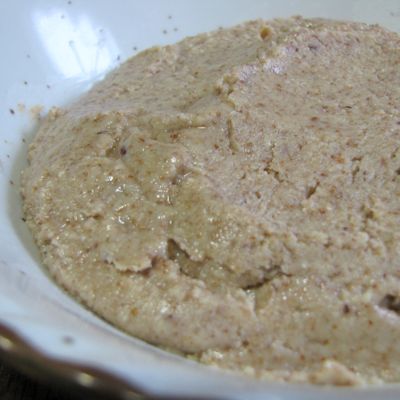
Being new to the world of food processing, I was unsure how to make almond butter in it. I have found it difficult, but not impossible, to make almond butter in the Vita-Mix. I have a friend who makes it all the time in her food processor, so when she was visiting this Saturday, I asked her to make some with me.
First, what I have already known, one must start 2 cups of with a fattier variety of raw almonds, such as carmel or mission almonds. If you are using nonpareil almonds, you may have to add oil to achieve a smooth, fluid consistency.
Second, the secret to success that I was missing — one must give the food processor TIME. This is very important.
Also, I don’t believe a regular, run of the mill food processor will work. I recommend a Cuisinart with at least an 8-cup capacity. Reduce the amount of almonds for a smaller work bowl and increase the amount of almonds for a larger work bowl.
Update 12/1/09: Since raw nuts contain enzyme inhibitors, it is best to soak nuts overnight. This starts the germination process, by which the enzyme inhibitors are neutralized. So I’ve updated the recipe to include a soaking-dehydrating step, to make sure this almond butter is as healthy as possible.
Here’s how to do it:
Soak 2 cups of almonds overnight in water (enough to cover and then some) and 1/2 tablespoon sea salt. After the soaking time, drain and rinse the almonds. Spread in a single layer on a dehydrator tray and dry at about 95 degrees until crispy. This takes about 24 hours, give or take, depending on temperature and/or dehydrator.
Put the 2 cups of almonds in the food processor bowl. You’ll be using the regular blade. Add 1/4 to 1/2 teaspoon of sea salt (optional). Put the lid on and turn on the food processor.
Let the machine run. The almonds will get ground into a meal. Then you’ll begin to see almond butter as a bottom layer. Let it run longer, like even 5 minutes, until a ball of beginning-to-turn-into-butter almonds is bouncing around on the blade. If necessary, stop the machine and scrape down the sides of the bowl. Then turn it on again. The ball will slowly reduce in size until it is circulating freely in the bottom of the work bowl. When the ball is completely gone and the butter is circulating freely, the almond butter is done.
If after several minutes of processing, you find that you still have crumbs (meal) but not butter, add 1 tablespoon at a time of a mild flavored oil, such as expeller-pressed grapeseed oil, or mild olive oil (or even an expeller-pressed sesame oil for a sesame taste), and process until you have almond butter circulating freely.
Refrigerate in a glass jar. Enjoy!
Follow a similar procedure to make peanut butter, hazelnut butter or cashew butter.
...without giving up the foods you love or spending all day in the kitchen!

2 free books:
Eat God's Way
Ditch the Standard American Diet, get healthier & happier, and save money on groceries...
We only recommend products and services we wholeheartedly endorse. This post may contain special links through which we earn a small commission if you make a purchase (though your price is the same).


Sounds yummy, I am so glad that you and your food processor are doing so well together. 🙂
Oh, yes, we are! It is great to have one to help me in the kitchen.
Mmmmm, you just spurred me on to make my own peanut butter. Just one more thing I can do to save DH and myself money and feed us more wholesomely. Thanks!
Great! Please let me know how it works for you. Making almond butter, you can definitely save money. You’ll want to make sure you’re saving money making natural peanut butter, though. For instance, I used to buy organic, dry roasted Valencia peanuts for about $2 per pound and I would make my own pb. But then I found a local source for the same peanut butter — already made, fresh ground, organic peanuts, no additives — for about $1 per pound. So I stopped making it myself and was happy to let someone else do the work! -Wardee
I didn’t know that you had to have a certain kind of Almond. That must be why my champion juicer got too hot when I tried to make Almond Butter. There is a store here that sells organic almonds and they have a machine to process almond butter. Cost the same…very expensive, like $8.00 a pound.
That’s about what I pay for my almonds, which is a good price, considering. So you’re getting a good deal. At least from what I know. I can’t buy almond butter for that price, so I make my own.
ever make cashew butter..YUM!!! I have been making home-made dressings w/ pine nuts and /or cashews and/or macadamia nuts..plus coconut water and…whatever…lemon etc…
i’ll try and post a recipe sometime soon although i have been using recipes out of cookbooks and so i can’t really do those on the blog..kwim? here is my food blog.. the other ones is my main one.
http://settingofsilver.blogspot.com/
amy
I’ve updated this recipe to start with soaked then dehydrated almonds – the soaking process neutralizes enzyme inhibitors, making these nuts an excellent source of digestive enzymes!
Wow Wardee – I had never considered that before! I have 2 almond trees on my wish list for christmas that are supposed to do ok here but we’ll see if they actually fruit.
I’m curious where your local source for peanut butter is? My 6yo is allergic to tree nuts so we haven’t stopped pb yet. I’d love to buy it as locally as possible but I thought peanuts only grew in the south.
xo,
Annette
.-= Sustainable Eats´s last blog post… Giving the Gift of Self Sufficiency =-.
Annette,
That local source for peanut butter wasn’t really local peanuts. 🙂 It was Glorybee in Eugene; they probably got their peanuts from the south! Anyway, they ended up raising their price, so now I’m back to buying roasted peanuts from Azure Standard and making my own pb again. As you probably know, roasting is a second choice to soaking (germinating) – but it does take care of some of the enzyme inhibitors.
Question…is it a must to dehydrate the nuts after soaking or could it work just as well to blend/puree the soaked nuts the next morning?
Thanks!
Taylor – You can try it, but the excess water content will make it less like nut butter and more like a batter. It might work out great though, as sometimes the almonds tend to be really dry otherwise. Let me know!
Hi Wardee –
this is exactly what I have been looking for! Have you ever tried it with Butte almonds?
Zak – No, I haven’t. Are they a high-fat variety of almond? If so, they will work well here, probably.
Wardee,
so you don’t use your VM then for almond butter? i did make cashew bbutter in mine last week but added oil. this is a big discussion on a VM list right now-how to make almond butter. I do have a Foodprocessor.. but one of the reasons i got the VM was to make nut butters. do you make other nut butters in it?
Amy – No, I don’t use the VM for nut butters. I think the food processor works much better. It has a wider base to allow for better circulation. Still, no appliance can overcome lack of oil, IMO. So lower-fat almonds are not going to make good almond butter no matter what you use.
I used the food processor for this and found out I had low-fat almonds. But with the addition of about a tablespoon of ghee fixed the problem. Since I am on the GAPS Intro, I was not able to use my usual cold-pressed olive oil, but in the future will probably do so. The Cusinart did heat up significantly. I got a little worried. Any troubleshooting tips on that one?
Do you get your nuts locally or do you mail-order them? I am trying to find a good price on raw, organic nuts but…it is quite daunting!
Thanks, Wardee, for posting this; I was hoping to find just this kind of experience. I just soaked and dried my first (and won’t be the last) 10 pounds of really raw and organic Carmel almonds from Briden Wilson Farms in California. Took 27 hours in the Excalibur, but the butter was perfect out of the Cuisinart.
Some of it then was used as the basis for some yummy nut balls, with coconut flour, chia seeds, and some other stuff. I can share the recipe if there’s interest.
Lloyd
Lloyd — Wonderful! I’m interested in your recipe. 🙂
Would this work well with sunflower seeds too? Thanks! I’m hoping to try soaking and dehydrating the raw sunflower seeds I got today in the oven..
I’m interested in making sunflower seed butter as well. Does anyone have a tasty, easy recipe for a newbie?
Donna — Soak the sunflower seeds in salty water, then dehydrate them. You can roast them if you’d like. Then grind up into sunflower butter.
Hi,
I am in need of an idea to do with my failed almond butter. I bought raw organic almonds at Wegmans and soaked them 24 hours. I put them in the food processor for it seemed like 15 minutes or longer with some unrefined coconut oil. Now I realized I probably shouldn’t have added the coconut oil. It’s bothering me that the almond butter didn’t turn out and I don’t want to waste all those good almonds. It doesn’t taste too great. Does anyone know of a recipe I could use to incorporate these almonds into? I would even bake them if it was a good recipe.
Thank you for your help.
Blessings, Marjorie
I don’t own a dehydrator, so would it be possible to roast/dry them on the lowest oven setting (170 degrees)? If so, for how long? Thanks 🙂
Melissa — Yes you can use the oven. Crack the door a bit for circulation. I don’t know how long, I’m sorry!
I am fairly new to soaking and dehydrating. I have a few pounds of purchased almond flour I would like to use up. Any recommendations on how to soak and use the almond flour would be greatly appreciated. I wanted to make the almond flour pie crust from lesson plan # 160 but did not because I was unsure of how to proceed with my previously purchased almond flour. Thank you!
Thanks for sharing your almond butter technique. I was not happy with the VitaMix method either, so I tried it in the food processor. It did just what you described, and after about 4-5 minutes it was perfect! I did add a bit of pumpkin seed oil at the very end as it seemed a bit dry. Yumm!
I was wondering if you have to drain the water after soaking the nuts, or can you use it in making nut milk?
Do you have to dehydrate the almonds after soaking? Or can you skip that step, rinsing the soaked almonds and start processing?
Hi Kim,
You do need to dehydrate the almonds after soaking. Wardee has tried it without dehydrating and it didn’t work because of the water in the nuts – it’s less of a nut butter and more a watery paste.
~Millie, TCS Customer Success Team
I’ve been a member of your site for quite some time and having been meaning to ask about peanut butter! Finally, I’m getting around to it! When you use peanut butter in your recipes, do you soak, dehydrate and then roast your peanuts before grinding them into peanut butter, or do you just buy organic peanut butter (or grind fresh it at the store)? In other words, how important is to have soaked peanut butter?
Thanks for all your wonderful information! God bless!
Hi Michelle,
That is what Wardee does. Or soak in salty water, then roast (which tastes better than dehydrated).
You can also purchase dry roasted peanuts. Due to the roasting, the anti-nutrients have been reduced somewhat (though not as effective as soaking).
~Danielle, TCS Customer Success Team
Hello! I have a question about raw almonds…. I did some searching and found that truly raw almonds (ones that have not at least been steam pasteurized) aren’t even sold in the US…. is this true? I have almonds that say they are raw that I bought at Costco, but if you look in the small print, they say they have been steam pasteurized. Is it ok if the almond has been steam pasteurized or does it need to be completely raw? Also, do you know of a good source for almonds? Thanks!
Hi, Jessica,
Wardee has two great sources to purchase almonds. You will find the links to Wildly Organic and Azure Standard here: https://traditionalcookingschool.com/tools/fundamentals-i-resources/
Since it is illegal for almond farmers in America to sell their product unless it is “pasteurized”, these farmers have selected the most minimal processing that they can and still comply with U.S. law. They also can still be sprouted.
~Peggy, TCS Customer Success Team
Hi Wardee!
Is it essential to dehydrate the nuts after soaking before making the nut butter? Would it hurt to skip that step and make the nut butter with the soaked nuts?
Hi, Lisa.
You do need to dehydrate the almonds after soaking. Wardee has tried it without dehydrating and it didn’t work because of the water in the nuts – it’s less of a nut butter and more a watery paste.
~Danielle, TCS Customer Success Team